Summary
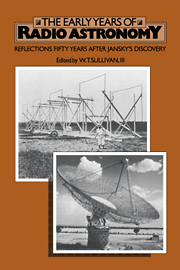
The beginning of radio astronomy was remarkable — who does not find the stories of Karl Jansky and Grote Reber appealing? In the first case we have a man working on the very practical business of bettering telephone communications, but in the end, through a combination of skill, persistence and fortune, revealing a phenomenon which eventually would transform the way astronomy had been done for centuries. And then while the scientific establishment ignores Jansky's discovery, in the second instance a man devotes his spare time for almost a decade to the task of studying the waves of “cosmic static” falling in the back yard of his suburban home.
Following World War II the study of extraterrestrial noise grew rapidly, but it was another decade before the traditional community of astronomers fully recognized the value of the new radio techniques. Jesse Greenstein was one of the very few in that community who paid any attention to radio results before 1950 — witness his co-authorship of the first theoretical paper dealing with radio noise (1937) and of the first review article on the subject (1947). He thus closes this section with an authoritative account of how early relationships evolved among theorists, optical astronomers, and radio observers.
Information
- Type
- Chapter
- Information
- The Early Years of Radio AstronomyReflections Fifty Years after Jansky's Discovery, pp. 1 - 2Publisher: Cambridge University PressPrint publication year: 1984
Accessibility standard: Unknown
Why this information is here
This section outlines the accessibility features of this content - including support for screen readers, full keyboard navigation and high-contrast display options. This may not be relevant for you.Accessibility Information
Accessibility compliance for the PDF of this chapter is currently unknown
and may be updated in the future.