Book contents
- Frontmatter
- Contents
- List of Contributors
- Foreword
- Preface
- PART I NOSOLOGY, MEASUREMENT, AND THE EPIDEMIOLOGY OF WOMEN AND DEPRESSION
- 1 Depression
- 2 The Epidemiology of Depression among Women
- PART II BIOLOGICAL, DEVELOPMENTAL, AND AGING MODELS OF RISK
- PART III COGNITIVE, EMOTIONAL, AND INTERPERSONAL MODELS OF RISK
- PART IV SOCIAL, POLITICAL, AND ECONOMIC MODELS OF RISK
- PART V SYSTEMS AND PROCESSES OF TREATMENT, PREVENTION, AND POLICY
- Author Index
- Subject Index
- References
2 - The Epidemiology of Depression among Women
Published online by Cambridge University Press: 05 June 2012

Book contents
- Frontmatter
- Contents
- List of Contributors
- Foreword
- Preface
- PART I NOSOLOGY, MEASUREMENT, AND THE EPIDEMIOLOGY OF WOMEN AND DEPRESSION
- 1 Depression
- 2 The Epidemiology of Depression among Women
- PART II BIOLOGICAL, DEVELOPMENTAL, AND AGING MODELS OF RISK
- PART III COGNITIVE, EMOTIONAL, AND INTERPERSONAL MODELS OF RISK
- PART IV SOCIAL, POLITICAL, AND ECONOMIC MODELS OF RISK
- PART V SYSTEMS AND PROCESSES OF TREATMENT, PREVENTION, AND POLICY
- Author Index
- Subject Index
- References
Summary
Nonbipolar major depression is estimated by the World Health Organization (WHO) Global Burden of Disease (GBD) Study to be the leading cause of disease-related disability among women in the world today (Murray & Lopez, 1996). This conclusion is based on epidemiological data that have documented a high prevalence of major depression among women around the world in conjunction with estimates of disease burden based on expert judgements. This chapter reviews the epidemiological research that underlies the WHO GBD estimates as well as more recent epidemiological research on women and depression. The discussion begins with a review of basic descriptive epidemiological patterns and then turns to epidemiological evidence about the cause of the higher prevalence of depression among women than men.
PREVALENCE
The fact that women have a higher prevalence of depression than do men is one of the most widely documented findings in psychiatric epidemiology, having been found throughout the world using a variety of diagnostic schemes and interview methods (Andrade et al., 2003; Nolen-Hoeksema, 1987). The prevalence of major depression among women in community epidemiological studies is typically estimated to be between one and a half and three times that of men, although there is enormous variation in the estimated total population prevalence of major depression across these studies. Lifetime prevalence estimates of major depressive episode range between 6 and 17%. Twelve-month prevalence estimates range between 1 and 10%. Current prevalence estimates range between less than 1 and 6%.
Information
- Type
- Chapter
- Information
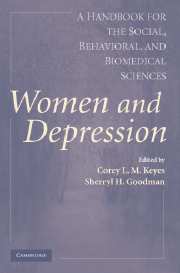
- Women and DepressionA Handbook for the Social, Behavioral, and Biomedical Sciences, pp. 22 - 38Publisher: Cambridge University PressPrint publication year: 2006
References
, , , , & (2004). A population based twin study of sex differences in depressive symptoms. Twin Research, 7, 176–181CrossRefGoogle ScholarPubMed
, & (1998). Everyday stressors and gender differences in daily distress. Journal of Personality and Social Psychology, 75, 670–680CrossRefGoogle ScholarPubMed
American Psychiatric Association. Diagnostic and Statistical Manual of Mental Disorders, (DSM-IV), 4th ed. Washington, DC: American Psychiatric Association; 1994
, , , , , . (2003). The epidemiology of major depressive episodes: Results from the International Consortium of Psychiatric Epidemiology (ICPE) Surveys. International Journal of Methods in Psychiatric Research, 12, 3–21CrossRefGoogle ScholarPubMed
, , , & (1999). Pubertal changes in hormone levels and depression in girls. Psychological Medicine, 29, 1043–1053CrossRefGoogle ScholarPubMed
, , & (1998). Puberty and depression: The roles of age, pubertal status, and pubertal timing. Psychological Medicine, 28, 51–61CrossRefGoogle ScholarPubMed
, & (1997). The depressive spectrum: Diagnostic classification and course. Journal of Affective Disorders, 45, 31–39CrossRefGoogle ScholarPubMed
(2003). Gender differences in bipolar disorder. Psychiatric Clinics of North America, 26, 595–620CrossRefGoogle ScholarPubMed
(2004). Intra-episode hypomanic symptoms during major depression and their correlates. Psychiatry and Clinical Neurosciences, 58, 289–294CrossRefGoogle ScholarPubMed
, , , & (1994). The prevalence and distribution of major depression in a national community sample: The National Comorbidity Survey. American Journal of Psychiatry, 151, 979–986Google Scholar
, , , , , . (2001). Depressive symptoms, menopausal status, and climacteric symptoms in women at midlife. Psychosomatic Medicine, 63, 603–608CrossRefGoogle ScholarPubMed
(1995). Sex differences in depression: A role for preexisting anxiety. Psychiatry Research, 58, 1–12CrossRefGoogle ScholarPubMed
, , & (1993). Aetiology of anxiety and depressive disorders in an inner-city population: 2. Comorbidity and adversity. Psychological Medicine, 23, 155–165CrossRefGoogle Scholar
, & (2004). Special considerations in treating bipolar disorder in women. Bipolar Disorders, 6, 2–13CrossRefGoogle ScholarPubMed
Cross-National Collaborative Group. (1992). The changing rate of major depression: Cross-national comparisons. Journal of the American Medical Association, 268, 3098–3105CrossRef
(1972). Mood changes and menstrual symptoms with different gestagen/estrogen combinations. A double blind comparison with placebo. Acta Psychiatrica Scandinavica, Supplementum, 236, 1–86Google Scholar
, , , , , . (2004). Prevalence, severity, and unmet need for treatment of mental disorders in the World Health Organization World Mental Health Surveys. Journal of the American Medical Association, 291, 2581–2590Google ScholarPubMed
(1990). Adolescents at risk: Prevalence and prevention. New York: Oxford University PressGoogle Scholar
, , , , , . (1997). Genetics and developmental psychopathology: II. The main effects of genes and environment on behavioral problems in the Virginia Twin Study of Adolescent Behavioral Development. Journal of Child Psychology and Psychiatry, and Allied Disciplines, 38, 965–980CrossRefGoogle Scholar
, & (1992). The Zurich study Ⅻ. Sex difference in depression. Evidence from longitudinal epidemiological data. European Archives of Psychiatry and Clinical Neuroscience, 241, 222–230CrossRefGoogle Scholar
(1997). Psychopharmacologic treatment of pathologic aggression. Psychiatric Clinics of North America, 20, 427–451CrossRefGoogle ScholarPubMed
(1998). Depression with anger attacks. Journal of Clinical Psychiatry, 59 Suppl 18, 18–22Google ScholarPubMed
, , & (1996). Coming to age too early: Pubertal influences on girls' vulnerability to psychological distress. Child Development, 67, 3386–3400CrossRefGoogle ScholarPubMed
, & (1994). Diminished recall and the cohort effect of major depression: A simulation study. Psychological Medicine, 24, 375–383CrossRefGoogle ScholarPubMed
, , , , & (1989). Prevalence rates and demographic characteristics associated with depression in pregnancy and the postpartum. Journal of Consulting and Clinical Psychology, 57, 269–274CrossRefGoogle ScholarPubMed
(1972). The relationship between sex roles, marital status, and mental illness. Social Forces, 51, 34–44CrossRefGoogle Scholar
, & (1977). Response bias in surveys of mental health: An empirical investigation. American Journal of Sociology, 82, 1289–1317CrossRefGoogle Scholar
, , , & (1982). Are we entering an age of melancholy? Depressive illness in a prospective epidemiologic study over 25 years: The Lunby Study, Sweden. Psychological Medicine, 12, 279–289CrossRefGoogle Scholar
(1992). Today's children: Creating a future for a generation in crisis. New York: Times BooksGoogle Scholar
, & (1999). Development of gender differences in depression: Description and possible explanations. Annals of Medicine, 31, 372–379CrossRefGoogle ScholarPubMed
, , , & (1999). Ethnic differences in the association between pubertal status and symptoms of depression in adolescent girls. Journal of Adolescent Health, 25, 143–149CrossRefGoogle ScholarPubMed
, , & (2003). The effects of anxiety, substance use and conduct disorders on risk of major depressive disorder. Psychological Medicine, 33, 1423–1432CrossRefGoogle ScholarPubMed
, , & (1986). Relationships between psychological symptoms, somatic complaints and menopausal status. Maturitas, 8, 217–228CrossRefGoogle ScholarPubMed
, , & (1997). The familial aggregation of common psychiatric and substance abuse disorders in the National Comorbidity Survey: A family history study. British Journal of Psychiatry, 170, 541–548CrossRefGoogle ScholarPubMed
, , & (2004). The interrelationship of neuroticism, sex, and stressful life events in the prediction of episodes of major depression. American Journal of Psychiatry, 161, 631–636CrossRefGoogle ScholarPubMed
, & (1999). A population-based twin study of lifetime major depression in men and women. Archives of General Psychiatry, 56, 39–44CrossRefGoogle ScholarPubMed
Kessler, R. C. (2000). Gender differences in major depression: Epidemiologic findings. In (Ed.), Gender and its effect on psychopathology (pp. 61–84). Washington, DC: American Psychiatric PressGoogle Scholar
, & (1993). Childhood adversities and adult depression: Basic patterns of association in a US National Survey. Psychological Medicine, 23, 679–690CrossRefGoogle Scholar
, , , , , & (1994). Sex and depression in the National Comorbidity Survey II: Cohort effects. Journal of Affective Disorders, 30, 15–26CrossRefGoogle ScholarPubMed
, & (1984). Sex differences in vulnerability to undesirable life events. American Sociological Review, 49, 620–631CrossRefGoogle Scholar
, & (1981). Trends in the relationship between sex and psychological distress: 1957–1976. American Sociological Review, 46, 443–452CrossRefGoogle ScholarPubMed
, , , , , & (1996). Comorbidity of DSM-III-R major depressive disorder in the general population: Results from the US National Comorbidity Survey. British Journal of Psychiatry, 168, 17–30Google Scholar
, , , , , . (1998). Methodological studies of the Composite International Diagnostic Interview (CIDI) in the U.S. National Comorbidity Survey. International Journal of Methods in Psychiatric Research, 7, 33–55CrossRefGoogle Scholar
, , , & (1997). Prevalence, correlates and course of minor depression and major depression in the NCS. Journal of Affective Disorders, 45, 19–30CrossRefGoogle Scholar
Klein, D. N., Durbin, C. E., Shankman, S. A., & Santiago, N. J. (2002). Depression and personality. In & (Eds.), Handbook of depression. (pp. 115–140). New York: GuilfordGoogle Scholar
(1987). Sex differences in distress: the impact of gender and work roles. Journal of Health and Social Behavior, 28, 290–305CrossRefGoogle ScholarPubMed
, , & (1994). Comorbidity and co-transmission of alcoholism, anxiety and depression. Psychological Medicine, 24, 69–80CrossRefGoogle ScholarPubMed
, , , & (2004). Is there evidence for a male depressive syndrome in inpatients with major depression? Journal of Affective Disorders, 80, 87–93CrossRefGoogle ScholarPubMed
Monroe, S. M., & Hadjiyannakis, K. (2002). The social environment and depression: focusing on severe life stress. In & (Eds.), Handbook of depression (pp. 314–340). New York: GuilfordGoogle Scholar
, , , , , . (1999). Recurrence after recovery from major depressive disorder during 15 years of observational follow-up. American Journal of Psychiatry, 156, 1000–1006Google ScholarPubMed
, , , , & (1996). The long-term impact of the physical, emotional, and sexual abuse of children: A community study. Child Abuse & Neglect, 20, 7–21CrossRefGoogle ScholarPubMed
, , & (1997). Gender differences in the onset of depression following a shared life event: A study of couples. Psychological Medicine, 27, 9–19CrossRefGoogle ScholarPubMed
(1987). Sex differences in unipolar depression: Evidence and theory. Psychological Bulletin, 101, 259–282CrossRefGoogle ScholarPubMed
(1990). Sex differences in depression. Palo Alto, CA: Stanford University Press
, , , , & (2004). Relevance of anger and irritability in outpatients with major depressive disorder. Psychopathology, 37, 155–160CrossRefGoogle ScholarPubMed
, , , & (1998). Gender differences in patients with bipolar disorder influence outcome in the medical outcomes survey (SF-20) subscale scores. Journal of Affective Disorders, 49, 189–193CrossRefGoogle ScholarPubMed
, , , & (2003). Interpersonal dependence and major depression: Aetiological inter-relationship and gender differences. Psychological Medicine, 33, 927–931CrossRefGoogle ScholarPubMed
Sichel, D. (2000). Postpartum psychiatric disorders. In , , & (Eds.), Mood disorders in Women (pp. 313–328). London: Martin DunitzGoogle Scholar
, , , , , . (1999). The influence of genetic factors and life stress on depression among adolescent girls. Archives of General Psychiatry, 56, 225–232CrossRefGoogle ScholarPubMed
, & (1987). Moving into adolescence: The impact of pubertal change and school context. New York: Aldine de GruyterGoogle Scholar
, & (1995). Recall of psychiatric history in cross-sectional surveys: Implications for epidemiologic research. Epidemiological Reviews, 17, 221–227CrossRefGoogle ScholarPubMed
, , & (1997). First-episode major depression: Few sex differences in course. Archives of General Psychiatry, 54, 633–639CrossRefGoogle ScholarPubMed
, & (1980). The Midtown Manhattan Longitudinal Study vs ‘the Mental Paradise Lost’ doctrine. A controversy joined. Archives of General Psychiatry, 37, 209–221CrossRefGoogle ScholarPubMed
, , , & (1993). Sex differences in rates of depression: Cross-national perspectives [Special Issue: Toward a new psychobiology of depression in women]. Journal of Affective Disorders, 29, 77–84CrossRefGoogle Scholar
(1999). The emergence of gender difference in depressed mood during adolescence: the role of intensified gender socialization. Developmental Psychology, 35, 232–245CrossRefGoogle ScholarPubMed
, , & (1997). Fifteen years on: Evolving ideas in researching sex differences in depression. Psychological Medicine, 27, 875–883CrossRefGoogle ScholarPubMed
, , & (1993). Relationship of psychiatric illness to childbearing status: A hospital-based epidemiologic study. Journal of Affective Disorders, 28, 39–50CrossRefGoogle ScholarPubMed
World Health Organization. The ICD-10 Classification of Mental and Behavioral Disorders: Diagnostic Criteria for Research. Geneva, Switzerland: World Health Organization; 1993
Yonkers, K. A., Bradshaw, K. D., & Halbreich, U. (2000). Oestrogens, progestins and mood. In , , & (Eds.), Mood disorders in women (pp. 207–232). London: Martin DunitzGoogle Scholar
, , , , & (1990). Sex differences in the lifetime prevalence of depression. Journal of Affective Disorders, 18, 187–192CrossRefGoogle ScholarPubMed
, & (1997). A meta-analysis of the effect of hormone replacement therapy upon depressed mood. Psychoneuroendocrinology, 22, 189–212CrossRefGoogle ScholarPubMed
Accessibility standard: Unknown
Why this information is here
This section outlines the accessibility features of this content - including support for screen readers, full keyboard navigation and high-contrast display options. This may not be relevant for you.Accessibility Information
Accessibility compliance for the PDF of this chapter is currently unknown
and may be updated in the future.
- 56
- Cited by