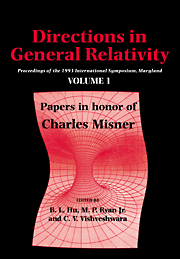
 Directions in General Relativity
 Proceedings of the 1993 International Symposium, Maryland: Papers in Honor of Charles Misner
Book contents
- Frontmatter
- Contents
- Contributors
- Symposium Program
- Papers from both Volumes Classified by Subject
- Preface
- Charles W. Misner: Insight and Discovery
- Remarks Concerning the Geometries of Gravity and Gauge Fields
- Gravity and Unification of Fundamental Interactions
- Minisuperspaces: Symmetries and Quantization
- Quantum Cosmology
- A Pictorial History of some Gravitational Instantons
- No Time Machines from Lightlike Sources in 2+1 Gravity
- Inhomogeneity and Anisotropy Generation in FRW Cosmologies
- Misner, Kinks and Black Holes
- The Quantum Mechanics of Closed Systems
- Cosmological Vacuum Phase Transitions
- Minisuperspace as a Quantum Open System
- Ricci Flow on Minisuperspaces and the Geometry-Topology Problem
- Classical and Quantum Dynamics of Black Hole Interiors
- Matter Time in Canonical Quantum Gravity
- The Isotropy and Homogeneity of the Universe
- Recent Advances in ADM Reduction
- Some Progress in Classical Canonical Gravity
- Harmonic Map Formulation of Colliding Electrovac Plane Waves
- Geometry, the Renormalization Group and Gravity
- An Example of Indeterminacy in the Time-Development of “Already Unified Field Theory”: A Collision between Electomagnetic Plane Waves
- Non-static Metrics of Hiscock-Gott Type
- Non-Standard Phase Space Variables, Quantization and Path-Integrals, or Little Ado about Much
- The Present Status of the Decaying Neutrino Theory
- Exploiting the Computer to Investigate Black Holes and Cosmic Censorship
- Misner Space as a Prototype for Almost Any Pathology
- Relativity and Rotation
- The First Law of Black Hole Mechanics
- Gravitational Radiation Antenna Observations
- The Back-Reaction is Never Negligible: Entropy of Black Holes and Radiation
- Toward a Thesis Topic
- Charles Misner: A Celebration of Memories
- Curriculum Vitae of C. W. Misner
- Ph. D. Theses supervised by C. W. Misner
- List of Publications of C. W. Misner
Minisuperspace as a Quantum Open System
Published online by Cambridge University Press: 03 February 2010

Book contents
- Frontmatter
- Contents
- Contributors
- Symposium Program
- Papers from both Volumes Classified by Subject
- Preface
- Charles W. Misner: Insight and Discovery
- Remarks Concerning the Geometries of Gravity and Gauge Fields
- Gravity and Unification of Fundamental Interactions
- Minisuperspaces: Symmetries and Quantization
- Quantum Cosmology
- A Pictorial History of some Gravitational Instantons
- No Time Machines from Lightlike Sources in 2+1 Gravity
- Inhomogeneity and Anisotropy Generation in FRW Cosmologies
- Misner, Kinks and Black Holes
- The Quantum Mechanics of Closed Systems
- Cosmological Vacuum Phase Transitions
- Minisuperspace as a Quantum Open System
- Ricci Flow on Minisuperspaces and the Geometry-Topology Problem
- Classical and Quantum Dynamics of Black Hole Interiors
- Matter Time in Canonical Quantum Gravity
- The Isotropy and Homogeneity of the Universe
- Recent Advances in ADM Reduction
- Some Progress in Classical Canonical Gravity
- Harmonic Map Formulation of Colliding Electrovac Plane Waves
- Geometry, the Renormalization Group and Gravity
- An Example of Indeterminacy in the Time-Development of “Already Unified Field Theory”: A Collision between Electomagnetic Plane Waves
- Non-static Metrics of Hiscock-Gott Type
- Non-Standard Phase Space Variables, Quantization and Path-Integrals, or Little Ado about Much
- The Present Status of the Decaying Neutrino Theory
- Exploiting the Computer to Investigate Black Holes and Cosmic Censorship
- Misner Space as a Prototype for Almost Any Pathology
- Relativity and Rotation
- The First Law of Black Hole Mechanics
- Gravitational Radiation Antenna Observations
- The Back-Reaction is Never Negligible: Entropy of Black Holes and Radiation
- Toward a Thesis Topic
- Charles Misner: A Celebration of Memories
- Curriculum Vitae of C. W. Misner
- Ph. D. Theses supervised by C. W. Misner
- List of Publications of C. W. Misner
Summary
Abstract
We trace the development of ideas on dissipative processes in chaotic cosmology and on minisuperspace quantum cosmology from the time Misner proposed them to current research. We show
1) how the effect of quantum processes like particle creation in the early universe can address the issues of the isotropy and homogeneity of the observed universe,
2) how viewing minisuperspace as a quantum open system can address the issue of the validity of such approximations customarily adopted in quantum cosmology, and
3) how invoking statistical processes like decoherence and correlation when considered together can help to establish a theory of quantum fields in curved spacetime as the semiclassical limit of quantum gravity.
Dedicated to Professor Misner on the occasion of his sixtieth birthday, June 1992.
Introduction
In the five years between 1967 and 1972, Charlie Misner made an idelible mark in relativistic cosmology in three aspects.
First he introduced the idea of chaotic cosmology. In contrast to the reigning standard model of Friedmann-Lemaitre-Robertson-Walker universe where isotropy and homogeneity are ‘put in by hand’ from the beginning, chaotic cosmology assumes that the universe can have arbitrary irregularities initially. This is perhaps a more general and philosophically pleasing assumption. To reconcile an irregular early universe with the observed large scale smoothness of the present universe, one has to introduce physical mechanisms to dissipate away the anisotropies and inhomogeneities. This is why dissipative processes are essential to the implementation of the chaotic cosmology program. Misner (1968) was the first to try out this program in a Bianchi type-I universe with the neutrino viscosity at work in the lepton era.
Information
- Type
- Chapter
- Information
- Directions in General RelativityProceedings of the 1993 International Symposium, Maryland: Papers in Honor of Charles Misner, pp. 145 - 165Publisher: Cambridge University PressPrint publication year: 1993
Accessibility standard: Unknown
Why this information is here
This section outlines the accessibility features of this content - including support for screen readers, full keyboard navigation and high-contrast display options. This may not be relevant for you.Accessibility Information
Accessibility compliance for the PDF of this book is currently unknown
and may be updated in the future.
- 7
- Cited by