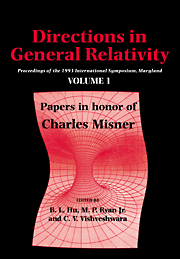
 Directions in General Relativity
 Proceedings of the 1993 International Symposium, Maryland: Papers in Honor of Charles Misner
Book contents
- Frontmatter
- Contents
- Contributors
- Symposium Program
- Papers from both Volumes Classified by Subject
- Preface
- Charles W. Misner: Insight and Discovery
- Remarks Concerning the Geometries of Gravity and Gauge Fields
- Gravity and Unification of Fundamental Interactions
- Minisuperspaces: Symmetries and Quantization
- Quantum Cosmology
- A Pictorial History of some Gravitational Instantons
- No Time Machines from Lightlike Sources in 2+1 Gravity
- Inhomogeneity and Anisotropy Generation in FRW Cosmologies
- Misner, Kinks and Black Holes
- The Quantum Mechanics of Closed Systems
- Cosmological Vacuum Phase Transitions
- Minisuperspace as a Quantum Open System
- Ricci Flow on Minisuperspaces and the Geometry-Topology Problem
- Classical and Quantum Dynamics of Black Hole Interiors
- Matter Time in Canonical Quantum Gravity
- The Isotropy and Homogeneity of the Universe
- Recent Advances in ADM Reduction
- Some Progress in Classical Canonical Gravity
- Harmonic Map Formulation of Colliding Electrovac Plane Waves
- Geometry, the Renormalization Group and Gravity
- An Example of Indeterminacy in the Time-Development of “Already Unified Field Theory”: A Collision between Electomagnetic Plane Waves
- Non-static Metrics of Hiscock-Gott Type
- Non-Standard Phase Space Variables, Quantization and Path-Integrals, or Little Ado about Much
- The Present Status of the Decaying Neutrino Theory
- Exploiting the Computer to Investigate Black Holes and Cosmic Censorship
- Misner Space as a Prototype for Almost Any Pathology
- Relativity and Rotation
- The First Law of Black Hole Mechanics
- Gravitational Radiation Antenna Observations
- The Back-Reaction is Never Negligible: Entropy of Black Holes and Radiation
- Toward a Thesis Topic
- Charles Misner: A Celebration of Memories
- Curriculum Vitae of C. W. Misner
- Ph. D. Theses supervised by C. W. Misner
- List of Publications of C. W. Misner
Matter Time in Canonical Quantum Gravity
Published online by Cambridge University Press: 03 February 2010
By

Book contents
- Frontmatter
- Contents
- Contributors
- Symposium Program
- Papers from both Volumes Classified by Subject
- Preface
- Charles W. Misner: Insight and Discovery
- Remarks Concerning the Geometries of Gravity and Gauge Fields
- Gravity and Unification of Fundamental Interactions
- Minisuperspaces: Symmetries and Quantization
- Quantum Cosmology
- A Pictorial History of some Gravitational Instantons
- No Time Machines from Lightlike Sources in 2+1 Gravity
- Inhomogeneity and Anisotropy Generation in FRW Cosmologies
- Misner, Kinks and Black Holes
- The Quantum Mechanics of Closed Systems
- Cosmological Vacuum Phase Transitions
- Minisuperspace as a Quantum Open System
- Ricci Flow on Minisuperspaces and the Geometry-Topology Problem
- Classical and Quantum Dynamics of Black Hole Interiors
- Matter Time in Canonical Quantum Gravity
- The Isotropy and Homogeneity of the Universe
- Recent Advances in ADM Reduction
- Some Progress in Classical Canonical Gravity
- Harmonic Map Formulation of Colliding Electrovac Plane Waves
- Geometry, the Renormalization Group and Gravity
- An Example of Indeterminacy in the Time-Development of “Already Unified Field Theory”: A Collision between Electomagnetic Plane Waves
- Non-static Metrics of Hiscock-Gott Type
- Non-Standard Phase Space Variables, Quantization and Path-Integrals, or Little Ado about Much
- The Present Status of the Decaying Neutrino Theory
- Exploiting the Computer to Investigate Black Holes and Cosmic Censorship
- Misner Space as a Prototype for Almost Any Pathology
- Relativity and Rotation
- The First Law of Black Hole Mechanics
- Gravitational Radiation Antenna Observations
- The Back-Reaction is Never Negligible: Entropy of Black Holes and Radiation
- Toward a Thesis Topic
- Charles Misner: A Celebration of Memories
- Curriculum Vitae of C. W. Misner
- Ph. D. Theses supervised by C. W. Misner
- List of Publications of C. W. Misner
Summary
Abstract
The functional Schrodinger approach to canonical quantum gravity requires the construction of time and frame variables from the canonical data. I review the difficulties of basing such variables purely on the geometric data. I describe different ways of introducing matter variables for this purpose. I argue that the simplest phenomenological medium, an incoherent dust, does more than one can reasonably expect. The comoving coordinates of the dust particles and the proper time along their worldlines become canonical coordinates in the phase space of the coupled system. The Hamiltonian constraint can easily be solved for the momentum canonically conjugate to the dust time. The ensuing Hamiltonian density has an extraordinary feature not encountered in other systems: it depends only on the geometric variables, not on the dust frame and the dust time. This has three important consequences. Firstly, the functional Schrödinger equation can be solved by separating the dust time from geometric variables. Secondly, the Hamiltonian densities strongly commute and can therefore be simultaneously defined by spectral analysis. Thirdly, the Schrodinger equation can be solved independently of the supermomentum constraint, which is then satisfied by parametrizing this solution.
Canonical quantum gravity
One can never pay off old debts; the most one can do is to acknowledge them. Not that I lacked opportunity to acknowledge those which I owe Charlie Misner. He helped to set the entire framework of canonical gravity, and there is hardly a paper which I wrote since coming to the United States in which I did not have the chance – and the pleasure – to refer to his contributions.
Information
- Type
- Chapter
- Information
- Directions in General RelativityProceedings of the 1993 International Symposium, Maryland: Papers in Honor of Charles Misner, pp. 201 - 221Publisher: Cambridge University PressPrint publication year: 1993
Accessibility standard: Unknown
Why this information is here
This section outlines the accessibility features of this content - including support for screen readers, full keyboard navigation and high-contrast display options. This may not be relevant for you.Accessibility Information
Accessibility compliance for the PDF of this chapter is currently unknown
and may be updated in the future.
- 2
- Cited by