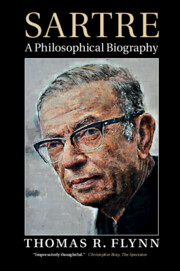
Book contents
- Frontmatter
- Dedication
- Contents
- Preface
- Acknowledgments
- Abbreviations
- 1 The childhood of a genius
- 2 An elite education: student, author, soldier, teacher
- 3 Teaching in the lycée, 1931–1939
- 4 First triumph: The Imagination
- 5 Consciousness as imagination
- 6 The necessity of contingency: Nausea
- 7 The war years, 1939–1944
- 8 Bad faith in human life: Being and Nothingness
- 9 Existentialism: the fruit of liberation
- 10 Ends and means: existential ethics
- 11 Means and ends: political existentialism
- 12 A theory of history: Search for a Method
- 13 Individuals and groups: Critique of Dialectical Reason
- 14 A second ethics?
- 15 Existential biography: Flaubert and others
- Conclusion: the Sartrean imaginary, chastened but indomitable
- Select bibliography
- Index
Preface
Published online by Cambridge University Press: 18 December 2014

Book contents
- Frontmatter
- Dedication
- Contents
- Preface
- Acknowledgments
- Abbreviations
- 1 The childhood of a genius
- 2 An elite education: student, author, soldier, teacher
- 3 Teaching in the lycée, 1931–1939
- 4 First triumph: The Imagination
- 5 Consciousness as imagination
- 6 The necessity of contingency: Nausea
- 7 The war years, 1939–1944
- 8 Bad faith in human life: Being and Nothingness
- 9 Existentialism: the fruit of liberation
- 10 Ends and means: existential ethics
- 11 Means and ends: political existentialism
- 12 A theory of history: Search for a Method
- 13 Individuals and groups: Critique of Dialectical Reason
- 14 A second ethics?
- 15 Existential biography: Flaubert and others
- Conclusion: the Sartrean imaginary, chastened but indomitable
- Select bibliography
- Index
Summary
Preface
On the evening of October 29, 1945, Jean-Paul Sartre delivered a much-anticipated lecture, advertised as “Existentialism is a Humanism,” to an overflow crowd in the Salle des Centraux on the Parisian Right Bank. As he was already well known for his novels Nausea and the recently published The Age of Reason and The Reprieve, his plays, The Flies and No Exit, and his philosophical essays, especially the daunting masterpiece Being and Nothingness, his talk was seen as the manifesto for this rapidly spreading style of thought. It is still the philosophical essay that people read when they seek an introduction to his work and to this movement in general. Yet it is the only piece that he openly regretted having published.
In what follows I shall survey the intellectual path that led Sartre to this juncture, the turn that it presaged, and the resultant works and deeds that came to define him as “Sartre.” This is a biography, the story of a life. But it is a philosophical biography, an account of the development of the thought and works of arguably the most famous philosopher of the twentieth century.
Information
- Type
- Chapter
- Information
- SartreA Philosophical Biography, pp. ix - xPublisher: Cambridge University PressPrint publication year: 2014
Accessibility standard: Unknown
Why this information is here
This section outlines the accessibility features of this content - including support for screen readers, full keyboard navigation and high-contrast display options. This may not be relevant for you.Accessibility Information
Accessibility compliance for the PDF of this book is currently unknown
and may be updated in the future.