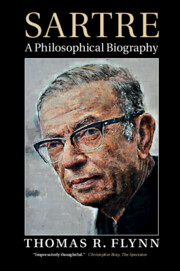
Book contents
- Frontmatter
- Dedication
- Contents
- Preface
- Acknowledgments
- Abbreviations
- 1 The childhood of a genius
- 2 An elite education: student, author, soldier, teacher
- 3 Teaching in the lycée, 1931–1939
- 4 First triumph: The Imagination
- 5 Consciousness as imagination
- 6 The necessity of contingency: Nausea
- 7 The war years, 1939–1944
- 8 Bad faith in human life: Being and Nothingness
- 9 Existentialism: the fruit of liberation
- 10 Ends and means: existential ethics
- 11 Means and ends: political existentialism
- 12 A theory of history: Search for a Method
- 13 Individuals and groups: Critique of Dialectical Reason
- 14 A second ethics?
- 15 Existential biography: Flaubert and others
- Conclusion: the Sartrean imaginary, chastened but indomitable
- Select bibliography
- Index
- References
7 - The war years, 1939–1944
Published online by Cambridge University Press: 18 December 2014

Book contents
- Frontmatter
- Dedication
- Contents
- Preface
- Acknowledgments
- Abbreviations
- 1 The childhood of a genius
- 2 An elite education: student, author, soldier, teacher
- 3 Teaching in the lycée, 1931–1939
- 4 First triumph: The Imagination
- 5 Consciousness as imagination
- 6 The necessity of contingency: Nausea
- 7 The war years, 1939–1944
- 8 Bad faith in human life: Being and Nothingness
- 9 Existentialism: the fruit of liberation
- 10 Ends and means: existential ethics
- 11 Means and ends: political existentialism
- 12 A theory of history: Search for a Method
- 13 Individuals and groups: Critique of Dialectical Reason
- 14 A second ethics?
- 15 Existential biography: Flaubert and others
- Conclusion: the Sartrean imaginary, chastened but indomitable
- Select bibliography
- Index
- References
Summary
Sartre’s keen sense of the maneuvering, opportunism, occasional heroism and frequent failure of nerve that marked European power politics toward the end of the 1930s was evident in his novelistic account. As we retrace these steps in “real life,” we encounter Sartre playing his own role in what he had reason to believe would be a published set of recollections of memorable events: his Carnets de la drôle de guerre (War Diaries). Mobilized and posted in Alsace, private Sartre filled fifteen good-sized notebooks with comments on his personal life, his mates, the state of the world along with reflections on literature and especially philosophy. In a letter to Beauvoir from a holding camp in Baccarat, Lorraine, on July 22, 1940, he announced: “I’ve begun to write a metaphysical treatise: L’Être et le Néant (Being and Nothingness)” which will develop many of the thoughts expressed both in his War Diaries and in his letters from this period.
Unfortunately, only six of these fifteen notebooks seem to have survived the misfortunes of war. But if you supplement what they contain with the almost daily letters that he exchanged with Beauvoir and others, you obtain a detailed view of their thoughts and reactions to life in the military and on the home front for the months between Sartre’s mobilization in September of 1939 and his second leave for home on March 28, 1940. On his return to his post, the letters continue through to his capture a few hours before the armistice, on June 21, 1940, which was his birthday. They become less frequent during his temporary incarceration for two months in Baccarat and his transfer in mid August to a massive POW camp outside of Trier, in Germany, that housed 26,000 prisoners, just as he recounts in The Roads of Freedom. Most of the letters from Germany have been lost.
Information
- Type
- Chapter
- Information
- SartreA Philosophical Biography, pp. 162 - 195Publisher: Cambridge University PressPrint publication year: 2014
References
, Quiet Moments in a War, trans. and introduction and (New York: Scribner’s, 1993), 234Google Scholar
, Bad Faith, Good Faith, and Authenticity in Sartre’s Early Philosophy (Philadelphia, PN: Temple University Press, 1995)Google Scholar
, Good Faith and Other Essays: Perspectives on Sartrean Ethics (Boston, MA: Rowman & Littlefield, 1996)Google Scholar
, “Ethique et violence dans les ‘Cahiers pour une morale,’” Cité no. 22 (2005): 73–88
’s Quatre-vingt-un chapitres sur l’Ésprit et les passions (Paris: à l’Émancipatrice, 1917)Google Scholar
Accessibility standard: Unknown
Why this information is here
This section outlines the accessibility features of this content - including support for screen readers, full keyboard navigation and high-contrast display options. This may not be relevant for you.Accessibility Information
Accessibility compliance for the PDF of this chapter is currently unknown
and may be updated in the future.