Book contents
- Frontmatter
- Contents
- Acknowledgments
- Introduction
- 1 Epistemology without Knowledge and without Belief
- 2 Abduction—Inference, Conjecture, or an Answer to a Question?
- 3 A Second-Generation Epistemic Logic and its General Significance
- 4 Presuppositions and Other Limitations of Inquiry
- 5 The Place of the a priori in Epistemology
- 6 Systems of Visual Identification in Neuroscience: Lessons from Epistemic Logic
- 7 Logical Explanations
- 8 Who Has Kidnapped the Notion of Information?
- 9 A Fallacious Fallacy?
- 10 Omitting Data—Ethical or Strategic Problem?
- Index
- References
9 - A Fallacious Fallacy?
Published online by Cambridge University Press: 05 June 2012

Book contents
- Frontmatter
- Contents
- Acknowledgments
- Introduction
- 1 Epistemology without Knowledge and without Belief
- 2 Abduction—Inference, Conjecture, or an Answer to a Question?
- 3 A Second-Generation Epistemic Logic and its General Significance
- 4 Presuppositions and Other Limitations of Inquiry
- 5 The Place of the a priori in Epistemology
- 6 Systems of Visual Identification in Neuroscience: Lessons from Epistemic Logic
- 7 Logical Explanations
- 8 Who Has Kidnapped the Notion of Information?
- 9 A Fallacious Fallacy?
- 10 Omitting Data—Ethical or Strategic Problem?
- Index
- References
Summary
One of the major current developments in cognitive psychology is what is usually referred to as the “theory of cognitive fallacies,” originated by Amos Tversky and Daniel Kahneman. The purported repercussions of their theory extend beyond psychology, however. A flavor of how seriously the fad of cognitive fallacies has been taken is perhaps conveyed by a quote from Piatelli-Palmerini (1994, xiii), who predicted “that sooner or later, Amos Tversky and Daniel Kahneman will win the Nobel Prize for economics.” His prediction was fulfilled in 2002.
The theory of cognitive fallacies is not merely a matter of bare facts of psychology. The phenomena (certain kinds of spontaneous cognitive judgments) that are the evidential basis of the theory derive their theoretical interests mainly from the fact that they are interpreted as representing fallacious—that is, irrational judgments on the part of the subject in question. Such an interpretation presupposes that we can independently establish what it means for a probability judgment to be rational. In the case of typical cognitive fallacies studied in the recent literature, this rationality is supposed to have been established by our usual probability calculus in its Bayesian use.
The fame of the cognitive fallacies notwithstanding, I will show in this chapter that at least one of them has been misdiagnosed by the theorists of cognitive fallacies. In reality, there need not be anything fallacious or otherwise irrational about the judgments that are supposed to exhibit this “fallacy.”
Information
- Type
- Chapter
- Information
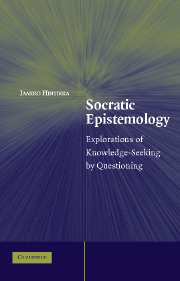
- Socratic EpistemologyExplorations of Knowledge-Seeking by Questioning, pp. 211 - 220Publisher: Cambridge University PressPrint publication year: 2007
References
, 1991, On Rhetoric, newly translated by George A. Kennedy, Oxford University Press, New York.Google Scholar
, , and , editors, 1988, Decision Making: Descriptive, Normative, and Prescriptive Interactions, Cambridge University Press, Cambridge.CrossRefGoogle Scholar
Gigerenzer, Gerd, 1991, ‘How to Make Cognitive Illusions Disappear: Beyond “Heuristic Biases,”’ in and , editors, European Review of Social Psychology, vol. 2, John Wiley, New York, pp. 83–115.Google Scholar
Hintikka, Jaakko, 2000, “The Theory-Ladenness of Intuitions,” in and , editors, Logique en Perspective, Ouisia, Bruxelles, pp. 259–287.Google Scholar
, 1995, “On Proper (Popper?) and Improper Uses of Information in Epistemology,” Theoria, vol. 59, pp. 158–165 (for 1993, appeared 1995).CrossRefGoogle Scholar
, 1993, “Socratic Questioning, Logic, and Rhetoric,” Revue Internationale de Philosophie, vol. 47, pp. 5–30.Google Scholar
Hintikka, Jaakko, 1992, “The Concept of Induction in the Light of the Interrogative Approach to Inquiry,” in , editor, Inference, Explanation, and Other Frustrations: Essays in the Philosophy of Science, University of California Press, Berkeley, pp. 23–43.Google Scholar
Hintikka, Jaakko, I. Halonen, and A. Mutanen, 1999, “Interrogative Logic as a General Theory of Reasoning,” in and , editors, Handbook of Applied Logic, Kluwer Academic, Dordrecht, pp. 295–337.Google Scholar
, , and , editors, 1982, Judgment under Uncertainty: Heuristics and Biases, Cambridge University Press, Cambridge.CrossRefGoogle Scholar
, editor, 1990, Rationality in Action: Contemporary Approaches, Cambridge University Press, Cambridge.Google Scholar
, and , 1983, “Extensional Versus Intuitive Reasoning: The Conjunction Fallacy in Probability Judgment,” Psychological Review, vol. 90, pp. 293–315.CrossRefGoogle Scholar
Accessibility standard: Unknown
Why this information is here
This section outlines the accessibility features of this content - including support for screen readers, full keyboard navigation and high-contrast display options. This may not be relevant for you.Accessibility Information
Accessibility compliance for the PDF of this book is currently unknown
and may be updated in the future.
- 1
- Cited by