Book contents
- Frontmatter
- Contents
- Acknowledgments
- Introduction
- 1 Epistemology without Knowledge and without Belief
- 2 Abduction—Inference, Conjecture, or an Answer to a Question?
- 3 A Second-Generation Epistemic Logic and its General Significance
- 4 Presuppositions and Other Limitations of Inquiry
- 5 The Place of the a priori in Epistemology
- 6 Systems of Visual Identification in Neuroscience: Lessons from Epistemic Logic
- 7 Logical Explanations
- 8 Who Has Kidnapped the Notion of Information?
- 9 A Fallacious Fallacy?
- 10 Omitting Data—Ethical or Strategic Problem?
- Index
- References
4 - Presuppositions and Other Limitations of Inquiry
Published online by Cambridge University Press: 05 June 2012

Book contents
- Frontmatter
- Contents
- Acknowledgments
- Introduction
- 1 Epistemology without Knowledge and without Belief
- 2 Abduction—Inference, Conjecture, or an Answer to a Question?
- 3 A Second-Generation Epistemic Logic and its General Significance
- 4 Presuppositions and Other Limitations of Inquiry
- 5 The Place of the a priori in Epistemology
- 6 Systems of Visual Identification in Neuroscience: Lessons from Epistemic Logic
- 7 Logical Explanations
- 8 Who Has Kidnapped the Notion of Information?
- 9 A Fallacious Fallacy?
- 10 Omitting Data—Ethical or Strategic Problem?
- Index
- References
Summary
Presuppositions as a Crucial Limitation of Inquiry
Socrates was right. All rational knowledge-seeking can be conceptualized as a questioning process, with question–answer steps interspersed with logical inference steps. “Rational” here means “capable of epistemological evaluation.” This is what I have argued in Hintikka 1998. Here I will not review the arguments for this view of “inquiry as inquiry,” as I have called it, but instead examine some of its implications. In any case, I am not the first philosopher by a long shot to defend the omnipresence of questioning in our knowledge-seeking. Aristotle modeled both his methodology and his logic on the different aspects of the Socratic questioning process, or elenchus. One of the better known—albeit not one of the best appreciated—later representatives of similar views is R. G. Collingwood, who went even further and asserted that “[e]very statement that anybody ever makes is made in answer to a question.” (Collingwood 1940, p. 23.)
Or is Collingwood perhaps merely echoing Aristotle according to whom all the propositions used as dialectical premises originate from questions? (See Topics I, x.) In any case, Collingwood had something of an ulterior motive in conceiving of all propositions as answers to questions. This ulterior motive is a legitimate one. He wanted in this way to subject to philosophical examination the limitations that characterize a certain line of inquiry or the thought of some individual thinker or even the intellectual stance of an entire era.
Information
- Type
- Chapter
- Information
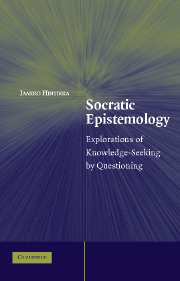
- Socratic EpistemologyExplorations of Knowledge-Seeking by Questioning, pp. 83 - 106Publisher: Cambridge University PressPrint publication year: 2007
References
Plato is cited in the Loeb Library translations (Harvard University Press).
, editor, 1992(a), Essays on the Philosophy of Socrates, Oxford University Press, New York.Google Scholar
, 1992(b), “Misunderstanding the ‘What-is-F-ness” question,” in Benson, 1992(a), pp. 123–136.Google Scholar
, 1955, “Semantic Entailment and Formal Derivability,” Mededlingen van de Koninklijke Nederlandse Akademie van Wetenschappen, Afd.Leterkund. N. R. vol. 18, no. 13, Amsterdam, pp. 309–342.Google Scholar
Hintikka, Jaakko, 2003, “A. Second-Generation Epistemic Logic and its Theoretical Significance,” in et al., editors, Knowledge Contributors, Kluwer Academic, Dordrecht, pp. 33–55.CrossRefGoogle Scholar
, 1998, “What Is Abduction? The Fundamental Problem of Contemporary Epistemology,” Proceedings of the Charles S. Peirce Society, vol. 34, pp. 503–533. A revised version entitled “Abduction—Inference, Conjecture, or an Answer to a Question” appears as Chapter 3 in this volume.Google Scholar
, 1996, The Principles of Mathematics Revisited, Cambridge University Press, New York.CrossRefGoogle Scholar
, , and , 1998, “Interrogative Logic as a General Theory of Inquiry,” in Hintikka, 1999, pp. 47–90.Google Scholar
, 1970, The Structure of Scientific Revolutions, second edition, University of Chicago Press, Chicago.Google Scholar
Vlastos, Gregory, 1971, “The Paradox of Socrates”, in , editor, The Philosophy of Socrates: A Collection of Critical Essays, University of Nortre Dame Press, Notre Dame, Indiana, pp. 1–21.CrossRefGoogle Scholar
Accessibility standard: Unknown
Why this information is here
This section outlines the accessibility features of this content - including support for screen readers, full keyboard navigation and high-contrast display options. This may not be relevant for you.Accessibility Information
Accessibility compliance for the PDF of this chapter is currently unknown
and may be updated in the future.
- 2
- Cited by