Summary
… we must obey;
Speak what we feel, not what we ought to say …
(v, iii, 323–4)Anyone who sets out to say what he makes of King Lear is soon likely to start wondering at his rashness. The further he goes, the less easy he finds it even to keep his critical balance. More perhaps than any other work – certainly more than any other of Shakespeare's, I think – it impels us finally to ‘speak what we feel, not what we ought to say’. To ‘obey’ it is to answer with nothing less. And yet it also makes us feel that whatever we do speak, or could speak, is inadequate to everything else we are brought to feel – even, in some obscure way, a betrayal of it. The drama so engages us that to feel it adequately requires us in the end to become wholly open to, totally consumed in, the most painful and bewildering feelings. But because those feelings press toward release, toward some form in which we can name them and (to that extent at least) master them, to speak adequately requires us in the end to detach ourselves from our feelings, to withhold or withdraw some part of ourselves from the integrity with which we have to experience the drama. It is a difficult enough predicament for any reader or spectator; for the critic, who commits himself to expressing some coherent sense of the play as a whole, it is acute – and none the less so because (as I see it) this kind of predicament is largely what the play is about.
Information
- Type
- Chapter
- Information
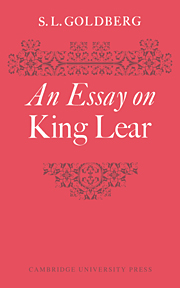
- An Essay on King Lear , pp. 1 - 6Publisher: Cambridge University PressPrint publication year: 1974
Accessibility standard: Unknown
Why this information is here
This section outlines the accessibility features of this content - including support for screen readers, full keyboard navigation and high-contrast display options. This may not be relevant for you.Accessibility Information
Accessibility compliance for the PDF of this book is currently unknown
and may be updated in the future.