Book contents
- Frontmatter
- Contents
- Contributors
- Editors
- Chapter 1 Introduction
- Part One Claiming the Past
- Part Two Problems of Meaning and Method
- Chapter 8 What Is a Crisis of Intelligibility?
- Chapter 9 Contesting Religious Claims over Archaeological Sites
- Chapter 10 Multivocality and “Wikiality”
- Chapter 11 “Do not do unto others…”
- Chapter 12 Should Ruins Be Preserved?
- Part Three Problems of Ownership and Control
- References
- Index
- References
Chapter 10 - Multivocality and “Wikiality”
The Epistemology and Ethics of a Pragmatic Archaeology
Published online by Cambridge University Press: 05 December 2012

Book contents
- Frontmatter
- Contents
- Contributors
- Editors
- Chapter 1 Introduction
- Part One Claiming the Past
- Part Two Problems of Meaning and Method
- Chapter 8 What Is a Crisis of Intelligibility?
- Chapter 9 Contesting Religious Claims over Archaeological Sites
- Chapter 10 Multivocality and “Wikiality”
- Chapter 11 “Do not do unto others…”
- Chapter 12 Should Ruins Be Preserved?
- Part Three Problems of Ownership and Control
- References
- Index
- References
Summary
A major contribution of the postprocessual critique has been its advocacy of “multivocality” in archaeological practice, debate, and the construction of narratives about the past. The idea that archaeological inquiry and conclusions should not exclusively be the domain of Western academicians but should involve local and descendant communities, artists, amateurs, and multiple potential “publics” may be seen as a way of developing a more democratic, and ultimately more responsible, archaeology. Practising a truly multivocal archaeology, however, faces ongoing problems in both theory and implementation. First, how can archaeologists adequately account for and synthesize many disparate – and perhaps incompatible – views? Are all perspectives and approaches equally valid? Second, how can archaeologists present different views without privileging certain ones at the expense of others? How can we instead make available the heteroglossia and polyphony (as conceptualized by Bakhtin [1981, 1984] and rearticulated for archaeology by Joyce [2002]) to be experienced and contributed to by all interested participants?
Although critical concern regarding the constitution of archaeological knowledge has been a significant feature of archaeology for the past thirty years or more, experimentation with, and advocacy of, multivocality has really only become prominent over the past decade. First articulated as a way to include the voices of different stakeholders in interpreting and presenting the past (e.g., Bender 1998), and featuring heavily in the “reflexive” framework of the recent Çatalhöyük project (Hodder 1999, 2000, 2005), multivocality has since come to mean the inclusion of different perspectives at all stages of the archaeological process, from the construction of research design; through project organization and execution; to publication, presentation, and curation of the materials and stories produced. As Joyce (2002) has discussed, what can be seen as two main dimensions of multivocality, the inclusion of multiple voices and multiple ways of knowing, may be better understood as corresponding to Bakhtin's (1981, 1984) concepts of polyphony (many voices) and heteroglossia (different languages), respectively.
Information
- Type
- Chapter
- Information
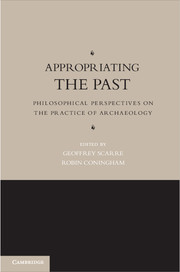
- Appropriating the PastPhilosophical Perspectives on the Practice of Archaeology, pp. 176 - 194Publisher: Cambridge University PressPrint publication year: 2012
References
2004
Accessibility standard: Unknown
Why this information is here
This section outlines the accessibility features of this content - including support for screen readers, full keyboard navigation and high-contrast display options. This may not be relevant for you.Accessibility Information
Accessibility compliance for the PDF of this chapter is currently unknown
and may be updated in the future.