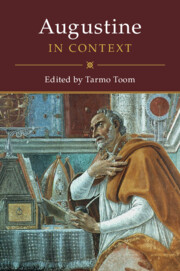
Book contents
- Augustine in Context
- Augustine in Context
- Copyright page
- Contents
- Contributors
- Acknowledgments
- General Abbreviations
- Abbreviations of Augustine’s Works
- Introduction
- 1 Augustine in Context and Augustine on Context
- Part I Life
- Part II Literary and Intellectual Contexts
- Part III Religious Contexts
- Part IV Political, Social, and Cultural Contexts
- Part V Reception
- A Note on Augustine’s Works
- Further Reading
- Index
- References
Further Reading
Published online by Cambridge University Press: 18 December 2017
Edited by

Book contents
- Augustine in Context
- Augustine in Context
- Copyright page
- Contents
- Contributors
- Acknowledgments
- General Abbreviations
- Abbreviations of Augustine’s Works
- Introduction
- 1 Augustine in Context and Augustine on Context
- Part I Life
- Part II Literary and Intellectual Contexts
- Part III Religious Contexts
- Part IV Political, Social, and Cultural Contexts
- Part V Reception
- A Note on Augustine’s Works
- Further Reading
- Index
- References
Summary
A summary is not available for this content so a preview has been provided. Please use the Get access link above for information on how to access this content.
Information
- Type
- Chapter
- Information
- Augustine in Context , pp. 247 - 260Publisher: Cambridge University PressPrint publication year: 2018
References
Primary Sources
Cox, P. Biography in Late Antiquity, Transformation of the Classical Heritage 5. Berkeley: University of California Press, 1983.Google Scholar
Hägg, T. The Art of Biography in Antiquity. New York: Cambridge University Press, 2012.CrossRefGoogle Scholar
Hägg, T., and Rousseau, P., Greek Biography and Panegyric in Late Antiquity, Transformation of the Classical Heritage 31. Berkeley: University of California Press, 2000.CrossRefGoogle Scholar
Momigliano, A. The Development of Greek Biography, expanded edn. Cambridge, MA: Harvard University Press, 1993.Google Scholar
Urbano, A. P. The Philosophical Life: Biography and the Crafting of Intellectual Identity in LateAntiquity, Patristic Monograph Series 21. Washington, DC: Catholic University of America Press, 2013.CrossRefGoogle Scholar
Williams, M. S. Authorised Lives in Early Christian Biography: Between Eusebius and Augustine, Cambridge Classical Studies. Cambridge: University of Cambridge, 2008.Google Scholar
BeDuhn, J. D. Augustine’s Manichaean Dilemma I: Conversion and Apostasy, 373–388 C.E., Divinations. Philadelphia: University of Pennsylvania Press, 2010.CrossRefGoogle Scholar
BeDuhn, J. D. Augustine’s Manichaean Dilemma II: Making a “Catholic” Self, 388–401 C.E., Divinations. Philadelphia: University of Pennsylvania Press, 2013.Google Scholar
Courcelle, P. Les “Confessions” de s. Augustin dans la tradition littéraire: Antécédents et postérité. Paris: Études Augustiniennes, 1963.Google Scholar
Kotzé, A. Augustine’s Confessions: Communicative Purpose and Audience, Supplements to Vigiliae Christianae. Leiden: Brill, 2004.CrossRefGoogle Scholar
Stock, B. Augustine the Reader: Meditation, Self-Knowledge and the Ethics of Interpretation. Cambridge, MA: Harvard University Press, 1996.CrossRefGoogle Scholar
Clark, G. “City of Books: Augustine and the World as Text.” In Klingshirn, W. E. and Safran, L. (eds.), The Early Christian Book. Washington, DC: Catholic University of America Press, 2007, 117–38.Google Scholar
Early Christian Biographies, Fathers of the Church Series 15, trans. Defferari, R.. Washington, DC: Catholic University of America Press, 2001.Google Scholar
Hermanowicz, E. T. Possidius of Calama: A Study of the North African Episcopate at the Time of Augustine, Oxford Early Christian Series. Oxford: Oxford University Press, 2008.CrossRefGoogle Scholar
Hermanowicz, E. T. “Catholic Bishops and Appeals to the Imperial Court: A Legal Study of the Calama Riots in 408.” Journal of Early Christian Studies 12 (2004), 481–521.CrossRefGoogle Scholar
Vessey, M. “The History of the Book: Augustine’s City of God and Post-Roman Cultural Memory.” In Wetzel, J. (ed.), Augustine’s City of God: A Critical Guide. Cambridge: Cambridge University Press, 2012, 14–32.CrossRefGoogle Scholar
Vessey, M. Latin Christian Writers in Late Antiquity and Their Texts, Variorum Collected Studies Series. Aldershot: Ashgate, 2005.Google Scholar
Weiskotten, H. T. The Life of Saint Augustine: A Translation of the Sancti Augustini Vita by Possidius, Bishop of Calama. Merchantville, NJ: Evolution Publishers, 2008 (first published in 1919).Google Scholar
Benseddik, N. “À la recherche de Thagaste, patrie de saint Augustin.” In Fux, P.-Y., Roessli, J.-M., and Wermelinger, O. (eds.), “Augustinus Afer”: Saint Augustin: Africanité et Universalité: Actes du Colloque International, Alger-Annaba, 1–7 Avril 2001. Fribourg: Éditions Universitaires, 2003, 413–36.Google Scholar
Humphrey, J. H. (ed.). The Circus and a Byzantine Cemetery at Carthage, vol. I. Ann Arbor: University of Michigan Press, 1988.Google Scholar
Leone, A. The End of the Pagan City: Religion, Economy, and Urbanism in Late Antique North Africa. Oxford: Oxford University Press, 2013.CrossRefGoogle Scholar
Lepelley, C. Les Cités de l’Afrique Romaine au Bas-Empire, vol. II: Notices d’Histoire Municipale. Paris: Études Augustiniennes, 1981.Google Scholar
Potter, T. W. Towns in Late Antiquity: Iol Caesarea and Its Context. Ian Sanders Memorial Committee, Department of Archaeology and Prehistory, University of Sheffield, 1995.Google Scholar
Sears, G. M. Late Roman African Urbanism, British Archaeological Reports International Series 1693. Oxford: Archaeopress, 2007.Google Scholar
Stern, K. B. Inscribing Devotion and Death: Archaeological Evidence for Jewish Populations of North Africa. Leiden: Brill, 2008.Google Scholar
Brown, P. Power and Persuasion in Late Antiquity: Towards a Christian Empire. Madison: University of Wisconsin Press, 1992.Google Scholar
Cameron, A. Christianity and the Rhetoric of Empire: The Development of Christian Discourse. Berkeley: University of California Press, 1991.CrossRefGoogle Scholar
Curran, J. R. Pagan City and Christian Capital: Rome in the Fourth Century, Oxford Classical Monographs. Oxford: Oxford University Press, 2000.Google Scholar
Krautheimer, R. Three Christian Capitals: Topography and Politics. Berkeley: University of California Press, 1983.CrossRefGoogle Scholar
Matthews, J. Western Aristocracies and Imperial Court, A.D. 364–425. Oxford: Clarendon Press, 1975 (reprinted with postscript in 1990).Google Scholar
McLynn, N. B. Ambrose of Milan: Church and Court in a Christian Capital, Transformation of the Classical Heritage 22. Berkeley: University of California Press, 1994.Google Scholar
Salzman, M. R. The Making of a Christian Aristocracy: Social and Religious Change in the Western Roman Empire. Cambridge, MA: Harvard University Press, 2002.CrossRefGoogle Scholar
Williams, D. H. Ambrose of Milan and the End of the Nicene-Arian Conflicts, Oxford Early Christian Studies. Oxford: Clarendon Press, 1995.CrossRefGoogle Scholar
Brown, P. Poverty and Leadership in the Later Roman Empire. Hannover, NH: University Press of New England, 2002.Google Scholar
Brown, P. Power and Persuasion in Late Antiquity: Towards a Christian Empire, Curti Lectures 1988. Madison: University of Wisconsin Press, 1992.Google Scholar
Chadwick, H. The Role of the Christian Bishop in Ancient Society, Protocol Series of the Colloquies of the Center 35. Berkeley, CA: Center for Hermeneutical Studies in Hellenism and Modern Studies, 1979.Google Scholar
Demacopoulos, G. Five Models of Spiritual Direction in the Early Church. South Bend, IN: University of Notre Dame Press, 2007.Google Scholar
Hermanowicz, E. Possidius of Calama: A Study of the North African Episcopate, Oxford Early Christian Studies. Oxford: Oxford University Press, 2008.CrossRefGoogle Scholar
Lamoureux, J. C. “Episcopal Courts in Late Antiquity.” Journal of Early Christian Studies 3 (1995), 143–67.Google Scholar
Lenksi, N. “Evidence for the Audientia Episcopalis in the New Letters of Augustine.” In Mathisen, R. W. (ed.), Law, Society, and Authority in Late Antiquity. Oxford: Oxford University Press, 2001, 83–97.Google Scholar
Rapp, C. Holy Bishops in Late Antiquity: The Nature of Christian Leadership in an Age of Transition, Transformation of the Classical Heritage 37. Berkeley: University of California Press, 2005.CrossRefGoogle Scholar
Sterk, A. Renouncing the World Yet Leading the Church: The Monk-Bishop in Late Antiquity. Cambridge, MA: Harvard University Press, 2004.CrossRefGoogle Scholar
Secondary Sources
Cox, P. Biography in Late Antiquity, Transformation of the Classical Heritage 5. Berkeley: University of California Press, 1983.Google Scholar
Hägg, T. The Art of Biography in Antiquity. New York: Cambridge University Press, 2012.CrossRefGoogle Scholar
Hägg, T., and Rousseau, P., Greek Biography and Panegyric in Late Antiquity, Transformation of the Classical Heritage 31. Berkeley: University of California Press, 2000.CrossRefGoogle Scholar
Momigliano, A. The Development of Greek Biography, expanded edn. Cambridge, MA: Harvard University Press, 1993.Google Scholar
Urbano, A. P. The Philosophical Life: Biography and the Crafting of Intellectual Identity in LateAntiquity, Patristic Monograph Series 21. Washington, DC: Catholic University of America Press, 2013.CrossRefGoogle Scholar
Williams, M. S. Authorised Lives in Early Christian Biography: Between Eusebius and Augustine, Cambridge Classical Studies. Cambridge: University of Cambridge, 2008.Google Scholar
BeDuhn, J. D. Augustine’s Manichaean Dilemma I: Conversion and Apostasy, 373–388 C.E., Divinations. Philadelphia: University of Pennsylvania Press, 2010.CrossRefGoogle Scholar
BeDuhn, J. D. Augustine’s Manichaean Dilemma II: Making a “Catholic” Self, 388–401 C.E., Divinations. Philadelphia: University of Pennsylvania Press, 2013.Google Scholar
Courcelle, P. Les “Confessions” de s. Augustin dans la tradition littéraire: Antécédents et postérité. Paris: Études Augustiniennes, 1963.Google Scholar
Kotzé, A. Augustine’s Confessions: Communicative Purpose and Audience, Supplements to Vigiliae Christianae. Leiden: Brill, 2004.CrossRefGoogle Scholar
Stock, B. Augustine the Reader: Meditation, Self-Knowledge and the Ethics of Interpretation. Cambridge, MA: Harvard University Press, 1996.CrossRefGoogle Scholar
Clark, G. “City of Books: Augustine and the World as Text.” In Klingshirn, W. E. and Safran, L. (eds.), The Early Christian Book. Washington, DC: Catholic University of America Press, 2007, 117–38.Google Scholar
Early Christian Biographies, Fathers of the Church Series 15, trans. Defferari, R.. Washington, DC: Catholic University of America Press, 2001.Google Scholar
Hermanowicz, E. T. Possidius of Calama: A Study of the North African Episcopate at the Time of Augustine, Oxford Early Christian Series. Oxford: Oxford University Press, 2008.CrossRefGoogle Scholar
Hermanowicz, E. T. “Catholic Bishops and Appeals to the Imperial Court: A Legal Study of the Calama Riots in 408.” Journal of Early Christian Studies 12 (2004), 481–521.CrossRefGoogle Scholar
Vessey, M. “The History of the Book: Augustine’s City of God and Post-Roman Cultural Memory.” In Wetzel, J. (ed.), Augustine’s City of God: A Critical Guide. Cambridge: Cambridge University Press, 2012, 14–32.CrossRefGoogle Scholar
Vessey, M. Latin Christian Writers in Late Antiquity and Their Texts, Variorum Collected Studies Series. Aldershot: Ashgate, 2005.Google Scholar
Weiskotten, H. T. The Life of Saint Augustine: A Translation of the Sancti Augustini Vita by Possidius, Bishop of Calama. Merchantville, NJ: Evolution Publishers, 2008 (first published in 1919).Google Scholar
Benseddik, N. “À la recherche de Thagaste, patrie de saint Augustin.” In Fux, P.-Y., Roessli, J.-M., and Wermelinger, O. (eds.), “Augustinus Afer”: Saint Augustin: Africanité et Universalité: Actes du Colloque International, Alger-Annaba, 1–7 Avril 2001. Fribourg: Éditions Universitaires, 2003, 413–36.Google Scholar
Humphrey, J. H. (ed.). The Circus and a Byzantine Cemetery at Carthage, vol. I. Ann Arbor: University of Michigan Press, 1988.Google Scholar
Leone, A. The End of the Pagan City: Religion, Economy, and Urbanism in Late Antique North Africa. Oxford: Oxford University Press, 2013.CrossRefGoogle Scholar
Lepelley, C. Les Cités de l’Afrique Romaine au Bas-Empire, vol. II: Notices d’Histoire Municipale. Paris: Études Augustiniennes, 1981.Google Scholar
Potter, T. W. Towns in Late Antiquity: Iol Caesarea and Its Context. Ian Sanders Memorial Committee, Department of Archaeology and Prehistory, University of Sheffield, 1995.Google Scholar
Sears, G. M. Late Roman African Urbanism, British Archaeological Reports International Series 1693. Oxford: Archaeopress, 2007.Google Scholar
Stern, K. B. Inscribing Devotion and Death: Archaeological Evidence for Jewish Populations of North Africa. Leiden: Brill, 2008.Google Scholar
Brown, P. Power and Persuasion in Late Antiquity: Towards a Christian Empire. Madison: University of Wisconsin Press, 1992.Google Scholar
Cameron, A. Christianity and the Rhetoric of Empire: The Development of Christian Discourse. Berkeley: University of California Press, 1991.CrossRefGoogle Scholar
Curran, J. R. Pagan City and Christian Capital: Rome in the Fourth Century, Oxford Classical Monographs. Oxford: Oxford University Press, 2000.Google Scholar
Krautheimer, R. Three Christian Capitals: Topography and Politics. Berkeley: University of California Press, 1983.CrossRefGoogle Scholar
Matthews, J. Western Aristocracies and Imperial Court, A.D. 364–425. Oxford: Clarendon Press, 1975 (reprinted with postscript in 1990).Google Scholar
McLynn, N. B. Ambrose of Milan: Church and Court in a Christian Capital, Transformation of the Classical Heritage 22. Berkeley: University of California Press, 1994.Google Scholar
Salzman, M. R. The Making of a Christian Aristocracy: Social and Religious Change in the Western Roman Empire. Cambridge, MA: Harvard University Press, 2002.CrossRefGoogle Scholar
Williams, D. H. Ambrose of Milan and the End of the Nicene-Arian Conflicts, Oxford Early Christian Studies. Oxford: Clarendon Press, 1995.CrossRefGoogle Scholar
Brown, P. Poverty and Leadership in the Later Roman Empire. Hannover, NH: University Press of New England, 2002.Google Scholar
Brown, P. Power and Persuasion in Late Antiquity: Towards a Christian Empire, Curti Lectures 1988. Madison: University of Wisconsin Press, 1992.Google Scholar
Chadwick, H. The Role of the Christian Bishop in Ancient Society, Protocol Series of the Colloquies of the Center 35. Berkeley, CA: Center for Hermeneutical Studies in Hellenism and Modern Studies, 1979.Google Scholar
Demacopoulos, G. Five Models of Spiritual Direction in the Early Church. South Bend, IN: University of Notre Dame Press, 2007.Google Scholar
Hermanowicz, E. Possidius of Calama: A Study of the North African Episcopate, Oxford Early Christian Studies. Oxford: Oxford University Press, 2008.CrossRefGoogle Scholar
Lamoureux, J. C. “Episcopal Courts in Late Antiquity.” Journal of Early Christian Studies 3 (1995), 143–67.Google Scholar
Lenksi, N. “Evidence for the Audientia Episcopalis in the New Letters of Augustine.” In Mathisen, R. W. (ed.), Law, Society, and Authority in Late Antiquity. Oxford: Oxford University Press, 2001, 83–97.Google Scholar
Rapp, C. Holy Bishops in Late Antiquity: The Nature of Christian Leadership in an Age of Transition, Transformation of the Classical Heritage 37. Berkeley: University of California Press, 2005.CrossRefGoogle Scholar
Sterk, A. Renouncing the World Yet Leading the Church: The Monk-Bishop in Late Antiquity. Cambridge, MA: Harvard University Press, 2004.CrossRefGoogle Scholar
Adams, J. N. Social Variation and the Latin Language. Cambridge: Cambridge University Press, 2013.CrossRefGoogle Scholar
Amat, J. “Le latin de la passion de Perpétue et de Félicité.” In Callebat, L. (ed.), Latin vulgaire, latin tardif IV: Actes du 4e Colloque international sur le latin vulgaire et tardif, Caen, 2–5 septembre 1994. Hildesheim: Olms/Weidmann, 1995, 445–54.Google Scholar
Brown, P. “Christianity and Local Culture in Late Roman Africa.” Journal of Roman Studies 58 (1968), 85–95.CrossRefGoogle Scholar
Burton., P. The Old Latin Gospels: A Study of Their Texts and Language, Oxford Early Christian Studies. Oxford: Oxford University Press, 2000.CrossRefGoogle Scholar
Burton., P. Language in the Confessions of Saint Augustine. Oxford: Oxford University Press, 2007.CrossRefGoogle Scholar
Clackson, J. “Originality and Pastiche in the Passion of Perpetua.” Rationes Rerum 5 (2015), 79–98.Google Scholar
Dickey, E. (ed.). The Colloquia of the Hermeneumata Pseudodositheana, Cambridge Classical Texts and Commentaries 49. Cambridge: Cambridge University Press, 2012, vol. 1.CrossRefGoogle Scholar
Herman, J. “Spoken and Written Latin in the Last Centuries of the Roman Empire: A Contribution to the Linguistic History of the Western Provinces.” In Wright, R. (ed.), Latin and the Romance Languages in the Middle Ages, Romance Linguistics. London: Routledge, 1991, 29–43.Google Scholar
Kaster, R. A., Guardians of Language: The Grammarian and Society in Late Antiquity, Transformation of the Classical Heritage 11. Berkeley: University of California Press, 1988.CrossRefGoogle Scholar
Long, A. A. “Stoic Linguistics, Plato’s Cratylus, and Augustine’s De dialecta.” In Frede, D. and Inwood, B. (eds.), Language and Learning: Philosophy of Language in the Hellenistic Age. Cambridge: Cambridge University Press, 2005, 36–55.CrossRefGoogle Scholar
Pezzini, G. “Caesar the Linguist: The Debate about the Latin Language.” In Grillo, L. and Krebs, C. (eds.), The Cambridge Companion to Julius Caesar. Cambridge: Cambridge University Press, 2018.Google Scholar
Edwards, M., et al. (eds.). Apologetics in the Roman Empire: Pagans, Jews, and Christians. Oxford: Oxford University Press, 1999.CrossRefGoogle Scholar
Fux, P.-Y., et al. (eds.). Augustinus Afer. Saint Augustin: africanité et universalité; Actes du Colloque international, Alger-Annaba, 1–7 avril 2001, Paradosis 45. Fribourg: Editions Universitaires, 2003, vol. 1.Google Scholar
Lee, B. T., et al. (eds.). Apuleius and Africa, Routledge Monographs in Classical Studies 18. London: Routledge, 2014.CrossRefGoogle Scholar
MacCormack, S. The Shadows of Poetry: Vergil in the Mind of Augustine, Transformation of the Classical Heritage 26. Berkeley: University of California Press, 1998.CrossRefGoogle Scholar
Simmons, M. B., Arnobius of Sicca: Religious Conflict and Competition in the Age of Diocletian, Oxford Early Christian Studies. Oxford: Oxford University Press, 1996.Google Scholar
Burton, P. “The Vocabulary of the Liberal Arts in Augustine’s Confessions.” In Pollmann, K. and Vessey, M. (eds.), Augustine and the Disciplines: From Cassiciacum to Confessions. Oxford: Oxford University Press, 2005, 141–64.Google Scholar
Chin, C. “The Grammarian’s Spoils: De Doctrina Christiana and the Contexts of Literary Education.” In Pollman and Vessey, Augustine and the Disciplines, 167–8.CrossRefGoogle Scholar
McCarthy, M. “‘We Are Your Books’: Augustine, the Bible and the Practice of Authority.” Journal of the American Academy of Religion 75 (2007), 324–52.CrossRefGoogle Scholar
Stock, B. Augustine the Reader: Meditation, Self-Knowledge, and the Ethics of Interpretation. Cambridge, MA: Harvard University Press, 1996.CrossRefGoogle Scholar
Everett, F. The Bible in the Early Church, Studies in Early Christianity 3. New York: Garland Press, 1993.Google Scholar
Gamble, H. Y. Books and Readers in the Early Church: A History of Early Christian Texts. New Haven, CT: Yale University Press, 1995.Google Scholar
Geerlings, W., and Schulze, C. (eds.). Der Kommentar in Antike und Mittelalter: Beiträge zu seiner Erforschung, Clavis Commentariorum Antiquitatis et Medii Aevi 2. Leiden: Brill, 2002.CrossRefGoogle Scholar
Hauser, A. J., and Watson, D. (eds.). A History of Biblical Interpretation, vol. 1: The Ancient Period. Grand Rapids, MI: Eerdmans, 2003.Google Scholar
Kannengiesser, C. (ed.). Handbook of Patristic Exegesis: The Bible in Ancient Christianity, Bible in Ancient Christianity Series 1–2. Leiden: Brill, 2006, 2 vols.CrossRefGoogle Scholar
Lössl, J., and Watt, J. W. (eds.). Interpreting the Bible and Aristotle in Late Antiquity: The Alexandrian Commentary Tradition between Rome and Bagdad. Surrey, UK: Ashgate, 2011.Google Scholar
Simonetti, M. Biblical Interpretation in the Early Church: An Historical Introduction to Patristic Exegesis, trans. Hughes, J. A.. Edinburgh: T&T Clark, 1994.Google Scholar
Young, F. M. Biblical Exegesis and the Formation of Christian Culture. Cambridge: Cambridge University Press, 1997.CrossRefGoogle Scholar
Bastiaensen, A. “Augustin et ses prédécesseurs latins chrétiens.” In den Boeft, J. and van Oort, J. (eds.), Augustiniana Traiectina: Communications présentées au colloque international d’Utrecht, 13–14 novembre 1986. Paris: Études augustiniennes, 1987, 59–72.Google Scholar
Dihle, A. Greek and Latin Literature of the Roman Empire from Augustus to Justinian. London: Routledge, 1994.Google Scholar
Edwards, M. “Augustine and his Christian Predecessors.” In Vessey, M. and Reid, S. (eds.), A Companion to Augustine. Chichester: Wiley-Blackwell, 2012, 215–26.Google Scholar
Garnsey, P. “Lactantius and Augustine.” In Bowman, A. K. and Millar, F. (eds.), Representations of Empire: Rome and the Mediterranean World, Proceedings of the British Academy 114. Oxford: Oxford University Press, 2004, 153–79.Google Scholar
Quasten, J. Patrology, vol. 2: The Ante-Nicene Literature after Irenaeus and vol. 4: The Golden Age of Patristic Literature from the Council of Nicaea to the Council of Chalcedon, trans. Solari, P.. Allen, TX: Christian Classics, 1992, 1995.Google Scholar
Stock, B. Augustine the Reader: Meditation, Self-Knowledge, and the Ethics of Interpretation. Cambridge: Cambridge University Press, 1996.CrossRefGoogle Scholar
Tilley, M. A. “Understanding Augustine Misunderstanding Tyconius.” Studia Patristica 27 (1993), 405–8.Google Scholar
Brown, P. The Body and Society: Men, Women, and Sexual Renunciation in Early Christianity, 2nd edn. New York: Columbia University Press, 2008.Google Scholar
Burns, J. P., and Jensen, R. M., Christianity in Roman Africa: The Development of its Practices and Beliefs. Grand Rapids, MI: Eerdmans, 2014.Google Scholar
Courcelle, P. Les Confessions de saint Augustin dans la tradition littéraire: Antécédents et postérité. Paris: Études Augustiniennes, 1963.Google Scholar
Courcelle, P. Recherches sur les Confessions de saint Augustine, nouvelle edition augmentée et illustrée. Paris: Boccard, 1968.Google Scholar
Decret, F. Early Christianity in North Africa, trans. Smither, E.. Cambridge: James Clarke, 2011.CrossRefGoogle Scholar
Harrison, C. Augustine: Christian Truth and Fractured Humanity, Christian Theology in Context. Oxford: Oxford University Press, 2000.CrossRefGoogle Scholar
Hunter, D. G. Marriage, Celibacy, and Heresy in Ancient Christianity, Oxford Early Christian Studies. Oxford: Oxford University Press, 2007.CrossRefGoogle Scholar
Rist, J. M. Augustine: Ancient Thought Baptized. Cambridge: Cambridge University Press, 1994.CrossRefGoogle Scholar
Allen, P., and Cunningham, M. (eds.). Preacher and Audience: Studies in Early Christian and Byzantine Homiletics, New History of the Sermon 1. Leiden: Brill, 1998.Google Scholar
Morello, R., and Morrison, A. D. (eds.). Ancient Letters: Classical and Late Antique Epistolography. Oxford: Oxford University Press, 2007.CrossRefGoogle Scholar
Neil, B., and Allen, P. (eds.). Collecting Early Christian Letters from the Apostle Paul to Late Antiquity. Cambridge: Cambridge University Press, 2015.CrossRefGoogle Scholar
Olivar, A. La Predicación Cristiana Antigua, Biblioteca Herder 189. Barcelona: Herder, 1991.Google Scholar
Sogno, C., Storin, B. K., and Watts, E. J. (eds.). Late Antique Letter Collections: A Critical Introduction and Reference Guide. Berkeley: University of California Press, 2016.CrossRefGoogle Scholar
Catapano, G. “Philosophia.” In Dodaro, R., Mayer, C., and Müller, C. (eds.), Augustinus-Lexikon. Basel: Schwabe, 2016, vol. 2, fasc. 5–6, 720–42.Google Scholar
Courcelle, P. P. Late Latin Writers and Their Greek Sources, trans. Wedeck, H. E.. Cambridge, MA: Harvard University Press, 1969.Google Scholar
Gersh, S. Middle Platonism and Neoplatonism: The Latin Tradition. South Bend, IN: University of Notre Dame Press, 1986, 2 vols.Google Scholar
Gerson, L. P. (ed.). The Cambridge History of Philosophy in Late Antiquity. Cambridge: Cambridge University Press, 2010, 2 vols.Google Scholar
Adams, J. N. Social Variation and the Latin Language. Cambridge: Cambridge University Press, 2013.CrossRefGoogle Scholar
Amat, J. “Le latin de la passion de Perpétue et de Félicité.” In Callebat, L. (ed.), Latin vulgaire, latin tardif IV: Actes du 4e Colloque international sur le latin vulgaire et tardif, Caen, 2–5 septembre 1994. Hildesheim: Olms/Weidmann, 1995, 445–54.Google Scholar
Brown, P. “Christianity and Local Culture in Late Roman Africa.” Journal of Roman Studies 58 (1968), 85–95.CrossRefGoogle Scholar
Burton., P. The Old Latin Gospels: A Study of Their Texts and Language, Oxford Early Christian Studies. Oxford: Oxford University Press, 2000.CrossRefGoogle Scholar
Burton., P. Language in the Confessions of Saint Augustine. Oxford: Oxford University Press, 2007.CrossRefGoogle Scholar
Clackson, J. “Originality and Pastiche in the Passion of Perpetua.” Rationes Rerum 5 (2015), 79–98.Google Scholar
Dickey, E. (ed.). The Colloquia of the Hermeneumata Pseudodositheana, Cambridge Classical Texts and Commentaries 49. Cambridge: Cambridge University Press, 2012, vol. 1.CrossRefGoogle Scholar
Herman, J. “Spoken and Written Latin in the Last Centuries of the Roman Empire: A Contribution to the Linguistic History of the Western Provinces.” In Wright, R. (ed.), Latin and the Romance Languages in the Middle Ages, Romance Linguistics. London: Routledge, 1991, 29–43.Google Scholar
Kaster, R. A., Guardians of Language: The Grammarian and Society in Late Antiquity, Transformation of the Classical Heritage 11. Berkeley: University of California Press, 1988.CrossRefGoogle Scholar
Long, A. A. “Stoic Linguistics, Plato’s Cratylus, and Augustine’s De dialecta.” In Frede, D. and Inwood, B. (eds.), Language and Learning: Philosophy of Language in the Hellenistic Age. Cambridge: Cambridge University Press, 2005, 36–55.CrossRefGoogle Scholar
Pezzini, G. “Caesar the Linguist: The Debate about the Latin Language.” In Grillo, L. and Krebs, C. (eds.), The Cambridge Companion to Julius Caesar. Cambridge: Cambridge University Press, 2018.Google Scholar
Edwards, M., et al. (eds.). Apologetics in the Roman Empire: Pagans, Jews, and Christians. Oxford: Oxford University Press, 1999.CrossRefGoogle Scholar
Fux, P.-Y., et al. (eds.). Augustinus Afer. Saint Augustin: africanité et universalité; Actes du Colloque international, Alger-Annaba, 1–7 avril 2001, Paradosis 45. Fribourg: Editions Universitaires, 2003, vol. 1.Google Scholar
Lee, B. T., et al. (eds.). Apuleius and Africa, Routledge Monographs in Classical Studies 18. London: Routledge, 2014.CrossRefGoogle Scholar
MacCormack, S. The Shadows of Poetry: Vergil in the Mind of Augustine, Transformation of the Classical Heritage 26. Berkeley: University of California Press, 1998.CrossRefGoogle Scholar
Simmons, M. B., Arnobius of Sicca: Religious Conflict and Competition in the Age of Diocletian, Oxford Early Christian Studies. Oxford: Oxford University Press, 1996.Google Scholar
Burton, P. “The Vocabulary of the Liberal Arts in Augustine’s Confessions.” In Pollmann, K. and Vessey, M. (eds.), Augustine and the Disciplines: From Cassiciacum to Confessions. Oxford: Oxford University Press, 2005, 141–64.Google Scholar
Chin, C. “The Grammarian’s Spoils: De Doctrina Christiana and the Contexts of Literary Education.” In Pollman and Vessey, Augustine and the Disciplines, 167–8.CrossRefGoogle Scholar
McCarthy, M. “‘We Are Your Books’: Augustine, the Bible and the Practice of Authority.” Journal of the American Academy of Religion 75 (2007), 324–52.CrossRefGoogle Scholar
Stock, B. Augustine the Reader: Meditation, Self-Knowledge, and the Ethics of Interpretation. Cambridge, MA: Harvard University Press, 1996.CrossRefGoogle Scholar
Everett, F. The Bible in the Early Church, Studies in Early Christianity 3. New York: Garland Press, 1993.Google Scholar
Gamble, H. Y. Books and Readers in the Early Church: A History of Early Christian Texts. New Haven, CT: Yale University Press, 1995.Google Scholar
Geerlings, W., and Schulze, C. (eds.). Der Kommentar in Antike und Mittelalter: Beiträge zu seiner Erforschung, Clavis Commentariorum Antiquitatis et Medii Aevi 2. Leiden: Brill, 2002.CrossRefGoogle Scholar
Hauser, A. J., and Watson, D. (eds.). A History of Biblical Interpretation, vol. 1: The Ancient Period. Grand Rapids, MI: Eerdmans, 2003.Google Scholar
Kannengiesser, C. (ed.). Handbook of Patristic Exegesis: The Bible in Ancient Christianity, Bible in Ancient Christianity Series 1–2. Leiden: Brill, 2006, 2 vols.CrossRefGoogle Scholar
Lössl, J., and Watt, J. W. (eds.). Interpreting the Bible and Aristotle in Late Antiquity: The Alexandrian Commentary Tradition between Rome and Bagdad. Surrey, UK: Ashgate, 2011.Google Scholar
Simonetti, M. Biblical Interpretation in the Early Church: An Historical Introduction to Patristic Exegesis, trans. Hughes, J. A.. Edinburgh: T&T Clark, 1994.Google Scholar
Young, F. M. Biblical Exegesis and the Formation of Christian Culture. Cambridge: Cambridge University Press, 1997.CrossRefGoogle Scholar
Bastiaensen, A. “Augustin et ses prédécesseurs latins chrétiens.” In den Boeft, J. and van Oort, J. (eds.), Augustiniana Traiectina: Communications présentées au colloque international d’Utrecht, 13–14 novembre 1986. Paris: Études augustiniennes, 1987, 59–72.Google Scholar
Dihle, A. Greek and Latin Literature of the Roman Empire from Augustus to Justinian. London: Routledge, 1994.Google Scholar
Edwards, M. “Augustine and his Christian Predecessors.” In Vessey, M. and Reid, S. (eds.), A Companion to Augustine. Chichester: Wiley-Blackwell, 2012, 215–26.Google Scholar
Garnsey, P. “Lactantius and Augustine.” In Bowman, A. K. and Millar, F. (eds.), Representations of Empire: Rome and the Mediterranean World, Proceedings of the British Academy 114. Oxford: Oxford University Press, 2004, 153–79.Google Scholar
Quasten, J. Patrology, vol. 2: The Ante-Nicene Literature after Irenaeus and vol. 4: The Golden Age of Patristic Literature from the Council of Nicaea to the Council of Chalcedon, trans. Solari, P.. Allen, TX: Christian Classics, 1992, 1995.Google Scholar
Stock, B. Augustine the Reader: Meditation, Self-Knowledge, and the Ethics of Interpretation. Cambridge: Cambridge University Press, 1996.CrossRefGoogle Scholar
Tilley, M. A. “Understanding Augustine Misunderstanding Tyconius.” Studia Patristica 27 (1993), 405–8.Google Scholar
Brown, P. The Body and Society: Men, Women, and Sexual Renunciation in Early Christianity, 2nd edn. New York: Columbia University Press, 2008.Google Scholar
Burns, J. P., and Jensen, R. M., Christianity in Roman Africa: The Development of its Practices and Beliefs. Grand Rapids, MI: Eerdmans, 2014.Google Scholar
Courcelle, P. Les Confessions de saint Augustin dans la tradition littéraire: Antécédents et postérité. Paris: Études Augustiniennes, 1963.Google Scholar
Courcelle, P. Recherches sur les Confessions de saint Augustine, nouvelle edition augmentée et illustrée. Paris: Boccard, 1968.Google Scholar
Decret, F. Early Christianity in North Africa, trans. Smither, E.. Cambridge: James Clarke, 2011.CrossRefGoogle Scholar
Harrison, C. Augustine: Christian Truth and Fractured Humanity, Christian Theology in Context. Oxford: Oxford University Press, 2000.CrossRefGoogle Scholar
Hunter, D. G. Marriage, Celibacy, and Heresy in Ancient Christianity, Oxford Early Christian Studies. Oxford: Oxford University Press, 2007.CrossRefGoogle Scholar
Rist, J. M. Augustine: Ancient Thought Baptized. Cambridge: Cambridge University Press, 1994.CrossRefGoogle Scholar
Allen, P., and Cunningham, M. (eds.). Preacher and Audience: Studies in Early Christian and Byzantine Homiletics, New History of the Sermon 1. Leiden: Brill, 1998.Google Scholar
Morello, R., and Morrison, A. D. (eds.). Ancient Letters: Classical and Late Antique Epistolography. Oxford: Oxford University Press, 2007.CrossRefGoogle Scholar
Neil, B., and Allen, P. (eds.). Collecting Early Christian Letters from the Apostle Paul to Late Antiquity. Cambridge: Cambridge University Press, 2015.CrossRefGoogle Scholar
Olivar, A. La Predicación Cristiana Antigua, Biblioteca Herder 189. Barcelona: Herder, 1991.Google Scholar
Sogno, C., Storin, B. K., and Watts, E. J. (eds.). Late Antique Letter Collections: A Critical Introduction and Reference Guide. Berkeley: University of California Press, 2016.CrossRefGoogle Scholar
Catapano, G. “Philosophia.” In Dodaro, R., Mayer, C., and Müller, C. (eds.), Augustinus-Lexikon. Basel: Schwabe, 2016, vol. 2, fasc. 5–6, 720–42.Google Scholar
Courcelle, P. P. Late Latin Writers and Their Greek Sources, trans. Wedeck, H. E.. Cambridge, MA: Harvard University Press, 1969.Google Scholar
Gersh, S. Middle Platonism and Neoplatonism: The Latin Tradition. South Bend, IN: University of Notre Dame Press, 1986, 2 vols.Google Scholar
Gerson, L. P. (ed.). The Cambridge History of Philosophy in Late Antiquity. Cambridge: Cambridge University Press, 2010, 2 vols.Google Scholar
Beard, M., et al. (eds.). Religions of Rome, vol. 1: A History and Religions of Rome; vol. 2: A Sourcebook. Cambridge: Cambridge University Press, 1998.Google Scholar
Brodd, J., and Reed, J. L. (eds.). Rome and Religion: A Cross-Disciplinary Dialogue on the Imperial Cult, Writings from the Greco-Roman World Supplement Series 5. Atlanta, GA: Society of Biblical Literature, 2011.Google Scholar
Dillon, J. M., and Gerson, L. P. (eds.). Neoplatonic Philosophy: Introductory Readings. Indianapolis, IN: Hackett, 2004.Google Scholar
Meyer, M. W. (ed.). The Ancient Mysteries: A Sourcebook of Sacred Texts. Philadelphia: University of Pennsylvania Press, 1987.Google Scholar
Rives, J. B. Religion in the Roman Empire, Blackwell Ancient Religions. Malden, MA: Blackwell, 2007.Google Scholar
Baker-Brian, N. J. Manichaeism: An Ancient Faith Rediscovered. London: T&T Clark, 2011.Google Scholar
BeDuhn, J. D. Augustine’s Manichaean Dilemma 2: Making a “Catholic” Self, 388–401 C.E., Divinations. Philadelphia: University of Pennsylvania Press, 2013.Google Scholar
BeDuhn, J. D. Augustine’s Manichaean Dilemma 1: Conversion and Apostasy, 373–388 C.E., Divinations. Philadelphia: University of Pennsylvania Press, 2010.CrossRefGoogle Scholar
BeDuhn, J. D. The Manichaean Body: In Discipline and Ritual. Baltimore, MD: Johns Hopkins University Press, 2000.Google Scholar
Gardner, I., and Lieu, S. N. C.. Manichaean Texts from the Roman Empire. Cambridge: Cambridge University Press, 2004.CrossRefGoogle Scholar
Alexander, J. “Donatism.” In Esler, P. (ed.), The Early Christian World. London: Routledge, 2000, vol. 2, 952–74.Google Scholar
Dossey, L. Peasant and Empire in Christian North Africa, Transformation of the Classical Heritage 47. Berkeley: University of California Press, 2010.Google Scholar
Dupont, A., et al. (eds.). The Uniquely African Controversy: Studies on Donatist Christianity, Late Antique History and Religion 9. Leuven: Peeters, 2015.Google Scholar
Frend, W. H. C. The Donatist Church: A Movement of Protest in Roman North Africa. Oxford: Clarendon Press, 1952.Google Scholar
Edwards, M. (ed.). Optatus: Against the Donatists, Translated Texts for Historians 27. Liverpool: Liverpool University Press, 1998.Google Scholar
Miles, R. (ed.). The Donatist Schism: Controversy and Contexts, Translated Texts for Historians: Contexts. Liverpool: Liverpool University Press, 2016.CrossRefGoogle Scholar
Shaw, B. Sacred Violence: African Christians and Sectarian Hatred in the Age of Augustine Cambridge: Cambridge University Press, 2011.CrossRefGoogle Scholar
Tilley, M. The Bible in Christian North Africa: The Donatist World. Minneapolis, MN: Fortress Press, 1997.Google Scholar
Bonner, G. St. Augustine of Hippo: Life and Controversies, 3rd edn. Norwich: Canterbury Press, 2002.Google Scholar
Cary, P. Inner Grace: Augustine in the Traditions of Plato and Paul. Oxford: Oxford University Press, 2008.CrossRefGoogle Scholar
Clark, E. A. The Origenist Controversy: The Cultural Construction of an Early Christian Debate. Princeton, NJ: Princeton University Press, 1992.CrossRefGoogle Scholar
Markus, R. A. The End of Ancient Christianity. Cambridge: Cambridge University Press, 1990.Google Scholar
Weaver, R. H. Divine Grace and Human Agency: A Study of the Semi-Pelagian Controversy, Patristic Monograph Series 15. Macon, GA: Mercer University Press, 1996.Google Scholar
Ayres, L. Nicaea and Its Legacy: An Approach to Fourth-Century Trinitarian Theology. Oxford: Oxford University Press, 2004.CrossRefGoogle Scholar
Barnes, M. R. “The Fourth Century as Trinitarian Canon.” In Ayres, L. and Jones, G. (eds.), Christian Origins: Theology, Rhetoric an Community. London: Routledge, 1998, 47–67.Google Scholar
Gryson, R. (ed.). Scolies ariennes sur le concile d’Aquilée, Sources Chrétiennes 267. Paris: Éditions de Cerf, 1980.Google Scholar
Hanson, R. P. C. The Search for the Christian Doctrine of God. Edinburgh: T&T Clark, 1988.Google Scholar
Meslin, M. Les Ariens d’Occident 335–430, Patristica Sorbonensia 8. Paris: Éditions du Seuil, 1967.Google Scholar
Williams, D. H. Ambrose of Milan and the End of the Arian-Nicene Conflicts, Oxford Early Christian Studies. Oxford: Clarendon Press, 1995.CrossRefGoogle Scholar
Weedman, M. The Trinitarian Theology of Hilary of Poitiers Supplements to Vigiliae Christianae 89. Leiden: Brill, 2007.Google Scholar
Bonner, G., et al. (eds.). Saint Augustine. The Monastic Rules, Augustine Series 4. Hyde Park. NY: New City, 2004.Google Scholar
Dunn, M. The Emergence of Monasticism: From the Desert Fathers to the Early Middle Ages. Oxford: Wiley-Blackwell, 2003.CrossRefGoogle Scholar
Rousseau, P. Basil of Caesarea, Transformation of the Classical Heritage 20. Berkeley: University of California Press, 1994.CrossRefGoogle Scholar
Rousseau, P. Pachomius: The Making of a Community in Fourth-Century Egypt, Transformation of the Classical Heritage 6. Berkeley: University of California Press, 1985.CrossRefGoogle Scholar
Rubenson, S. Letters of St Antony: Monasticism and the Making of a Saint, Studies in Antiquity and Christianity. Minneapolis, MN: Fortress, 1995.Google Scholar
Verheijen, L. La Règle de Saint Augustine. Paris: Études Augustiniennes, 1967, 2 vols.Google Scholar
Beard, M., et al. (eds.). Religions of Rome, vol. 1: A History and Religions of Rome; vol. 2: A Sourcebook. Cambridge: Cambridge University Press, 1998.Google Scholar
Brodd, J., and Reed, J. L. (eds.). Rome and Religion: A Cross-Disciplinary Dialogue on the Imperial Cult, Writings from the Greco-Roman World Supplement Series 5. Atlanta, GA: Society of Biblical Literature, 2011.Google Scholar
Dillon, J. M., and Gerson, L. P. (eds.). Neoplatonic Philosophy: Introductory Readings. Indianapolis, IN: Hackett, 2004.Google Scholar
Meyer, M. W. (ed.). The Ancient Mysteries: A Sourcebook of Sacred Texts. Philadelphia: University of Pennsylvania Press, 1987.Google Scholar
Rives, J. B. Religion in the Roman Empire, Blackwell Ancient Religions. Malden, MA: Blackwell, 2007.Google Scholar
Baker-Brian, N. J. Manichaeism: An Ancient Faith Rediscovered. London: T&T Clark, 2011.Google Scholar
BeDuhn, J. D. Augustine’s Manichaean Dilemma 2: Making a “Catholic” Self, 388–401 C.E., Divinations. Philadelphia: University of Pennsylvania Press, 2013.Google Scholar
BeDuhn, J. D. Augustine’s Manichaean Dilemma 1: Conversion and Apostasy, 373–388 C.E., Divinations. Philadelphia: University of Pennsylvania Press, 2010.CrossRefGoogle Scholar
BeDuhn, J. D. The Manichaean Body: In Discipline and Ritual. Baltimore, MD: Johns Hopkins University Press, 2000.Google Scholar
Gardner, I., and Lieu, S. N. C.. Manichaean Texts from the Roman Empire. Cambridge: Cambridge University Press, 2004.CrossRefGoogle Scholar
Alexander, J. “Donatism.” In Esler, P. (ed.), The Early Christian World. London: Routledge, 2000, vol. 2, 952–74.Google Scholar
Dossey, L. Peasant and Empire in Christian North Africa, Transformation of the Classical Heritage 47. Berkeley: University of California Press, 2010.Google Scholar
Dupont, A., et al. (eds.). The Uniquely African Controversy: Studies on Donatist Christianity, Late Antique History and Religion 9. Leuven: Peeters, 2015.Google Scholar
Frend, W. H. C. The Donatist Church: A Movement of Protest in Roman North Africa. Oxford: Clarendon Press, 1952.Google Scholar
Edwards, M. (ed.). Optatus: Against the Donatists, Translated Texts for Historians 27. Liverpool: Liverpool University Press, 1998.Google Scholar
Miles, R. (ed.). The Donatist Schism: Controversy and Contexts, Translated Texts for Historians: Contexts. Liverpool: Liverpool University Press, 2016.CrossRefGoogle Scholar
Shaw, B. Sacred Violence: African Christians and Sectarian Hatred in the Age of Augustine Cambridge: Cambridge University Press, 2011.CrossRefGoogle Scholar
Tilley, M. The Bible in Christian North Africa: The Donatist World. Minneapolis, MN: Fortress Press, 1997.Google Scholar
Bonner, G. St. Augustine of Hippo: Life and Controversies, 3rd edn. Norwich: Canterbury Press, 2002.Google Scholar
Cary, P. Inner Grace: Augustine in the Traditions of Plato and Paul. Oxford: Oxford University Press, 2008.CrossRefGoogle Scholar
Clark, E. A. The Origenist Controversy: The Cultural Construction of an Early Christian Debate. Princeton, NJ: Princeton University Press, 1992.CrossRefGoogle Scholar
Markus, R. A. The End of Ancient Christianity. Cambridge: Cambridge University Press, 1990.Google Scholar
Weaver, R. H. Divine Grace and Human Agency: A Study of the Semi-Pelagian Controversy, Patristic Monograph Series 15. Macon, GA: Mercer University Press, 1996.Google Scholar
Ayres, L. Nicaea and Its Legacy: An Approach to Fourth-Century Trinitarian Theology. Oxford: Oxford University Press, 2004.CrossRefGoogle Scholar
Barnes, M. R. “The Fourth Century as Trinitarian Canon.” In Ayres, L. and Jones, G. (eds.), Christian Origins: Theology, Rhetoric an Community. London: Routledge, 1998, 47–67.Google Scholar
Gryson, R. (ed.). Scolies ariennes sur le concile d’Aquilée, Sources Chrétiennes 267. Paris: Éditions de Cerf, 1980.Google Scholar
Hanson, R. P. C. The Search for the Christian Doctrine of God. Edinburgh: T&T Clark, 1988.Google Scholar
Meslin, M. Les Ariens d’Occident 335–430, Patristica Sorbonensia 8. Paris: Éditions du Seuil, 1967.Google Scholar
Williams, D. H. Ambrose of Milan and the End of the Arian-Nicene Conflicts, Oxford Early Christian Studies. Oxford: Clarendon Press, 1995.CrossRefGoogle Scholar
Weedman, M. The Trinitarian Theology of Hilary of Poitiers Supplements to Vigiliae Christianae 89. Leiden: Brill, 2007.Google Scholar
Bonner, G., et al. (eds.). Saint Augustine. The Monastic Rules, Augustine Series 4. Hyde Park. NY: New City, 2004.Google Scholar
Dunn, M. The Emergence of Monasticism: From the Desert Fathers to the Early Middle Ages. Oxford: Wiley-Blackwell, 2003.CrossRefGoogle Scholar
Rousseau, P. Basil of Caesarea, Transformation of the Classical Heritage 20. Berkeley: University of California Press, 1994.CrossRefGoogle Scholar
Rousseau, P. Pachomius: The Making of a Community in Fourth-Century Egypt, Transformation of the Classical Heritage 6. Berkeley: University of California Press, 1985.CrossRefGoogle Scholar
Rubenson, S. Letters of St Antony: Monasticism and the Making of a Saint, Studies in Antiquity and Christianity. Minneapolis, MN: Fortress, 1995.Google Scholar
Verheijen, L. La Règle de Saint Augustine. Paris: Études Augustiniennes, 1967, 2 vols.Google Scholar
Brown, P. Power and Persuasion in Late Antiquity: Towards a Christian Empire. Madison: University of Wisconsin Press, 1992.Google Scholar
Cherry, D. Frontier and Society in Roman North Africa. Oxford: Clarendon Press, 1998.CrossRefGoogle Scholar
Dossey, L. Peasant and Empire in Christian North Africa, Transformation of the Classical Heritage 47. Berkeley: University of California Press, 2010.Google Scholar
Errington, R. M. Roman Imperial Policy from Julian to Theodosius, Studies in the History of Greece and Rome. Chapel Hill: University of North Carolina Press, 2006.Google Scholar
Jones, A. H. M. 1964. The Later Roman Empire, 284–602: A Social Economic and Administrative Survey, 1st American edn. Norman: University of Oklahoma Press, 1964, 2 vols.Google Scholar
Shaw, B. D. Sacred Violence: African Christians and Sectarian Hatred in the Age of Augustine. Cambridge: Cambridge University Press, 2011.CrossRefGoogle Scholar
Reichberg, G., et al. (eds.). Ethics of War: Classic and Contemporary Readings. Oxford: Blackwell, 2006.Google Scholar
Markus, R. A. “Saint Augustine’s Views on the ‘Just War.’” In Sheils, W. J. (ed.), The Church and War: Papers Read at the Twenty-First Summer Meeting and the Twenty-Second Winter Meeting of the Ecclesiastical History Society, Studies in Church History 20. Oxford: Blackwell, 1983, 1–13.Google Scholar
Russell, F. The Just War in the Middle Ages, Cambridge Studies in Medieval Life and Thoughts, 3rd series, 8. Cambridge: Cambridge University Press, 1975.Google Scholar
Sabin, P., et al. (eds.). The Cambridge History of Greek and Roman Warfare. Cambridge: Cambridge University Press, 2007.Google Scholar
Sarantis, A., and Christie, N. (eds.). War and Warfare in Late Antiquity: Current Perspectives, Late Antique Archaeology 8. Leiden: Brill, 2013, 2 vols.CrossRefGoogle Scholar
Sizgorich, T. Violence and Belief in Late Antiquity: Militant Devotion in Christianity and Islam, Divinations. Philadelphia: University of Pennsylvania Press, 2009.CrossRefGoogle Scholar
Brown, P. “Religious Coercion in the Later Roman Empire: The Case of North Africa.” Historia 48 (1963), 283–305.Google Scholar
Drake, H. A. (ed.). Violence in Late Antiquity: Perceptions and Practices. Aldershot: Ashgate, 2006.Google Scholar
Geljon, A. C., and Roukema, R. (eds.). Violence in Ancient Christianity: Victims and Perpetrators, Supplements to Vigiliae Christianae 125. Leiden: Brill, 2014.CrossRefGoogle Scholar
Iosif, D. “The Present and Future Worlds Are Enemies to Each Other.” In Alston, R., van Nijf, O. M., and Williamson, C. G. (eds.), Cults, Creeds and Identities in the Greek City after the Classical Age, Groningen-Royal Holloway Studies on the Greek City after the Classical Age 3. Leuven: Peeters, 2013, 289–308.Google Scholar
Iosif, D. “Illness as Demon Possession in the World of the First Christian Ascetics and Monks.” Mental Health, Religion and Culture 14(4) (2011), 323–40.CrossRefGoogle Scholar
Shaw, B. D. Sacred Violence: African Christians and Sectarian Hatred in the Age of Augustine. Cambridge: Cambridge University Press, 2011.CrossRefGoogle Scholar
Tilley, M. A. Donatist Martyr Stories: The Church in Conflict in Roman North Africa, Translated Texts for Historians 24. Liverpool: Liverpool University Press, 1996.CrossRefGoogle Scholar
Brown, P. Augustine of Hippo, new edn. Berkeley: University of California Press, 2000.Google Scholar
Fredriksen, P. “The Confessions as Autobiography.” In Vessey, M. (ed.), A Companion to Augustine, Blackwell Companions to the Ancient World. Malden, MA: Wiley-Blackwell, 2012, 87–98.CrossRefGoogle Scholar
Huebner, S., and Nathan, G. (eds.). Mediterranean Families in Antiquity: Households, Extended Family and Domestic Space. Oxford: Wiley-Blackwell, 2016.CrossRefGoogle Scholar
Lepelley, C. “Spes saeculi. Le Milieu sociale d’Augustin et ses ambitions séculiers avant sa conversion.” Atti della Academia della Scienze di Torino 120 (1986), 99–117.Google Scholar
Nathan, G. The Family in Late Antiquity: The Rise of Christianity and the Endurance of Tradition. London: Routledge, 2000.Google Scholar
Shaw, B. “The Family in Late Antiquity: The Experience of Augustine.” Past and Present 115 (1987), 3–51.CrossRefGoogle Scholar
Brown, P. The Cult of the Saints: Its Rise and Function in Latin Christianity, Haskell Lectures on History of Religions, New Series 2. Chicago: University of Chicago Press, 1981.Google Scholar
Brown, P. Poverty and Leadership in the Later Roman Empire, Menaheim Stern Jerusalem Lectures. Hanover, NH: University Press of New England. 2002.Google Scholar
Grig, L. (ed.). Popular Culture in the Ancient World. Cambridge: Cambridge University Press, 2016.CrossRefGoogle Scholar
Rebillard, E. Christians and Their Many Identities in Late Antiquity, North Africa 200–450 CE. Itacha, NY: Cornell University Press, 2012.Google Scholar
Brown, P. Power and Persuasion in Late Antiquity: Towards a Christian Empire. Madison: University of Wisconsin Press, 1992.Google Scholar
Cherry, D. Frontier and Society in Roman North Africa. Oxford: Clarendon Press, 1998.CrossRefGoogle Scholar
Dossey, L. Peasant and Empire in Christian North Africa, Transformation of the Classical Heritage 47. Berkeley: University of California Press, 2010.Google Scholar
Errington, R. M. Roman Imperial Policy from Julian to Theodosius, Studies in the History of Greece and Rome. Chapel Hill: University of North Carolina Press, 2006.Google Scholar
Jones, A. H. M. 1964. The Later Roman Empire, 284–602: A Social Economic and Administrative Survey, 1st American edn. Norman: University of Oklahoma Press, 1964, 2 vols.Google Scholar
Shaw, B. D. Sacred Violence: African Christians and Sectarian Hatred in the Age of Augustine. Cambridge: Cambridge University Press, 2011.CrossRefGoogle Scholar
Reichberg, G., et al. (eds.). Ethics of War: Classic and Contemporary Readings. Oxford: Blackwell, 2006.Google Scholar
Markus, R. A. “Saint Augustine’s Views on the ‘Just War.’” In Sheils, W. J. (ed.), The Church and War: Papers Read at the Twenty-First Summer Meeting and the Twenty-Second Winter Meeting of the Ecclesiastical History Society, Studies in Church History 20. Oxford: Blackwell, 1983, 1–13.Google Scholar
Russell, F. The Just War in the Middle Ages, Cambridge Studies in Medieval Life and Thoughts, 3rd series, 8. Cambridge: Cambridge University Press, 1975.Google Scholar
Sabin, P., et al. (eds.). The Cambridge History of Greek and Roman Warfare. Cambridge: Cambridge University Press, 2007.Google Scholar
Sarantis, A., and Christie, N. (eds.). War and Warfare in Late Antiquity: Current Perspectives, Late Antique Archaeology 8. Leiden: Brill, 2013, 2 vols.CrossRefGoogle Scholar
Sizgorich, T. Violence and Belief in Late Antiquity: Militant Devotion in Christianity and Islam, Divinations. Philadelphia: University of Pennsylvania Press, 2009.CrossRefGoogle Scholar
Brown, P. “Religious Coercion in the Later Roman Empire: The Case of North Africa.” Historia 48 (1963), 283–305.Google Scholar
Drake, H. A. (ed.). Violence in Late Antiquity: Perceptions and Practices. Aldershot: Ashgate, 2006.Google Scholar
Geljon, A. C., and Roukema, R. (eds.). Violence in Ancient Christianity: Victims and Perpetrators, Supplements to Vigiliae Christianae 125. Leiden: Brill, 2014.CrossRefGoogle Scholar
Iosif, D. “The Present and Future Worlds Are Enemies to Each Other.” In Alston, R., van Nijf, O. M., and Williamson, C. G. (eds.), Cults, Creeds and Identities in the Greek City after the Classical Age, Groningen-Royal Holloway Studies on the Greek City after the Classical Age 3. Leuven: Peeters, 2013, 289–308.Google Scholar
Iosif, D. “Illness as Demon Possession in the World of the First Christian Ascetics and Monks.” Mental Health, Religion and Culture 14(4) (2011), 323–40.CrossRefGoogle Scholar
Shaw, B. D. Sacred Violence: African Christians and Sectarian Hatred in the Age of Augustine. Cambridge: Cambridge University Press, 2011.CrossRefGoogle Scholar
Tilley, M. A. Donatist Martyr Stories: The Church in Conflict in Roman North Africa, Translated Texts for Historians 24. Liverpool: Liverpool University Press, 1996.CrossRefGoogle Scholar
Brown, P. Augustine of Hippo, new edn. Berkeley: University of California Press, 2000.Google Scholar
Fredriksen, P. “The Confessions as Autobiography.” In Vessey, M. (ed.), A Companion to Augustine, Blackwell Companions to the Ancient World. Malden, MA: Wiley-Blackwell, 2012, 87–98.CrossRefGoogle Scholar
Huebner, S., and Nathan, G. (eds.). Mediterranean Families in Antiquity: Households, Extended Family and Domestic Space. Oxford: Wiley-Blackwell, 2016.CrossRefGoogle Scholar
Lepelley, C. “Spes saeculi. Le Milieu sociale d’Augustin et ses ambitions séculiers avant sa conversion.” Atti della Academia della Scienze di Torino 120 (1986), 99–117.Google Scholar
Nathan, G. The Family in Late Antiquity: The Rise of Christianity and the Endurance of Tradition. London: Routledge, 2000.Google Scholar
Shaw, B. “The Family in Late Antiquity: The Experience of Augustine.” Past and Present 115 (1987), 3–51.CrossRefGoogle Scholar
Brown, P. The Cult of the Saints: Its Rise and Function in Latin Christianity, Haskell Lectures on History of Religions, New Series 2. Chicago: University of Chicago Press, 1981.Google Scholar
Brown, P. Poverty and Leadership in the Later Roman Empire, Menaheim Stern Jerusalem Lectures. Hanover, NH: University Press of New England. 2002.Google Scholar
Grig, L. (ed.). Popular Culture in the Ancient World. Cambridge: Cambridge University Press, 2016.CrossRefGoogle Scholar
Rebillard, E. Christians and Their Many Identities in Late Antiquity, North Africa 200–450 CE. Itacha, NY: Cornell University Press, 2012.Google Scholar
Pollmann, K., and Otten, W. (eds.). The Oxford Guide to the Historical Reception of Augustine, Oxford: Oxford University Press, 2013, 3 vols.CrossRefGoogle Scholar
Bardy, G. (ed.). Les révisions: texte de l’édition bénédictine, Bibliothèque Augustinienne, Oeuvres de Saint Augustin 12. Paris: Desclée, de Brouwer, 1950.Google Scholar
Brachtendorf, J., “Augustins De libero arbitrio und die Selbstrezeption in Augustins Spätwerk.” In Fischer, N. (ed.), Die Gnadenlehre als ‘salto mortale’ der Vernunft? Natur, Freiheit und Gnade im Spannungsfeld von Augustinus und Kant. Freiburg im Breisgau: Alber, 2012, 50–68.CrossRefGoogle Scholar
Brachtendorf, J., and Drecoll, V. (eds.). Augustinus, De libero arbitrio, Augustinus Opera/Werke. Paderborn: Schöningh, 2006.Google Scholar
Fitzgerald, A. “Retractationes.” In Fitzgerald, A. (ed.), Augustine through the Ages: An Encyclopedia. Grand Rapids, MI: Eerdmans, 1999, 723–4.Google Scholar
Harnack, A., Die Retractationen Augustins, Sitzungsberichte der Königlich Preussischen Akademie der Wissenschaften, Philosophisch historische Klasse 2. Berlin: Akademie der Wissenschaften, 1905.Google Scholar
Madec, G., Introduction aux “Révisions” et à la Lecture des Oeuvres de Saint Augustin, Collection des études augustiniennes, Série Antiquité 150. Paris: Institut d’études augustiniennes, 1996.Google Scholar
Fürst, A. Augustins Briefwechsel mit Hieronymus, Jahrbuch für Antike und Christentum, Ergänzungsband, 29. Münster: Aschendorffsche Verlagsbuchhandlung, 1999.Google Scholar
Goodrich, R. Contextualising Cassian: Aristocrats, Asceticism, and Reformation in Fifth Century Gaul, Oxford Early Christian Studies. Oxford: Oxford University Press, 2007.CrossRefGoogle Scholar
Inglebert, H. “Un exemple historiographique au Ve siècle. La conception de l’histoire chez Quovultdeus de Carthage et ses relations avec la Cité de Dieu.” Revue des Études Augustiniennes 37 (1991), 307–20.Google Scholar
Lancel, S. Actes de la Conférence de Carthage en 411, Sources Chrétiennes 194, 1972, vol. 1.Google Scholar
Moreau, M. “Le dossier Marcellinus dans la Correspondance de saint Augustin,” Études augustiniennes 9 (1973), 3–181.Google Scholar
Mratschek-Halfmann, S. Der Briefwechsel des Paulinus von Nola. Kommunikation und soziale Kontakte zwischen christlichen Intellektuellen. Göttingen: Vandenhoeck & Ruprecht, 2002.Google Scholar
Ogliari, D. Gratia et certamen: The Relationship between Grace and Free Will in the Discussion of Augustine with the So-Called Semipelagians, Bibliotheca Ephemeridum theologicarum Lovaniensium 169. Leuven: Peeters, 2003.Google Scholar
Trout, D. E. Paulinus of Nola: Life, Letters, and Poems. Berkeley: University of California Press, 1999.CrossRefGoogle Scholar
Guarino, T. Vincent of Lérins and the Development of Christian Doctrine, Foundations of Theological Exegesis and Christian Spirituality. Grand Rapids, MI: Baker Academic, 2013.Google Scholar
Hwang, A. Intrepid Lover of Perfect Grace: The Life and Thought of Prosper of Aquitaine. Washington, DC: Catholic University of America Press, 2009.Google Scholar
Mathisen, R. Ecclesiastical Factionalism and Religious Controversy in Firth-Century Gaul. Washington, DC: Catholic University of America Press, 1989.Google Scholar
Ogliari, D. Gratia er Certamen: The Relationship between Grace and Free Will in the Discussion of Augustine with the So-Called Semipelagians, Bibliotheca Ephemeridum theologicarum Lovaniensium 169. Leuven: Leuven University Press, 2003.Google Scholar
Stewart, C. Cassian the Monk, Oxford Studies in Historical Theology. Oxford: Oxford University Press, 1998.CrossRefGoogle Scholar
Weaver, R. H. Divine Grace and Human Agency: A Study of the Semi-Pelagian Controversy, Patristic Monograph Series 15. Macon, GA: Mercer University Press, 1996.Google Scholar
Bardy, G. (ed.). Les révisions: texte de l’édition bénédictine, Bibliothèque Augustinienne, Oeuvres de Saint Augustin 12. Paris: Desclée, de Brouwer, 1950.Google Scholar
Brachtendorf, J., “Augustins De libero arbitrio und die Selbstrezeption in Augustins Spätwerk.” In Fischer, N. (ed.), Die Gnadenlehre als ‘salto mortale’ der Vernunft? Natur, Freiheit und Gnade im Spannungsfeld von Augustinus und Kant. Freiburg im Breisgau: Alber, 2012, 50–68.CrossRefGoogle Scholar
Brachtendorf, J., and Drecoll, V. (eds.). Augustinus, De libero arbitrio, Augustinus Opera/Werke. Paderborn: Schöningh, 2006.Google Scholar
Fitzgerald, A. “Retractationes.” In Fitzgerald, A. (ed.), Augustine through the Ages: An Encyclopedia. Grand Rapids, MI: Eerdmans, 1999, 723–4.Google Scholar
Harnack, A., Die Retractationen Augustins, Sitzungsberichte der Königlich Preussischen Akademie der Wissenschaften, Philosophisch historische Klasse 2. Berlin: Akademie der Wissenschaften, 1905.Google Scholar
Madec, G., Introduction aux “Révisions” et à la Lecture des Oeuvres de Saint Augustin, Collection des études augustiniennes, Série Antiquité 150. Paris: Institut d’études augustiniennes, 1996.Google Scholar
Fürst, A. Augustins Briefwechsel mit Hieronymus, Jahrbuch für Antike und Christentum, Ergänzungsband, 29. Münster: Aschendorffsche Verlagsbuchhandlung, 1999.Google Scholar
Goodrich, R. Contextualising Cassian: Aristocrats, Asceticism, and Reformation in Fifth Century Gaul, Oxford Early Christian Studies. Oxford: Oxford University Press, 2007.CrossRefGoogle Scholar
Inglebert, H. “Un exemple historiographique au Ve siècle. La conception de l’histoire chez Quovultdeus de Carthage et ses relations avec la Cité de Dieu.” Revue des Études Augustiniennes 37 (1991), 307–20.Google Scholar
Lancel, S. Actes de la Conférence de Carthage en 411, Sources Chrétiennes 194, 1972, vol. 1.Google Scholar
Moreau, M. “Le dossier Marcellinus dans la Correspondance de saint Augustin,” Études augustiniennes 9 (1973), 3–181.Google Scholar
Mratschek-Halfmann, S. Der Briefwechsel des Paulinus von Nola. Kommunikation und soziale Kontakte zwischen christlichen Intellektuellen. Göttingen: Vandenhoeck & Ruprecht, 2002.Google Scholar
Ogliari, D. Gratia et certamen: The Relationship between Grace and Free Will in the Discussion of Augustine with the So-Called Semipelagians, Bibliotheca Ephemeridum theologicarum Lovaniensium 169. Leuven: Peeters, 2003.Google Scholar
Trout, D. E. Paulinus of Nola: Life, Letters, and Poems. Berkeley: University of California Press, 1999.CrossRefGoogle Scholar
Guarino, T. Vincent of Lérins and the Development of Christian Doctrine, Foundations of Theological Exegesis and Christian Spirituality. Grand Rapids, MI: Baker Academic, 2013.Google Scholar
Hwang, A. Intrepid Lover of Perfect Grace: The Life and Thought of Prosper of Aquitaine. Washington, DC: Catholic University of America Press, 2009.Google Scholar
Mathisen, R. Ecclesiastical Factionalism and Religious Controversy in Firth-Century Gaul. Washington, DC: Catholic University of America Press, 1989.Google Scholar
Ogliari, D. Gratia er Certamen: The Relationship between Grace and Free Will in the Discussion of Augustine with the So-Called Semipelagians, Bibliotheca Ephemeridum theologicarum Lovaniensium 169. Leuven: Leuven University Press, 2003.Google Scholar
Stewart, C. Cassian the Monk, Oxford Studies in Historical Theology. Oxford: Oxford University Press, 1998.CrossRefGoogle Scholar
Weaver, R. H. Divine Grace and Human Agency: A Study of the Semi-Pelagian Controversy, Patristic Monograph Series 15. Macon, GA: Mercer University Press, 1996.Google Scholar
Accessibility standard: Unknown
Why this information is here
This section outlines the accessibility features of this content - including support for screen readers, full keyboard navigation and high-contrast display options. This may not be relevant for you.Accessibility Information
Accessibility compliance for the HTML of this chapter is currently unknown
and may be updated in the future.