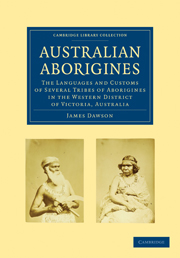
 Australian Aborigines
 The Languages and Customs of Several Tribes of Aborigines in the Western District of Victoria, Australia
Book contents
- Frontmatter
- PREFACE
- INTRODUCTORY NOTE
- Contents
- YARRUUN PARPUR TARNEEN
- CHAPTER I TRIBES
- CHAPTER II POPULATION
- CHAPTER III CHIEFS
- CHAPTER IV PROPERTY
- CHAPTER V CLOTHING
- CHAPTER VI HABITATIONS
- CHAPTER VII CLEANLINESS
- CHAPTER VIII DOMESTIC FURNITURE
- CHAPTER IX COOKING AND FOOD
- CHAPTER X TOOLS
- CHAPTER XI LAWS OF MARRIAGE
- CHAPTER XII CHILDREN
- CHAPTER XIII NAMES OF PERSONS
- CHAPTER XIV SUPERSTITIONS AND DISEASES
- CHAPTER XV DEATH AND BURIAL
- CHAPTER XVI AVENGING OF DEATH
- CHAPTER XVII GREAT MEETINGS
- CHAPTER XVIII AMUSEMENTS
- CHAPTER XIX WEAPONS
- CHAPTER XX ANIMALS
- CHAPTER XXI METEOROLOGY, ASTRONOMY, ETC
- CHAPTER XXII NATIVE MOUNDS
- CHAPTER XXIII ANECDOTES
- CONVEYANCE, BY PRINCIPAL CHIEFS TO JOHN BATMAN, OF 100,000 ACRES OF LAND, BETWEEN GEELONG AND QUEENSCLIFF
- VOCABULARIES.—WORDS; ANIMALS; RELATIONSHIPS; NAMES OF PLACES; GRAMMAR AND SENTENCES; NUMERALS
- NOTES
CHAPTER XVIII - AMUSEMENTS
Published online by Cambridge University Press: 07 September 2010
Book contents
- Frontmatter
- PREFACE
- INTRODUCTORY NOTE
- Contents
- YARRUUN PARPUR TARNEEN
- CHAPTER I TRIBES
- CHAPTER II POPULATION
- CHAPTER III CHIEFS
- CHAPTER IV PROPERTY
- CHAPTER V CLOTHING
- CHAPTER VI HABITATIONS
- CHAPTER VII CLEANLINESS
- CHAPTER VIII DOMESTIC FURNITURE
- CHAPTER IX COOKING AND FOOD
- CHAPTER X TOOLS
- CHAPTER XI LAWS OF MARRIAGE
- CHAPTER XII CHILDREN
- CHAPTER XIII NAMES OF PERSONS
- CHAPTER XIV SUPERSTITIONS AND DISEASES
- CHAPTER XV DEATH AND BURIAL
- CHAPTER XVI AVENGING OF DEATH
- CHAPTER XVII GREAT MEETINGS
- CHAPTER XVIII AMUSEMENTS
- CHAPTER XIX WEAPONS
- CHAPTER XX ANIMALS
- CHAPTER XXI METEOROLOGY, ASTRONOMY, ETC
- CHAPTER XXII NATIVE MOUNDS
- CHAPTER XXIII ANECDOTES
- CONVEYANCE, BY PRINCIPAL CHIEFS TO JOHN BATMAN, OF 100,000 ACRES OF LAND, BETWEEN GEELONG AND QUEENSCLIFF
- VOCABULARIES.—WORDS; ANIMALS; RELATIONSHIPS; NAMES OF PLACES; GRAMMAR AND SENTENCES; NUMERALS
- NOTES
Summary
The leading amusement of the Australian aborigines is the karweann, or korroborse, which somewhat resembles pantomime, and consists of music, dancing, and acting.
Little can be said in favour of the aboriginal music. The airs are monotonous and doleful, and there is no such thing as harmony. Men and women join in singing. The women commence, each one accompanying her voice with regular beats of the open hand on a rolled-up opossum rug, which sometimes contains shells, to produce a jingling sound; the men strike in with their voices and with their music sticks. These sticks are made of hard wood, and are about nine inches long and an inch and a half in diameter, rounded, and tapering at each end to a point. The one is held stationary, and is struck with the other. The sound produced is clear and musical, and can be heard at a great distance.
Many songs having appropriate airs are universally known. Very often complimentary or descriptive songs are composed on the instant, and are sung to well-known airs, the whole company joining in the chorus. A lament called ‘Mallse maltese,’ composed in New South Wales in commemoration of the ravages of small-pox, is known all over the Australian colonies, and is sung in a doleful strain, accompanied with groans and imitations of a dying person. The following is a song in the Chaap wuurong language, with its translation. It is said to have been composed in the neighbourhood of Sydney by one of the aborigines of that country, and to have been translated into the different languages as it became known. In singing it the last two lines are repeated three times.
Information
- Type
- Chapter
- Information
- Australian AboriginesThe Languages and Customs of Several Tribes of Aborigines in the Western District of Victoria, Australia, pp. 80 - 86Publisher: Cambridge University PressPrint publication year: 2009First published in: 1881
Accessibility standard: Unknown
Why this information is here
This section outlines the accessibility features of this content - including support for screen readers, full keyboard navigation and high-contrast display options. This may not be relevant for you.Accessibility Information
Accessibility compliance for the PDF of this chapter is currently unknown
and may be updated in the future.