Book contents
- Frontmatter
- Contents
- Preface
- Glossary
- Map
- Chapter 1 The Geography of the Western Himalayas
- Chapter 2 Political Economy of the Western Himalayas: Early Nineteenth Century
- Chapter 3 The Foundations of British Rule: Hill State, Hill Station, Land Settlement and Monetisation
- Chapter 4 Peasant Rebellions and Royal Reconciliation: British Rule inside the Hill States
- Chapter 5 Social Movements during British Rule
- Chapter 6 After Independence
- Conclusion
- Bibliography
- Index
Preface
Published online by Cambridge University Press: 26 October 2011

Book contents
- Frontmatter
- Contents
- Preface
- Glossary
- Map
- Chapter 1 The Geography of the Western Himalayas
- Chapter 2 Political Economy of the Western Himalayas: Early Nineteenth Century
- Chapter 3 The Foundations of British Rule: Hill State, Hill Station, Land Settlement and Monetisation
- Chapter 4 Peasant Rebellions and Royal Reconciliation: British Rule inside the Hill States
- Chapter 5 Social Movements during British Rule
- Chapter 6 After Independence
- Conclusion
- Bibliography
- Index
Summary
In August 1990, when V.P. Singh, the Prime Minister of India, announced the partial implementation of the Mandal Commission recommendations, large-scale student protests erupted in many campuses of North India. These protests challenged the move to reserve a chunk of government jobs for candidates from, what were called, the ‘Other Backward Classes’ (OBCs), based on the recommendations of the Mandal Commission. While these student protestors received much support from the urban middle classes of North India, no political party came out in formal support, nor did any institution of the State or Government. This was primarily because the OBCs represented the large mass of agriculturalists, artisans and rural service providers – the Shudras according to Hindu caste hierarchy – who more often than not constituted a clear demographic majority in any given geographical region. In the context of universal suffrage, it would have been electoral suicide to oppose a move which purportedly benefited them.
Except in Himachal Pradesh. The Himachal Pradesh Government seemed to fly in the face of such basic political logic and filed a petition in the Supreme Court challenging the implementation of these OBC reservations. These reservations also evoked strong protests in the neighbouring regions of Garhwal and Kumaon and fed into their longstanding demand for a state separate from OBC-dominated Uttar Pradesh. What was striking was that in these Himalayan regions, the muscle of the anti-reservation protests was provided by the agriculturalists. It was perhaps the only part of India where one could say with some certainty that a majority of the people opposed reservation.
Information
- Type
- Chapter
- Information
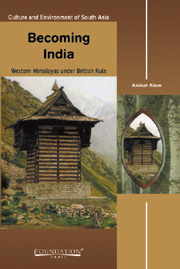
- Becoming IndiaWestern Himalayas under British Rule, pp. v - xPublisher: Foundation BooksPrint publication year: 2007
Accessibility standard: Unknown
Why this information is here
This section outlines the accessibility features of this content - including support for screen readers, full keyboard navigation and high-contrast display options. This may not be relevant for you.Accessibility Information
Accessibility compliance for the PDF of this chapter is currently unknown
and may be updated in the future.