
Skip to main content Accessibility help
×
  • Cited by 9
    • Show more authors
    • You may already have access via personal or institutional login
    • Select format
    • Publisher:
      Cambridge University Press
      Publication date:
      19 August 2019
      05 September 2019
      ISBN:
      9781108668675
      9781108482288
      9781108711814
      Dimensions:
      (228 x 152 mm)
      Weight & Pages:
      0.87kg, 462 Pages
      Dimensions:
      (228 x 152 mm)
      Weight & Pages:
      0.77kg, 462 Pages
    You may already have access via personal or institutional login
  • Selected: Digital
    Add to cart View cart Buy from Cambridge.org

    Book description

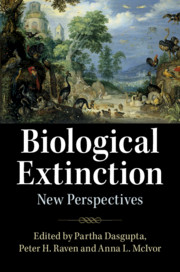
    The rapidly increasing human pressure on the biosphere is pushing biodiversity into the sixth mass extinction event in the history of life on Earth. The organisms being exterminated are integral working parts of our planet's life support system, and their loss is permanent. Like climate change, this irreversible loss has potentially devastating consequences for humanity. As we come to recognise the many ways in which we depend on nature, this can pave the way for a new ethic that acknowledges the importance of co-existence between humans and other species. Biological Extinction features chapters contributed by leading thinkers in diverse fields of knowledge and practice, including biology, economics, geology, archaeology, demography, architecture and intermediate technology. Drawing on examples from various socio-ecological systems, the book offers new perspectives on the urgent issue of biological extinction, proposing novel solutions to the problems that we face.

    Reviews

    ‘Many policy makers, especially those trained in economics, can describe the management of environmental systems as if we (humans) are best suited to be in the ‘driver's seat', making all the decisions to assure our wellbeing is the sole consideration. They should all read the chapters in this volume! Extinction is an irreversible externality whose full impact is uncertain. By combining the insights of social and natural scientists, Dasgupta, Raven, and McIvor have assembled essays that will change this view. They are accessible, engaging, and important.'

    V. Kerry Smith - Emeritus Regents Professor, Arizona State University

    ‘Partha Dasgupta, unexcelled among economists for his contributions to ecological economics, and Peter Raven, revered for his leadership in biodiversity science, have combined to assemble a collection of papers by a virtual who's who of experts on the subject of biodiversity loss and sustainability. This volume, the product of an obviously remarkable meeting at the Vatican, will be a touchstone for all those concerned with our declining biodiversity, and the implications for the future welfare of humanity.'

    Simon A. Levin - James S. McDonnell Distinguished University Professor in Ecology and Evolutionary Biology, Princeton University

    'This volume provides an informative reference for policy makers and practitioners, offering new perspectives on biological extinction that adopt principles of social justice and sustainability.'

    R. A. Delgado, Jr Source: Choice

    Refine List

    Actions for selected content:

    Select all | Deselect all
    • View selected items
    • Export citations
    • Download PDF (zip)
    • Save to Kindle
    • Save to Dropbox
    • Save to Google Drive

    Save Search

    You can save your searches here and later view and run them again in "My saved searches".

    Please provide a title, maximum of 40 characters.
    ×

    Contents

    Metrics

    Altmetric attention score

    Full text views

    Total number of HTML views: 0
    Total number of PDF views: 0 *
    Loading metrics...

    Book summary page views

    Total views: 0 *
    Loading metrics...

    * Views captured on Cambridge Core between #date#. This data will be updated every 24 hours.

    Usage data cannot currently be displayed.

    Accessibility standard: Unknown

    Why this information is here

    This section outlines the accessibility features of this content - including support for screen readers, full keyboard navigation and high-contrast display options. This may not be relevant for you.

    Accessibility Information

    Accessibility compliance for the PDF of this book is currently unknown and may be updated in the future.
