8 - Malcolm
Published online by Cambridge University Press: 05 June 2012

Summary
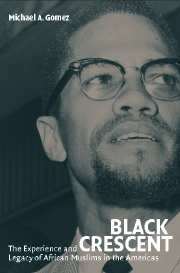
Interest in the life and times of Malcolm X has, if anything, accelerated rather than diminished in recent years. Since his rise to prominence in the 1950s, there has been a steady production of scholarly and popular materials concerning him by way of books, articles, plays, documentaries, music, and films. Much of the scholarly literature represents quasi-proprietary disputes among nationalists, pan-Africanists, Marxists, loyalists, and those attempting psychoanalytic applications (not necessarily mutually exclusive categories) over a complex and evolving public figure. The present study will not engage many of these debates, and there is little point in exhaustive revisitation of what is already known. Rather, the following is a more narrowly defined attempt to place Malcolm X within a context of movement from heterodoxy to orthodoxy; to assess his role in that movement; and to address attendant issues related to that role. The principal argument here is that Minister Malcolm was largely responsible for changing the intellectual climate among African American Muslims, such that orthodoxy became much more palatable, precisely because he was both the leading spokesperson for black nationalism and pan-Africanism, and, as the most dynamic representative of Islam in North America, was best situated to attempt a reconciliation of religious divergence. Malcolm represented the maturation of a process initially articulated by Noble Drew Ali and developed by Elijah Muhammad, a process whose beginnings are at least indirectly related to the presence of enslaved (and free) African Muslims in colonial and antebellum North America.
Information
- Type
- Chapter
- Information
- Black CrescentThe Experience and Legacy of African Muslims in the Americas, pp. 331 - 370Publisher: Cambridge University PressPrint publication year: 2005
Accessibility standard: Unknown
Why this information is here
This section outlines the accessibility features of this content - including support for screen readers, full keyboard navigation and high-contrast display options. This may not be relevant for you.Accessibility Information
Accessibility compliance for the PDF of this chapter is currently unknown
and may be updated in the future.