Book contents
- Frontmatter
- Contents
- Foreword by Ong Keng Yong
- Foreword by Bruce Davis
- Acknowledgements by Academic Editor
- Acknowledgements by Technical Director REPSF
- The Contributors
- The Regional Economic Policy Support Facility
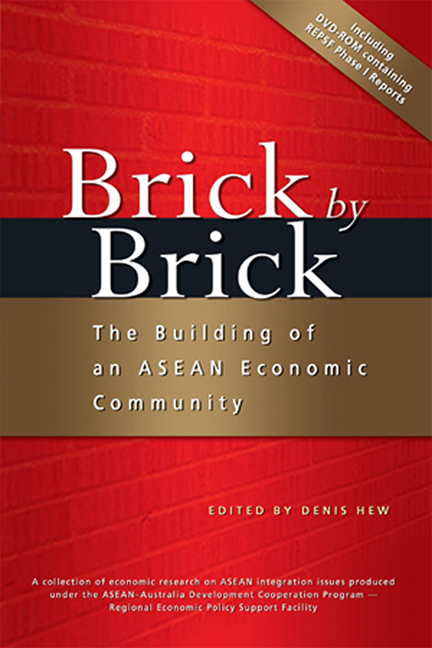
- 1 Introduction: Brick by Brick — The Building of an ASEAN Economic Community
- 2 What is a Single Market? An Application to the Case of ASEAN
- 3 The Challenge of Economic Integration for Transitional Economies of Southeast Asia
- 4 A Review of Regional Tariffs and Trade in the ASEAN Priority Goods Sectors
- 5 Non-tariff Barriers to Trade in the ASEAN Priority Goods Sectors
- 6 An Assessment of ASEAN's Priority Sectors for Fast-track Integration
- 7 ASEAN Tax Regimes: Impediment or Pathway to Greater Integration
- 8 An Overview of the Foreign Direct Investment Jurisprudence
- 9 ASEAN's FTA Negotiations with Dialogue Partners:Identifying Strengths and Weaknesses in Business Opportunities
- 10 Conclusion: Towards an ASEAN Economic Community by 2015
- Index
- Contents of Accompanying CD-ROM: AADCP-REPSF Phase I Research Program
6 - An Assessment of ASEAN's Priority Sectors for Fast-track Integration
Published online by Cambridge University Press: 21 October 2015
Edited by

Book contents
- Frontmatter
- Contents
- Foreword by Ong Keng Yong
- Foreword by Bruce Davis
- Acknowledgements by Academic Editor
- Acknowledgements by Technical Director REPSF
- The Contributors
- The Regional Economic Policy Support Facility
- 1 Introduction: Brick by Brick — The Building of an ASEAN Economic Community
- 2 What is a Single Market? An Application to the Case of ASEAN
- 3 The Challenge of Economic Integration for Transitional Economies of Southeast Asia
- 4 A Review of Regional Tariffs and Trade in the ASEAN Priority Goods Sectors
- 5 Non-tariff Barriers to Trade in the ASEAN Priority Goods Sectors
- 6 An Assessment of ASEAN's Priority Sectors for Fast-track Integration
- 7 ASEAN Tax Regimes: Impediment or Pathway to Greater Integration
- 8 An Overview of the Foreign Direct Investment Jurisprudence
- 9 ASEAN's FTA Negotiations with Dialogue Partners:Identifying Strengths and Weaknesses in Business Opportunities
- 10 Conclusion: Towards an ASEAN Economic Community by 2015
- Index
- Contents of Accompanying CD-ROM: AADCP-REPSF Phase I Research Program
Summary
Introduction
ASEAN integration offers significant gains to all members. It allows them to capture the gains from interactions with other countries both within ASEAN and with the rest of the world so as to facilitate faster economic growth and improve living standards. The gains include those from freer trade in goods and services, from more open capital flows and from transfers in technology.
Increasing economic integration with other ASEAN countries and with the world brings these benefits, but it also involves more competition and change. For example:
• Market shares are continually evolving, and new suppliers continue to emerge in the home market and in third-country markets. China and its impact on world markets is the most recent startling example, but the same processes are at work within ASEAN as well.
• Not only does competitiveness in traditional products change, but also new products emerge. The finer division of production processes, the greater complexity in global supply chains and the growth of trade in components in the region are examples.
• There are new ways of organizing business and new forms of international business. The rise in significance of trade in services in its own right and as a complement to other forms of international business is an example.
• Foreign direct investment (FDI) has always been a critical part of the business-led integration of economies in East Asia. Businesses losing competitiveness in higher income countries have relocated offshore. Now new investors are emerging, and new partnership possibilities are developing. Examples are related to the growing flows of FDI from India and from China.
These changes are all sources of benefit, but the willingness of a community to open their economy demands a level of confidence about the ability to adjust to them. The importance of this confidence and its impact on the process of integration are key issues in capturing the gains from integration. We comment on the connections between community confidence, policy reform and economic integration below.
Information
- Type
- Chapter
- Information
- Brick by BrickThe Building of an ASEAN Economic Community, pp. 116 - 131Publisher: ISEAS–Yusof Ishak InstitutePrint publication year: 2007
Accessibility standard: Unknown
Why this information is here
This section outlines the accessibility features of this content - including support for screen readers, full keyboard navigation and high-contrast display options. This may not be relevant for you.Accessibility Information
Accessibility compliance for the PDF of this book is currently unknown
and may be updated in the future.