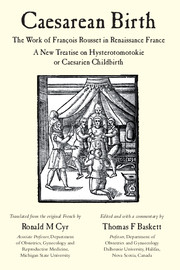
 Caesarean Birth
 The Work of François Rousset in Renaissance France - A New Treatise on Hysterotomotokie or Caesarian Childbirth
Book contents
- Frontmatter
- Contents
- Acknowledgements
- Preface
- Translator's introduction
- François Rousset and the first text on caesarean section: a commentary by Thomas F Baskett
- A New Treatise on Hysterotomotokie or Caesarien Childbirth
- Sonnet
- Dedication
- Preface to the reader
- Part 1 Definition of caesarean childbirth
- Part 2 Second proof: logic (reason)
- Part 3 Third justification: expert opinion
- Part 4 Examples documenting other worse dangers from similar operations that are not caesarean
- Part 5 Other more popular justifications
- Part 6 On the fertility that remains after caesarean section
- A short guide to surgeons on the technique of caesarean
- Approbation
- Copyright
- Appendix 1 Summary of 16th century French history
- Appendix 2 Renée de France (1510–1575), Duchess of Ferrara, Chartres, Montargis and Nemours
- Appendix 3 Jacques de Savoie-Nemours (1531–1585), Duc de Nemours and Genevois
- Index
Preface
Published online by Cambridge University Press: 05 June 2014

Book contents
- Frontmatter
- Contents
- Acknowledgements
- Preface
- Translator's introduction
- François Rousset and the first text on caesarean section: a commentary by Thomas F Baskett
- A New Treatise on Hysterotomotokie or Caesarien Childbirth
- Sonnet
- Dedication
- Preface to the reader
- Part 1 Definition of caesarean childbirth
- Part 2 Second proof: logic (reason)
- Part 3 Third justification: expert opinion
- Part 4 Examples documenting other worse dangers from similar operations that are not caesarean
- Part 5 Other more popular justifications
- Part 6 On the fertility that remains after caesarean section
- A short guide to surgeons on the technique of caesarean
- Approbation
- Copyright
- Appendix 1 Summary of 16th century French history
- Appendix 2 Renée de France (1510–1575), Duchess of Ferrara, Chartres, Montargis and Nemours
- Appendix 3 Jacques de Savoie-Nemours (1531–1585), Duc de Nemours and Genevois
- Index
Summary
Both of us were vaguely aware of François Rousset's treatise on caesarean birth but had only seen isolated quotes citing it as the first text on the subject. One of us (TFB), while pursuing further research on caesarean section, found a copy of the original 1581 publication in French in the library of the Royal College of Obstetricians and Gynaecologists in London.
In its time, Rousset's book was translated into German and Latin; however, there is no known English translation. This is hardly surprising, since Latin was the lingua franca of the Church and European scholars until the 17th century. Rousset's motive for writing in French is explained in his preface: he wanted his message to reach the surgeons of the day, few of whom were proficient in Latin.
It seems to us only fitting that, after some 430 years, there should be available an English translation of this seminal work. Furthermore, in some countries, one-quarter to one-third of women are now delivered by caesarean section, which is a continuing source of controversy in both the medical and lay press. It therefore seems appropriate to review the text, which was also highly controversial four centuries ago, that first promoted the procedure.
Information
- Type
- Chapter
- Information
- Caesarean BirthThe Work of François Rousset in Renaissance France - A New Treatise on Hysterotomotokie or Caesarian Childbirth, pp. viiiPublisher: Cambridge University PressPrint publication year: 2010
Accessibility standard: Unknown
Why this information is here
This section outlines the accessibility features of this content - including support for screen readers, full keyboard navigation and high-contrast display options. This may not be relevant for you.Accessibility Information
Accessibility compliance for the PDF of this book is currently unknown
and may be updated in the future.