

Introduction
To clarify the aims underlying this book, we share a short anecdote with you. Of course, we do not know for sure if this story is entirely true, but it provides excellent food for thought about what this book is about.
The anecdote is about the rebuilding of St Paul’s Cathedral in London. The architect Sir Christopher Wren designed and supervised the construction of more than fifty churches in London following the Great Fire of 1666. The reconstruction of St Paul’s Cathedral was his masterpiece.
The story begins with Sir Christopher walking among the many workers building the cathedral. Apparently, he was not known to many of them. As he surveyed the progress of the building, he stopped and asked three different workers, all of whom were engaged in the same task, what they were each doing. He received three different answers. The first said, while acting a bit irritated, “You can see what I am doing, I am cutting this stone.”
The second answered, “I am earning three shillings, six pennies a day, to support my family.”
The third man straightened up, squared his shoulders, and, overlooking the building site, replied, “I am helping to build the most beautiful cathedral in London.”
This anecdote illustrates that people have different evaluations of the meaning of their work, ranging from work done as imposed labour and experienced as a burden to work as a means to acquire income and an existence to work seen as a means to contribute to something of personal and social value.
The anecdote shapes the aspiration underlying this book that all workers should be seen as builders of cathedrals – cathedrals of flourishing working lives. A second ambition is for workers to see themselves as cathedral builders. To clarify our third ambition, we expand the anecdote slightly.
It is tempting to attribute the three such different answers Sir Christopher obtained to a difference in personality or upbringing. However, we know on theoretical [Reference Bandura1, Reference Hackman and Oldham2, Reference Schein3] and empirical [Reference Amabile, Conti, Coon, Lazenby and Herron4–Reference Lazarus and Folkman7] grounds and from practice that context is often more important than personal characteristics. For example, the three workers might have worked under contracts with three different supervisors.
The first worker’s boss might have said: “Here is a pile of rough stones, and here are your tools. When I come back, I expect a pile of smooth, stackable stones.” The boss of the second worker may have said: “I know that your wife is sick and you need extra money for your family. I have a job for you here; it is hard work, but because of that, it is well paid.” The boss of worker three may have said: “We are responsible with a group of five for that piece of wall of the cathedral that we are building. There are rough materials and tools. It should be carved, carried, stacked and bricked. You are professionals; see for yourself how you organise your work together within this magnificent project.”
Of course, this is a fantasy projected from the present to the past. However, it clarifies our third ambition, which involves how workers’ immediate social conditions should enable them to build great cathedrals of flourishing working lives. In this book, we argue that the CA can serve as a vehicle to achieve these goals. This value-driven approach focuses on normativity, diversity, and contextuality, aligning with the normative views of both the scientific and professional fields of work and health. The ambitions in these fields form an assignment, which means that science and scientific theories should improve the world and not just explain and analyse it. This view is fortunately becoming increasingly common and congruent with the field of occupational practice and the professionals working in that field, who want to create flourishing work environments rather than just understanding why work is often degrading or exclusionary for so many people.
The Capability Approach
To begin our elaboration of the CA, we take as a starting point the questions that have always been central to Amartya Sen, the founder of the approach. These questions concern what is truly important for people in their lives and how to recognise a society that facilitates this. The most general answer to these questions is that people should have a set of capabilities or a set of diverse freedoms. According to Sen, a capability exists when someone has the freedom to do or be what theyFootnote 1 have good reason to value. As stated earlier, our view of this book is that if workers can be who they want to be in their work and do the things that add value for themselves and their working environment, this contributes to well-being and flourishing at work.
Functioning, another important concept in capability theory, is the actual realisation of freedom or capabilities. What people find important in their lives is subjective, and what they are free to do and be is contextual and objectifiable. It is a shared responsibility of the individual and the social context to build and maintain a set of capabilities necessary to realise a valuable life. The extent to which people have the freedom to realise their personal goals can be measured and objectified. This measurability and objectivity are important ambitions of Sen; thus, capabilities transcend the subjectivity of satisfaction or well-being.
By formulating the achievement of personal values and goals as a social goal and as entitlements or rights, the CA is able to realise deontological (virtue) ethics within the consequential (purpose ethics) reality of everyday life that people – and organisations – have and should have goals. However, in our society and economy, all activities and services, especially paid work, are at risk of being reduced to their strictly economic goals. It is a consequential pitfall to promote services aimed at participation and well-being, as if they will always contribute to the efficiency and productivity of employees. That is an economic, not a health and well-being, objective. In many cases, promoting health contributes to the organisation’s economic goals. However, the added ‘deontological’ value of our work as health professionals is precisely that workers have the right to a broader value perspective.
Sen does not find the debate between deontologists and consequentialists very interesting. That is understandable from his broader societal perspective. For us, from the perspective of the (by definition purpose-oriented) work context and work organisation, the debate is indeed interesting. Sen highlights the debate between ‘Niti’ and ‘Nyaya’ as much more relevant ([Reference Sen8]; see next section). In our view, the CA implicitly unites deontology and consequentialism and thus integrates and transcends them. It achieves this synthesis both by introducing deontological values within a purpose-oriented reality and by the vision that the purpose can also lie in a good process of virtuous behaviour.
Niti and Nyaya; Contract Thinkers and Outcome-Realisation Thinkers
To do justice to both positions, we first discuss ‘Niti’ and ‘Nyaya’ and then explain the perspectives mentioned earlier, deontology and consequentialism. In his seminal book The Idea of Justice, Sen identifies two ethical movements that originated from the European Enlightenment that aimed to realise a just society: social contract thinkers versus realisation-oriented thinkers or ‘Niti’ versus ‘Nyaya’ in Old Indian writings [Reference Sen8].
In the view of contract thinkers, often based on an ideal theoretical model, perfectly just social arrangements and institutions are needed, grounded in a so-called social contract. This is an implicit and hypothetical agreement about the distribution of power. It can be inferred that the starting point of contract thinkers is essentially a negative view of men (and women): good behaviour is not a natural choice for people, but policies and regulations must enforce it.
Sen identifies two problems with the contract approach (‘Niti’) [Reference Sen8]. First, there is no accepted agreement about a ‘just society’. Second, this approach does not help solve the fundamental problems of real-world social injustice. Slavery and apartheid, for example, could have existed despite being evident injustices within a social contract framework legitimised by so-called right institutions and regulations.
What Sen argues for institutional concepts of justice also applies to scientific theories. These must be assessed normatively for their effect in practical situations. Bad theories, as we know from experience in diverse fields, can legitimise the dehumanisation of people and cause great violence, resulting in the decimation of people. Sen claims this, for example, with respect to Thomas Malthus’s theory. Malthus argues that when population growth exceeds food production growth, famines are a ‘natural’ consequence of rebalancing population size and food availability [discussed in Reference Drèze and Sen9]. By giving credence to the theory and understanding of famines as a type of natural event, governments did not intervene to curtail mass deaths. In various publications produced jointly with Jean Drèze, Amartya Sen showed how Malthusian theory was conceptually flawed and how measures could have been taken to prevent the deaths of millions of people from starvation [Reference Drèze and Sen9]. If we do not assess theories for their practical effects, they can have severe consequences.
The other movement, driven by outcome-realisation thinkers, ‘Nyaya’ in Old Indian writings, makes comparisons between different ways in which people’s lives can be led, that is, actual realisation. The outcomes are influenced not only by institutions but also by people’s actual behaviour, social interactions, and other factors. Sen, an advocate for ‘Nyaya’ or outcome-realisation approaches, argues that we should focus on removing injustices that most or all of us are likely to agree on and that can be alleviated. Sen is convinced that most people immediately recognise injustice in their immediate environment and want to eliminate it. They do not need a theory for that.
The starting point is that people make rational choices from a broader perspective than only or primarily self-interest. The public interest is, in many cases, a voluntary choice of people and does not have to be regulated or enforced in a contract. This reflects a positive view of humanity, as also advocated by Habermas, who strongly suggests that human communication and rational discourse naturally lead to cooperative and prosocial behaviour under the right conditions [Reference Habermas, Habermas and Habermas10]. In Chapter 3, this is nuanced in the sense that this applies to the vast majority of humanity, but a small percentage abuses the circumstances and the institutional context for malicious purposes. See Chapter 3 for an elaborate discussion of this.
Nomothetic and Ideographic Perspectives
The concepts of ‘Niti’ and ‘Nyaya’ (as indicated by the ancient Indian equivalents of contract thinkers and result realisation thinkers) also resemble the nomothetic and ideographic perspectives. These perspectives play a role in the argumentation in Chapter 2. In short, the nomothetic perspective focuses on discovering general regularities and rules that are widely applicable to greater groups and populations; the ideographic perspective focuses on understanding specific phenomena in their unique context that are directly applicable in a specific practice.
As mentioned, another important philosophical distinction is between deontology and consequentialism. We will briefly explain these concepts now.
Deontology and Consequentialism/Utilitarianism
First, we explain consequentialism, focusing on utilitarianism, as it is the primary contemporary representative of this philosophical approach. Second, we discuss the deontological perspective, with Kantianism as its most important representative.
From the utilitarian perspective, developed in its classic form by Bentham [Reference Bentham11], Mill [Reference Mill12, Reference Mill13], and Sidgwick [Reference Sidgwick14], behaviour is considered right if it accomplishes the best possible outcome: ‘the greatest good for the greatest number of people’. Any action that accomplishes this objective is seen as right, regardless of whether the action violates certain actors’ rights in the process. Note that the utilitarian perspective on justice does not guarantee justice for all, as there is no guarantee for the rights of the few or ‘minorities’ of various kinds. If total happiness outnumbers the unhappiness of a small disadvantaged group, it meets the central premise of utilitarianism.
The Kantian perspective on right behaviour is different in this important respect. Kant takes a duty-ethical perspective in that morality lies in the rightness of the action itself and the obligation one has towards the other and not in the outcome of that action [Reference Kant15]. The starting point is that autonomous human beings can choose rationally and be held responsible for their choice. Kant stated this premise in several formulations of the categorical imperative. The second formulation (also called the formulation of humanity) states that an actor should always see themself or any other actor as a holder of value in themself; literally, ‘act in such a way that you treat humanity, whether in your own person or in the person of any other, never merely as a means to an end, but always at the same time as an end’.
Kantian ethics informed the underpinning theory for the formulation of universal human rights in general and the movement for the abolition of slavery in particular. Women’s rights, labour rights, and the rights and emancipation of minorities can also be founded or justified only deontologically. Consequential reasoning, despite being entrenched in our contemporary ways of thinking, does not provide a solid basis for human rights. Rights are useful for consequentialists, specifically utilitarians, if they lead to an overall good outcome; otherwise, they are not useful.
As indicated earlier, the CA essentially unites both perspectives (virtue ethics and purpose ethics) and thus neutralises them. It is, therefore, logical that Sen finds the distinction less meaningful. However, in our field of work and health, we find the distinction relevant to clarify certain matters. For example, as stated above, the added ‘deontological’ value of work is that workers deserve a broader value perspective than a narrow financial‒economic perspective. As a counterpart, there is also an obligation on the individual to build and maintain the ability to achieve important goals. This duality of entitlements and responsibility is an important aspect of the CA.
Capability Approach Focused on Values within Work
Research shows that for present-day workers, contributing to something valuable at work is an important aspect of their quality of working life and sustainable employability [Reference Gheaus and Herzog16, Reference Jahoda17, Reference Van der Klink, Bültmann, Burdorf, Schaufeli, Zijlstra and Abma18]. Therefore, the challenge in all workplaces is to identify what the important values are and how people are able and enabled to achieve them. Importantly, in the work context, until recently, in the capability tradition, work as such was seen as a capability (i.e., the importance of work in itself for well-being in general). Capabilities (well-being) within work (i.e., of specific aspects of work) have not been investigated. This aspect is elaborated upon in this book. This reflects the focus we have imposed on ourselves in this book: we address the normative aspect of the values people should be able to achieve within their work. Naturally, we also consider the normative nature of the CA regarding the way society and the economy are organised and the extent to which this facilitates, restricts, enables, or prevents the achievement of capabilities at work (see, e.g., Chapters 5 and 12). We are also fully aware of the clear warning by Gloss et al. [Reference Gloss, Carr, Reichman, Abdul-Nasiru and Oestereich19] that important goals and values are often not realised for population groups already living in poverty, where poverty, as Sen also demonstrated, equates to the lack of freedom to achieve important goals and values. Gloss et al., like us, argue that the CA offers the best guarantee against this risk. We discuss Gloss et al.’s article in more detail later on.
Conversion Factors
In the CA, resources – ‘means to achieve’ such as income and wealth but also health or labour conditions – have value only because of what individuals can be and do through ‘converting’ such means into valuable outcomes. This reflects the importance of conversion factors in the model. For Sen, equity in capabilities – ‘equal freedoms to achieve important goals people have/equal opportunities’ – is important and not equal in terms of resources (equal means), as in most economic and political philosophical theories [Reference Sen20] (Figure 1.1).
Equity in resources versus equity in capabilities.
Note: Artist: Bert Cornelius, © by Jac van der Klink. The image might be inspired by a picture of the Interaction Institute for Social Change, Artist: Angus Maguire.


Broad Applications of the Capability Approach
In addition to serving as a guiding model within organisations such as the United Nations, the Organisation for Economic Co-operation and Development, and the World Bank, the CA also has important applications outside the economy, including healthcare and education. In 2016, a consortium of Dutch researchers applied the capabilities approach to work and health [Reference Van der Klink, Bültmann, Burdorf, Schaufeli, Zijlstra and Abma18]. As stated earlier, they hypothesised that, in this practice and scientific domain, increasing work capabilities – the freedom to achieve values at work – contribute to the sustainable employability of employees. Their work is partly the basis of this book. In Chapter 2, they reflect on their work and the spin-off it had.
Adopting the CA implies both rights (entitlements for inclusivity in the work context) and responsibilities. This assumes that the individual worker must be both able and motivated to work. Furthermore, the work context should enable the performance of valued tasks that contribute to goals that are personally important and valued by the organisation.
A Capability Model for Work and Health
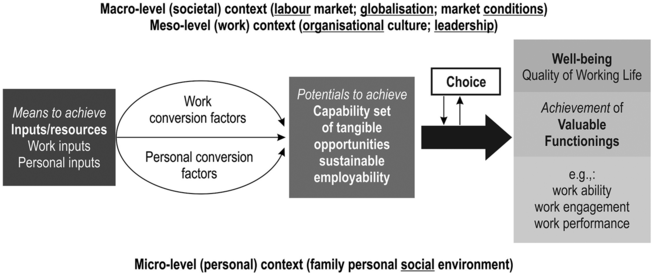
In Figure 1.2, the essential elements of the capability model for work are visualised.
The capability model for work and health.
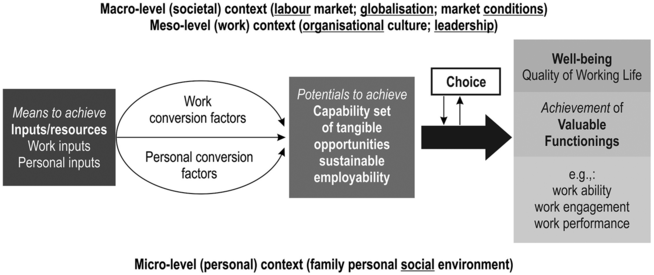
Figure 1.2 Long description
The means to achieve inputs or resources include work and personal inputs. These inputs are then processed through Work conversion factors and Personal conversion factors creating potentials to achieve capability set of tangible opportunities for sustainable employability. A Choice element acts as a mediator before reaching final outcomes which include well-being (Quality of Working Life) and specific achievements of valuable functionings like work ability, engagement, and performance. The macro level or the societal context includes the labour market, globalisation, and market conditions. The meso-level or the work context involves organisational culture and leadership. The micro-level or the personal context covers the family and personal social environment.
Figure 1.2 illustrates that workers possess resources or work inputs, including personal capacity, task structure, and work demands. These work inputs are not determinants of sustainable employability; instead, they are factors that can lead to a set of capabilities and achievable opportunities, provided that appropriate conversion factors are in place. Cutting stone, for example, is a burden in itself but is converted into a lesser burden if it is seen as contributing to building a cathedral.
The capability model, therefore, enables us to shape the ambition that employees see themselves as cathedral builders. Thinking in terms of values also realises the ambition that professionals see workers as cathedral builders. Finally, the contextual nature of the model, with contextual conversion factors translated as entitlements, shapes the third ambition.
Two Complementary Normative Approaches
As mentioned earlier, almost simultaneously with Van der Klink et al.’s [Reference Van der Klink, Bültmann, Burdorf, Schaufeli, Zijlstra and Abma18] article, Gloss et al. [Reference Gloss, Carr, Reichman, Abdul-Nasiru and Oestereich19] published an article that emphasised the importance of fostering environments in which individuals can flourish, not only in terms of performance but also in overall well-being and meaningful work. In both approaches, a normative starting point is used as a vehicle to achieve this ambition. Gloss et al. argue that industrial-organisational psychology has a strong bias towards POSH perspectives – Professionals, Official jobs in the formal economy, groups that are relatively Safe from discrimination, and High-income countries. The authors argue that this bias ignores the experiences and needs of individuals and communities living in multidimensional poverty, which hampers the discipline’s scientific progress, practical effectiveness, and moral responsibility. As mentioned earlier, their article contains a clear warning; in the storyline of the present chapter, this is the warning that the three ambitions mentioned earlier will not be realised for population groups that are already deprived.
In line with this, Gloss et al. [Reference Gloss, Carr, Reichman, Abdul-Nasiru and Oestereich19] pointed to the apparent paradox between the drive to promote work values for disadvantaged population groups on the one hand and the risk of imposing one’s own value system on other groups on the other hand. They rightly refer to the elaboration by Sen himself [Reference Sen20]. Sen argues that, first, justice-based interventions by one group on behalf of another are justified to correct major inequalities in society; second, because of the diversity in conceptualisations of justice that exist among different populations in the world, it is unjust for one group to impose its culturally value-laden conceptualisation of justice on other populations. In Sen’s analysis, the CA is aimed at resolving, or at least providing tools to resolve, the apparent conflict between the two observations described earlier.
Both approaches focus on the fundamental freedom for everyone to freely determine, revise, and pursue their own conception of what is good and just (as long as that right does not infringe on the similar right of another). Sen argues that when faced with the conflicting realities that: 1) injustices exist and must be ended; and that 2) this will inevitably involve imposing one’s culturally based value propositions on others, the best way forward is to intervene up to, but not beyond, the point at which the person whose well-being is being supported is truly free to determine their own destiny [Reference Sen20]. This genuine freedom to determine one’s own destiny (capability) is also the guiding principle within labour and health to work towards decent work in general but for threatened groups in particular, with respect to the value systems of those groups (see Chapters 5 and 12).
Outline of the Book
Part I of the book (Chapters 2–6) outlines the capability model as a foundation for sustainable employability, linking valuable work, social justice, and contributive justice. It also highlights both the challenges of assessing capabilities and the openness of the approach, which makes it compatible with other theories in work, health, and behaviour.
Chapter 2 builds on two previous studies that first introduced and operationalised the concept of sustainable employability (SE) through the CA, resulting in the development of the Capability Set for Work Questionnaire (CSWQ). The chapter summarises these foundational studies. It provides an updated account of how the relationship between SE and the CA has been further refined and extended. The chapter reviews findings from a Delphi survey among experts and addresses critical reflections from the literature. It outlines conceptual and empirical advances since 2016, distinguishing between three strands of research: Reference Bandura1) methodological work on the conceptual and measurement properties of the capability instrument; Reference Hackman and Oldham2) studies targeting specific groups of workers; and Reference Schein3) research on particular contexts and situations. The chapter ends with ongoing debates and proposes directions for future research. Finally, the chapter provides the full text of the CSWQ and a conversation guide to support its application in practice, particularly in consultation settings.
Chapter 3 positions contributive justice as an essential complement to distributive justice in work settings. It argues that contributive justice aligns more closely with the CA, particularly with Sen’s concept of freedom, and adapts Kulkarni’s definition of social justice to “equal freedom of capabilities in contribution” [Reference Kulkarni21]. This chapter emphasises that people are generally inclined towards prosocial behaviour when conditions are supportive and shows how contributive justice, combined with the CA, can foster inclusive and diverse work environments while also addressing the challenges posed by malicious intent.
Chapter 4 examines the role of capability as the central informational focus in Sen’s theory of justice. It highlights the tension between the complexity of assessing capabilities – defined not only by achieved functionings but also by genuine opportunities – and the apparent simplicity in Sen’s writings. By exploring the relationship between capability and human rights, the chapter explains this paradox. Two case studies illustrate methods for capability assessment and provide criteria for evaluating their validity and relevance. The chapter frames the CA as a realist, non-ideal theory of justice, with implications for how assessments should be designed.
Chapter 5 explores the integrative aspects of the CA in two dimensions: across disciplines and in daily practice. It explains how the CA’s openness to diverse knowledge and values has enabled its wide application, including in work and well-being. Ethically, this openness serves both to prevent harm and deprivation and to secure legitimacy for policies and practices informed by the CA. This chapter identifies the core concepts of the CA as a foundation for integration and examines how these concepts can be applied in practice, with particular attention to conversion factors and commodities, encouraging flexibility beyond existing categories.
Chapter 6 examines how the CA relates to and complements existing theories that address human flourishing, such as the International Classification of Functioning, Disability and Health, the job demands–resources model, self-determination theory, and the integrative model of behavioural prediction. It argues that the CA broadens these perspectives by focusing on improving conditions, expanding freedoms, and fostering human agency, thereby offering a more comprehensive understanding of flourishing and the conditions needed to support it.
Part II of the book (Chapters 7–10) explores how the capability model can be applied at three organisational levels: corporate governance, human resource management, and individual work. It demonstrates the model’s integrative power in identifying challenges, improvements, and solutions.
Chapter 7 links corporate governance with contributive justice, drawing on Amartya Sen’s idea of justice to frame organisational justice. It argues that fair governance must reflect stakeholder contributions and develops this through generalised stewardship theory. This model emphasises participation, process accountability, equity, integrity, and collective benefit, moving beyond transparency and distribution towards a contributive understanding of just corporate decision-making.
Chapter 8 applies the CA to human resource management (HRM) through the lens of sustainable employability. It examines strategic HRM, showing how the approach can support both employee and organisational goals, and inclusive HRM, where it serves as a framework for promoting access to decent work for vulnerable groups. The chapter concludes with future research directions for applying the CA to HRM at the individual, organisational, and societal levels.
Chapter 9 examines the CA in relation to decent work and flourishing at work. It highlights how combining these frameworks deepens the understanding of employment quality by linking job security, fair conditions, and rights with well-being, growth, and fulfilment. The chapter shows how integrating capabilities, decent work, and flourishing can guide organisations and policymakers towards promoting dignity, agency, and broader human development beyond minimum labour standards.
Chapter 10 illustrates the practical application of the CA in organisations at the individual, team, and boardroom levels. It presents examples such as supervisor–employee dialogues, workshops, capability counselling, leadership training, and governance support. By showing how the approach can be tailored to diverse contexts, this chapter demonstrates its practical relevance and encourages reflection and collective action in addressing wider societal challenges.
Part III of the book (Chapters 11–15) highlights, among other things, the balance between universal values and contextual diversity, connecting to the central debate between Martha Nussbaum’s call for a universal list of capabilities and Amartya Sen’s value-openness. It links this discussion to cross-cultural perspectives, decolonial approaches, and applications of work capabilities across occupations and countries, as well as themes of leadership and future global challenges. Alongside these conceptual debates, the section stresses the importance of policy implementation in applying the CA.
Chapter 11 examines the universality of the CA, showing how it balances universal principles of well-being with cultural and contextual diversity. Drawing on Sen and Nussbaum, it explores work as a site of self-realisation and justice, highlights the role of grassroots engagement, and emphasises cultural values, relationships, and agency. The chapter argues for a nuanced, inclusive understanding of flourishing that integrates cross-cultural psychology with the CA.
Chapter 12 examines decent work from a Global South perspective, combining the CA with decolonial theory. Using South Africa’s history as a case, it criticises the colonial and structural inequalities that shape labour and dignity. The chapter reframes the CA as relational and emancipatory, advancing a pluriversal view of decent work. Through the ethic of courageous truth-telling, it presents decent work as a transformative path towards justice, inclusion, and dignity.
Chapter 13 applies the CA to examine work capabilities across occupations and countries. It explores how education, labour markets, workplace practices, and policies shape opportunities at work, highlighting differences across contexts. Through cross-national and occupational comparisons, the chapter identifies key capabilities for meaningful work and concludes with recommendations for inclusive, enabling environments. It shows how the CA can expand human capabilities and promote decent, empowering work globally.
Chapter 14 explores how the CA can guide leadership in fostering employee capabilities across changing work contexts. It argues that leaders must create supportive environments that enable employees to achieve valued functions, enhancing their satisfaction, engagement, agility, and well-being. The chapter examines leadership strategies, resource use, and opportunities for employees, concluding with recommendations for promoting capability development in dynamic organisational settings.
Chapter 15 applies the capability model to the challenges of digitalisation, globalisation, and climate change. It explores how organisations can foster resilience, flexibility, and sustainability by enabling employees to adapt and thrive in shifting contexts. The chapter outlines strategies for using digital tools, embracing cultural diversity, and adopting eco-friendly practices.



 Open access