Skip to main content Accessibility help
×
Hostname: page-component-6b88cc9666-5vvpm Total loading time: 0 Render date: 2026-02-12T06:37:41.430Z Has data issue: false hasContentIssue false

Introduction

Published online by Cambridge University Press:  02 November 2021

R. Saravanan
Affiliation:
Texas A & M University

Summary

On the night of September 7, 1900, the residents of Galveston, Texas, then a coastal city of 37,000 located near Houston, went to sleep thinking it was a night like any other. The next morning, they woke up to the deadliest natural disaster in the history of the United States: the Great Galveston Hurricane.1 Galveston residents received no warning of the impending calamity. A 15-foot-high storm surge, driven by winds exceeding 130 miles per hour, inundated the city. More than 8,000 lives were lost.

Information

Type
Chapter
Information
The Climate Demon
Past, Present, and Future of Climate Prediction
, pp. 1 - 8
Publisher: Cambridge University Press
Print publication year: 2021

Introduction

On the night of September 7, 1900, the residents of Galveston, Texas, then a coastal city of 37,000 located near Houston, went to sleep thinking it was a night like any other. The next morning, they woke up to the deadliest natural disaster in the history of the United States: the Great Galveston Hurricane.1 Galveston residents received no warning of the impending calamity. A 15-foot-high storm surge, driven by winds exceeding 130 miles per hour, inundated the city. More than 8,000 lives were lost.

The US Weather Bureau had been trying to track the hurricane. On September 4, the Bureau was informed, via telegraph, that a hurricane had passed over Cuba. Based on previous experience, meteorologists believed that hurricanes moving away from Cuba, toward the Florida Straits, would curve back toward Florida and track northeastward. But, unbeknownst to meteorologists, this hurricane veered westward toward Texas. This was before radio communication and satellites, so even a ship that observed the hurricane on its route couldn’t send out a warning. The people of Galveston never saw it coming.

More than a century later, on August 25, 2017, another powerful storm, Hurricane Harvey, made landfall on the Texas coast, about 180 miles south of Houston. The Houston metropolitan area experienced unprecedented amounts of rainfall: A year’s worth of rain fell in just a few days, totaling to more than 60 inches (150 cm). More than 100 people lost their lives.2 Due to the incessant rain and the resulting flooding, Harvey became the costliest natural disaster in US history. But it was far from the deadliest, despite the large affected population. Satellites and computer models helped mitigate the disaster.

In 1900, forecasters had to rely only on their experience of past hurricanes to make predictions. The Great Galveston Hurricane had been sighted in Cuba, but it followed an unexpected path afterward, which the forecasters failed to predict. In 2017, Hurricane Harvey’s track was forecast days ahead using computer models of the atmosphere, fed by information from satellite observations in space. Even though the amount of rainfall was unprecedented, computer models were able to predict it well in advance.3 The people of Houston saw it coming. They had time to prepare.

There are a few lessons to be learned from these two Texas hurricanes. (1) Unprecedented events will occur. (2) Experience alone cannot help us prepare for them. (3) Models can predict unprecedented events. (4) Good observations are needed to feed information to the models.

Hurricane Harvey is an example of an unprecedented event that was accurately predicted. However, hurricane forecasts are not perfect. In September 2005, Houston underwent the largest evacuation in US history because it was expected that Hurricane Rita would make landfall close by. Rita changed course slightly at the last minute, missing the city; far more Houstonian lives were lost due to the evacuation process, fraught by gridlock as it was, than due to the hurricane itself.

The accurate forecast of Hurricane Harvey made it possible to prepare for the hurricane’s landfall, but it is still debated whether the city of Houston was as prepared as it could have been. No evacuation order was issued, due to the memory of the failed evacuation during Hurricane Rita. And the prodigious amount of rain, as well as the resulting flooding, surprised residents and emergency responders. Even when science accurately predicts an impending disaster, policy decisions on how to deal with the disaster are not easy to make. They require a great deal more than scientific insight. These policy decisions contain implicit or explicit moral choices that depend on human psychology and the socioeconomic status of the affected communities. Poorer communities may lack the transportation and alternative accommodation options that allow wealthier communities to evacuate.

Global warming is an unprecedented event in human history. It is a slow-motion disaster; we can see it coming, but not as clearly as we can see a hurricane on a weather map. Surface temperatures around the globe have been increasing since the late nineteenth century. This warming signal was initially weak, hidden amidst the background noise of the natural climate variations that have occurred for eons. But in recent decades, as the pace of warming has accelerated, the signal has emerged from the noise. Scientific studies, using a combination of data and models, attribute this warming signal to human activities. Since the Industrial Revolution, the burning of fossil fuels like coal, oil, and natural gas has led to the emission of gases such as carbon dioxide that warm the globe through a phenomenon known as the greenhouse effect.

The evidence for global warming comes from multiple lines of scientific inquiry – fossil records of climate variations that occurred in the distant past, statistical analyses of recent temperature measurements, and model predictions of future climate, among others. There are different uncertainties and errors associated with each line of inquiry, but, together, they lead to some robust conclusions. We predict that the Earth will continue to warm as we continue to use fossil fuels and that this warming will negatively impact society and the environment. Some regions of the world are already feeling the harmful effects of this climate crisis; if the warming continues, many more will follow suit. Warmer temperatures likely contributed to the unprecedented rainfall amounts associated with Hurricane Harvey. We can stop global warming by switching from fossil fuels to other sources of energy, ones that do not emit the gases responsible for the greenhouse effect. This switch needs to be made as quickly as possible. The longer we wait, the harder it becomes to reverse the harmful impacts of the accumulated greenhouse effect.

There is no simple solution for the problem of global warming. It will be hard for society to wean itself off fossil fuels. The need for energy pervades nearly every sphere of human activity, from home heating and cooling, to automobiles and aviation, to industrial manufacturing. Efforts to mitigate global warming, or adapt to it, will impact different countries and different strata of society in very different ways. To deal with the climate crisis in an equitable fashion, we must address complex geopolitical challenges and moral quandaries. The wealthy can escape from a regional disaster like a hurricane by evacuating to a safer location, leaving the poor and the vulnerable behind. There is no such escape from global warming, which will ultimately affect us all.

Purpose of the Book

Climate prediction is one of the most ambitious prediction efforts ever undertaken in human history. Computer models of climate, like the weather models used to forecast Hurricane Harvey, use the world’s most powerful supercomputers to generate predictions that are widely disseminated and analyzed. For instance, the research arm of the global consulting giant McKinsey released a report in 2020 assessing the impacts of global warming. The report included dire predictions, such as the one that, under a high carbon-dioxide-emission scenario,

urban areas in parts of India and Pakistan could be the first places in the world to experience heat waves that exceed the survivability threshold for a healthy human being, with small regions projected to experience a more than 60 percent annual chance of such a heat wave by 2050.4

Risk assessments like the one made by McKinsey are increasingly used by governments and businesses to make decisions that will transform the global economy. But these assessments present highly processed information, which involves multiple stages of knowledge transfer: Economists and social scientists create scenarios that climate scientists use to make predictions, which are then fed back to economists and social scientists so that they can assess impacts and risk. Due to limited data and imperfect models, there are uncertainties involved at each stage. Not all of this may be made apparent when the final risk assessments are presented.5

The vast majority of people around the world trust the climate predictions that form the basis of risk assessments like the one from McKinsey, and they accept the need for urgent actions to mitigate carbon emissions. But there is a minority that holds contrarian views. Some contrarians question the reality of global warming itself, arguing that the climate changes we see are just noise and that there is no long-term warming signal at all. Others accept that there is some warming, but question climate predictions, arguing that models overestimate the warming and that “[f]uture warming is likely to be at the lowest bound of these model results.”6 In the contrarian view, there is no need to take urgent action to mitigate carbon emissions.

At the other end of the ideological spectrum, we have the emergence of a fringe phenomenon known as “climate doomism,” where people mistakenly believe that climate models predict an inevitable climate apocalypse that will soon make our planet uninhabitable. This belief can inspire a range of negative emotions, ranging from debilitating anxiety to paralyzing despair, and can lead to people making life-changing decisions based on their beliefs. Since climate predictions are conditional on future human actions, such a fatalist belief could become a self-fulfilling prophecy if it becomes widespread and causes us to fail to act out of despair.

Climate predictions are accorded gravitas due to their scientific foundation and the sophisticated infrastructure that produces them. These predictions do not possess the certainty that doomers ascribe to them. They are, however, much more certain than the contrarians make them out to be. An important goal of this book is to inform those outside the field of climate science about the strengths and limitations of climate prediction by explaining the scientific knowledge that lies between the ideological extremes while motivating the need for urgent action.

We ask the following questions about the models used for climate prediction:

How were these models built?

What is the science behind them?

What is their philosophical basis?

Why should we trust them?

This book attempts to answer these questions by tracing the history of climate prediction and extrapolating it into the future. Along the way, it addresses some fundamental philosophical questions relating to the enterprise of climate modeling.

Different types of models are used to make predictions that directly affect society. Weather models make very accurate forecasts of air temperature and hurricane tracks for the next several days. Economic models predict, not quite so accurately, how the global economy will evolve over the next several years. These two types of models are fundamentally very different. Weather models solve the well-known equations of physics that govern the motion of air. But we don’t have accurate equations that describe the behavior of people and corporations. So economic models are often based on statistical approximations, derived from data, on how people and corporations behave.7 This means long-term economic predictions are far less reliable than short-term weather predictions.

On the modeling spectrum, climate models fall somewhere in between weather models and economic models. At their core, climate models are very similar to weather models in that they solve well-known equations governing the motion of air and water, derived from physics. But they also include approximate formulas to describe more complex processes, such as the formation of clouds and the impact of industrial haze. In order to make long-term predictions, climate models require additional assumptions about societal and economic behavior, which have nothing to do with the laws of physics. All this renders climate predictions more uncertain than weather predictions.

Despite the uncertainties, we have confidence in the basic aspects of global warming predicted by models – and these alone justify taking swift and effective action to mitigate carbon emissions. This action needs to be far stronger than the modest steps being taken now. The incomplete nature of models only means that there is still deep uncertainty, which is not widely appreciated, regarding predictions of extreme climate change scenarios. This uncertainty is by no means a reason for inaction, even if contrarians try to present it as such. If anything, the uncertainty adds urgency to the need for mitigation. Awareness of this uncertainty may also change the minds of those who believe that mitigation is futile because climate predictions foretell certain doom.

Structure of the Book

This book does not discuss all aspects of the global warming problem. It focuses on a specific topic: the role of climate prediction. It presents a frank assessment of the strengths and weaknesses of climate models used to make predictions. Although the shortcomings of climate models are enumerated, the book argues that these models are the best tools we have to apportion blame for the climate change that has already occurred and to rationally plan for climate change in the future.

The book is divided into three parts. It begins in the 1940s with Part I, which outlines the early history of computer models of weather and climate. Computers themselves were invented in part to make complex tasks such as weather and climate prediction possible. The first digital weather forecast was made in 1950 using a simple weather model. Soon after, complex computer models proved to be of great practical value in improving the quality of weather forecasts. Climate prediction, on the other hand, remained confined to curiosity-driven academic research until the signal of global warming was recognized in the late 1980s. At this time, climate models gained new prominence as practical tools for studying and predicting global warming.

All weather predictions are now made using complex computer models. But scientists make climate predictions using a variety of models ranging from the simple to the highly complex. Predictions from the simpler models have mostly qualitative value because they do not consider all important inputs. The more complex models are more comprehensive, and their predictions have more quantitative value. However, media coverage of climate predictions does not always distinguish between different types of model predictions, nor does it mention the different types of uncertainties associated with them. Simplicity is not always a virtue when it comes to climate modeling. Climate is the result of a complex interaction between the atmosphere, the land, the ocean, and the biosphere; complexity is inherent to the system. But how much complexity is essential for a model to make useful climate predictions?

These issues are addressed in Part II, which discusses current challenges in climate modeling using numerous analogies, including an 800-year-old problem faced by the city of Pisa that can still teach us about scientific complexity. The arc of climate model improvement, the progression from “unknown unknowns” to “known unknowns” to “known knowns” is described. Also introduced is the notion of “unknown knowns,” which corresponds to misinformation or disinformation associated with the spread of contrarian views on climate. This is followed by a discussion of the communication of climate change to the public and the associated difficulties in translating the details of climate predictions from scientific to natural language.

Part III describes trends in climate modeling driven by new science and technology, including geoengineering, machine learning, and the demise of Moore’s Law of ever-faster computer chips. The book ends with a discussion of the philosophical concept of Pascal’s Wager, the tradeoff between making modest sacrifices in the present in return for a large, promised reward in the future. This leads to a discussion of the impacts and risks of climate change. To confront the climate crisis, we must take steps now that will affect future generations, for better or for worse. Science can enumerate the value judgments and moral choices we need to make, but it cannot make those choices for us.

Multiple philosophical themes run through the book. One is the distinction between data-driven (or inductivist) science and hypothesis-driven (or deductivist) science. Another is the interplay between reductionist and emergent views of the climate system. This manifests as the tension between the simplicity and complexity of models, which this book ties back to the concept of Occam’s Razor. A third theme is the conflict between the predictability of determinism and the unpredictability of chaos. The concept of determinism is embodied in the notion of Laplace’s Demon, a hypothetical intellect that can compute the trajectory of every atom in the universe and which therefore has complete knowledge of the past and the future.

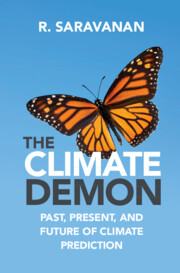
The title of the book refers to another recurring philosophical theme in the book, the notion of a Climate Demon. It is the climate analog of Laplace’s Demon, and serves as a metaphor for a model that accurately calculates the trajectory of future climate.

Accessibility standard: Unknown

Why this information is here

This section outlines the accessibility features of this content - including support for screen readers, full keyboard navigation and high-contrast display options. This may not be relevant for you.

Accessibility Information

Accessibility compliance for the HTML of this book is currently unknown and may be updated in the future.

Save book to Kindle

To save this book to your Kindle, first ensure no-reply@cambridge.org is added to your Approved Personal Document E-mail List under your Personal Document Settings on the Manage Your Content and Devices page of your Amazon account. Then enter the ‘name’ part of your Kindle email address below. Find out more about saving to your Kindle.

Note you can select to save to either the @free.kindle.com or @kindle.com variations. ‘@free.kindle.com’ emails are free but can only be saved to your device when it is connected to wi-fi. ‘@kindle.com’ emails can be delivered even when you are not connected to wi-fi, but note that service fees apply.

Find out more about the Kindle Personal Document Service.

  • Introduction
  • R. Saravanan, Texas A & M University
  • Book: The Climate Demon
  • Online publication: 02 November 2021
  • Chapter DOI: https://doi.org/10.1017/9781009039604.002
Available formats
×

Save book to Dropbox

To save content items to your account, please confirm that you agree to abide by our usage policies. If this is the first time you use this feature, you will be asked to authorise Cambridge Core to connect with your account. Find out more about saving content to Dropbox.

  • Introduction
  • R. Saravanan, Texas A & M University
  • Book: The Climate Demon
  • Online publication: 02 November 2021
  • Chapter DOI: https://doi.org/10.1017/9781009039604.002
Available formats
×

Save book to Google Drive

To save content items to your account, please confirm that you agree to abide by our usage policies. If this is the first time you use this feature, you will be asked to authorise Cambridge Core to connect with your account. Find out more about saving content to Google Drive.

  • Introduction
  • R. Saravanan, Texas A & M University
  • Book: The Climate Demon
  • Online publication: 02 November 2021
  • Chapter DOI: https://doi.org/10.1017/9781009039604.002
Available formats
×