Book contents
- Complex Ecology
- Complex Ecology
- Copyright page
- Dedication
- Contents
- Contributors
- Foreword
- Acknowledgements
- Introduction
- 1 Aggregation in Complex Systems
- 2 Diversity in Ecology and Conservation
- 3 The Role of Flows of Energy and Resources in Structuring Ecological and Social Systems
- 4 Non-linearity in Natural, Physical and Social Systems
- 5 Applied Implications and Subversive Science
- Epilogue
- Index
- References
5 - Applied Implications and Subversive Science
Published online by Cambridge University Press: 16 May 2018

Book contents
- Complex Ecology
- Complex Ecology
- Copyright page
- Dedication
- Contents
- Contributors
- Foreword
- Acknowledgements
- Introduction
- 1 Aggregation in Complex Systems
- 2 Diversity in Ecology and Conservation
- 3 The Role of Flows of Energy and Resources in Structuring Ecological and Social Systems
- 4 Non-linearity in Natural, Physical and Social Systems
- 5 Applied Implications and Subversive Science
- Epilogue
- Index
- References
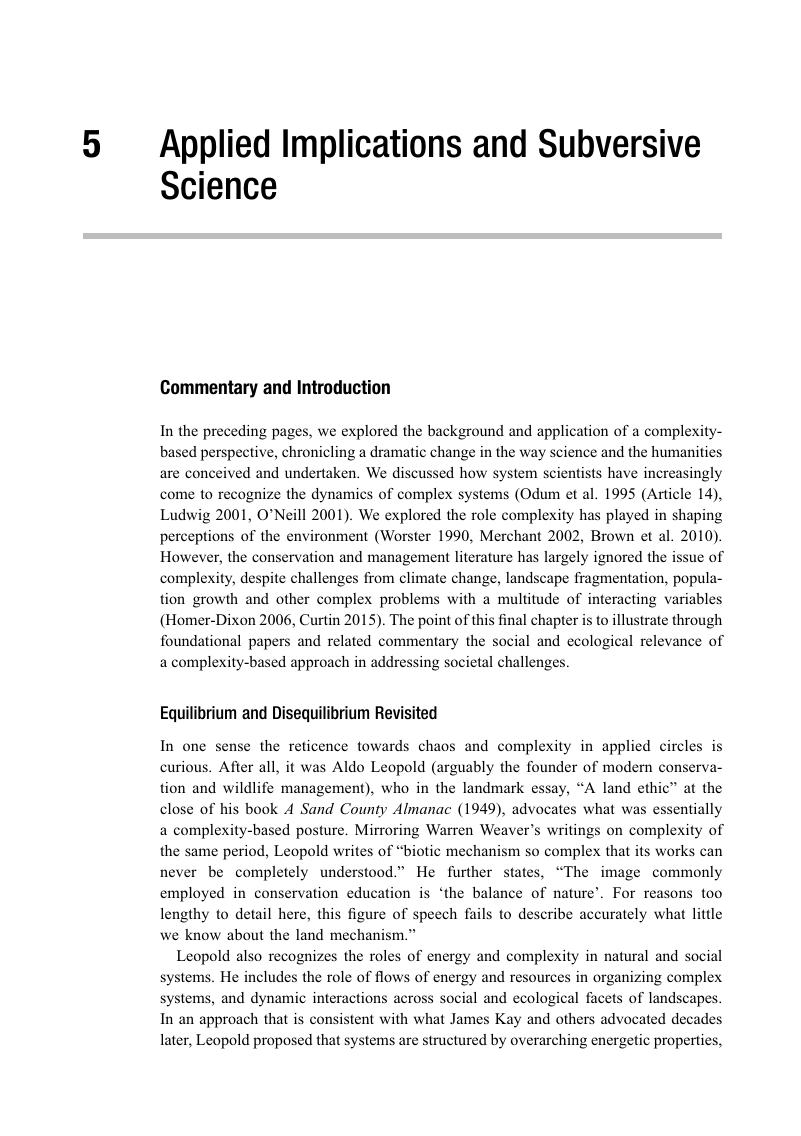
Summary
A summary is not available for this content so a preview has been provided. Please use the Get access link above for information on how to access this content.
Information
- Type
- Chapter
- Information
- Complex EcologyFoundational Perspectives on Dynamic Approaches to Ecology and Conservation, pp. 388 - 566Publisher: Cambridge University PressPrint publication year: 2018
References
Literature Cited
Acheson, J. M. (1988). The Lobster Gangs of Maine. Hanover, NH: University of New England Press.Google Scholar
Allen, T. F. H. and Starr, T. B. (2017). Hierarchy (second edition). Chicago, IL: University of Chicago Press.10.7208/chicago/9780226489711.001.0001CrossRefGoogle Scholar
Benessia, A. et al. (2016). The Rightful Place of Science: Science on the Verge. Tempe, AZ: Consortium for Science, Policy and Outcomes at Arizona State University.Google Scholar
Bergandi, D. (1995). Reductionist holism: an oxymoron or a philosophical chimera of Eugene Odum’s systems ecology? Laudus Vitalis: Journal of Philosophy and Life Sciences, 3, 145–178.Google Scholar
Berkes, F. and Folke, C., editors (1998). Linking Social and Ecological Systems. Cambridge: Cambridge University Press.Google Scholar
Brown, J. H. and Kodric-Brown, A. (1977). Turnover rates in insular biogeography: effect of immigration on extinction. Ecology, 58, 445–449.10.2307/1935620CrossRefGoogle Scholar
Brown, J. H. et al. (2011). Energetic limits to economic growth. BioScience, 61, 19–26.CrossRefGoogle Scholar
Brown, V. A., Harris, J. A. and Russell, J. Y. (2010). Tackling Wicked Problems: Through the Transdisciplinary Imagination. London: Earthscan Press.Google Scholar
Buell, F. (2003). From Apocalypse to Way of Life: Environmental Crisis in the American Century. New York: Routledge.Google Scholar
Cain, S. A. (1938). The species-area curve. American Midland Naturalist, 19, 573–581.10.2307/2420468CrossRefGoogle Scholar
Checkland, P. B. (1985). From optimizing to learning: a development of systems thinking for the 1990s. Journal of the Operational Research Society, 36, 757–767.CrossRefGoogle Scholar
Choi, J. S., Frank, K. T., Petrie, P. D. and Leggett, W. C. (2005). Integrated assessment of a large marine ecosystem: a case study of the devolution of the eastern Scotian Shelf, Canada. Annual Review of Oceanography and Marine Biology, 43, 47–67.Google Scholar
Clark, W. C. and Munn, R. E., editors (1986). Sustainable Development and the Biosphere. Cambridge: Cambridge University Press.Google Scholar
Clark, W. C., Jones, D. D. and Holling, C. S. (1979). Lessons for ecological policy design. Ecological Modeling, 7, 1–53.10.1016/0304-3800(79)90008-5CrossRefGoogle Scholar
Clements, F. (1916). Plant Succession: An Analysis of the Development of Vegetation. Washington, DC: Carnegie Institute of Washington.10.5962/bhl.title.56234CrossRefGoogle Scholar
Cohen, J. E. (1971). Mathematics as metaphor: a review of “Dynamical System Theory in Biology. Vol. 1, Stability Theory and Its Applications by Robert Rosen.” Science, 172, 3984.Google Scholar
Curtin, C. G. (2015). The Science of Open Space: Theory and Practice for Conserving Large, Complex Systems. Washington, DC: Island Press.10.5822/978-1-61091-205-1CrossRefGoogle Scholar
Curtin, C. G. and Parker, J. P. (2014). Foundations of resilience science. Conservation Biology, 4, 912–923.CrossRefGoogle Scholar
Diamond, J. M. (1972). Biogeographic kinetics: estimation of relaxation times for avifaunas of southwest Pacific islands. Proceedings of the National Academy of Sciences, 69, 3199–3203.10.1073/pnas.69.11.3199CrossRefGoogle ScholarPubMed
Diamond, J. M. (1975). The island dilemma: lessons of modern biogeographic studies for the design of natural reserves. Biological Conservation, 7, 129–146.10.1016/0006-3207(75)90052-XCrossRefGoogle Scholar
Dullinger, S. et al. (2013). Europe’s other debt crisis caused by the long legacy of future extinctions. Proceedings of the National Academy of Sciences, 110, 7342–7347.CrossRefGoogle Scholar
Fel’dbaum, A. A. (1961). Dual control theory. Parts I and II. Automation and Remote Control, 21(9), 874–880 and 21(11), 1033–1039 (Russian original published September 1960).Google Scholar
Folke, C. (2006). Resilience: the emergence of a perspective for social–ecological systems analyses. Global Environmental Change, 16: 253–267.10.1016/j.gloenvcha.2006.04.002CrossRefGoogle Scholar
Forman, R. T. T. (1995). Land Mosaics: The Ecology of Landscapes and Regions. Washington, DC: Island Press.10.1017/9781107050327CrossRefGoogle Scholar
Forrester, J. (1971). Counterintuitive behavior of social systems. Technology Review, 73, 52–68.Google Scholar
Funtowicz, S. and Ravetz, J. (1985). Three types of risk assessment: a methodological analysis. In Covello, V. T., Mumpower, J. L., Stallen, P. J. M. and Uppuluri, V. R. R. (editors), Environmental Impact Assessment, Technology Assessment, and Risk Analysis, pp. 831–848. Berlin: Springer.10.1007/978-3-642-70634-9_30CrossRefGoogle Scholar
Funtowicz, S. and Ravetz, J. (1991). A new scientific methodology for global environmental issues. In Costanza, R. (editor), Ecological Economics. The Science and Management of Sustainability, pp. 137–152. New York: Columbia Press.Google Scholar
Funtowicz, S. O. and Ravetz, J. R. (1992). The good, the true and the post-modern. Futures, 24, 963–976.10.1016/0016-3287(92)90131-XCrossRefGoogle Scholar
Funtowicz, S. and Ravetz, J. (1993). Science for the post-normal age. Futures, 25, 739–755.10.1016/0016-3287(93)90022-LCrossRefGoogle Scholar
Funtowicz, S. and Ravetz, J. (1994). The worth of a songbird: ecological economics as a post-normal science. Ecological Economics, 10, 197–207.10.1016/0921-8009(94)90108-2CrossRefGoogle Scholar
Gafta, D. and Akeroyd, J. R. (2006). Nature Conservation: Concepts and Practice. New York: Springer.10.1007/978-3-540-47229-2CrossRefGoogle Scholar
Gates, D. M. and Schmerl, R. B., editors (2012). Perspectives of Biophysical Ecology, Volume 12. New York: Springer Science & Business Media.Google Scholar
Gell-Mann, M. (1994). The Quark and the Jaguar: Adventures in the Simple and the Complex. New York: Macmillan.Google Scholar
Gibbons, M., Limoges, C., Nowotny, H., Schwartzman, S., Scott, P. and Trow, M. (1994). The New Production of Knowledge: The Dynamics of Science and Research in Contemporary Societies. London: SAGE.Google Scholar
Grinnell, J. (1917). The niche-relationships of the California thrasher. The Auk, 34, 427–433.10.2307/4072271CrossRefGoogle Scholar
Gunderson, L. H. and Holling, C. S. (2002). Panarchy: Understanding Transformations in Human and Natural Systems. Washington, DC: Island Press.Google Scholar
Gunderson, L. H., Holling, C. S. and Light, S. S. (1995). Barriers and Bridges to the Renewal of Ecosystems and Institutions. New York: Columbia University Press.Google Scholar
Hays, S. P. (1989). Beauty, Health, and Permanence: Environmental Politics in the United States, 1955–1985. Cambridge: Cambridge University Press.Google Scholar
Holland, J. (1995). Hidden Order: How Adaptation Builds Complexity. New York: Helix Books.Google Scholar
Holling, C. S. (1973). Resilience and stability of ecological systems. Annual Review of Ecology and Systematics, 4, 1–23.CrossRefGoogle Scholar
Holling, C. S. (1986). The resilience of terrestrial ecosystems: local surprise and global change. In Clark, W. C. and Munn, R. E. (editors), Sustainable Development of the Biosphere, pp. 292–317. Cambridge: Cambridge University Press.Google Scholar
Holling, C. S. and Meffe, G. K. (1996). Command and control and the pathology of natural resource management. Conservation Biology, 10, 328–337.10.1046/j.1523-1739.1996.10020328.xCrossRefGoogle Scholar
Homer-Dixon, T. (2006). The Upside of Down: Catastrophe, Creativity, and the Renewal of Civilization. Washington, DC: Island Press.Google Scholar
Innes, J. E. and Booher, D. E. (1999). Consensus building and complex adaptive systems: a framework for evaluating collaborative planning. Journal of the American Planning Association, 65, 412–423.10.1080/01944369908976071CrossRefGoogle Scholar
Ison, R. and Collins, K. (2008). Public policy that does the right thing, rather than the wrong thing righter. In Analyzing Collaborative and Deliberative Forms of Governance. Crawford School of Economics and Government. Canberra: Australian National University.Google Scholar
Jones, C.G. and Lawton, J. K. (1995). Linking Species and Ecosystems. New York: Chapman Hall.10.1007/978-1-4615-1773-3CrossRefGoogle Scholar
Kauffman, S. (1993). Origins of Order: Self-Organization and Selection in Evolution. Oxford: Oxford University Press.10.1093/oso/9780195079517.001.0001CrossRefGoogle Scholar
Keller, D. R. and Golley, F. B., editors (2000). The Philosophy of Ecology: From Science to Synthesis. Athens, GA: University of Georgia Press.Google Scholar
Koestler, A. and Smythies, J. R. (1969). Beyond Reductionism: New Perspectives in the Life Sciences. Boston, MA: Beacon Press.Google Scholar
Kuhn, T. S. (1962). Structure of Scientific Revolutions. Chicago, IL: University of Chicago Press.Google Scholar
Kuussaari, M., Bommarco, R., Heikkinen, R. K., Helm, A., Krauss, J., Lindborg, R. and Stefanescu, C. (2009). Extinction debt: a challenge for biodiversity conservation. Trends in Ecology and Evolution, 24, 564–571.10.1016/j.tree.2009.04.011CrossRefGoogle ScholarPubMed
Levin, S. A. (1999). Fragile Dominion: Complexity and the Commons. Boulder, CO: Perseus Books.Google Scholar
Lewin, R. (1999). Complexity: Life at the Edge of Chaos. Chicago, IL: University of Chicago Press.Google Scholar
Ludwig, D., Jones, D. D. and Holling, C. S. (1978). Qualitative analysis of insect outbreak systems: the spruce budworm and forest. Journal of Animal Ecology, 47, 315–332.10.2307/3939CrossRefGoogle Scholar
MacArthur, R. H. (1955). Fluctuations of animal populations and a measure of community stability. Ecology, 36, 533–536.10.2307/1929601CrossRefGoogle Scholar
MacArthur, R. H. and Wilson, E. O. (1967). The Theory of Island Biogeography. Princeton, NJ: Princeton University Press.Google Scholar
May, R. M. (1972). Will a large complex system be stable? Nature, 238, 413–414.10.1038/238413a0CrossRefGoogle Scholar
May, R. M. (1976). Simple mathematical models with very complicated dynamics. Nature, 261, 459–467.10.1038/261459a0CrossRefGoogle ScholarPubMed
Meadows, D. H., Meadows, D. L., Randers, J. and Behrens, W. W. (1972). Limits to Growth. New York: Potomac Associates.Google Scholar
Meine, C. (1988). Aldo Leopold, his Life and Work. Madison, WI: University of Wisconsin Press.Google Scholar
Merchant, C. (2002). The Columbia Guide to Environmental History. New York: Columbia University Press.Google Scholar
Mwangi, E. and Ostrom, E. (2009). Top-down solutions: looking up from East Africa’s rangelands. Environment: Science and Policy for Sustainable Development, 51, 34–45.10.3200/ENVT.51.1.34-45CrossRefGoogle Scholar
Norberg, J. and Cumming, G. S. (2008). Complexity Theory for a Sustainable Future. New York: Columbia University Press.Google Scholar
O’Neill, R. V. (2001). Is it time to bury the ecosystem concept? (with full military honors, of course!). Ecology, 82, 275–3284.Google Scholar
Ostrom, E. (1990). Governing the Commons: The Evolution of Institutions for Collective Action. Cambridge: Cambridge University Press.10.1017/CBO9780511807763CrossRefGoogle Scholar
Ostrom, E. (2007). A diagnostic approach for going beyond panaceas. Proceedings of the National Academy of Sciences, 104, 15181–15187.10.1073/pnas.0702288104CrossRefGoogle ScholarPubMed
Ostrom, E. et al. (2002). The Drama of the Commons. Washington, DC: National Academy Press.Google Scholar
Petersen, A. C., Cath, A., Hage, M., Kunseler, E. and van der Sluijs, J. P. (2011). Post-normal science in practice at the Netherlands Environmental Assessment Agency. Science, Technology & Human Values, 36, 362–388.10.1177/0162243910385797CrossRefGoogle ScholarPubMed
Pickett, S. T. A. and White, P. S. (1986). The Ecology of Natural Disturbance and Patch Dynamics. New York: Academic Press.Google Scholar
Pilkey, O. H. and Pilkey-Jarvis, L. (2007). Useless Arithmetic: Why Environmental Scientists Can’t Predict the Future. New York: Columbia University Press.Google Scholar
Pulliam, H. R. and Danielson, B. J. (1991). Sources, sinks, and habitat selection: a landscape perspective on population dynamics. The American Naturalist, 137, S50–S66.10.1086/285139CrossRefGoogle Scholar
Quammen, D. (1997). The Song of the Dodo: Island Biogeography in an Age of Extinction. New York: Scribner.Google Scholar
Ravetz, J. R. (1971). Scientific Knowledge and its Social Problems. Oxford: Oxford University Press.Google Scholar
Ravetz, J. R. (2006). Post-normal science and the Complexity of transitions towards sustainability. Ecological Complexity, 3, 275–284.10.1016/j.ecocom.2007.02.001CrossRefGoogle Scholar
Reinert, H. and Reinert, E. S. (2006). Creative destruction in economics: Nietzsche, Sombart, and Schumpeter. In Backhaus, J. G. and Drechsler, W. (editors), Friedrich Nietzsche (1844–1900): Economy and Society, Volume 3. New York: Springer Science & Business Media.Google Scholar
Rittel, H. W. J. and Webber, M. M. (1973). Dilemmas in a general theory of planning. Policy Science, 4, 155–169.10.1007/BF01405730CrossRefGoogle Scholar
Robinson, S. K., Thompson III, K. R., Donovan, T. M. and Faaborg, J. (1995). Regional forest fragmentation and the nesting success of migratory birds. Science, 267, 1987–1990.10.1126/science.267.5206.1987CrossRefGoogle ScholarPubMed
Sax, D. F., Stachowicz, J. J. and Gaines, S. D. (2005). Species Invasions: Insights into Ecology, Evolution and Biogeography. Sunderland, MA: Sinauer Associates.Google Scholar
Schneider, S. H., Turner, B. L. and Garriga, H. M. (1998). Imaginable surprise in global change science. Journal of Risk Research, 1, 165–185.10.1080/136698798377240CrossRefGoogle Scholar
Schön, D. A. (1995). The new scholarship requires a new epistemology. Change, 27(6), 27–34.10.1080/00091383.1995.10544673CrossRefGoogle Scholar
Schumpeter, J. A. (1942). Capitalism, Socialism, and Democracy. New York: Harper Brothers.Google Scholar
Senge, P. M. (1990). The Fifth Discipline: The Art and Practice of Organizational Learning. New York: Doubleday.Google Scholar
Shackley, S. and Wynne, B. (1996). Representing uncertainty in global climate change science and policy: boundary-ordering devices and authority. Science, Technology & Human Values, 21, 275–302.10.1177/016224399602100302CrossRefGoogle Scholar
Smith, E. (1990). Chaos in fisheries management. Maritime Anthropological Studies, 3, 1–13.Google Scholar
Soulé, M. E. and Wilcox, B. A. (1980). Conservation Biology: An Evolutionary-Ecological Perspective. Sunderland, MA: Sinauer Press.Google Scholar
Stokes, D. E. (1997). Pasteur’s Quadrant: Basic Science and Technological Innovation. Washington, DC: Brookings Institution Press.Google Scholar
Tainter, J. (1990). The Collapse of Complex Societies. Cambridge: Cambridge University Press.Google Scholar
Tansley, A. G. (1935). The use and abuse of vegetational concepts and terms. Ecology, 16, 284–307.10.2307/1930070CrossRefGoogle Scholar
Thomas, W. L., Sauer, C. O., Bates, M. and Mumford, L. (1956). Man’s Role in Changing the Face of the Earth. Chicago, IL: University of Chicago Press.Google Scholar
Tilman, D., May, R. M., Lehman, C. L. and Nowak, M. A. (1994). Habitat destruction and the extinction debt. Nature, 371, 65–66.10.1038/371065a0CrossRefGoogle Scholar
Tobey, R. C. (1981). Saving the Prairies: The Life Cycle of the Founding School of American Plant Ecology, 1895–1955. Berkeley, CA: University of California Press.10.1525/9780520334205CrossRefGoogle Scholar
Turner, B. L. et al. (1990). The Earth as Transformed by Human Action: Global and Regional Changes in the Biosphere over the past 300 Years. Cambridge: Cambridge University Press.Google Scholar
Turner, B., Skole, D., Sanderson, S., Fischer, G., Fresco, L. and Leemans, R. (1995). Land-Use and Land-Cover Change. International Geosphere-Biosphere Programme, Report 35. Stockholm.Google Scholar
Turner, D. R. and Vitousek, P. M. (1987). Nodule biomass in the nitrogen-fixing alien Myrica faya in Hawaii Volcanoes National Park. Pacific Science, 41, 186–190.Google Scholar
Turnpenny, J., Jones, M. and Lorenzoni, I. (2011). Special issue on Post Normal Science. Science, Technology & Human Values, 38(3).Google Scholar
Vitousek, P. M. (1986). Biological invasions and ecosystem properties: can species make a difference? In Mooney, H. A. and Drake, J. (editors), Biological Invasions of North America and Hawaii, pp. 163–176. New York: Springer-Verlag.10.1007/978-1-4612-4988-7_10CrossRefGoogle Scholar
Vitousek, P. M. (1990). Biological invasions and ecosystem processes: towards an integration of population biology and ecosystem studies. Oikos, 57, 7–13.10.2307/3565731CrossRefGoogle Scholar
Vitousek, P. M. (1994). Beyond global warming: ecology and global change. Ecology, 75, 1861–1876.10.2307/1941591CrossRefGoogle Scholar
Vitousek, P. M., Loope, L. L. and Stone, C. P. (1987). Introduced species in Hawaii: biological effects and opportunities for ecological research. Trends in Ecology and Evolution, 2, 224–227.10.1016/0169-5347(87)90026-7CrossRefGoogle ScholarPubMed
Walker, B. H., Ludwig, D., Holling, C. S. and Peterman, R. M. (1981). Stability of semiarid savanna grazing systems. Journal of Ecology, 69, 473–498.10.2307/2259679CrossRefGoogle Scholar
Watt, A. S. (1947). Pattern and process in the plant community. Journal of Ecology, 35, 1–22.10.2307/2256497CrossRefGoogle Scholar
Weinberg, A. (1972) Science and trans-science. Minerva, 10, 209–222.10.1007/BF01682418CrossRefGoogle Scholar
Wiens, J. A. (2009). Landscape ecology as a foundation for sustainable conservation. Landscape Ecology, 24, 1053–1065.10.1007/s10980-008-9284-xCrossRefGoogle Scholar
Wilson, J. A. (2002). Scientific uncertainty, complex systems, and the design of common-pool institutions. In Ostrom, E., et al. (editors), The Drama of the Commons, pp. 327–360. Washington, DC: National Academy Press.Google Scholar
Worster, D. (1977). Nature’s Economy: A History of Ecological Ideas. Cambridge: Cambridge University Press.Google Scholar
Worster, D. (1990). Ecology of order and chaos. Environmental History Review, 14, 1–18.10.2307/3984623CrossRefGoogle Scholar
Wu, J. and Loucks, O. L. (1995). From balance of nature to hierarchical patch dynamics: a paradigm shift in ecology. Quarterly Review of Biology, 70, 439–466.10.1086/419172CrossRefGoogle Scholar
Accessibility standard: Unknown
Why this information is here
This section outlines the accessibility features of this content - including support for screen readers, full keyboard navigation and high-contrast display options. This may not be relevant for you.Accessibility Information
Accessibility compliance for the HTML of this chapter is currently unknown
and may be updated in the future.