Introduction
Published online by Cambridge University Press: 05 June 2012

Summary
Americans justifiably cherish the liberty of conscience as a foundational limitation on state power. Few today would challenge the assessment offered in 1919 by future Supreme Court Chief Justice Harlan Fiske Stone that the liberty of conscience is so vital that “it may well be questioned whether the state which preserves its life by a settled policy of violation of the conscience of the individual will not in fact ultimately lose it by the process.” Stone was affirming, in the wake of World War I, the ongoing need to recognize and respect conscientious objector status. The nation's commitment to conscience has helped provide legal protection for individuals faced with direct state encroachment on their core moral convictions, not only in the draft context, but also, for example, for students facing state-required participation in the pledge of allegiance. “If there is any fixed star in our constitutional constellation,” Justice Jackson wrote for the court in Barnette, the landmark case striking down a state's pledge requirement, “it is that no official, high or petty, can prescribe what shall be orthodox in politics, nationalism, religion, or other matters of opinion or force citizens to confess by word or act their faith therein.” At stake was nothing less than the court's duty to preserve “freedom of conscience to the full.”
When the state moves against the individual, either foreclosing dissent or coercing assent to the majority's ideals, it makes sense to view liberty of conscience as a legal protection that arises at the point of conflict between an individual's deeply held moral or religious beliefs and state power.
Information
- Type
- Chapter
- Information
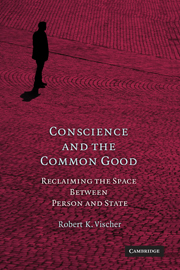
- Conscience and the Common GoodReclaiming the Space Between Person and State, pp. 1 - 12Publisher: Cambridge University PressPrint publication year: 2009
References
, The Christian Conscience, 24 (1968)
, In Good Conscience, 41 (1991)
Accessibility standard: Unknown
Why this information is here
This section outlines the accessibility features of this content - including support for screen readers, full keyboard navigation and high-contrast display options. This may not be relevant for you.Accessibility Information
Accessibility compliance for the PDF of this book is currently unknown
and may be updated in the future.