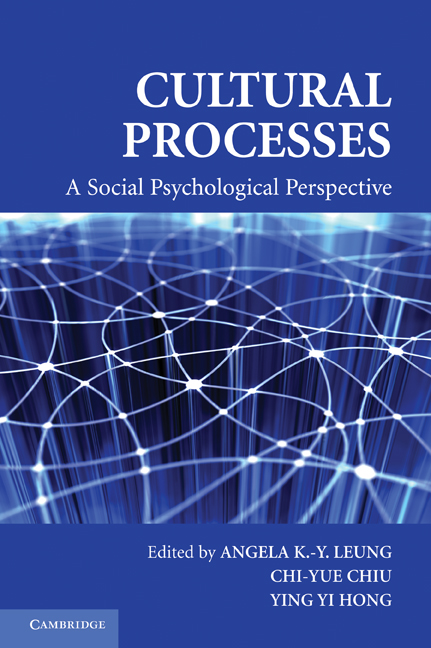
Cultural Processes

-
Select format
-
- Publisher:
- Cambridge University Press
- Publication date:
- 05 June 2012
- 06 December 2010
- ISBN:
- 9780511779374
- 9780521765237
- 9780521758413
- Dimensions:
- (228 x 152 mm)
- Weight & Pages:
- 0.56kg, 336 Pages
- Dimensions:
- (228 x 152 mm)
- Weight & Pages:
- 0.45kg, 336 Pages
- Subjects:
- Social Theory, Social Psychology, Anthropology: General Interest, Psychology, Psychology: General Interest, Sociology
- Series:
- Culture and Psychology
You may already have access via personal or institutional login- Subjects:
- Social Theory, Social Psychology, Anthropology: General Interest, Psychology, Psychology: General Interest, Sociology
- Series:
- Culture and Psychology
Show more authors 
You may already have access via personal or institutional login
Book description
With the rapid growth of knowledge concerning ethnic and national group differences in human behaviors in the last two decades, researchers are increasingly curious as to why, how, and when such differences surface. The field is ready to leapfrog from a descriptive science of group differences to a science of cultural processes. The goal of this book is to lay the theoretical foundation for this exciting development by proposing an original process model of culture. This new perspective discusses and extends contemporary social psychological theories of social cognition and social motivation to explain why culture matters in human psychology. We view culture as a loose network of imperfectly shared knowledge representations for coordinating social transactions. As such, culture serves different adaptive functions important for individuals' goal pursuits. Furthermore, with the increasingly globalized and hyper-connected multicultural space, much can be revealed about how different cultural traditions come into contact.
Reviews
“This book lays out a brilliant process model of culture. It shows how culturally shared knowledge is used to structure social transactions and it lays the groundwork for a new science of cultural processes. It's an outstanding contribution to psychology.”
– Carol Dweck, Stanford University
“This is an up-to-date statement of one of the most productive and innovative research groups in culture and psychology. Treating culture as process, they spell out the underlying metatheory of culture, describe their most recent research findings, theorize about cultural representations and functions, and apply this framework to pressing contemporary research questions, such as cultural differences in self-enhancement, subjective well-being, work teams, and conflict resolution, as well as intercultural processes of negation and communication. This volume is simultaneously a cogent argument for a dynamic perspective on culture, a searching analysis of cultural dynamics, and an invaluable foundation from which to launch further inquiries into cultural changes in the globalized world.”
– Yoshi Kashima, The University of Melbourne
“An overview of the cutting edge. This wide-ranging and well-integrated volume makes a compelling case for a dynamic, processual approach. Anyone interested in cultural determinants of thoughts and behavior should turn to this book to learn of the exciting recent developments in cultural psychology.”
– Michael Morris, Columbia University
Contents
Contents
Metrics
Altmetric attention score
Full text views
Full text views helpTotal number of HTML views: 0
Total number of PDF views: 0 *
 Loading metrics...
* Views captured on Cambridge Core between #date#. This data will be updated every 24 hours.
Usage data cannot currently be displayed.
Accessibility standard: Unknown
Why this information is here
This section outlines the accessibility features of this content - including support for screen readers, full keyboard navigation and high-contrast display options. This may not be relevant for you.
Accessibility Information
Accessibility compliance for the PDF of this book is currently unknown and may be updated in the future.