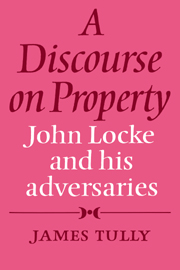
Book contents
5 - Exclusive rights
Published online by Cambridge University Press: 25 October 2009

Summary
Locke's apostrophe
Chapter five of the Second Treatise opens with a summation of the matrix of natural and inclusive rights, and this now functions as a set of premisses for the continuation of the study. In the first eight lines Locke sets out the two initial conditions which partially define man's natural state. Scripture reveals that the world is a gift, given by God to mankind in common. Natural reason teaches that each man has a right to the things which nature affords for his subsistence. We have seen that these two propositions are derived from biblical exegesis and from natural law. The two derivations are complementary and, consequently, the two conclusions describe the same state of affairs. Kendall suggests that there is an illogical transition from the natural right which ‘men’ have to the world as the common property of ‘mankind’ (1965: p. 69; Laslett, 1970: p. 303). To say, however, that each man has an inclusive claim right, entailed by a natural duty, is logically equivalent to saying that the world belongs to all men in the same manner. Locke's right is designed, as we have seen, to perform this function. He immediately continues with the assertion that, if common property in this sense is supposed, then ‘it seems to some a very great difficulty, how any one should ever come to have a Property in any thing’ (2.25).
Information
- Type
- Chapter
- Information
- A Discourse on PropertyJohn Locke and his Adversaries, pp. 95 - 130Publisher: Cambridge University PressPrint publication year: 1980
Accessibility standard: Unknown
Why this information is here
This section outlines the accessibility features of this content - including support for screen readers, full keyboard navigation and high-contrast display options. This may not be relevant for you.Accessibility Information
Accessibility compliance for the PDF of this book is currently unknown
and may be updated in the future.
- 1
- Cited by