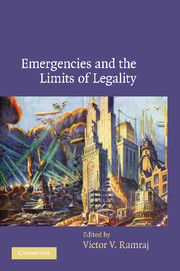
Book contents
- Frontmatter
- Contents
- List of contributors
- Preface
- Introduction
- PART ONE Legality and extra-legality
- PART TWO Conceptual and normative theories
- PART THREE Political and sociological theories
- 6 The constitutional politics of emergency powers: some conceptual issues
- 7 A topography of emergency power
- 8 Law, terror and social movements: the repression-mobilisation nexus
- PART FOUR Prospective constraints on state power
- PART FIVE Judicial responses to official disobedience
- PART SIX Post-colonial and international perspectives
- Index
- References
7 - A topography of emergency power
Published online by Cambridge University Press: 10 August 2009
Edited by

Book contents
- Frontmatter
- Contents
- List of contributors
- Preface
- Introduction
- PART ONE Legality and extra-legality
- PART TWO Conceptual and normative theories
- PART THREE Political and sociological theories
- 6 The constitutional politics of emergency powers: some conceptual issues
- 7 A topography of emergency power
- 8 Law, terror and social movements: the repression-mobilisation nexus
- PART FOUR Prospective constraints on state power
- PART FIVE Judicial responses to official disobedience
- PART SIX Post-colonial and international perspectives
- Index
- References
Summary
Introduction
People are ends in themselves, and states and institutions are means to their well-being. This essay argues that making emergency powers more conducive to that end requires a shift in focus. We have tended to think of emergency institutions in terms of legal norms and exceptions. But safe emergency powers depend primarily on whether public officials behave themselves, and this, in turn, depends on the landscape of formal and informal power and constraint which officials inhabit. Hence, if the well-being of people is our central concern even in times of crisis, we must move beyond a perspective which emphasises boundaries of law to concentrate on this broader terrain. For, bounded and formally delineated law never rules on its own. Law and other institutions are shot through with individual agency not just in times of crisis but every day, and this agency and informal power is a central, not peripheral element of rule.
Agency, the central element of informal power, has traditionally been associated with arbitrariness and opposed to the rule of law. Correlatively, agency is associated with a prudential mode of politics while the rule of law is associated with a principled mode. But agency is a necessary part of all institutions, both logically and normatively. Because circumstances are always variable and people unpredictable, without the benefit of flexibility which agency provides, institutions and laws could not do the moral work we set for them.
Information
- Type
- Chapter
- Information
- Emergencies and the Limits of Legality , pp. 156 - 171Publisher: Cambridge University PressPrint publication year: 2008
References
, States of Emergency in Liberal Democracies (Cambridge: Cambridge University Press, forthcoming 2009)CrossRefGoogle Scholar
, ‘Constitutionalism and Presidential Prerogative: Jeffersonian and Hamiltonian Perspectives’ (2004) 48 American Journal of Political Science429–44CrossRefGoogle Scholar
, ‘Martial Law: The Development of a Theory of Emergency Powers, 1776–1861’ (1974) 18 The American Journal of Legal History52–79CrossRefGoogle Scholar
, Two Treatises of Government, (ed.) (Cambridge: Cambridge University Press, 1988), § 91CrossRefGoogle Scholar
, ‘Perpetual Peace’ in (ed.), Kant's Political Writings (Cambridge: Cambridge University Press, 1970), pp. 126–7Google Scholar
, Indira Gandhi, the ‘Emergency’ and Indian Democracy (New York: Oxford University Press, 2000)Google Scholar
, The Constitution of Law (Cambridge: Cambridge University Press, 2006), p. 54CrossRefGoogle Scholar
et al., ‘The Supreme Court During Crisis: How War Affects Only Nonwar Cases’ (2005) 80 New York University Law Review1–116Google Scholar
, ‘Derogation of Human Rights in Situations of Public Emergency: The Experience of European Convention’ (1982) 9 Yale Journal of World Public Order113–32Google Scholar
Accessibility standard: Unknown
Why this information is here
This section outlines the accessibility features of this content - including support for screen readers, full keyboard navigation and high-contrast display options. This may not be relevant for you.Accessibility Information
Accessibility compliance for the PDF of this book is currently unknown
and may be updated in the future.