Book contents
Preface
Published online by Cambridge University Press: 05 June 2012

Summary
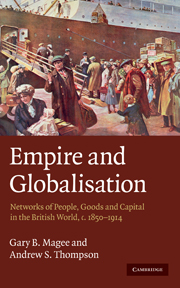
‘Empire’ and ‘globalisation’ are currently two of the most prominent and widely debated discourses in the humanities and social sciences. This book explores the historical relationship between them. We take as our starting-point one of the great global movements of population – the largely voluntary emigration of men, women and children from Europe to the New World between the mid nineteenth century and the First World War. While migration may be ‘as old as humanity itself’, it was during these years that the world witnessed an unprecedented exodus of 50 million or so Europeans. Britain led the way, supplying approximately 13.5 million migrants, or a quarter of the total. Aided by improvements in transport and communications, arguably no less dramatic in their ability to transform life than those witnessed over the last half-century, the majority of these British people settled across Australia, New Zealand, South Africa, Canada and the United States.
The consequences of this population outflow were profound. On the one hand, emigration was a force for global economic growth – integrating labour, commodity and capital markets to an extent never previously seen. Yet, on the other, this business of white settlement – for that is was it was, or at least became – led to the widespread dispossession and oppression of indigenous peoples, as well as to a racialisation of the social order, the polarising effects of which were felt powerfully at the time and still resonate today.
Information
- Type
- Chapter
- Information
- Empire and GlobalisationNetworks of People, Goods and Capital in the British World, c.1850–1914, pp. xi - xviiPublisher: Cambridge University PressPrint publication year: 2010
Accessibility standard: Unknown
Why this information is here
This section outlines the accessibility features of this content - including support for screen readers, full keyboard navigation and high-contrast display options. This may not be relevant for you.Accessibility Information
Accessibility compliance for the PDF of this chapter is currently unknown
and may be updated in the future.