Conclusion
Published online by Cambridge University Press: 15 June 2022

Summary
This book has taken you on a whirlwind tour of a large world region. The sights included the earth's crust, a range of flora and fauna, and glimpses of people's mindsets and livelihoods. You may well be left with a kaleidoscope of impressions and questions – but rest assured: this was intentional. The main purpose of this introductory tour was to reflect on how humans, animals and plants have found ways to live together over countless generations – and how these ways have been changing in recent times.
Along the way, we – your tour guides – have attempted to deflate us – human beings – in the stories we tell ourselves about the past. We suggested that human histories are always utterly intertwined with plant and animal histories. History is co-created: it is always interspecies history. We presented empirical examples to make that point, but we had to hurry so we were highly selective, zipped through time, touched very lightly on complex cases, passed over many nuances and refrained from dipping deeply into ongoing scholarly debates. We hope that our numerous references, and the extensive bibliography, make up for this shortfall and help you on your way into the vast empirical and theoretical literature.
What have we learned? First, that the conventions of academic history-writing are inadequate to deal with the complexities that we have encountered. We historians need to reconfigure our craft, recalibrate our knowledge production, reconsider our methodological choices and make our theoretical work more globally inclusive than is currently the case. More of us should question the spatial categories that we routinely use to structure our accounts of the past (for example, state territories) and, instead, experiment with non-conventional ones. We need to rethink time periods (for example, ‘prehistoric’ or ‘colonial’), and we should feel our way beyond the dogma of chronometric time.
Above all, it is important to reconsider what makes an authoritative account of the past. The stories we tell have an impact on how we, and others, act in the world. Academic history may claim authority, but it is only convincing if it recognises two things. To start with, we must acknowledge and analyse the power relations that exist between academically trained scholars and ‘non-professional’ thinkers about the past.
Information
- Type
- Chapter
- Information
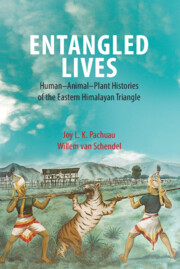
- Entangled LivesHuman-Animal-Plant Histories of the Eastern Himalayan Triangle, pp. 258 - 263Publisher: Cambridge University PressPrint publication year: 2022
Accessibility standard: Unknown
Why this information is here
This section outlines the accessibility features of this content - including support for screen readers, full keyboard navigation and high-contrast display options. This may not be relevant for you.Accessibility Information
Accessibility compliance for the PDF of this chapter is currently unknown
and may be updated in the future.