Book contents
- Frontmatter
- Contents
- Figures
- Tables
- Boxes
- Contributors
- Preface
- A reader’s guide
- Abbreviations
- 1 General introduction
- Part I EU history, institutions and legal dimension
- Part II EU market integration
- Part III EU monetary integration
- 10 The theory of monetary integration
- 11 The development of EU economic and monetary integration
- 12 The Operation of EMU
- Part IV The single European market
- Part V EU budget and structural policies
- Part VI EU external relations
- Part VII The future of the EU
- Bibliography
- Author Index
- Index
- References
This chapter is part of a book that is no longer available to purchase from Cambridge Core
12 - The Operation of EMU
from Part III - EU monetary integration

Book contents
- Frontmatter
- Contents
- Figures
- Tables
- Boxes
- Contributors
- Preface
- A reader’s guide
- Abbreviations
- 1 General introduction
- Part I EU history, institutions and legal dimension
- Part II EU market integration
- Part III EU monetary integration
- 10 The theory of monetary integration
- 11 The development of EU economic and monetary integration
- 12 The Operation of EMU
- Part IV The single European market
- Part V EU budget and structural policies
- Part VI EU external relations
- Part VII The future of the EU
- Bibliography
- Author Index
- Index
- References
Summary
Introduction
The EU’s European monetary union (EMU) has four broad ingredients: the euro and the single European monetary policy (SMP); the coordination of European macroeconomic policies through the Stability and Growth Pact (SGP), the Broad Economic Policy Guidelines (BEPG) and related processes; the completion of the Single European Market (SEM); and the operation of the structural funds and other cohesion measures. This chapter will consider only the first two, as the others are dealt with in Chapters 7, 11, 12 and 19.
Although the euro did not come into existence until 1 January 1999, and then only in financial markets, most of the characteristics of stage 3 of EMU (Chapter 11) were operating once the European Central Bank (ECB) opened in June 1998. The ECB, in the form of the European Monetary Institute (EMI), had been preparing for the day with all EU national central banks (NCBs) since 1994. The form of the coming SMP was already known by 1998, in both framework and instruments. In the same way, much of the framework for the operation of the economic coordination among the member states (MSs) had been developed with the SGP of July 1997 and BEPG commencement in 1998. The generalized framework was incorporated in the Treaty of Amsterdam (October 1997). There was thus no great break in behaviour at the beginning of 1999, especially since the main qualification period under the Treaty on European Union (TEU) convergence criteria had related to 1997. However, the SGP effectively broke down in 2003 and had to be revised in 2005 after a period of debate.
Information
- Type
- Chapter
- Information
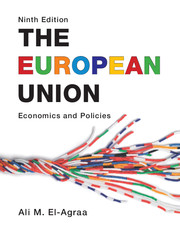
- The European UnionEconomics and Policies, pp. 182 - 194Publisher: Cambridge University PressPrint publication year: 2011
References
2008
EMU@10: Successes and Challenges after 10 Years of Economic and Monetary Union
DG ECOFIN, Brussels
2009
The Economics of Monetary Union
Oxford University Press
2004
The Monetary Policy of the ECB
ECB, Frankfurt
Accessibility standard: Unknown
Why this information is here
This section outlines the accessibility features of this content - including support for screen readers, full keyboard navigation and high-contrast display options. This may not be relevant for you.Accessibility Information
Accessibility compliance for the PDF of this book is currently unknown
and may be updated in the future.
- 1
- Cited by