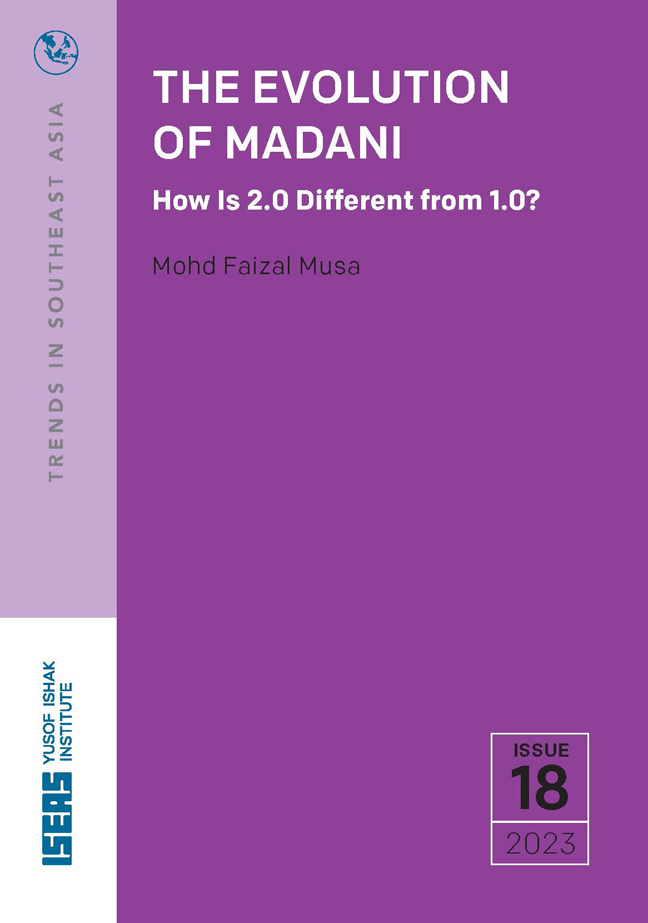
The Evolution of Madani

-
Select format
-
- Publisher:
- ISEAS–Yusof Ishak Institute
- Publication date:
- 26 March 2024
- 01 November 2023
- ISBN:
- 9789815104905
- 9789815104899
- Dimensions:
- Weight & Pages:
- Dimensions:
- Weight & Pages:
- Series:
- Trends in Southeast Asia
Show more authors 
You may already have access via personal or institutional login
Book description
In 1995, then Finance Minister and Deputy Prime Minister Anwar Ibrahim introduced 'Masyarakat Madani' as his proposed economic framework for Malaysia. The term was heavily debated among scholars and politicians across all parties and ideologies. It was often argued that Madani was an effort to limit the rise of political Islam.
Following Anwar Ibrahim's dismissal from government in 1998, Madani came to be more narrowly redefined as 'civil society' However, Anwar's supporters, known as the 'Anwarinas', strove to keep the spirit of Madani alive and continued to promote its ideals of social justice, democratic values and inclusivity. They were encouraged further by the fall of Barisan Nasional from federal power in the fourteenth General Election in 2018.
After Anwar Ibrahim became Malaysia's tenth Prime Minister in 2022, he reintroduced Madani as a framework for the country, to be implemented in various sectors. Anwar Ibrahim likely received help from scholars such as Ziauddin Sardar, as reflected in his election manifesto, Script for a Better Malaysia. This time around, the core component of Madani is Maqasid Al-Shariah, or the higher objectives of sharia.
In that sense, Madani is now arguably more an expression of what may be called post-Islamism. For it to succeed, however, it will have to counteract the growing power of the conservatives and Islamists. This may be an uphill battle, given that a key component party of the unity government - UMNO - is facing several allegations of corruption.
Metrics
Full text views
Full text views helpTotal number of HTML views: 0
Total number of PDF views: 0 *
 Loading metrics...
* Views captured on Cambridge Core between #date#. This data will be updated every 24 hours.
Usage data cannot currently be displayed.
Accessibility standard: Unknown
Why this information is here
This section outlines the accessibility features of this content - including support for screen readers, full keyboard navigation and high-contrast display options. This may not be relevant for you.
Accessibility Information
Accessibility compliance for the PDF of this book is currently unknown and may be updated in the future.