Book contents
- Frontmatter
- Contents
- List of Contributors
- Preface
- 1 Evolutionary reconstructions of great ape intelligence
- 2 Enhanced cognitive capacity as a contingent fact of hominid phylogeny
- PART I COGNITION IN LIVING GREAT APES
- Introduction
- 3 The manual skills and cognition that lie behind hominid tool use
- 4 The cognitive complexity of social organization and socialization in wild baboons and chimpanzees: guided participation, socializing interactions, and event representation
- 5 Gestural communication in the great apes
- 6 Great ape cognitive systems
- PART II MODERN GREAT APE ADAPTATION
- PART III FOSSIL GREAT APE ADAPTATIONS
- Part IV INTEGRATION
- Author index
- Species index
- Subject index
6 - Great ape cognitive systems
Published online by Cambridge University Press: 20 August 2009

Book contents
- Frontmatter
- Contents
- List of Contributors
- Preface
- 1 Evolutionary reconstructions of great ape intelligence
- 2 Enhanced cognitive capacity as a contingent fact of hominid phylogeny
- PART I COGNITION IN LIVING GREAT APES
- Introduction
- 3 The manual skills and cognition that lie behind hominid tool use
- 4 The cognitive complexity of social organization and socialization in wild baboons and chimpanzees: guided participation, socializing interactions, and event representation
- 5 Gestural communication in the great apes
- 6 Great ape cognitive systems
- PART II MODERN GREAT APE ADAPTATION
- PART III FOSSIL GREAT APE ADAPTATIONS
- Part IV INTEGRATION
- Author index
- Species index
- Subject index
Summary
INTRODUCTION
This chapter considers cognition in great apes as integrated systems that orchestrate the many abilities that great apes express, systems for which satisfactory characterizations remain elusive. In part, difficulties owe to research trends. Empirical studies have been guided by diverse and sometimes contradictory models, questions, measures, tasks, and living conditions. Performance levels have proven inconsistent across individuals, rearing conditions, and testing conditions, and evidence is patchy across species for virtually any facet of cognition. Evidence on wild great apes, the most important from an evolutionary perspective, is especially patchy because research has favored captives; much of what is available was collected for other purposes, so it was neither described nor analyzed with cognition in mind. The issues at stake are also hard–felt ones that touch on the human–nonhuman boundary, so entrenched beliefs infect how the literature is interpreted and even what of it is read.
Attempts have none the less been made to develop an integrated model of great ape cognition using available evidence. They include both edited survey volumes (Matsuzawa 2001a; Parker, Mitchell & Miles 1999; Russon, Bard & Parker 1996) and integrative reviews, three of the latter as major books (Byrne 1995 (RWB), Parker & McKinney 1999 (P&M); Tomasello & Call 1997 (T&C)) and others as articles (e.g., Byrne 1997; Suddendorf & Whiten 2001; Thompson & Oden 2000; Whiten & Byrne 1991). My aim is not to analyze this terrain, yet again, in detail, but to offer a compact mise à date to ground evolutionary reconstruction.
Information
- Type
- Chapter
- Information
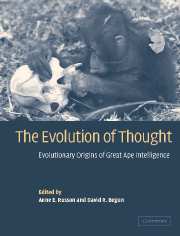
- The Evolution of ThoughtEvolutionary Origins of Great Ape Intelligence, pp. 76 - 100Publisher: Cambridge University PressPrint publication year: 2004
Accessibility standard: Unknown
Why this information is here
This section outlines the accessibility features of this content - including support for screen readers, full keyboard navigation and high-contrast display options. This may not be relevant for you.Accessibility Information
Accessibility compliance for the PDF of this chapter is currently unknown
and may be updated in the future.
- 7
- Cited by