Book contents
- Frontmatter
- Contents
- Illustrations (to be found between pages 146 and 147)
- Preface and acknowledgements
- List of abbreviations
- Introduction
- 1 Illusions of supremacy
- 2 The problems of isolation
- 3 Problems of consolidation
- 4 Two Eastern Questions
- 5 The transformation of Great Power politics
- 6 The end of an era
- Conclusion
- Select bibliography
- Index
- Plate section
- References
Introduction
Published online by Cambridge University Press: 07 October 2011

Book contents
- Frontmatter
- Contents
- Illustrations (to be found between pages 146 and 147)
- Preface and acknowledgements
- List of abbreviations
- Introduction
- 1 Illusions of supremacy
- 2 The problems of isolation
- 3 Problems of consolidation
- 4 Two Eastern Questions
- 5 The transformation of Great Power politics
- 6 The end of an era
- Conclusion
- Select bibliography
- Index
- Plate section
- References
Summary
‘So that’s your Diary – that’s your private mind
Translated into shirt-sleeved History. That
Is what diplomacy left behind
For after-ages to peruse, and find
What passed beneath your elegant silk-hat.
…
But I, for one, am grateful, overjoyed
And unindignant that your punctual pen
Should have been so constructively employed
In manifesting to unprivileged men
The visionless officialized fatuity
That once made Europe safe for Perpetuity.’
Siegfried Sassoon, ‘On Reading the War Diary of a Defunct Ambassador’
For those who share the poet’s sentiments, this book is already too long. Those who take a more detached, possibly even cynical, view of the diplomatic machinations before the Great War may well judge it to be too short. This book is not intended as an exploration of past international relations as such. It does not seek to probe into every nook and cranny of Britain’s foreign affairs in the second half of the long nineteenth century. Neither does it offer an administrative history of ‘the quill-driving life of the F.O.’ and the then still separate diplomatic service. It seeks, instead, to explore an aspect of British foreign policy, to which historians have frequently alluded, but which still remains hidden in the darker recesses of the past: the ‘official mind’.
At its best, diplomatic history has never been the preserve of painstaking plodders who merely chart the waxing and waning of foreign relations, without any pretence at understanding their wider context or significance. It would be a bloodless analysis of diplomatic activity, indeed, that did not trouble itself to relate that activity to contemporary norms of behaviour and contemporary conceptions of what was politically permissible or practically possible. Without taking into account ‘the manner in which contemporaries tried to explain their situation in time and place and … the language and concepts in which such explanations are formulated’ no real understanding of past politics is possible.
Information
- Type
- Chapter
- Information
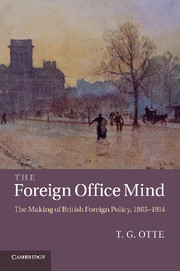
- The Foreign Office MindThe Making of British Foreign Policy, 1865–1914, pp. 1 - 22Publisher: Cambridge University PressPrint publication year: 2011
References
Britain, Soviet Russia and the Collapse of the Versailles Order, 1919–1939Cambridge 2006Google Scholar
Elgin and Churchill at the Colonial Office, 1905–1908: The Watershed of the Empire-CommonwealthLondon 1968Google Scholar
The Making of the Diplomatic Mind: The Training, Outlook, and Style of United States Foreign Service Officers, 1908–1951Middletown, CT 1975Google Scholar
International Politics and the Military Mind: The Case of the French Republic, 1911–1914JMH xxv 1953 273Google Scholar
Succeeding John Bull: America and Britain’s Place in the World, 1900–1975Cambridge 1984CrossRefGoogle Scholar
Memoirs and Letters of the Right Hon. Sir Robert Morier, G.C.B., from 1826 to 1876London 1911Google Scholar
1923
Victorian Minds: A Study of Intellectuals in Crisis and Ideologies in TransitionChicago, IL 1995Google Scholar
Gentlemen Capitalists: The Social and Political World of the Victorian BusinessmanStanford, CA 1992Google Scholar
Education and Empire: Naval Tradition and England’s Elite SchoolingLondon and New York 1999Google Scholar
Military Identities: The Regimental System, the British Army, and the British People, c. 1870–2000Oxford 2005CrossRefGoogle Scholar
Sir Arthur Nicolson, Bart., First Lord Carnock: A Study in the Old DiplomacyLondon 1937Google Scholar
Arthur Lionel Smith, Master of Balliol (1916–1924): A Biography and Some Reminiscences by His WifeLondon 1930Google Scholar
La Génération de 1911–1914: Image, Mythe et Realité?Revue française de science politique xxi 1971 981Google Scholar
Generationen in der Geschichte: Überlegungen zu einer umstrittenen KonzeptionG&G iii 1977 434Google Scholar
The Conflict of Generations: The Character and Significance of Student MovementsNew York 1969Google Scholar
The Cohort as a Concept in the Study of Social ChangeAmerican Sociological Review xxx 1965 843CrossRefGoogle Scholar
Gesammelte Werke, v, Die Geistige Welt: Einleitung in die Philosophie des LebensGöttingen 1957Google Scholar
The Intellectual Development of Karl Mannheim: Culture, Politics, and PlanningCambridge 1985Google Scholar
Birth Dates Matter: Generational Voting in the British House of Commons, 1841–1859Journal of the Historical Society iii 2004 373Google Scholar
Accessibility standard: Unknown
Why this information is here
This section outlines the accessibility features of this content - including support for screen readers, full keyboard navigation and high-contrast display options. This may not be relevant for you.Accessibility Information
Accessibility compliance for the PDF of this book is currently unknown
and may be updated in the future.