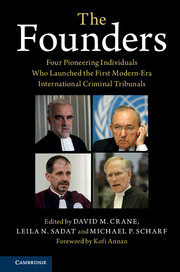
 The Founders
 Four Pioneering Individuals Who Launched the First Modern-Era International Criminal Tribunals
Foreword
Published online by Cambridge University Press: 23 March 2018

Summary
The common sense of mankind demands that law shall not stop with the punishment of petty crimes by little people. It must also reach men who possess themselves of great power.
US Chief Prosecutor Robert H. Jackson, in his opening statement before the International Military Tribunal at Nuremberg in 1945Throughout history, men of great power have destroyed their own people. Yet it is only recently that mankind has stepped forward and sought to hold those responsible for atrocity accountable. In the past, there was little of this, and the beast of impunity nibbled around the edges of civilization. A commentator once said that the history of mankind is the history of war and the history of war is the history of mankind: an apt point to make.
In the twentieth century, tens of millions of human beings were destroyed at the hands of their own governments. Yet history and circumstance pointed to a possible better place. In the midst of this bloody century there were four bright and shining years that augured well for the future. From 1945 to 1949, the United Nations was formed, the Nuremberg Principles adopted, and key human rights instruments, such as the Universal Declaration of Human Rights, the Genocide Convention, and the Geneva Conventions, were passed. In this short time, the cornerstone of the modern international criminal law paradigm was laid down.
Yet the shadow of the Cold War almost washed away this new hope for humanity. The geopolitical dynamic that split the world almost in half saw both sides look away from human rights abuses and atrocities in order to maintain a political check against the other. This was the true age of the dictator, as strongmen used the standoff between the West and the Soviet bloc to their advantage to seek, establish, and maintain absolute power. When the Iron Curtain rusted and finally fell, mankind paused and considered new ways of holding those who violated international law accountable. Could this be the beginning of the end of conflict, a true democratic world peace supervised by a renewed United Nations?
Information
- Type
- Chapter
- Information
- The FoundersFour Pioneering Individuals Who Launched the First Modern-Era International Criminal Tribunals, pp. xv - xviPublisher: Cambridge University PressPrint publication year: 2018
Accessibility standard: Unknown
Why this information is here
This section outlines the accessibility features of this content - including support for screen readers, full keyboard navigation and high-contrast display options. This may not be relevant for you.Accessibility Information
Accessibility compliance for the PDF of this chapter is currently unknown
and may be updated in the future.