


Perverting the Novel
Frequent and loud laughter is the characteristic of folly and ill manners: it is the manner in which the mob express their silly joy at silly things.
Let us return to Sara Ahmed’s reflections on the “politics of ‘lifelines.’”Footnote 2 One way to “rethink the relationship between inheritance (the lines that we are given as our point of arrival into familial and social space) and reproduction (the demand that we return the gift of the line by extending that line)” is to examine how such lines are plotted in the literary forms that emerged in the eighteenth century specifically to map new hegemonies of inheritance and reproduction – an array of prose writings that, as Homer Obed Brown has argued, eventually came to be recognized as a unified genre called the novel.Footnote 3 Several decades of novel studies have established that the novel plays a crucial role in the cultural transition from ancien régime, in which the aristocracy dominated politically, to bourgeois liberalism, in which the so-called enlightened individual – buoyed by imperial forms of finance including “cultural capital” – emerges as political agent.Footnote 4 The novel does this, in large part, by advancing a theory of subjectivity that repurposes public or political problems as matters of private concern – the stuff of “personal narratives.”Footnote 5 Ahmed writes, “For a life to count as a good life, then it must return the debt of its life by taking on the direction promised as a social good, which means imagining one’s futurity in terms of reaching certain points along a life course,” and this is precisely how the linear narratives of eighteenth-century novels of courtship and marriage organize the lifelines they represent, making legible the various “turning points” an individual – usually imagined to be a woman – must navigate successfully along the path to personal fulfillment, which is conflated with social success. In a genre of writing deliberately organized to map individual futures in this way, is there any possibility of “queer life” that, in Ahmed’s words, “fails to make such gestures of return”?
I wager that if there is, then we need funny ways of reading the novel to tease out those possibilities. This part of the book attempts just such a reading of a novel that devotes itself to cultivating a form of self-contained personhood – Frances Burney’s Evelina (Reference Burney and Bloom1778) – in order to ask whether novelistic subjects conceived along these lines nevertheless contain anything that might contribute to a theory of public life as more than a foil for the rewards of privatizing ourselves and capitalizing upon our social integration. I argue that Evelina, despite its heavy emplotment of marriage as the only desirable end of “a young lady’s entrance into the world,”Footnote 6 contains ideas about sex and subjectivity other than as forms of shelter from the world and its uncomfortable pressures, ideas that may point the way to a different theory of shared life than the novel is usually credited with hosting.
To read these ideas requires us to approach the novel in ways that it itself defines as perverse. In Sex, or The Unbearable, Lauren Berlant and Lee Edelman sketch the contours of such an approach by playing with the possibility of uncoupling sex from optimism, or “fantasies of the good life.” “Sex, as a locus for optimism,” they write, “is a site at which the promise of overcoming division and antagonism is frequently played out.”Footnote 7 But “sex without optimism” abandons the promise of sovereignty and resolution, inviting us to focus on the myriad registers of sexual experience that do not serve the fantasy of social and subjective coherence. For Edelman, this version of sex “has something to do with experiencing corporeally, and in the orbit of the libidinal, the shock of discontinuity and the encounter with nonknowledge.”Footnote 8 Berlant adds that “shock” is not the only response subjects display in the sexual encounter with “their incoherence or the incoherence of the world,” that “they often find it comic, feel a little ashamed of it, or are interested in it, excited by it, and exhausted by it too.”Footnote 9 All of Berlant’s descriptions of what it feels like to have sex, it must be said, function equally well as descriptions of what it feels like to read eighteenth-century fiction. Explanations for this congruity may be found throughout the vast scholarship that connects novelistic epistemologies to, on the one hand, theories of subjectivity emphasizing embodied forms of understanding, and, on the other, the aesthetics of novelty, strangeness, curiosity, and surprise.Footnote 10 One might go so far as to say that every serious consideration of the eighteenth-century novel since Ian Watt called attention to its intriguing “rise” has suggested, more or less explicitly, that the novel is in both form and function a sexual object.Footnote 11
Undeniably, the courtship novel’s predominant theory of sex and how to socialize it relies heavily on “fantasies of the good life” for its shape and momentum. There is no doubt that the novel’s boldest strokes aim at presenting newly legitimated forms of gendered feeling and sociality – the modes of what Thomas A. King calls the “heterosocial class body”Footnote 12 – as the most desirable, almost the only conceivable, way to move into and hopefully back out of “the world.”Footnote 13 But a novel like Evelina necessarily provides plenty of material in excess of this fantasy, because it is set in a world that its heroine must experience as, in her own words, “unaccountable and perplexing.”Footnote 14 By attending to those parts of the eighteenth-century text that seem most incoherent to the marriage plot – from the shockingly discontinuous to the exhausting, the baffling to the silly – we find the material the genre of the novel eventually considers too queer to accommodate within its bourgeois optimism. This is a precious trove of human possibility. What might the novel offer to theories of self, sex, and society when it entertains the possibility of coming “undone,” or unmooring its lines of thought from the mandate of resolution and recognition, to favor forms of play of dubious social promise? To borrow language from Austen’s Henry Tilney, what ideas has the novel been admitting?Footnote 15
The perverse promise of a character like Evelina can be found, I offer, in her laughter. I focus here not on the “subversive laughter” that Audrey Bilger and other feminist critics find in Burney’s work, which aims to preserve forms of feminine sovereignty in a patriarchal culture that wants to eliminate them,Footnote 16 but on an archaic form of laughter described by Hobbes as “that distortion of the countenance” that signifies “a passion which hath no name,” a laughter later described by James Beattie as “animal laughter.”Footnote 17 Hobbes famously insisted that “the passion of laughter is nothing else but a sudden glory arising from sudden conception of some eminency in ourselves, by comparison with the infirmities of others, or with our own formerly,” a theory that structures the competitive and, as Simon Dickie has argued, strikingly cruel sense of humor in eighteenth-century satire.Footnote 18 As Ronald Paulson has shown, running alongside such Hobbesian entertainments, eighteenth-century theories of comedy constitute “the history of one attempt after another to refute Hobbes,” and the novel played a key role in this history by revising the vicious spirit of satire into modes of social observation consistent with the affective registers of sentimentalism.Footnote 19 Yet, in the context of eighteenth-century humor, there is an aberrant quality in Evelina’s laughter, a trace of a passion that refuses to be named because it resists the logics of either satire or sentiment when they join forces to consolidate passion into competing theories of sovereignty.Footnote 20 Dickie shows how residual humors in the eighteenth-century novel expose (to borrow Edelman’s terms) a shocking discontinuity in our understanding of the novel and the culture it represents: For one who reads the novel as a sentimental form, the sense of humor Dickie excavates from this work indeed presents a disorienting “encounter with nonknowledge.”Footnote 21
Following Berlant’s lead, I approach the problem of residual humors slightly differently to investigate the less shocking, but no less important, ways they uncouple themselves from the marriage plot and its sentiments. I consider both Evelina’s laughter and the foppish affectations that provoke it to be examples of what Berlant has identified as “the waste materials of everyday communication in the national public sphere,” materials that yield, through queer ways of reading, “a counterpolitics of the silly object.”Footnote 22 Wayward humors in Evelina keep alive latent possibilities for unnarrated affective and erotic connections, I argue, and therefore unimagined forms of community – variations on Lord Chesterfield’s “mob.” While the marriage plot generates a self that experiences public life as at best a set of external pressures and at worse a series of violent affronts, a particular strain of laughter invites us to abandon fantasies of self-fashioning for radical fantasies of encounter.
Neither satire and its theories of affectation nor the marriage plot and its theory of sensibility can account for “animal laughter,” but Evelina cannot resist representing it, as if the novel, like its heroine, in the face of certain provocations cannot for its life preserve its gravity. In place of individual sovereignty, such laughter provokes a residual identification with something in the self’s materiality that pits passion against orders of naming altogether, raising the possibility of opting for shared passion, with all its agonies, instead of social legitimacy. Laughter therefore does not merely reveal the tension between what Helen Thompson has identified as “Evelina’s two publics,”Footnote 23 one addressed by her body and the other by her literary voice, but points the way to a third, barely imagined public – a queerer world than the marriage plot can comprehend.
I Blush for My Folly!
At the heart of Evelina’s uneasiness about how a young woman negotiates an embodied subjectivity in the public eye – that is, about how a woman enters the world to make herself sexually available to a good marriage and only to a good marriage – lies the question of whether laughter can ever be fully civilized. Burney poses this question by introducing two different kinds of laughter and positioning her protagonist ambivalently between them. The first is evoked in the first line of Evelina’s first letter: She describes the group of friends she wishes to join in London as constituting a “house of joy; every face wears a smile, and a laugh is at every body’s service.”Footnote 24 Evelina’s fantasy of London social life is founded on a theory of social laughter – a broadened and feminized version of Shaftesbury’s sensus communis, in which laughter confirms the bonds of polite society through shared joy, rather than unnaturally imposing them through forms of social restriction.Footnote 25 But when she enters the social arena by attending her first London ball, she finds herself compromised by a different kind of laughter, when she laughs uncontrollably at another guest. The quick sliding of sociable laughter into antisocial laughter presents the main challenge the novel assigns its female protagonist: to discipline her humor.
The scene of Evelina’s first assembly establishes the faltering rhythm of her linear course toward advantageous marriage. Ignorant of the conventions of London assemblies, Evelina refuses to dance with Mr. Lovel, the first man who requests her hand, because she could “scarce forbear laughing” at his “foppish” affectations; she later agrees to dance with the “gaily but not foppishly dressed” Lord Orville. Offended at her apparent impertinence, Lovel accosts her, demanding an explanation. Evelina reports:
I interrupted him – I blush for my folly, – with laughing; yet I could not help it, for, added to the man’s stately foppishness, (and he actually took snuff between every three words) when I looked round at Lord Orville, I saw such extreme surprise in his face, – the cause of which appeared so absurd, that I could not for my life preserve my gravity.
I had not laughed before from the time I had left Miss Mirvan, and I had much better have cried then; Lord Orville actually stared at me; the beau, I know not his name, looked quite enraged. “Refrain – Madam,” (said he, with an important air,) “a few moments refrain!”
Evelina later learns that her perplexing behaviour, particularly her intemperate laughter, was a topic of conversation among the men. While Lovel insisted that it exposed her “ill-breeding,” Lord Orville observed,
“Whether ignorant, or mischievous, I will not pretend to determine, but certain it is, she attended to all I could say to her, though I have really fatigued myself with fruitless endeavours to entertain her, with the most immovable gravity; but no sooner did Lovel begin his complaint, than she was seized with a fit of laughing, first affronting the poor beau, and then enjoying his mortification.”
A third gentleman, the rakish Sir Clement Willoughby, responds gleefully, “Ha! ha! ha! why there’s some genius in that, my Lord, though perhaps rather – rustic” (38).
Humor and laughter were matters of sustained philosophical and political concern in eighteenth-century Britain, and Burney draws upon frameworks that her readers would have recognized to hold her laughing heroine up for scrutiny (including, crucially, self-scrutiny).Footnote 26 This scene tests the ethics of ridicule in terms similar to those Dickie identifies in Fielding’s novels,Footnote 27 which instruct readers by fictional example how to laugh in ways that keep everyone, including the one who laughs, socially “in line.” As a response to Lovel’s foppishness, Evelina’s laughter certainly illustrates Fielding’s famous maxim from the preface to Joseph Andrews that “from the Discovery of … Affectation arises the Ridiculous – which always strikes the reader with Surprize and Pleasure.”Footnote 28 At the same time, Evelina’s conspicuous status as a cultural outsider invokes Shaftesbury’s warning in Sensus Communis, based on the fictional example of an Ethiopian visiting Europe during Carnival, that we must “beware, lest by taking plain Nature for a Vizard, we become more ridiculous than the People whom we ridicule.”Footnote 29
Evelina, like Shaftesbury’s Ethiopian, lacks an understanding of the culture to ground her judgments of others’ comportment.Footnote 30 While this ignorance facilitates a certain level of ethnographic insight, allowing her to perceive the absurdity of fashionable society’s ritual behaviors, it also makes her susceptible to misinterpretations that lead to offensive improprieties.Footnote 31 Shaftesbury insists that the “Face of Truth” lies behind every affected performance,Footnote 32 and by this logic, even a fop like Lovel is capable of earnest feelings that must be taken seriously. Lord Orville’s sympathy for “the poor beau” suggests that while Lovel may be ridiculous, his mortification is not. Having unceremoniously passed over one suitor in favor of another of higher rank, Evelina has in fact authored the indignation that appears to her “absurd,” leading Lord Orville to conclude that hers is a cruel laughter that delights in the suffering that it itself has caused.
As Paulson and others have shown, eighteenth-century philosophy and fiction gradually supersede Hobbes’s definition of laughter as the sign of a selfish passion that delights in “glory” over others with various theories of laughter as an instrument of social order, something that can be deployed, misused, tempered, and regulated for diverse social purposes. Reforming laughter by making it answerable to compassion, the late eighteenth-century novel delivers on the promise of Francis Hutcheson’s essays on laughter, which refuted Hobbes by subordinating laughter to emergent forms of repulsion and sympathy. “The enormous crime or grievous calamity of another,” Hutcheson writes,
is not of itself a subject which can be naturally turned into ridicule: the former raises horror in us, and hatred; and the latter pity. When Laughter arises on such occasions, it is not excited by the guilt or misery. To observe the contortions of the human body in the air, upon the blowing up of an enemy’s ship, may raise Laughter in those who do not reflect on the agony and distress of the sufferers; but the reflecting on this distress could never move Laughter of itself. So some fantastic circumstances accompanying a crime may raise Laughter; but a piece of cruel barbarity, or treacherous villainy, of itself, must raise very contrary passions.Footnote 33
Hutcheson influenced not only Fielding’s writings on satire but also Hume’s and Smith’s theories of social feeling and moral sentiment, laying out the moral framework that shaped the debate on ridicule and corrective laughter for the duration of the century.Footnote 34 In Hutcheson’s terms, Evelina’s mockery of Lovel may be seen as “unreflective.” She laughs at the fop’s superficial silliness because she does not understand the “distress” that animates him, nor her own role in his suffering, but there is plenty of evidence in her character that she is capable of cultivating a better understanding of and more refined responses to social stimuli. Indeed, as she becomes familiar with the social mores governing various levels of London life, her fits of laughter abate and she is frequently moved to compassion by spectacles of unhappiness that strike others as funny. Throughout the novel, “loud,” “hearty,” “immoderate,” “contemptuous,” “rude,” “impertinent,” and “ungovernable” laughter mark the moral limitations of the high and low orders of London life alike, while Evelina’s reticence, unwillingness, and inability to participate in such laughter – her commitment to the “gravity” Lord Orville inspires in her – preserves her for better orders of social feeling.
The rehabilitation of laughter is part of the marriage plot’s civilizing process. In the character of Evelina, the novel absorbs Hobbesian passions into a process of gendered personal development driven by self-correction and motivated by the promise of marriage.Footnote 35 The novel narrates its heroine’s entrance into the world as the story of her outgrowing a “rustic” juvenescence by cultivating a written voice capable of translating the material body’s rude sensibilities into more sophisticated ones. If Evelina succeeds in this endeavor, she will make of herself a more appropriate sexual partner for a sensitive man like Lord Orville than for a high-spirited rake like Sir Clement Willoughby, who prefers his women “rather rustic.”Footnote 36 Mr. Lovel, the fop, is never a contender for the heroine’s sexual attention, but a foil to the marriage plot itself.
Evelina’s marriage plot thus devotes itself to curing its heroine of whatever it is in her that allows her to be “seized” by such “fits of laughing.” This discipline takes the form of “gravity,” a term that tethers Evelina to Orville: She uses it explicitly to describe herself, her writing, Lord Orville, and his effect on her multiple times throughout the novel.Footnote 37 When Lovel’s appearance at the ball sends her spiraling away from the “immovable gravity” she displays around Orville, her writing supplies the necessary counterweight to bring her back to the plot. “I interrupted him – I blush for my folly, – with laughing”: At the ball, Evelina’s laughter interrupts Lovel, but in her written account of this event, she compensates for her rudeness by interrupting her own laughter with a corrective “blush.” If Evelina’s laughter betrays a satiric tendency in this early scene, her blush shows her potential for the kind of rehabilitation the novel specializes in presenting as a process of personal maturation. A hallmark of modern sensibility, the blush allows the civilized body to ward off the spirit of Hobbes.Footnote 38 His system, in which laughter indicates the pleasure of “some sudden conception of some eminency in ourselves, by comparison with the infirmity of others, or our own formerly,” would have us renounce past versions of ourselves by laughing them away, perpetuating a culture in which social superiority, including that of a person who has risen from an inferior position, always carries the privilege of being able to delight in its own eminence. But Evelina represents a new, feminized model of self-awareness that insists that becoming a better person always entails feeling bad – especially feeling bad about bad forms of feeling good.Footnote 39 In her wake, novelistic heroines who laugh easily must learn to “reflect on distress,” lest their pleasure encroach on, and thus contribute to, the pains of others.Footnote 40
Philosophers like Hobbes and Shaftesbury, despite their vast differences of opinion, focus alike on laughter as a mode of public engagement – a way that men relate to one another in the world. In the novel, the blushing body collaborates with what Thompson calls “the abstracting promise of letters” to generate a feminine narrator whose most important job is to render her own material body fit for public (and ultimately privatized) consumption rather than participation. Thompson shows the difficulty, even impossibility, of performing this function smoothly, as the female body tends to be received in public as indecent one way or another, whether salacious or disgusting. The negotiations are complex enough, in fact, to generate the effect of what readers come to recognize as a complex psychological interiority. It is important to remember that Nancy Armstrong’s oft-cited observation that the modern individual invented by the novel “was first and foremost a woman” has a less-acknowledged corollary: that this individual is compelled to devote itself, at the expense of social or political fellowship, to the project of “being itself,” because, according to the novel, just being a woman is plenty of work.Footnote 41 The invention of subjectivity along these lines is less a grounds for feminism, as it is frequently misinterpreted to be, than the premise of neoliberalism – the naturalization of the idea that one contributes to the world most valuably by taking care only of oneself. By authorizing a female subjectivity through the logic of self-discipline, the novel legitimizes a particular form of self-promoting narcissism under the bourgeois signs of sentimentalism and sensibility.
George Haggerty is thus right to point out that “for Frances Burney, community is unthinkable.”Footnote 42 “Burney,” he writes, “seems to understand community and subjectivity as mutually exclusive. She works to build rich contexts of community only to break her heroines free from them.… Burney makes it clear in her fiction that community makes female individuality impossible.”Footnote 43 In lieu of community – a community pathologized as a mob of “friends, fops, and feminists” – Burney’s novels promise their protagonists and readers alike the mutually dependent and exclusive satisfactions of a sensible marriage and self-coherence. Because friends, fops, and feminists are “the symptom of a community that tries to deny its most basic desires,” it is the sole task of a Burney heroine, Haggerty argues, to model “a distrust of desire out of which the female individual emerges.”Footnote 44 Burney’s persistent staging of encounters between her protagonists and these symptomatic characters serves narratively, within the unforgiving logic of the marriage plot, to inoculate novelistic heroines against the surge of desires that might inspire flights from patriarchal safety zones and the pursuit of unsanctioned community formations. By training her confusion in public into a form of disgust at public contact, the Burney heroine plunges herself masochistically into the heterosocial field of gravity, which offers her only “the abjection of privacy.”Footnote 45 But inoculation, as eighteenth-century Britons knew quite well, is a risky method of self-preservation, and even when it works it frequently leaves traces of the body’s encounter with threatening pathogens – marks that testify that the body successfully preserved from fatal transformation has been touched and turned a little.Footnote 46 Laughter, as the locus of the individual’s most pronounced strains against itself, exposes the local failures of this process and thus the enduring potential, even within the unforgiving ecosystem of the novel, for other kinds of subjectivities with other social tendencies and commitments.
Evelina’s laughter is a symptom of a culture both fascinated with and terrified of such subjective undoing. The novel cannot pathologize this laughter in quite the same way it dispatches with friends, fops, and feminists – dismissing them, through caricature, as silly, superfluous to the serious business of marrying soundly – because it hews too closely to the material of which the heroine herself is made. If it were to make her too silly, humiliate her too profoundly, it would compromise the dignity of her shame and make it impossible for her to author the domestication of her own humors for sanctioned sexual purposes. Neither can it quarantine her from her own marriage. According to its own logic, the novel’s heroine must be a host for “folly” just as she must blush for it. As Stephanie Insley Hershinow has argued, the eighteenth-century novel calibrated these dynamics of female subjectivity in the figure of the “novice”: the feminized adolescent whose personhood encompasses an “infancy/maturity dyad” that insists that “infancy and adolescence are life stages during which one is particularly vulnerable to experience’s effects.”Footnote 47 Simultaneously child and adult, the novice collapses adolescence and infancy into one another in ways that intensify the stakes of social “coming out” rituals: A young lady’s entrance into the world, under these conditions, is where her very personhood is realized. “The ballroom,” Hershinow writes, “on this model, is another nursery.”Footnote 48 A novice par excellence, Evelina is immature enough to laugh at social silliness in the ballroom, but grown enough to know that she shouldn’t have.
The promise of the individuated subject is that, coming from nothing (in Hershinow’s brilliant formulation, having been “born yesterday”), she may perform for the world the work of becoming and remaining socially acceptable. Yet the novel, so intent on rehabilitating the past for present consumption, is preoccupied with the cultural baggage it and its characters carry. Thus, to the same degree that it is made available for appropriation by dominant orders of feeling and desire, Evelina’s laughter also remains potentially pathogenic to subjective coherence and the marriage plot that demands it of women.Footnote 49 While the discourse of sensibility adapts archaic passions to the Lockean subject through the logic of domesticated feeling, the problem of laughter brings to the novel’s surface passions that have evaded the civilizing process. If, as John Mullan has noted, in the culture of sensibility “sociability depends upon the traffic not only of opinions, but of harmoniously organized feelings,”Footnote 50 then female narrators are both the emblem of this form of sociability and a worrisome sign of its impossibility, since the theme of their labor entails the spectacle of dissonant and disorderly feelings. As Rebecca Tierney-Hynes observes, novelistic sensibility’s “horror of impropriety, an extreme sensitivity to sexual imputation,” derives from “an anxious attempt to suppress its origins in sexual euphemism” in earlier French romance.Footnote 51 Sensibility thus brings to the novel the very problem it is called upon to solve.
Sensitive to this paradox, novelists like Burney do not share male philosophers’ optimism about civilizing laughter. Perhaps the woman author’s heightened awareness of the stakes and pitfalls of rewriting the body into modernity’s new publics makes her writing more anxious about the disruptive potential of residual humors. By making inherited humors the focus of its protagonist’s labors, Evelina unwittingly scripts the immanence of “passions that have no name” in a social body striving for legitimacy, entertaining the possibility that people might want very different things than the story allows for.
Evelina’s Orifice
“Evelina has the satirist’s inclination,” writes Paulson, “but she must come to terms with a society she has first seen through.”Footnote 52 These terms are unmistakably clear: they are names, endowed by the men who command them, that confer social recognition.Footnote 53 While the novel plots to make Evelina lean in, at times desperately, to the most rewarding name, it heightens the drama of this narrative by placing the usual morass of obstacles in her way, including, prominently, her own “inclination” another way, toward an impolite laughter and the unsanctioned pleasures associated with it.
What if Evelina didn’t “come to terms” with this society – what if she didn’t have to? Burney’s novel does not ask this question, but it worries about it. It is an anxiety appropriate to its status, in Paulson’s words, as “a transitional novel”Footnote 54 in which “the anatomy of society is still present, and the protagonist is still functioning as a satiric device, but the fictional form given these matters is about to absorb and subordinate them all to the single theme of the protagonist’s growing self-awareness.”Footnote 55 The “matters” of the past have been gathered together, even broken down, to fuel the machinery of modern female subjectivity, but they have not yet been digested. As Conrad Brunstöm observes, Burney’s “central characters are not … transgressive figures, but the worlds they are forced to inhabit are fissured by transgressive possibilities.”Footnote 56 In the worlds imagined by the novel, there are yet plenty of ways a young lady might incline, transgressive beyond satire. A growing body of readings of how eighteenth-century novels provide the very representations of the body that their narratives disavow shows how compulsively the novel rehearses material its narrative deems impossible.Footnote 57 Dwelling with the resonances of Evelina’s laughter that the novel encourages us most strenuously to refuse, we find that the queer possibilities we presume the novel would never dream of are actually the stuff of dreams the novel can’t stop having.Footnote 58
To put it another way, what if we read the novel’s domestic drive as simply an annihilating perversion of its wildest dreams? At the ball, Evelina certainly evinces some odd inclinations that cannot be accounted for as irreverently “satirical.” Her laughter’s involuntary quality, and its affiliation with other unbidden physical symptoms including speechlessness and compulsive wandering, anachronistically evoke the early modern passions – those physiological forces that interact with the organs and the humors to animate bodies in ways independent of social considerations. Nancy Selleck has shown how, in early modern medical discourse, the body and the psyche are connected by the movement of “spirits” between the passions and the humors that make up the human creature. “Passions can change one’s humoral balance,” she writes, “and conversely, changes in humoral balance (brought about, for instance, by food or air) will produce passions.”Footnote 59 In this system, both body and psyche are vulnerable to material influence, whether coming from within or outside the individual, in a way that the Carthesian, Lockean, or even Humean subject is not. Unlike ideas, which can be correct or mistaken, or feelings, which are socially inflected, the passions are forces of a nature vaster than humanity and not subordinate to the mind.
In The Anatomy of Melancholy (1621), Robert Burton offered a humoral explanation for laughter, attributing it to the dominance of blood in the constitution. In more severe cases, an overbalance of blood might lead a person to laugh inappropriately, excessively, or uncontrollably. Burton offers an account of a man who witnessed a woman fall over asleep during a sermon, “at which object most of the company laughed, but he for his part, was so much moved, that for three whole dayes after he did nothing but laugh, by which meanes he was much weakned, and worse a long time after.”Footnote 60 Elsewhere, Burton includes laughter in a list of physical symptoms of melancholy generated by the internal motions of passions, vapors, and humors: “Weeping, Sighing, Laughing, Itching, Trembling, Sweating, Blushing, hearing and seeing strange noyses, visions, winde, cruditie, are motions of the body, depending upon … precedent motions of the mind.”Footnote 61 Laughter in particular may be the result of an “abundance of pleasant vapors, which in sanguine melancholy especially, break from the heart, and tickle the midriffe, because it is transverse and full of nerves: by which titillation the sense being moved, and arteries distended, or pulled, the spirits from thence move and possesse the sides, veines, countenance, eyes.”Footnote 62
While Evelina’s body is initially a spectacle of “‘conspicuous,’ but illegitimate, beauty,”Footnote 63 her laughter distorts it into a site of humoral affliction. When she first sees Lovel, Evelina “could scarce forbear laughing”; in the presence of Lord Orville, she is “seized with such a panic, that I could hardly speak a word”; when Lovel makes his reappearance she reports that “I could not for my life preserve my gravity” (30, 31, 34). Lovel’s interpretation of her laughter as a sign of “ill-breeding” is not merely an insult inspired by wounded pride; Evelina’s body is speaking in a syntax anathema to high society, rudely disrupting the “complex dynamic of concealment and revelation” that, according to Patricia Meyer Spacks, the novel of manners delineates with care.Footnote 64 She is undoubtedly humiliated here, in the sense of being forcefully, publicly returned to her materiality – her “humus” as well as her humors – not because she is too beautiful but because her “countenance” is grotesquely “distorted” by her passions in exactly the way described by Hobbes.
James Beattie recognized the coexistence of this bodily laughter alongside the social laughter, including satirical laughter, that is the focus of what Dickie calls “the great laughter debate” of the eighteenth century.Footnote 65 “The laughter occasioned by tickling or gladness,” Beattie writes, “is different from that which arises on reading the Tale of a Tub. The former may be called Animal Laughter: the latter (if it were lawful to adopt a new word, which has become very common of late) I should term Sentimental.”Footnote 66 Beattie, like Hutcheson and his interlocutors, is most interested in the latter: the kind of laughter that “is the effect of good humour, complacency, and tender affection,” like the smile that “renders a countenance amiable in the highest degree.”Footnote 67 But he takes the time to describe in detail this other laughter, so that we may not confuse its symptoms with the sentimental: “Animal laughter admits of various degrees; from the gentle impulse excited in a child by moderate joy, to that terrifying and even mortal convulsion, which has been known to accompany an unexpected change in fortune.”Footnote 68 Sentiment has not eliminated uncivil passions, but operates alongside them. “Animal and Sentimental laughter are frequently blended; but it is easy to distinguish them,” Beattie assures us:
The former is often excessive; the latter never, unless heightened by the other. The latter is always pleasing, both in itself and its cause; the former may be painful in both. But their principal difference is this: – the one always proceeds from a sentiment or emotion, excited in the mind, in consequence of certain objects or ideas being presented to it, of which emotion we may be conscious even when we suppress laughter; the other arises, not from any sentiment, or perception of ludicrous ideas, but from some bodily feeling, or sudden impulse, on what is called the animal spirits, proceeding, or seeming to proceed, from the operation of causes purely material.Footnote 69
To a certain extent, Evelina’s laughter “proceeds from a sentiment or emotion, excited in the mind, in consequence of certain objects or ideas being presented to it”: she laughs at Lovel’s affectations because she thinks they are ridiculous. But there are suggestions that animal laughter is blended in, taking her Fieldingesque laughter too far. Beattie’s model of animal laughter “heightening” sentimental laughter to excess anticipates Freud’s description, in his analysis of Dora, of how the shocking sensation of genital stimulation is “displace[d] from the lower body to the upper” – from the genitals to the mouth and throat – resulting in “an excessive intensity” in oral sensations “from its repressed source.”Footnote 70 Freud is talking about a scene of kissing, but the example of laughing, in Beattie’s reading, relocates bodily feeling to the same place. Moreover, laughing figures the “mouth and throat” not only (as Freud does) as an area that receives the pressure of the male body, but as a set of expressive parts – parts from which (as Beattie insists) “animal spirits” may “proceed” into the world. It is as if Evelina’s animal spirits have hijacked the social mechanism of satire to find social expression; her symptom is perplexing but also socially assertive.Footnote 71 Lord Orville’s description of her as “seized with a fit of laughing” certainly interprets her laughter as “some bodily feeling, or sudden impulse,” or what Freud would call hysterical. Evelina’s own account, by representing her laughing body as an unruly, purely material thing with a life of its own, suggests that unpredictable animal spirits run through even the most docile subjects.
The novel negotiates this tension between Evelina’s material body and her sentimental self, as Thompson, Kristina Straub, and others have shown, by providing the protagonist repeated opportunities to distinguish herself from various female grotesques: Madame Duval, the Branghton girls, unnamed sex workers, Mrs. Selwyn.Footnote 72 A primary danger of animal spirits in the female body is that they will manifest in sexual impropriety; Burney borrows from the tool kit of misogynist satire to ensure that female sexual availability beyond the purview of advantageous marriage looks repulsive. Following an appalling dinner with the Branghtons, “ill-served, ill-cooked, and ill-managed,” Polly Branghton invites Evelina to join her people-watching from the window of her father’s shop downstairs, drawing an insult from her brother Tom: “‘Lord, Poll,’ said the brother, ‘you’re always wanting to be staring and gaping; and I’m sure you needn’t be so fond of showing yourself, for you’re ugly enough to frighten a horse’” (176). Like Swift’s disgraced urban nymphs, the examples of vulgar femininity in Evelina are designed to inspire skepticism about material techniques of female self-presentation. Fashionable supplements like wigs, face paint, dresses, and alluring postures, which aim to manipulate or evade the marriage market by heightening female sexual attractiveness, are compromised by their proximity to, and alliance with, the purely material body at its most disgusting.
Burney merges satiric laughter with sentimental feeling against spectacles of vulgar materiality. And women are not the only ones targeted by the satire of material fashion; men associated with this culture are also prone to slip from objects of curiosity to ones of disgust. As Evelina herself quips after her first day out shopping in London: “what most diverted me was, that we were more frequently served by men than by women; and such men! so finical, so affected! they seemed to understand every part of a woman’s dress better than we do ourselves; and they recommended caps and ribbands with an air of so much importance, that I wished to ask them how long they had left off wearing them” (29). Thus Evelina is compelled, when describing the experience of having her own hair dressed, to hold her own body at arm’s length as a curious object: “You can’t think how oddly my head feels; full of powder and black pins, and a great cushion on the top of it. I believe you would hardly know me, for my face looks quite different to what it did before my hair was dressed” (29). In this iconic scene, Evelina presents her own body as a ridiculous object in a way that alienates it, and all material things, however closely they accrue to her person, from her subjectivity. Her hair, having been recruited by the odd culture of London public life, is no longer a property of her self.Footnote 73
By not identifying Evelina with her gussied up external appearance, the novel also precludes the possibility that we may confuse her with the organic mass, by turns alluring and disgusting, of the hidden female body. But Evelina’s laughing mouth betrays her efforts toward abstraction by recommitting her body, and in particular her face – which the culture of sensibility would privilege as a surface for expressing emotions – to what Daniel Cottom calls the deforming “topology of the orifice.”Footnote 74 In the image of the orifice, Cottom writes,
we are presented with an event in which we can distinguish elements of beauty, violence, disgust, lusciousness, and confusion, but in which we are prevented from focusing on any one privileged line. Instead, straight lines are shown to hesitate, yield, drift: to see themselves in a dreamy geometry that is feminine and yet, contrary to the developing bourgeois ideal popularized by writers such as Samuel Richardson and Jean-Jacques Rousseau, not at all proper.Footnote 75
Cottom uses Chardin’s painting The Ray (1728) to demonstrate the disorienting effects when body parts privileged by Cartesian metaphysics and sentimentalism – the face, the gut – are returned to the (dis)order of visceral material. His description of the painting’s peculiar central figure – a gutted fish belly that mimics a human face – also applies to what happens when we imagine Evelina’s lovely face being seized by that “distortion of the countenance which we call laughter”: “Rather than exhibiting the soul of humanity, the face appears as a thing at once animate, inanimate, and representational. This is a face gaping with displacements, unaccountable to metaphysics, its orifices exposing an irreducible heterogeneity of form in which beauty must be seen to touch upon nausea.”Footnote 76 Like the painted ray, animal laughter exhibits “the body in its materiality, which is us but not ours.”Footnote 77 Evelina may insist that her face “looks quite different” with her hair dressed, but these alterations are nothing compared with those threatened by animal laughter, which exposes the mouth as one of the body’s “orifices, those decidedly un-Carthesian vortices.”Footnote 78
Animal laughter inverts the logic of epistolary selfhood. Through it, the subject experiences her own materiality not as the “unnatural” effect of objectification but as the dizzying jouissance of being a sentient thing in and of the material world. Such laughter wrests the body from the economy of liberal self-production and posits it instead as an instance of what Jane Bennett calls “vibrant matter.”Footnote 79 By returning Evelina to viscera, unbidden laughter threatens to reveal the kinship of her epistolary self-management to the disgraced labors of solicitous women who mimic legitimate beauty by “mending their faces” – labor that, as Thomas Rowlandson’s caricatures of sex workers make clear, organizes cosmetic improvement around disguising the orifice of the mouth as the seat of an amiable smile (Figure 3.1). The practice of letter-writing allows Evelina to cultivate a voice without a mouth, a voice that may claim authority over the body – but her laughter collapses her voice into its orificial channel, into the visceral text of the humoral body.
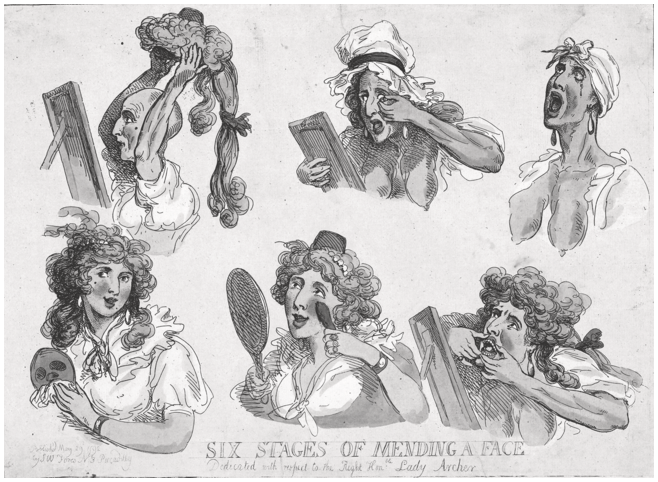
This disruption in the novel’s plotting of marriageable female subjectivity potentially changes the whole bent of the story. The topology of the orifice, as Cottom shows, frustrates Enlightenment projects to consign human and other material bodies to delineated systems of sense and distinction, whether narrative, graphic, or conceptual. Laughter does the same thing to the “privileged line” of the novelistic plotting of privatized subjectivity. For the same reason that Norbert Elias had difficulty accommodating laughter into his account of the Western “civilizing process,” the novel has difficulty domesticating laughter to sensibility, even when it successfully wrangles “satiric inclinations.” As Anca Parvulescu writes of Elias’s unfinished “Essay on Laughter,” “Elias knew that a focus on laughter does not simply repeat or strengthen the argument of The Civilizing Process, but rather twists it in important ways. Despite a clear prohibition against certain kinds of laughs, and in part because of it, the passion of laughter ‘returns’ repeatedly, such that, in the twentieth century, one can find a range of passional laughs, remnants of passion in a world of emotion.”Footnote 80 Laughter testifies to a reserve of humors within the subject that haven’t been conscripted into the modern order of things, passions that refuse to relinquish their social lives, whether the social body can account for them or not.
Evelina’s laughter signals that, whatever her epistolary self says, her body in its materiality hosts desires that are her but not hers. It shows us that she, like all living subjects, is made of more than what is proper to her subjective formation. In this way, her laughter is an example of the “practical consciousness” Raymond Williams locates within a given culture’s “structures of feeling”: a consciousness manifest in “what is actually being lived, and not only what it is thought is being lived.”Footnote 81 Laughter like Evelina’s carries a deep-seated awareness of cultural possibility, drawn from the social field in which the subject is constituted, that precedes articulation as a concept, or what Williams calls a “fixed form”; it reveals that aspect of subjectivity committed to registering, through disorganized and spontaneous feelings, “a particular quality of social experience and relationship, historically distinct from other particular qualities, which gives the sense of a generation or of a period,” a part of the subject in excess of the project of becoming coherent as a self-regulating individual within that social structure.Footnote 82 Laughter, in other words, serves as a reminder that the subject belongs to the social writ large as much as, if not more than, she belongs to herself, to any other individual, or to any particular mode, institution, or narrative of selfhood.
As practical consciousness, laughter moves the subject to express cultural logics that she may not cognitively avow or even understand; it carries ideas that are in her though they are beyond her. While the subject’s connection to broad structures of feeling is the foundation of radical possibility beyond what first-person narrative and characterization allow, the laughter in which this connection is manifested is not necessarily attached to a radical politics. The social dynamic of animal laughter is only politically promising because it is profoundly ambivalent. Evelina uses this ambivalence to cast suspicion on laughing bodies in the episode of Captain Mirvan’s infamously brutal prank on Madame Duval, which sees her frightened, abducted from her carriage, subjected to physical violence, and abandoned in a ditch, tied by her ankles to a tree. Burney devotes several pages to detailing the laughter of the people conspiring in this cruel joke: The footman “was evidently in torture from restraining his laughter,” Captain Mirvan returns from his assault of Madame Duval speaking “in a voice almost stifled with laughter,” and “the servants were ready to die with laughter” at her physical disarray following the attack (147, 148, 150). In contrast, throughout the episode Evelina suffers different feelings: “I was really frightened, and trembled exceedingly,” she tells the reader, and to Sir Clement she insists, “I cannot bear that she should be treated with such indignity” (147). When Evelina finds her grandmother in the ditch, she “flew to her, with unfeigned concern at her situation,” and chooses her next actions carefully, “being very unwilling to add to [the footman’s] mirth,” and regretful of the necessity of allowing the servants to see their mistress at all “so forlorn, so miserable a figure” (149, 150). Yet, for all this sympathetic care, when Madame Duval finally describes her horrific treatment by the Captain, “this narrative almost compelled me to laugh,” Evelina confesses, despite the fact that “I was really irritated with the Captain, for carrying his love of tormenting, – sport, he calls it, – to such barbarous and unjustifiable extremes” (152). Surging up against her will in a bid to join the laughter of those whose actions she condemns, in this case Evelina’s animal laughter responds to the prompt of misogynist glee.
Unlike her laughter at Lovel, which makes its shameful way out, Evelina’s laughter at her grandmother is successfully stifled. Instead of laughing, “I consoled and soothed her as well as I was able, and told her that, since M. Du Bois had escaped, I hoped, when she recovered from her fright, all would end well” (152). Burney’s alignment of animal laughter, in this instance, with such brazen callousness helps to advance the novel’s suspicion of all humors that resist being organized into economies of sentiment, and provides Evelina with an opportunity to show that she is now able to subdue her unthinking feelings as she composes herself into the sympathetic subject she wishes to be. By overcoming her compulsion to laugh, Evelina consolidates the scene’s lesson that uncontrolled social play tends to devolve into the worst kind of “sport,” and that there are better, less “barbarous” pleasures to be had in rituals of thoughtful consolation. Crucially, however, while the novel presents such demonstrations of sympathy to advance its protagonist’s maturation as a socially sensitive person, it provides little to no evidence that they contribute to the formation of social bonds. Madame Duval remains, despite Evelina’s kindness to her, an obnoxious connection; at the day’s end, Evelina is relieved when Lady Howard and Mrs. Mirvan take over the burden of being kind to her, allowing her to withdraw, with Miss Mirvan, “to our own room” (153).
The episode confirms the novel’s vision of the social world as the site of relentless tension and torment, where cruel humors proliferate unchecked, and from which one must retreat in order to find relief. At the conclusion of her account, Evelina resolves that in the future, when faced with the Captain’s violence, she will “by no means consent to be passive” (153), but the novel remains unable to narrate how she might publicly resist misogyny without deferring to the authority of better men.Footnote 83 Evelina’s desire to be less passive is subsumed by the marriage plot’s desire for kinder patriarchs; social problems will not be solved in this novel by women’s social movements. Yet if we read against the grain of this plot and allow Evelina’s desire to speak out against the Captain to collude with, rather than disavow, the image of her gaping, laughing mouth at the ball, we might find another route into better social life in the novel’s orificial topology. Rather than abandon laughter’s political promise in the wake of the Captain’s prank, how might we recommit to it, and what would such commitment generate?
This novel that testifies to the individual’s desire for private life casts a shadow narrative about her latent passion for publicity – a desire not to enter the world only long enough to find a permanent shelter from it, but fully to be in and of it. At stake in the divergence of these narratives is not merely the sovereignty of individuated female subjectivity or the satisfactions of its private life, both fantasies detailed fastidiously in novelistic writing, but, as Haggerty reminds us, the very possibility of community. The Enlightenment project to sublimate the humors through the scripting of sex and sensibility is a political intervention that strategically stymies the synthesis of subjectivities unpremised on the great divide of public and private life. Therefore, a counterpolitical response must be committed to the queer experience of undifferentiated spheres of social life. Just as The Ray distorts the forms of still life to propose “that the ideal line of geometry, the axiomatic shortest distance between two points, is more accurately to be seen as a grotesque, groundless, unaccountable passage through the swirling substance of the world,”Footnote 84 the spectacle of Evelina’s laughter threatens to transform the novel’s plot through the world toward marriage into an “unaccountable” exploration of worldly experience. The question remains, whether such unexpected passages can be formed into a counterpolitics to bourgeois individualism and the heterosocial class body.
A Monstrous Good Stare
The political commitment I am describing is radical, but that does not mean that it must be experienced as profound. On the contrary, as Evelina indicates, there is nothing heterosocial class culture is as eager to dismiss as what it calls frivolousness, or a kind of silly vulgarity. Pierre Bourdieu describes this revulsion as the bourgeois “disgust at the ‘facile.’” “It could be shown,” he writes,
that the whole language of aesthetics is contained in a fundamental refusal of the facile, in all the meanings which bourgeois ethics and aesthetics give to the word; that “pure taste,” purely negative in its essence, is based on the disgust that is often called “visceral” (it “makes one sick” or “makes one vomit”) for everything that is “facile” – facile music, or a facile stylistic effect, but also “easy virtue” or an “easy lay.” The refusal of what is easy in the sense of simple, and therefore shallow, and “cheap,” because it is easily decoded and culturally “undemanding,” naturally leads to the refusal of what is facile in the ethical or aesthetic sense, of everything which offers pleasures that are too immediately accessible and so discredited as “childish” or “primitive” (as opposed to the deferred pleasures of legitimate art).Footnote 85
Evelina’s laughter at Lovel is identified as tasteless in precisely these terms. Her open mouth allows evidence of vulgar sensation to puncture the ritualized rhythms of sensibility. “‘Pure’ taste and the aesthetics which provides its theory,” Bourdieu reminds us, “are founded on a refusal of ‘impure’ taste and of aisthesis (sensation), the simple, primitive form of pleasure reduced to a pleasure of the senses, as in what Kant calls ‘the taste of the tongue, the palate and the throat,’ a surrender to immediate sensation which in another order looks like imprudence.”Footnote 86 Sir Clement, the character most attuned to the female body’s vulnerability to being seized for “vulgar sensuality,”Footnote 87 captures this conflation of childishness, primitivity, and “easy virtue” in his observation of the “rustic” quality of Evelina’s laughter.
To pursue counterpolitics to the novel’s marriage plot, a plot premised on distinctions between “good” and “poor” taste, we must imagine a way for Evelina to escape Lord Orville’s gravity without conceding to Sir Clement’s predatory seductions. Niklas Luhmann writes of the fate of “love as passion” in the eighteenth-century novel, “the impossibility of its lasting makes love difficult, especially for the women. They have to become unhappy.… What is available as a ‘virtue’ is in truth an interest in permanence, in calmness.”Footnote 88 The ironically named Sir Clement serves as the bad weather that threatens women when they enter the sexual playing field; the menace that ensures passion is experienced as threat. Evelina inclines both its female protagonist and its readers toward Lord Orville because he embodies the promise of resolution extended by patriarchal recognition – a permanent shelter from the storm of desire.
The novel, of course, frames what Luhmann calls the “unhappiness” of dissipating passion as a form of liberation from confusing feelings. In this way, it complies with John Gregory’s declaration of paternal concern in his famous conduct book addressed to his daughters: “I do not wish you to have sentiments that might perplex you: I wish you to have sentiment that may uniformly and steadily guide you, and such as your hearts so thoroughly approve, that you would not forego them for any consideration that this world could offer.”Footnote 89 While Lord Orville himself seems initially put off by the “immovable gravity” he inspires in Evelina, this is precisely the effect that makes him a sexual beacon in the discombobulating world of London social life. When, at her second dance assembly, Evelina is teased to the point of “burst[ing] into tears” by Sir Clement, Lord Orville steps in and “immediately led me to a seat, and said in a low voice, ‘Be not distressed, I beseech you: I shall ever think my name honoured by your making use of it’” (49).Footnote 90 This episode provides an early, succinct summary of the novel’s marriage plot, according to which the sexual subject desires nothing more than relief from public stimulation.
It is thus significant that when faced with Mr. Lovel in Lord Orville’s presence, Evelina reports that “I could not for my life preserve my gravity.” Into the marriage plot’s rhythm of frenzy eclipsed by rest, the fop intrudes as a distracting form of restlessness, one not oriented toward resolution but veering unexpectedly away from it to ludic heights. In Mr. Lovel – the “odious creature who had been my … torment” (37) – Evelina finds her first encounter with queerness. In Burney’s novel, the queerness of Lovel’s foppishness is overdetermined. In the late eighteenth century, fops were well established in theatrical comedy and graphic satire as, in Haggerty’s words, “gender misfits,” connoting a contradictory combination of sexual deviancies that focused sometimes on women, sometimes on men, and sometimes on material fashion itself. In this period when, as Declan Kavanaugh has argued, “the authenticity of what Jürgen Habermas historicizes as the public sphere [comes to be] premised on the incommensurability of the effeminate with the private, reasoned, and manly citizen,”Footnote 91 the presence of fops, or foppishness, rendered the public social body as “unaccountable and perplexing” as embodied feminized selfhood. Moreover, as Emma Katherine Atwood argues, fops also present a form of “queer time that cannot be reconciled to [hegemonic, heteronormative] organizational models” of temporality.Footnote 92 When Lovel first approaches Evelina, he worries aloud that he may be “so unhappy as to address you too late,” when in fact he addresses her too early, before she is ready to participate in the ritual. Ever an ill fit with the timing of marriage plots on the stage, the fop sits oddly in relation to Evelina’s marriage plot as well, presenting an annoying male suitor who, despite the fact that the novel never suggests that he is a source of either sexual threat (like Sir Clement) or sexual promise (like Lord Orville), nevertheless refuses to leave Evelina alone.
When Mr. Lovel approaches Evelina and Lord Orville at the first ball, she finds him so outrageously funny that not only does she become distorted with laughter, but Lord Orville himself is for a moment transformed into a ridiculous object: “I could not help [laughing], for, added to the man’s stately foppishness … when I looked round at Lord Orville, I saw such extreme surprise in his face, – the cause of which appeared so absurd, that I could not for my life preserve my gravity” (34). Lovel’s capacity to amplify his own absurdity so that it seizes those around him poses a direct challenge to the sentimental or domestic novel’s economy of desire based on the gravity of sex. Berlant observes that when we tell a lover, “You make me feel safe,” it “means that I can relax and have fun where I am also not safe, where I am too close to the ridiculous, the disgusting, the merely weird, or – simply too close to having a desire.”Footnote 93 Evelina tries to preempt the possibility of this kind of erotic “safe space,” of sexual fun held electrifyingly close to subjective undoing, by introducing Mr. Lovel as the debased image of inconceivable desire. Burney throws the fop – the ridiculous, the disgusting, and the merely weird all in one – “too close” to her protagonist to illustrate how unsafe it is for her to be near him and to heighten the promise of safety in a good husband. In this instance, however, Orville provides no shelter. Instead, both he and Evelina are briefly disfigured into weird shapes that expose them as “too close to having a desire” for something beyond the purview of the narrative into which the novel conscripts them.
But what would that be? One possibility is hinted at in a later scene, when Evelina is separated from her friends during an outing to Marylebone Gardens and ends up in the company of sex workers. We must tease out the alternative vision of sexuality and public life contained in this episode, because the novel does not offer it up willingly. At this point in the novel, well into the second volume, Evelina is not laughing. Lost and separated from her friends, she wanders “in disordered haste, from place to place, without knowing which way to turn, or whether I went,” teased by impertinent men who take her for a prostitute, until one of them actually offers to “enlist [her] in my service” and “then, with great violence … seized my hand.” Terrified, Evelina breaks away and seeks shelter with “two ladies” who are nearby, but “when I observed, that every other word I spoke produced a loud laugh!” she catches on that, “to my inexpressible horror, … I had sought protection from insult, of those who were themselves most likely to offer it!” (234). The women “held me fast, that it was utterly impossible” to “escape,” at which point Lord Orville appears, “advancing our way.” To Evelina’s “infinite joy, he passed us by without distinguishing me; though I saw that, in a careless manner, his eyes surveyed the party” (235). Her likeness to a prostitute saves her, ironically, from the very shame that this likeness threatens to incur.
There is a measure of sexual impropriety in Evelina’s proximity to sex workers, even though it is so unwitting as to be, for her, a source of “inexpressible horror” and “terror, which I have no words to describe” (234). This scene stages the moral bind of women in public that John Gregory warned his daughters about through the example of laughing at the theater. “Sometimes,” he warns,
a girl laughs with all the simplicity of unsuspecting innocence, for no other reason but being infected with other people’s laughter: she is then believed to know more than she should do. – If she does happen to understand an improper thing, she suffers a very complicated distress: she feels her modesty hurt in the most sensible manner, and at the same time is ashamed of appearing conscious of the injury. The only way to avoid these inconveniences, is never to go to a play that is particularly offensive to delicacy.Footnote 94
For a woman laughing publicly, not getting a bawdy joke is just as bad as getting one if others around her suspect that she “knows” something. Thus Evelina insists that “had I, indeed, been sunk to the guilty state, which such companions might lead him to suspect, I could scarce have had feelings more cruelly depressing” (234). Being taken for a prostitute is the equivalent, for her, of being taken as a prostitute. Both states represent, for Evelina, the ultimate “unhappiness.” Yet, by her own logic, Evelina is confirmed to be “one of these unhappy women” in the very instant she seems to avoid being caught in that position: Lord Orville passes “without distinguishing” her precisely because he has taken her for a prostitute. Counter to her declaration that “I could scarce have had feelings more cruelly depressing,” Evelina responds to being conflated with her ostensibly horrifying companions “with infinite joy” (235).
This joy at not being recognized by Lord Orville accidentally aligns her with the vulgar pleasure of the laughing prostitutes. She is still not laughing, but the eruption of joy serves a similar purpose, lifting her out of the mandated morass of sentimental shame and horror as she registers with elation the odd indifference of the patriarchal gaze, its “careless manner” as opposed to grave concern. And even as the novel wishes us not to recognize this flash of joy as a form of wayward desire, the sex workers zero in on its implications immediately:
As soon as he was gone, one of these unhappy women said, “Do you know that young fellow?”
Not thinking it possible she should mean Lord Orville by such a term, I readily answered, “No, Madam.”
“Why then,” answered she, “you have a monstrous good stare, for a little county Miss.”
Echoing and sexually amplifying Mr. Lovel’s early distortion of Lord Orville into a ridiculous spectacle, the sex worker, following Evelina’s own “monstrous good stare,” transforms the lord into a vulgar “fellow.” Aligned with the sex worker’s perspective, released from the obligation to receive the nobleman’s recognition, Evelina’s eye dilates into an orifice that takes Lord Orville as a completely different kind of sex object – not a source of relief from worldly feeling, but a thing of material pleasure.
Evelina’s brief moment at the epitome of novelistic “unhappiness,” a companion of other “unhappy women,” provides a glimmer of another order of happiness. The novelistic trope of the sensible lord versus the audacious rake only allows for two models of functional masculinity: the aristocratic body as phallic placeholder for a name or the aristocratic body as sexual aggressor. If Lord Orville might be conceived, even just for a moment, as a material plaything rather than a name-bearer – a “fellow” rather than an ideal husband, a politically diminished penis rather than a phallus – then Evelina sustains for that moment the possibility of myriad undescribed forms of subjectivity, sexuality, and sociality. We know, from her laughter at Mr. Lovel, that Evelina’s body is vulnerable to being taken by its own wayward humors under certain kinds of provocation. Here, vulgar forms of sex and sexuality beyond the purview of patriarchal endorsement, as well as sudden fellowship with socially abject companions, are revealed to host feelings quite different from the expected “cruelly depressing.” It is a passing moment of queer optimism.
Despite the novel’s rejection of them, these pleasures are hardly mysterious to eighteenth-century culture of all orders. Lord Chesterfield, for example, strictly dismissed “frequent and loud laughter” as “the characteristic of folly and ill manners; it is the manner in which the mob express their silly joy at silly things.”Footnote 95 His aversion to the “silly joys” of the masses points to the counterpolitics Berlant finds in the “silly object,” which redirects aesthetic satisfaction (and the self-contained subjectivity it consolidates) into the unresolvable pleasures of aimless play (and the promiscuous social intimacies it generates).Footnote 96 When the prostitute demonstrates to an incredulous Evelina that it is, indeed, possible to turn Lord Orville into a “young fellow,” she introduces the novel’s clearest model for subverting patriarchal sexual order: to answer the lord’s gravitas with a laughter that treats him as a silly thing designed to serve one’s silly joy.
Enjoying His Mortification
Evelina’s capacity for a “monstrous good stare” – a capacity for grotesque joy – invites us to reconsider Lord Orville’s observation that in response to Lovel’s approach “she was seized with a fit of laughing, first affronting the poor beau, and then enjoying his mortification.” While Evelina’s written reflection on the episode refuses to credit this interpretation, Orville has noticed from the beginning the field of “enjoyment” the female subject must disavow in order to become eligible for patriarchal inscription: what Hélène Cixous calls the “laugh of the Medusa,” a radically generous embodied discourse that engulfs phallocentric abstractions and the hierarchies of power they authorize and dissolves them, or “mortifies” them, back into the field of material play.Footnote 97 If Evelina’s laughter at Lovel can be called satirical, it is perversely so: Rather than annihilating Lovel, it gives her over to him at the same time that it fixes him to her. The question Burney conspicuously avoids asking is whether a young woman who laughs like Evelina might encounter her own grotesque materiality with pleasure rather than pain. By turning Evelina into a laughing spectacle, Lovel presents the possibility that her body may be for things other than marriage, sympathy, shame, and other patriarchal conscriptions. Learning to enjoy his company would necessarily be part of an autoerotic pedagogy, as she would simultaneously learn to enjoy the most shameful pleasures afforded by her own body.
At the same time, this lesson extends outward to a collective erotic pedagogy that radically rewrites the dynamic of men’s perpetual gaze upon women in the marriage market. The first thing Evelina feels at the ball, before any of the drama unfolds, is irritation at how “the gentlemen, as they passed and repassed, looked as if they thought we were quite at their disposal, and only waiting for the honour of their commands.” She determines then “that, far from humouring such airs, I would rather not dance at all, than with any one who would seem to think me ready to accept the first partner who would condescend to take me” (30). Her clearly stated preference not to participate in this mating ritual gestures, Bartleby-like, to an unrealized shadow narrative in which Evelina is allowed to commit to this early determination to opt out of the marriage economy. In this nascent non–marriage plot it is a stroke of good fortune that she is first approached in such a queer way by Lovel, whose “dress was so foppish, that I really believed he even wished to be stared at”:
Bowing almost to the ground with a sort of swing, and waving his hand, with the greatest conceit, after a short and silly pause, he said, “Madam – may I presume?” – and stopt, offering to take my hand. I drew it back, but could scarce forbear laughing. “Allow me, Madam,” continued he, affectedly breaking off every half moment, “the honour and happiness – if I am not so unhappy as to address you too late – to have the happiness and honour –”
Again he would have taken my hand; but bowing my head, I begged to be excused, and turned to Miss Mirvan to conceal my laughter.
Lovel’s “silliness” breaks the stifling rhythms of heteronormative cruising. His ostentatious dress invites a woman to stare at him rather than submit to his stare; his hesitant and halting manner dissipates the gravity of men’s condescension to women, of “the honour of their commands.” Lovel ushers in the orificial logic that generates Evelina’s laughter. In his affectation, by turns “swing[ing],” “waving,” and halting, as Cottom says of The Ray’s strokes, “straight lines are shown to hesitate, yield, drift”; his undulating mishandling of the relation between “honour and happiness” (or is it “happiness and honour”? or is he already “unhappy”?) diverts privileged lines of heterosocial emplotment into the narrative equivalent of a “dreamy geometry” that loses focus on gendered – which is to say, happy and honorable – subject formation. If there could be a novel that privileged Evelina’s encounter with Lovel, and contoured it with feelings other than shame, its story could be: Boy unfurls spectacularly before girl; girl laughs with surprise and delight; their perversions embrace each other; no one “takes” or is “taken.”
Such a story must reorient the affect not only of Evelina’s laughter, from satirical to grotesque, but also of Lovel’s mortification, from devastating to kind of fun. My wager is that if Evelina’s laughter can be unfastened from novelistically mandated shame, so too can Lovel’s humiliation. Haggerty argues that “the refusal to enter a legitimate negotiation with members of the opposite sex renders [the fop] ridiculous in Burney’s world: at best he is silly; at worst, a dangerous and threatening alternative to gendered clarity.”Footnote 98 Haggerty means “silly” the way the novel wants us to understand it: the mark of something dismissible, something that may be abjected with the light touch of amusement. But Evelina’s laughter at Lovel, as we have seen, is not light at all. The conventional economy of silliness fails in this instance because Lovel’s silliness is too entangled with his threat to clarity; instead of resolving the problem the fop poses, Evelina’s laughter amplifies it into a proper problematic, one that supports the theorization, if not of a “legitimate negotiation” between fops and women, then, more promisingly, of an illegitimate one.
If Evelina laughs like a Medusa, then Lovel’s foppishness privileges him as precisely the kind of man who might enjoy playing this game, because he was never in possession of the phallus to begin with. King shows how, into the emergent heterosocial order and its untraditional demarcations of private and public life, the fop functions as the bearer of “residual pederasty”: a previously dominant principle of social order in which public recognition was conferred by “status bodies” – that is, bodies of noble blood – upon other male bodies through formal, public displays of “erotic proximity.” As the emergent liberal public sphere replaced these courtly sexual “networks of super- and subordination” with “representations of the gendered pleasures (or ‘feeling’) of private men and women – pleasures that originated in the intimacy of the domestic home space,” two important changes happen to the cultural reproduction of status, changes codified in the novel: One, the subordinate man is replaced by a woman, and two, the instrument by which status is conferred is abstracted from the eroticized body to the name conferred by marriage.Footnote 99 The fop thus serves as a reminder of how bodies might share – via erotic proximity and uncontingent on gender difference – public status: “The proximity of women and effeminate men suggested that identification and desire could be aligned. Their friendship argued that men’s derivation of liberal identity from their shared possessive relation to women and the domestic sphere could never be fully successful.”Footnote 100
Read together, Evelina and Lovel model a partnership of queer bedfellows whose shared pleasure is so committed to public life that it need not even be taken to bed. Evelina carries residual humors, with different ideas about what a woman’s body is for, into the world of the novel; Lovel carries residual presumptions about male deference, erotic performance, and indifference to marriage as legitimate ways of pursuing public recognition. The fop expands a Cixousian vision of humoral female subjectivity into a theory of radical community, while the laughing Medusa (in the queer version of Evelina, maybe she enjoys having her hair done!) insists on a place for all versions of monstrous embodiment in this community and its erotic networks. Such formations, both subjective and collective, would not insist on happiness, pleasure, or any other unified category of feeling, signifying relief, as a condition of their functionality – unlike John Gregory, queer social orders do not wish away perplexing feelings. But important forms of fellowship would emerge through an alternative economy of pleasure in which Evelina could enjoy animal laughter’s subversion of dignity, and Lovel, catching her joy, could show men how to share, with women and with each other, the joy of playful submission – of being another’s toy – as a form of public affirmation.
Tickling, or The Unbearable
Because the novel, like the heterosocial order it champions, is motivated by resolution, it must elide the difference between things that perplex and things that harm. Abandoning the cruel optimism of the marriage plot therefore requires models of engagement, both hermeneutic and social, that privilege suspense and uncertainty – not under the aegis of a high poetics, as Romanticism imagined, but in more “facile” ways.
One model can be found in Adam Phillips’s description of the phenomenon of tickling:
Through tickling, the child will be initiated in a distinctive way into the helplessness and disarray of a certain kind of primitive pleasure, dependent on the adult to hold and not to exploit the experience. And this means to stop at the blurred point, so acutely felt in tickling, at which pleasure becomes pain, and the child experiences an intensely anguished confusion; because the tickling narrative, unlike the sexual narrative, has no climax. The child, as the mother says, will get hysterical.Footnote 101
John Gregory does not approve of tickling, and wishes for his daughters to let their “hearts” guide them steadily through and past such perplexing situations. Burney’s novel concurs, plotting its heroine’s and readers’ way toward steadier feeling. And yet, as I have argued above, the initial encounter between Evelina and Lovel may be read as one of the great tickling scenes of English literature.
It is, significantly, a scene of mutual tickling. Because tickling, though pervasive, is unsanctioned in Evelina, there is no “adult” controlling the scene; Evelina and Lovel drive each other into a shared “intensely anguished confusion” that temporarily stymies the sexual narrative. This is why the model of satire quickly proves inadequate to explain Evelina’s laughter at Lovel: Power is so disorganized in this encounter between social nobodies that, rather than one taking pleasure in another’s pain, both their pleasures and pains become blurry. Is Lovel’s halting, repetitive speech painfully inept, or a sign of the excessive pleasure he takes in his own public manner? Is Evelina’s uncontrollable laughter a crueller delight to Lovel or to her? Tickling offers a way of accounting, as the novel cannot, for the myriad ways subjects might enjoy their mortification.
Just as this way of (dis)organizing social encounters affords new possibilities for relating to others, so does this way of reading afford new approaches to the most “unaccountable and perplexing” scenes from eighteenth-century novels. Take, for example, the infamous “monkey scene” toward the end of Evelina, in which Captain Mirvan brings a monkey dressed up like Mr. Lovel to a party, and the monkey brutally attacks Mr. Lovel, to the delight of some and the horror of others.Footnote 102 The cruel narrative of the Captain’s prank is clear. Earlier in the novel, in an argument with Lovel over the merits of France, the Captain scoffs that over there, “the men, as they call themselves, are no better than monkeys; and as to the women, why they are mere dolls.” For Captain Mirvan, foppishness, Frenchness, and monkeyness are synonymous, signifying identical forms of opposition to English masculinity, and, more broadly, naturalized gender distinction in general, which for him is the mark of humanness itself. The satire is meant to reaffirm the boundaries protecting English life from the encroachment of strangeness. Yet, as both Laura Brown and Susan Greenfield have shown, the monkey, possessing a life of its own, exceeds the design of the Captain’s mockery, wreaking havoc in a way that opens up (for Brown) the whole “problematic of intimacy and difference in the eighteenth-century imagination”Footnote 103 and (for Greenfield) the “instability of human identity [that] proves too pervasive to be resolved.”Footnote 104 As a result, the novel’s progress toward marriage, just as it seems more certain than ever, becomes momentarily lost in the text’s heaviest flirting with queer ideas.
The monkey provides precisely the kind of “shock” Edelman describes as sexual: “experiencing corporeally, and in the orbit of the libidinal, the shock of discontinuity and the encounter with nonknowledge.” For Lovel, the horribly shocking encounter with the monkey is preceded by a poignant curiosity that indicates a desire for a form of fellowship he had never before imagined:
[Mirvan:] “Pray, have you e’er a brother in these here parts?”
[Lovel:] “Me, Sir? – no, thank Heaven, I’m free from all encumbrances of that sort.”
“Well,” cried the Captain, “I met a person just now so like you, I could have sworn he had been your twin brother.”
“It would have been a most singular pleasure to me,” said Mr. Lovel, “if I also could have seen him; for, really, I have not the least notion what sort of a person I am, and I have a prodigious curiosity to know.”
This is, for Lovel, an uncharacteristically calm assertion of a radically undetermined desire: His arguably anxious acknowledgment that he has no “notion what sort of a person I am” is settled, and made peaceful, at the crux of “a most singular pleasure to me” and “a prodigious curiosity to know.”Footnote 105 Lovel models in this extraordinary line an answer to Barbara Johnson’s question of how to plot our own unpredictable, yet vital, encounters with what we do not yet know: “How can one set oneself up to be surprised by otherness?”Footnote 106 With uncharacteristic elegance, Lovel invites “discontinuity and the encounter with nonknowledge” by disavowing any stable understanding of himself, so that whatever kind of other might appear, it can be received with pleasure (instead of, or in addition to, shock) as a fellow, a version of the same. As Derrida insists in a line I have repeated throughout this book, such a posture is not merely a social one but a political one, enabling the kind of radical hospitality that holds both oneself and the world open to being otherwise: “to be hospitable is to let oneself be overtaken, to be ready to not be ready, if such is possible.”Footnote 107 If Lovel is inconceivable even to himself, then he may be strange to everyone else, but no one is completely strange to him.
In this moment, before the monkey brings chaos, Lovel brings the novel as close as it ever comes to articulating an alternative subjective posture for Evelina, a fellow nobody (suspended, for just one episode longer, between men’s names).Footnote 108 If “not having the least notion what sort of person I am” could position her not as disciplinarian over the versions of herself that cause confusion, but rather as radically open to confusion, to being given multiple ideas of who she could be by the world’s variety of unexpected others, Evelina could tell some very different stories. Brown observes this flicker of possibility in the conclusion of her essay. “What is [the] significance,” she asks, of Lovel’s uncertainty, of his potential intimacy with the monkey, “for Evelina?”
Not that Mr. Lovel is a figure for Gulliver as he tests the limits – or limitlessness – of the human, or for the woman carried off to be raped by the orangutan in the ape-human miscegenation myth. Not that the monkey’s resemblance to the beau suggests that Evelina is on the verge of marrying an ape rather than “the best of men,” or that the monkey’s monstrousness indicates an aversion to marriage in the midst of the marriage plot, or that Evelina would prefer to kiss the monkey than her future husband, or that the marital embrace might be an act of violence. Not that the monkey signals the problematic nature of intimacy as it is shaped by the experience of modernity, where any connection between beings generates fundamental questions of identity and difference that involve the idea of being itself. It is impossible to reconcile these aspects of the aura of the monkey anecdote with the affirmation of marriage, manners, and patriarchy with which Evelina ends.
Except to imagine that affirmation as a more strenuous effort, more speculative and experimental, more richly allusive and fully contemporary, and more vitally engaged with the experience of alterity, than the conventions of domestic fiction seem to warrant. In this view, any of the former scenarios is possible, because Evelina’s monkey means much more than Evelina can say.Footnote 109
Lovel’s expression of “prodigious curiosity,” joined to “a most singular pleasure,” to meet the stranger (who turns out to be a version of himself as a monkey) is the novel’s most open invitation for anything in the world to happen. The brutality of the scene that ensues, and the misery into which it plunges Lovel, seems in this context like a monstrous version of Evelina’s own corrective blush – an aggressive gesture to stanch the influx of unanticipated implications the novel seemed, for a moment, to welcome. The novel’s cruelest stroke is its granting Lovel’s earnest wish to meet his other-as-brother, to be surprised, with an encounter defined only by terror and mutual violence.
Yet there remains plenty of undisciplined material in the scene that may be tickled into other formations – it is another episode with a kind of “dreamy geometry” that rewards perverse reading. When Captain Mirvan, “to the utter astonishment of every body but himself, … hauled into the room a monkey, full-dressed, and extravagantly, à la mode!” the “dismay of the company was almost general,” Evelina reports, but it takes a wide array of forms:
Poor Mr. Lovel seemed thunderstruck with indignation and surprise: Lady Louisa began a scream, which for some time was incessant; Miss Mirvan and I jumped involuntarily upon the seats of our chairs; Mrs. Beaumont herself followed our example; Lord Orville placed himself before me as a guard; and Mrs. Selwyn, Lord Merton, and Mr. Coverley, burst into a loud, immoderate, ungovernable fit of laughter, in which they were joined by the Captain, till, unable to support himself, he rolled on the floor.
The spontaneous choreography of the group scatters the plot line into a spectacle of unexpected intimacies and resemblances: The monkey mimics Lovel, first in dress, then in violence. Evelina and Miss Mirvan “jump involuntarily” as one. Orville emerges as uncharacteristically physically assertive when, “seizing the monkey by the collar, [he] made him loosen [Lovel’s] ear; and then with a sudden swing, flung him out of the room” (401). The trio of Mrs. Selwyn, Lord Merton, and Mr. Coverly collectively supply the “loud, immoderate, ungovernable fit of laughter” that blurs the distinction between the depraved aristocracy and Chesterfield’s silly mob. And in their shared fright, Mr. Lovel and Lady Louisa seem to melt into one voice, both crying, “I shall die!” so that “it was impossible now to distinguish whose screams were loudest, those of Mr. Lovel, or of the terrified Lady Louisa, who I believe, thought her own turn was approaching” (401).
The way this scene lends itself to grotesque possibilities beyond the aims of the Captain’s satire is captured and enhanced by the illustration included as a frontispiece to volume 3 in the novel’s fourth edition (Figure 3.2). The image focuses on what Brown calls the “shocking embrace” of human and nonhuman, the typical climax of representations of these relationships “characterized by a movement between distance and proximity.”Footnote 110 But there is a tickling quality to the image that captures some of the scene’s most striking movements without delivering the shock of climax. The congregation of chorus-like laughers is sketched behind the grinning Captain, but there is no sign of their immoderate “burst.” Evelina and Maria clutch each other but they look down on the scene together with remarkable placidness. Orville’s reach of concern is depicted as an echo of the Captain’s display of his accomplishment; the slightly different expressions on their faces joined to their almost identical stances make them appear to model two alternative ways of beholding the spectacle of the monkey’s embrace of Lovel. Perhaps most importantly to the curious but anticlimactic quality of the image, the look on Lovel’s face is deeply ambivalent: It could as easily be a smile as a grimace of trepidation.
Frontispiece to Evelina, 4th ed., vol. 3.
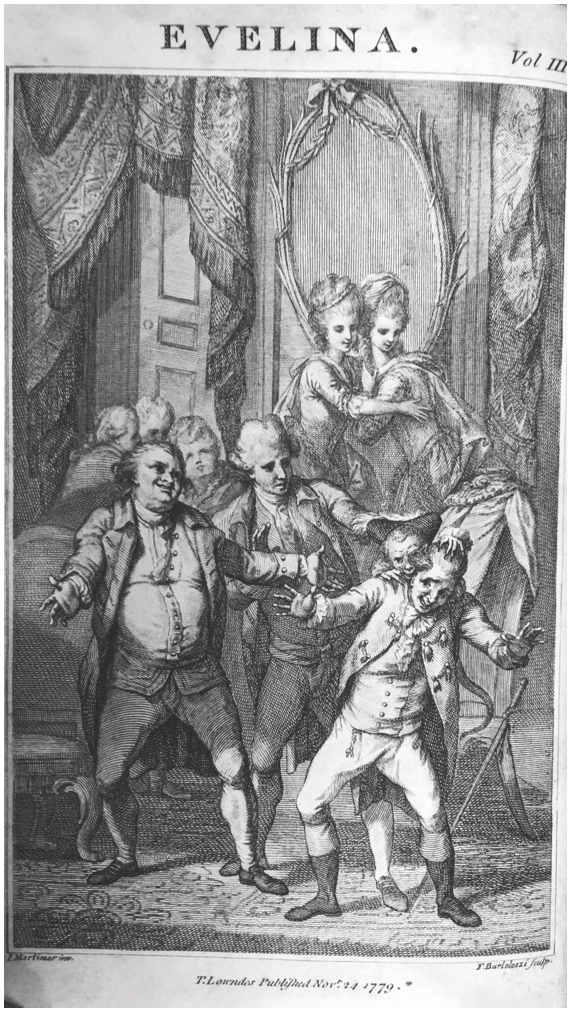
By eliminating the “shock value” of the novel’s scene, the illustration in some measure vindicates the queer promise of Lovel’s invitation to his strange double. If we allow the image to replace the violence and frenzy on which the novel insists with this funny collective posture of patient anticipation, we can read Evelina’s attention to Lovel’s encounter with the monkey as a kind of pedagogical engrossment. Greenfield calls attention to the way the illustration substantiates the text’s suggestion that “the heroine and the monkey are twinned in their joint roles as twins.”Footnote 111 Evelina, whose “striking” “likeness” to her dead mother has greased the machinery of the marriage plot, is presented here as the twin of her friend Maria Mirvan, Evelina’s professed “second self.” “In the frontispiece,” Greenfield observes, “the women before the mirror look identical, making it impossible to distinguish which one is the heroine.”Footnote 112 The image of a female figure embracing her mirror image in front of a mirror generates an odd topography that implies a fantasy narrative in which the reflection has emerged through the mirror to be embraced. The mirror here is a reprise of what happens to Evelina’s face when it is seized with laughter, as well as what happens to her epistolary text under the pressure of queer reading: A reflective surface has been transformed into an orifice.
Freed from staring at her own reflection, the heroine is repositioned simultaneously to embrace another woman and to refocus her attention on Lovel. From the beginning, Lovel has served as the monkey on Evelina’s (and Evelina’s) back: the “odious creature” who won’t leave her alone, who punctures the marriage plot’s gravity by tickling animal laughter out of her, who demonstrates that women may mortify men instead of themselves, not to dismiss them but to embrace them in dangerous play. In her first encounter with him, Evelina scoffs that Lovel presents himself as someone who “even wished to be stared at”; now, in her last, she indulges him in this wish. The illustration’s depiction of this final encounter also reprises the fantasy that men, including Lord Orville, could serve as instructive playthings for a community of women, as the two female figures are drawn together, wearing their own ambivalent smiles, to share a look at the strange games men play with each other when they are not fixated on taking women. As his body is unceremoniously clustered with the Captain’s, Lovel’s, and the monkey’s, Orville’s leg hilariously supplies an exaggerated phallic supplement to Lovel’s body. Compensating for the novel’s relentless emasculation of the fop, the illustration’s mock-cock suggests, perversely, that maybe there is much more going on in this novel than we knew, and that Lovel is the hero after all.
Significantly absent from the scene is Sir Clement Willoughby, the rake. His absence underscores the suggestion, embodied throughout the novel in Lovel’s pestering presence, that Willoughby is not the world’s only alternative to Orville after all – that rape or prostitution are not necessarily the logical conclusions of a woman’s failure to privatize herself through marriage. Lovel is a radical inclusion in this novel because he is the marriage plot’s transformative third term. Only under the purview of his queer authority is a woman available to truly other sexual economies, ones focused on shared public participation rather than misogynist competition over ownership of women’s bodies. Under Orville’s patronage, the novel aggressively privileges the marriage plot, refusing the silly stuff. But under Lovel’s, the novel becomes a much odder creature with radically uncertain notions of what women and their bodies are for.
We don’t know for certain what kinds of feelings may be passing through the orgiastic assemblage of characters in the illustration of the monkey scene because the novel will only narrate those that contribute to the marriage plot. In the novel, the eruption of animal spirits must be met with fear, shame, outrage, and ridicule. But what if the monkey’s open mouth, like Evelina’s laughing mouth, were imagined, momentarily, not as a threat but as an invitation to play at games the group has not yet imagined? Like the spectral smiling face on the open belly of Chardin’s fish, this is a solicitation to an encounter both terrifying and hilarious; the threat of harm, even death, has not been neutralized but exploded into a simultaneous promise of unbearable life.
The Novel’s Queerer Theories
Classical satire was invented to prevent the unholy union of women’s bodies and animal spirits from finding purchase in public life. Recall Horace’s opening to the Ars poetica:
If a painter were willing to join a horse’s neck to a human head and spread on multicolored feathers, with different parts of the body brought in from anywhere and everywhere, so that what starts out above as a beautiful woman ends up horribly as a black fish, could you my friends, if you had been admitted to the spectacle, hold back your laughter?Footnote 113
Evelina demonstrates that no, in the face of such grotesque spectacle, one probably cannot hold back one’s laughter; but it also demonstrates that laughter, honoring its own descent from grotesque embodiment, is at least as given to exploding cultural boundaries as it is to policing them. The “horrible” possibility of the most unnameable passions claiming political space, representable through the grotto-like orifices that gape shamelessly on women’s and animals’ bodies alike, finds in laughter a vehicle into social discourse.
The novel’s mission to humiliate spectacular bodies follows this long tradition of refusing dignity to “unnatural” appearances. Evelina and Lovel are first thrown together to set the machinery of public shame (privatized as a form of feeling) into action: Evelina’s laughter, read as satirical, assaults the presumption of his affected self-performance; his furious command that she “Refrain … refrain!” lets her know that she, too, is out of order. Under the weight of mutual discipline, both female nobody and fop understand that there is no way for them to participate in the rituals of public life without embarrassing themselves. But as Sara Ahmed observes, the “moment of queer pride is a refusal to be shamed by witnessing the other as being ashamed of you.”Footnote 114 As I have attempted to demonstrate, a way of reading that refuses to collaborate with the novel’s insistence on shame as the natural consequence of such appearances, behaviors, and encounters queers characters in delightful and politically promising ways.
Unraveling the culture of sensibility’s distinctions between natural and unnatural feeling, animal laughter – counter to satirical laughter – promises to transform any example of odd coupling, of strange bedfellows, into a viable public form. Releasing Lovel from his terror in the monkey’s embrace, or releasing Evelina from her discomfort in the presence of fops, delivers small consolations that may be tickled into more significant cultural interventions. As Haggerty argues, what is at stake in Burney’s novel is the very possibility of community in a society organized along sexual lines that discipline the contours of coherent, gendered subjectivity. In Haggerty’s words, “The friend, the fop, and the feminist … mark enjoyment for the heroine, but they also mark her undoing.”Footnote 115 The key to pushing the bounds of inconceivable selves and relations is not to tether them to dispassionate optimism – a promised dissipation of pain, fear, conflict, division, displeasure, or any other failure of satisfaction. A community tickled together must be riddled with failure because it refuses to refuse to fail; learning to enjoy the collective mortification of a sociopolitical assemblage that never gets it exactly right is a version of what Halberstam calls “the queer art of failure.”Footnote 116 If this failure to achieve sociopolitical coherence occasionally feels frustrating or infuriating, those feelings may coexist with the pleasure of knowing that what we are failing at is, ultimately, arriving at fascism.
In the courtship novel, opting out of the mandated optimism of the marriage plot depends on the subject’s capacity to commit to unbearable affinities. If a character like Evelina could make such a commitment, then men like Lovel become recognizable as another viable form of masculinity, one that endorses certain kinds of play while remaining vulnerable to the inevitable pains that hard play brings. Evelina, too, must learn to play with herself in order to learn how to play with others, and Lovel seems to be the best partner for her in this endeavor.
What if Evelina, eased into playfulness by a perplexing day out with women sex workers and male milliners, could simply enjoy the experiment of having her hair done?
Let us return to Evelina’s account of first “Londoniz[ing]” herself by going shopping and having her hair dressed. The novel encourages us to interpret this letter as a testimony to the gendered pleasures of an emergent commercial culture, a light satire of the effeminate demeanor of the men immersed in that culture, and a self-deprecating, inoculating reflection on the oddity of the commodified self. But we can play differently with the material the novel provides. How does the scene read if we entirely suspend the condescending bite of satire, and hear every observation as radically (we might feel, impossibly) generous?
At the milliners, the ladies we met were so much dressed, that I should rather have imagined that they were making visits than purchases. But what most diverted me was, that we were so much more frequently served by men than by women; and such men! so finical, so affected! they seemed to understand every part of a woman’s dress better than we do ourselves; and they recommended caps and ribbands with an air of so much importance, that I wished to ask them how long they had left off wearing them!
The dispatch with which they work in these great shops is amazing, for they have promised me a compleat suit of linen against the evening.
I have just had my hair dressed. You can’t think how oddly my head feels; full of powder and black pins, and a great cushion on the top of it. I believe you would hardly know me, for my face looks quite different to what it did before my hair was dressed. When I shall be able to make use of a comb for myself I cannot tell, for my hair is so much entangled, frizled they call it, that I fear it will be very difficult.
Conrad Brunström has called attention to the way Burney uses scenes of shopping, beginning with this one, to experiment with forms of “play” that open onto, even if they do not represent, queer social postures and relations.Footnote 117 For him, some of the most risqué exercises are Burney’s sketches of women who go shopping without buying anything, opting instead, as the ladies do in this passage, to treat it as a mode of “visiting” with one another, or to take pleasure in things “without paying for it.”Footnote 118 I am proposing that we extend this form of play to embrace the “finical” and “affected” manner of the milliners as a wonder from Evelina’s perspective, not a repulsive aberration. Certainly her punctuation in the first paragraph of this passage supports such a reading, leaning as it does into repeated exclamation points, which, then as now, encoded a feminized kind of lack of sophistication. A 2006 study of online discussion groups by Carol Waseleski confirmed that women “use exclamations significantly more than” men in social textual discourse, but noted that, counter to earlier interpretations of this trend, “the results of this study do not support the notion that exclamation points function solely or even primarily as markers of excitability.” Instead, Waseleski concludes, “female online discourse style is characterized by ‘supportiveness,’ which includes ‘expressions of appreciation, thanking, and community building activities that make other participants feel accepted and welcome.’”Footnote 119 In Evelina’s exclamation points, I see the unorganized energy of excitability becoming available, in eighteenth-century scenes of social encounter, to these postures of invitation and hospitality toward others. In this mode, Evelina might experience the surprise of the milliners’ gender performance, and the masterful “dispatch” of their labors, as “diverting” without any trace of contempt.
If Evelina can be read as an earnest student of London’s queerer subjects, then her experience of her own dressed hair may too be reclaimed from the domesticating force of satire. Graphic satires, such as “Bunters Hill or May Day” (1776), routinely made fun of the kind of hairstyle Evelina bears, emphasizing not only their disproportionate size but also the way they incorporated all manner of objects, creatures, and even other people (Figure 3.3). Could we read such images as sketches of promise rather than ridicule?Footnote 120 Not as advertisements for vanity or social competition, but as arresting icons of a promise that women’s bodies are capacious enough to give themselves earnestly, as the male milliners do, to public and collaborative activities including both work and play? To be fully immersed in embodied public participation may well feel “oddly,” as Evelina says, but surely such a feeling is better than fear or shame. Could we conceive of Evelina’s uncombable hair, so diligently “frizled” by her hairdresser’s amazing labors,Footnote 121 not as an inconvenience to her private self but as an homage to how majestically even “a little county Miss” may unfurl into untold forms of public life?
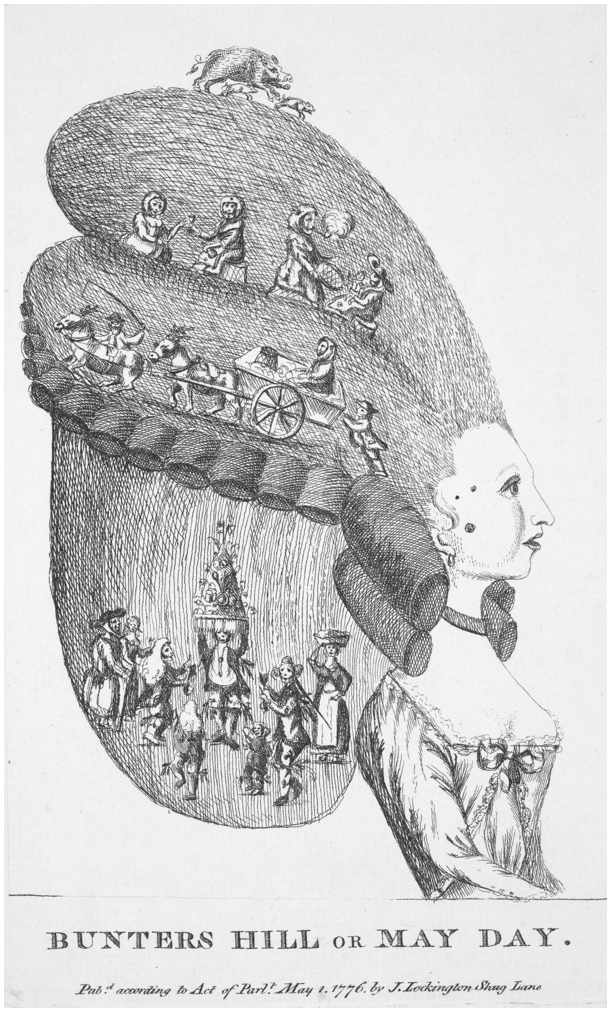
I am trying to imagine Evelina as an emergent Medusa, a woman learning to live as an assemblage, whose body is at once hers, and a thing with its own surprising life, and the world’s creature. What if Evelina didn’t reflexively abject the odd forms of her public presentation, shaped through the shared labors of friends, fops, and feminists? What if she devoted energy to identifying with the versions of herself that materialize in shared public spaces? What if being both an object and host of queer pleasure and fellowship was, following the example of Lovel, something she could imagine her own body being for?
The novel doesn’t endorse any of these possibilities, but it must theorize them because its plot is premised on the threat of the unbearable. There are ways of reading that may yet tickle them out. Approaching the text prepared to sustain play into the realm of the unbearable, experimenting with the possibility of irresolution – these are fun ways of reading that are also commitments to new orders of public life. We may learn through our encounters with texts (as well as with other kinds of others) to experience perplexity and its confusion of pleasure and pain as something other than the threat of harm. Forms of shared experience – subjective, sexual, social, and political – normally rendered inconceivable by the structures of social fear that compel us along cruelly optimistic lines might, under these conditions, flourish into viability.
Undoing Whiteness
Where Evelina’s paragraph about London milliners is marked by exclamation points, my own prose in the preceding section is riddled, even more heavily than usual, with question marks. It just came out this way, but I decided in rereading not to edit them out because they show me that at this point in my reading of Evelina, I have more questions than conclusions. Or, more accurately, that my conclusions are questions, and that my concluding move must be an effort to hold Burney’s novel open as question. I began Part 3 by announcing my intention to read the novel perversely; treating it as unresolved question rather than resolved narrative is perhaps the most basic way of perverting the courtship novel’s designs. So far, however, I have attended more to the novel’s disavowed conclusions – the endings and arrivals made imaginable by the questions the novel itself is asking. Is it possible to play even more irreverently with a text like this, to tickle it into asking (for) more?
The main question confronting me at this point is what I can say – what I must say – about race in my reading of Evelina. Despite – or, perversely, because of – the novel’s prohibitions on Evelina’s consorting with “friends, fops, and feminists,” this is precisely the crowd that has assembled around Evelina in scholarly work on the novel. But, while many critics of heteronormative patriarchy have found Burney’s novel good to think with, one glance at the bibliography on which I have (gratefully) drawn in Part 3 so far reveals that the novel does not lend itself in the same way to thinking critically about whiteness as it intersects with heteronormative gender and sexuality. Nevertheless, Evelina’s determination to generate its heroine’s subjectivity through her capacity to exist in the world without becoming “undone” is, unquestionably, as much a commitment to producing Evelina’s whiteness as it is to producing her femininity.
What company would have to gather around this novel to put critical pressure on the racial fantasy that infuses its marriage plot, its heteronormative aspirations?
As I have shown, the novel actively flirts with the possibilities of Evelina’s proximity to a queer public that is undeniably present in late eighteenth-century London social and commercial life. But its imagination does not extend to the boundaries of whiteness in the same way; it rehearses all its considerations of sex, gender, and social and national belonging within the parameters of an exclusionary racial logic it takes rigidly for granted. To soften and distort these boundaries requires exposing Evelina not only to ways of being that it resists, but to ways of being of which it cannot even conceive. I have in mind an expansion of Haggerty’s “friends, fops, and feminists,” as a designation of the novel’s potential intellectual community, to the radically undesignated “we” imagined by Wendy Trevino as a form of political solidarity:
what I am trying to say is that we should really think about who our friends are. What I am trying to describe is what is described in Tiqqun’s Call as “the we of a position.” A “we” that includes people we do & don’t like. A “we” that includes people we haven’t met yet & people we will never meet. A “we” that sees the hierarchy of the fields & calls bullshit without being dismissive of its bullshit effects. A “we” that is aware of other fields.Footnote 122
To make the material of Evelina available to such a “we” – we readers whom Burney could never have conceived as part of her readership, we the novel wouldn’t like if it could imagine us, we equipped by our unimaginable, incomprehensible knowledge to call bullshit on the novel’s own hierarchy of fields without being dismissive of those bullshit effects – we would have follow through on the queer promise of Evelina’s laughter and gut the novel in the manner of Chardin’s Ray. We can only make Evelina available to antiracist thinking by refusing its preferred contours, by turning them inside out. What I am trying to describe is the novel as orifice: it doesn’t “add” anything to our understanding of racialized viscerality, embodiment, or queerness, but it may be capable of opening itself onto such thought, to receive it and to be transformed by it.
***
How do we know that Evelina is white? This is not a trick question. She unequivocally is. In contrast to Burney’s later novel The Wanderer (1814), whose heroine enters the story in blackface and subsequently reveals her “brightest, whitest, and most dazzling fairness” to the other characters and the reader alike,Footnote 123 in Evelina there is no scene explicitly devoted to placing the protagonist on the emergent colonial racial matrix through which white liberal personhood is generated by the material conditions of enslaving Black people as a source of labor and seizing Indigenous lands as property. But, though The Wanderer does include such a scene, its turning the race of its heroine into a visual gimmick is also an imperialist sleight of hand. Neither Juliet Granville nor Evelina Anville is white as an effect of her appearance; they are white because they are written at the perpetual edge of being socially “undone” without ever risking their legibility as human beings.
This fact becomes clear when we consider Evelina’s orificial imagination in relation to what Zakiyyah Iman Jackson describes as “the plasticization of black(ened) people at the register of sign and materiality” – a phenomenon, Jackson argues, that “is central to the prevailing logics and praxis of the human and sex/gender.”Footnote 124 Jackson challenges us to
take seriously the particularization of gender and sexuality in black(ened) people in the context of a humanism that in its desire to universalize, ritualistically posits black(female)ness as opacity, inversion, and limit. In such a context, the black body is characterized by a plasticity, whereby raciality arbitrarily remaps black(ened) gender and sexuality, nonteleologically and nonbinaristically, with fleeting adherence to normativized heteropatriarchal codes. In such a context of paradoxical (un)gendering, and by gendering I mean humanization, power only takes direction from its own shifting exigencies – a predicament that might be described as chaos. This chaos by design is used to marginalize black(ened) genders and sexualities as the border of the sociological: a condition I refer to as ontologized plasticity.Footnote 125
When Evelina worries the possibility that Evelina’s body might dilate grotesquely in its encounters with the world, or that Lovel might be too closely related to a monkey – both examples from which I have attempted to tease more utopian queer promise than the novel itself will endorse – it does so in the context of the ontologized plasticity of “black(ened)” being that presents the real possibility that the human might be distorted into something other than itself as a racial problem. Both Evelina and Lovel are imaginable, and readable, as orificial subjects because the actual plasticization of humanity has been displaced by Enlightenment thought onto the violently imagined “black body,” which does not appear in Burney’s novel. Evelina and Lovel can be mortified repeatedly in the course of the novel’s explorations of social disgrace without ever becoming quite as materially distorted as I have tried to imagine them through the topology of the orifice. Jackson “reinterpret[s] Enlightenment thought not as black ‘exclusion’ or ‘denied humanity’ but rather as the violent imposition and appropriation – inclusion and recognition – of black(ened) humanity in the interest of plasticizing that very humanity.”Footnote 126 This is another elaboration of how, as I noted in Part 2, eighteenth-century British culture invests increasingly in flesh as part of a new colonial order: Its generation of, in Jackson’s words, “the fleshy being of blackness” as “infinitely malleable lexical and biological material” underwrites the age’s capacity to play with theories of the human and its potential embodiments, philosophically as well as financially.Footnote 127
A subset of these colonial inquiries into human existence and experience, theories of laughter from the eighteenth century to the present have always contained a central vein of racial thinking. One of the most influential pieces of the twentieth century, Henri Bergson’s Laughter: An Essay on the Meaning of the Comic (1900), treats “blackness” as a variety of physical “deformity that may become comic” because “a normally built person … could successfully imitate” it.Footnote 128 Bergson’s theory of “comic physiognomy” combines Hobbes’s preoccupation with embodied forms of social inferiority with Fielding’s fixation on affectation. For Bergson, a body that departs from the specs of “a normal person’s body” in ways that a “normal person” could imitate is funny (to the “normal person”) because it strikes them as a form of affectation as they implicitly imagine themselves affecting it. After entertaining the ableist example of forms of disability that make “normal” (i.e., able-bodied) people laugh, Bergson turns to the racist question of why “one” (i.e., a white person) laughs at a Black person. Citing “an ordinary cabby” who once described the face of a Black customer as “unwashed,” Bergson gleefully exclaims, “Unwashed! Does not this mean that a black face, in our imagination, is one daubed over with ink or soot?”Footnote 129 This ostensible revelation actually reveals nothing new, but rehearses a long-standing anti-Black trope of colonialist discourse. The anonymously authored A Woman of Colour: A Tale (1808), to name just one example, delineates this trope in mortifying detail when the mixed-race heroine, Olivia Fairfield, encounters a young white child who interprets the varying complexions of Olivia, her Jamaican servant Dido, and himself on a scale of “dirtiness.” After he complains that Dido is “so very dirty,” Olivia invites him to observe her own hands in comparison with his. “Mine looks clean,” he reports, and yours looks not so very dirty.” With excruciating patience, Olivia responds, “I am glad it does not look so very dirty … but you will be surprised when I tell you that mine is quite as clean as your own, and that the black woman’s below, is as clean as either of them.”Footnote 130 Despite Olivia’s pedagogical efforts, this anti-Black trope persists so tenaciously that by the end of the nineteenth century, as Anne McClintock has shown, it was trotted out in enormously successful campaigns to advertise name-brand soap.Footnote 131 As Annette K. Joseph-Gabriel puts it, Bergson, like so many writers before him, presumes “whiteness to be the point of departure, the normative state of being which is then deformed by the costume of black skin.”Footnote 132 This theory of laughter is entrenched in the colonial sciences of embodiment that claim to analyze various kinds of physiognomies but actually expose the logic of racist phenomenology.
Bergson’s imagined encounter between white cabby and Black fare recalls an earlier essay on laughter, one I discussed above in the context of eighteenth-century theories of laughter: the Third Earl of Shaftesbury’s Sensus Communis: An Essay on the Freedom of Wit and Humour (1709). Two centuries before Bergson, Shaftesbury also considers a scenario in which laughter and ridicule are inflected by racial difference. Yet in Shaftesbury’s example, it is whiteness, not Blackness, that appears (erroneously) to be an absurd costume. Part II of Sensus Communis opens with the hypothetical situation of the Ethiopian who finds himself in Europe during Carnival festivities:
If a native of Ethiopia were on a sudden transported into Europe and placed either at Paris or Venice at a time of Carnival, when the general face of mankind was disguised and almost every creature wore a mask, it is probable he would for some time be at a stand before he discovered the cheat, not imagining that a whole people could be so fantastical as, upon agreement at an appointed time, to transform themselves by a variety of habits and make it a solemn practice to impose upon one another by this universal confusion of characters and persons. Though he might at first perhaps have looked on this with a serious eye, it would hardly be possible for him to hold his countenance when he had perceived what was carrying on. The Europeans, on their side, might laugh perhaps at this simplicity. But our Ethiopian would certainly laugh with better reason. It is easy to see which of the two would be ridiculous. For he who laughs and is himself ridiculous bears a double share of ridicule. However, should it so happen that in the transport of ridicule, our Ethiopian, having his head still running upon masks and knowing nothing of the fair complexion and common dress of the Europeans, should upon the sight of a natural face and habit, laugh just as heartily as before, would not he in his turn become ridiculous, by carrying the jest too far, when by a silly presumption he took nature for mere art and mistook perhaps a man of sobriety and sense for one of those ridiculous mummers?Footnote 133
By centering the imaginary Ethiopian in this scenario, Shaftesbury, in contrast to Bergson, avoids the colonial impulse Aimé Césaire calls “thingification,” the dehumanizing treatment of colonized people as objects.Footnote 134 As David Sigler argues, Shaftesbury is less concerned with ridicule as a technique of humiliation than he is with laughter as a component of intersubjective relationality.Footnote 135 Here, ridicule does not move unidirectionally toward inherently comic objects, but circulates between subjects who encounter one another in some situation of unknowingness, and who become indeterminately bound to one another by intertwined dynamics of shifting recognition and misrecognition – a shifting, mutual funniness. Thinking within a more aristocratic cosmopolitan framework than a colonial one, Shaftesbury grants the Ethiopian and the Europeans the same capacity for silliness: the same right to ridicule, and the same vulnerability to being seen as ridiculous by, the other.
It is important that we not mistake this cosmopolitan thought experiment for a liberal, “multicultural” one. Shaftesbury imagines the Ethiopian and the European as equal subjects because he is theorizing a relationship among men of a particular status, bound by rank across differences of language and culture. This framework allows him to consider each man as a potentially ridiculous object to the other without compromising the inherent dignity of their shared status. What is striking to me is the way Shaftesbury’s reading of the scene pivots on the objectification not of the Ethiopian body but of the European – specifically, he locates the limit of the Ethiopian’s raillery, the propriety of his “transport of ridicule,” at the “fair complexion and common dress of the Europeans.” This is a moment of objectification, but the opposite of colonial “thingification”: the “fair complexion” is objectified in order to attach it unequivocally to a concept of natural and dignified being, with “sobriety and sense,” that which is objectively not ridiculous. The Ethiopian’s subjectivity is put to the purpose of identifying European embodiment with a universal norm among civil men.
In the two centuries between Shaftesbury’s essay on laughter and Bergson’s, the mounting hegemony of colonial thought overrides the ancien régime cosmopolitanism of early eighteenth-century Britain. In this process, the defining category that contains Shaftesbury’s theory – polite men – gives way to the more expansive, more imperialist category of “the human being.” The human continues to be defined, however, in terms inherited from Shaftesbury and other early Enlightenment thinkers, particularly the distinctions between the natural and the unnatural, the real and the artificial, the serious and the unserious. By the time Bergson is writing, he no longer has to explicitly attach whiteness to the concept of “a natural face”; the colonial imagination has come to take the whiteness of “true” humanity for granted. What is lost in the shift from polite circles to universal humanity is the dynamic of reciprocity and equal subjectivity. According to Shaftesbury’s theory of humor, Bergson’s “ordinary cabby” and “normally built person” should be making themselves ridiculous by mistaking uncostumed bodies for costumed ones. But colonial racism has effectively wedded whiteness and able-bodiedness to the category of the natural to the extent that ridicule can only be directed out from the subjective norm, toward people whose differences from this norm are interpreted as departures from a universal standard.
Recognizing this epistemic shift from the early eighteenth century to the late nineteenth is important for recognizing the violence performed by the colonial assignation of “humanity” that Jackson details. Like the “sensus communis” of Shaftesbury’s gentlemen, generated by the community coming together around a shared sense of what is ridiculous and what is not, Enlightenment humanism posits that humanity is bound categorically by a common understanding of the boundary between the natural and the unnatural, the rational and the irrational. This boundary has, since the eighteenth century, been the site where whiteness articulates itself in its enduring “humanist” form. Inclusion in the Enlightenment category of the human, in other words, has always been contingent on participating in the consensus around the racial norm of whiteness as foundational to humanity in general. This is how, as Jackson shows, people of all kinds are ushered into the disciplinary logic of the human. For those people who are not identified with whiteness, being included on these terms is as fundamentally violent as being excluded.
I am summarizing here just one strand of the much broader, more complex series of epistemic shifts detailed by Sylvia Wynter in “Unsettling the Coloniality of Being/Power/Truth/Freedom: Toward the Human, After Man, Its Overrepresentation – An Argument.”Footnote 136 In the colonial genealogy of the so-called human, the thread running from Shaftesbury to Bergson shows the “fair complexion” of the early modern European gentleman being absorbed into the nondescript “one” who laughs at the spectacle of human embodiments that vary from a norm that is able-bodied, male, and unequivocally white. These material specificities, by the turn of the twentieth century, no longer need to be objectified in description because they are synonymous with subjectivity itself under colonialism. “One,” the “ordinary,” the “normally built” – these are the rhetorical vehicles by which whiteness disavows its own situated materiality, its own genealogy of becoming, in what Wynter calls the “politics of being”: “a politics that is everywhere fought over what is to be the descriptive statement, the governing sociogenic principle, instituting of each genre of the human.”Footnote 137
Burney’s literary career falls halfway along the thread running from Shaftesbury to Bergson. I have tried to expose Evelina’s perverse potential for orificial distortion in order to tease it away from the cruel lines of heteropatriarchal emplotment that give the novel its form. But what does such a reading do when applied to a novel that appears, historically, at a crucial moment in the epistemic production of (to return to Jackson) “the black body … characterized by a plasticity, whereby raciality arbitrarily remaps black(ened) gender and sexuality, nonteleologically and nonbinaristically, with fleeting adherence to normativized heteropatriarchal codes”? What, in other words, are the stakes of fantasizing for Evelina and Lovel a more fleeting adherence to normativized heteropatriarchal codes in an age when such an ontology has already been imagined – as Black being – within the discipline of being white?
Even at their silliest, their oddest, and their most mortified, as subjects, Evelina and Lovel cannot divest themselves of whiteness. But as characters they can be read as something other than models of humanity. They can be read as openings in(to) the logic governing a particular “genre of the human,” as sites of human arrangement and disarrangement, dynamic and messy enough to offer a glimpse of what it might be like if the materials of white humanness were distorted into new topographies of embodied existence. Literary characters, like living people, contain more than the legible sum of their humanity. Orificial distortion is one way of imagining how the visceral material of a young lady and an awkward fop might add up to something other than a laughable example of (white) personhood. As an example of the queer art of failure, Evelina is an opportunity to consider that to fail well at heteronormativity in the colonial patriarchal world, one must also fail at whiteness. To pursue what I have called the promise of queer life, Evelina and Lovel would have to survive becoming absolute wrecks of “human” beings.
Cottom’s attention to the orifice not as a “body part” but as a form of topography might, here, be fruitfully put in conversation with Katherine McKittrick’s insistence that “racial-sexual domination is an ongoing spatial project,” against which Black woman have long engaged in “cartographies of struggle” to reimagine arrangements of the human.Footnote 138 In other words, the questions that an orificial reading of Evelina asks about desire, and pleasure, and embodiment, and relationality, though they may not have governed studies of the eighteenth-century courtship novel, have been elaborated, entertained, and enjoyed in fields of Black feminist and queer culture and inquiry. For as long as Black being has been violently rendered a “plastic” category in the field of Enlightenment human existence, it has also been a site where survival has compelled a retooling and rechoreographing of plasticity into viable ways of being – of being together, of being over time, and of being oriented toward freedom.
We don’t need Evelina to show us the radical possibilities of having her hair dressed. That work has been done elsewhere.
Grinning and Sweating
I think about Evelina when I watch Paris Is Burning, Jennie Livingston’s well-known 1990 documentary of the Harlem drag balls of the 1980s.Footnote 139 The ongoing legacy of the novel’s cruel optimism around normative femininity finds expression, two centuries later, in Venus Xtravaganza’s fantasy of the good life: “I would like to be a spoiled, rich, white girl. They get what they want, whenever they want it. And they don’t have to really struggle with finances and nice things, nice clothes … they don’t have to have that as a problem.”Footnote 140
A trans woman of Italian and Puerto Rican descent, Venus Xtravaganza stands out in the film as a blonde, light-skinned “femme realness queen,” defined in a voiceover by drag queen Dorian Corey as Venus is introduced dressing her blonde hair: “when they’re undetectable, when they walk out of that ballroom, into the sunlight and onto the subway, and get home and still have all their clothes and no blood running off their bodies, those are the Femme Realness Queens. And usually, it’s a category for young queens.”Footnote 141 The devastating irony of this moment cannot be lost on anyone who has seen the film before, as its narrative about Venus’s relative “success” pursuing the life of the “spoiled, rich, white girl” she desires to be concludes with the secondhand report of her murder, likely by one of the men on whose attentions she survived.
All of the film’s subjects speak, in one way or another, about the intersectional dynamics of class, race, gender, and sex that condition their lives as gay and queer men and trans women, and particularly about the intertwining of whiteness, heteronormativity, and financial prosperity in American culture of the 1980s. Venus, however, is the only featured subject who wishes explicitly to achieve – to embody – the happiness associated with whiteness, heteronormativity, and wealth: “I want a car. I want to be with the man I love. I want a nice home, away from New York, up the Peekskills or maybe in Florida. I want my sex change.… I want to get married in a church, in white.”Footnote 142
In her influential critique of the film, bell hooks argues that the liberatory queer promise of Harlem Ballroom culture is curtailed, in the documentary, by “a racialized fictional construction of the ‘feminine’ that suddenly makes the representation of whiteness as crucial to the experience of female impersonation as gender, that is to say when the idealized notion of the female/feminine is really a sexist idealization of white womanhood.”Footnote 143 This dynamic, hooks writes, “is brutally evident” in Paris Is Burning, in which “femininity is totally personified by whiteness.”Footnote 144 I would add that the film achieves this effect by leaning on several centuries of novels about young (white) ladies’ encounters with the world, which has trained us to focus on the (white) heroine around whom depictions of “the world” are organized into a legible narrative of “human struggle.” Paris Is Burning not only is about Venus and her desire for whiteness, but it knows that when white femininity enters the story, it demands to be centered. Everything else becomes about it.
The film presents Venus as a version of Burney’s Evelina: a young lady who enters the world in order to perform the kind of feminine embodiment that makes her eligible to be lifted from the terrain of material struggle – the struggle for money, for “nice things,” for survival – by the patronage of a socially established man. Both women are scripted as subjects for whom hope is indistinguishable from risk mitigation. Burney insists that we fear for Evelina’s safety as part of how we yearn for her marriage; when she is lost on the dark paths at Vauxhall, for example, she and her readers are meant to worry that she may not get home and still have all her clothes and no blood running off her body. But what the centuries of storytelling about cis white girls between Evelina and Paris Is Burning have taught us is that we can expect Evelina Anville to arrive in a position in which she can enjoy her “femme realness” as a material reward, and that we can expect Venus Xtravaganza not to.
The crucial difference between Evelina and Venus as subjects is the orientation of how they want. The main body of Livingston’s documentary, “New York 1986,” closes with Venus, reclined in a feminine curl and looking directly at her interviewer, declaring with her whole body, “I want this, this is what I want. And I’m gonna go for it.”Footnote 145 The film then moves to its epilogue, “New York 1989,” which reveals that Venus has been murdered, framing this event as the tragic consequence of her determination to “go for” what she wants. “I always said to her, ‘Venus, you take too many chances, you’re too wild with people in the streets. Something’s going to happen to you,’ but that was Venus,” reports Angie Xtravaganza, her house mother. “She always took a chance. She always went into a stranger’s car. She always did what she wanted to get what she wanted.”Footnote 146 This horrific narrative – both the way the film tells it and the way the world enacts it – is consistent with the lessons of Evelina, whose heroine is carefully scripted to be repelled by the sensation of expressing, much less pursuing, desire. Her very first letter to Mr. Villars foregrounds the torments of her relationship to wanting something as she convolutedly requests his permission to join the Mirvan family on their trip to London:
Well but, my dear Sir, I am desired to make a request to you. I hope you will not think me an encroacher; Lady Howard insists upon my writing! – yet I hardly know how to go on; a petition implies a want and have you left me one? No, indeed.
I am half ashamed of myself for beginning this letter. But these dear ladies are so pressing – I cannot, for my life, resist wishing for the pleasures they offer me, – provided you do not disapprove them.
They are to make a very short stay in town. The Captain will meet them in a day or two. Mrs. Mirvan and her sweet daughter both go; what a happy party! Yet, I am not very eager to accompany them: at least I shall be contented to remain where I am, if you desire that I should.
Assured, my dearest Sir, of your goodness, your bounty, and your indulgent kindness, ought I to form a wish that has not your sanction? Decide for me, therefore, without the least apprehension that I shall be uneasy or discontented. While I am yet in suspense, perhaps I may hope; but I am most certain that when you have once determined I shall not repine.
They tell me that London is now in full splendour. Two playhouses are open, – the Opera-house, – Ranelagh, – and the Pantheon. – You see I have learned all their names. However, pray don’t suppose that I make any point of going, for I shall hardly sigh, to see them depart without me, though I shall probably never meet with such another opportunity. And, indeed, their domestic happiness will be so great, – it is natural to wish to partake of it.
I believe I am bewitched! I made a resolution, when I began, that I would not be urgent; but my pen – or rather my thoughts, will not suffer me to keep it – for I acknowledge, I must acknowledge, I cannot help wishing for your permission.
I almost repent already that I have made this confession; pray forget that you have read it, if this journey is displeasing to you. But I will not write any longer; for the more I think of this affair, the less indifferent to it I find myself.
In her struggle to adhere to a becoming indifference to the prospect of the city and “splendour,” Evelina introduces herself to us in a rhetorical style not unlike Lovel’s approach to her at the ball: wavering, halting, self-contradicting. In this initial moment, as she contorts herself around a direct request for something, the geometry of Evelina is at its funniest, its dreamiest. The novel proceeds, once her wish to go to London is granted, to straighten her out. Henceforth, when Evelina wants, it is in the sense of lacking rather than actively desiring something. The closest thing to a climax in her romance with Lord Orville is organized around her being in want, as she attempts to resolve the tension around his disapproval of her taking a walk with another man (Mr. Macartney, a struggling poet, lodger with the Branghtons, and, it turns out, Evelina’s brother):
Again, for some time, we were both silent; yet, unwilling to leave him to reflections which could not but be to my disadvantage, I summoned sufficient courage to say, “There is no young creature, my Lord, who so greatly wants, or so earnestly wishes for, the advice and assistance of her friends, as I do: I am new to the world, and unused to acting for myself; – my intentions are never willfully blameable, yet I err perpetually! – I have hitherto been blessed with the most affectionate of friends, and, indeed, the ablest of men, to guide and instruct me upon every occasion: – but he is too distant, now, to be applied to at the moment I want his aid: – and here, – there is not a human being whose counsel I can ask.”
“Would to Heaven,” cried he, with a countenance from which all coldness and gravity were banished, and succeeded by the mildest benevolence, “that I were worthy, – and capable, – of supplying the place of such a friend to Miss Anville!”
“You do me but too much honour,” said I, “yet I hope your Lordship’s candour, – perhaps I ought to say indulgence, – will make some allowance, on account of my inexperience, for behaviour so inconsiderate: – May I, my Lord, hope that you will?”
“May I,” cried he, “hope that you will pardon the ill-grace with which I have submitted to my disappointment? And that you will permit me (kissing my hand) thus to seal my peace?”
“Our peace, my Lord!” said I, with revived spirits.
“This, then,” said he, again pressing it to his lips, “for our peace: and now, – are we not friends?”
Given the amount of torment and agony Evelina must endure to win Lord Orville’s hand, I cannot help but find the elaborately lukewarm tone of their union extremely funny. And yet, when I think about Venus Xtravaganza, the prospect of finding security with someone who approaches her with the “mildest benevolence,” who offers a love replete with peace and friendship, is not funny at all. I want it for Venus as much as Evelina wants it for Evelina. I want to be able to imagine a world in which she wouldn’t have to disavow her fierce desires, wouldn’t have to declare herself “in want” of the guidance and assistance of patronizing men as lifelines, wouldn’t have to pursue whiteness in order to get it.
***
While Paris Is Burning uses Venus Xtravaganza’s story to illustrate the perils of a young femme realness queen’s entrance into the world of Reagan-era New York, it uses its footage of the drag balls themselves to provide a glimpse of a different social order, one whose kinship network is organized by matriarchal houses and found family, and whose culture is consolidated and reproduced through rituals of dress, dance, and deportment that descend directly from the eighteenth-century London ball culture into which Evelina is initiated. In his 2013 study of Detroit’s Ballroom culture, Marlon M. Bailey emphasizes these modes of performance “as a form of labor, of work, that members of the community undertake to forge their minoritarian social sphere.”Footnote 147 “Ballroom’s reconstitution of gender and sexual subjectivities,” Bailey argues, creates “an elaborate, overlapping kinship structure” that houses Black queer lives on their own terms. The “cultural labor” of this work to generate a hospitable world is a mode of perpetual activity, both material and theoretical; it is not limited to formal shows and events. “Yet,” Bailey insists,
in Ballroom culture, there are no houses without balls, and there are no balls without houses. These aforementioned practices are inextricably associated with Ballroom members’ creation of an alternative world through ritualized performance and practices at ball events. Balls and houses are mutually constitutive. This interconnection between kinship and performance creates the conditions for the twin labor – kinship and performance – that builds and sustains the community.Footnote 148
The “twinning” of the ball and the house in Ballroom culture refuses the white heteronormative separation of “world” and “home,” of public and private life, that defines all social and subjective possibilities for Evelina. Burney depicts the practices of dressing up and showing off, of dance and step, of mirroring and spectacle that characterize the London ball scene as supplementary to the vital task of pairing off in viable couples capable of reproducing family names through legitimate “bloodlines.” Evelina is compelled to participate in social rituals, but she is required not to mistake the dance floor for “real life.” Drag Ballroom culture, by contrast, recognizes the ball – a site of embodied gender play where social and sexual relations remain in flux as they are in the process of being co-formed among various players – as the space of encounter where real family relations, and real forms of personhood, come into being. In doing so, it refuses the liberal reification of “human being” as an effortless, culturally uninflected mode of existence – the founding gesture by which both whiteness and heteronormativity erase the conditions of their own production.
Ballroom houses cannot remove the families they house from the violence of settler colonialism’s anti-Black world. But they do provide openings in the seeming unrelenting violence of heteronormative white supremacy: Holding the ideological mandates of race, class, and gender at bay, they make space for the material signifiers that carry these encodings into human embodiment to be sent into wayward and unpredictable play. Out of these laboriously playful rearrangements, new possibilities for being human become imaginable.
The genealogy of this Black queer cultural labor can be traced back, in fact, to Frances Burney’s London. In her scholarship on the history of “Black dandyism,” Monica L. Miller highlights the figure of Julius Soubise, “the ‘Black Prince’ of 1770s London.”Footnote 149 “As a former slave, companion to a duchess, athlete and coach, entertainer, ladies’ man, black fop, and quite visible member of the emerging black community,” Miller writes, “he was theatrical, spectacular, and a complication to perceptions of blackness, especially of black masculinity and sexuality.”Footnote 150 Miller focuses particularly on how Soubise channels his celebrity to push the bounds of foppishness into the distinct territory of the macaroni, “a group of aggressively foppish men” who “intensified their engagement with the commodity culture surrounding them” in ways that sent the eighteenth-century relationship of character and identity into crisis:Footnote 151
Described by some arbiters as “extravagantly outré,” macaroni dress, according to the fashion historian Valerie Steele, signified on conventional Continental male dress in terms of the extremity of the cut, the rich fabrics, the distinctiveness of the accessories associated with it, and the panache with which it was worn. The macaroni suit was slimmer than those of other soberly dressed men and even those of the fops, featuring “a shorter and more closely fitting waistcoat and frock coat,” that, because it riffed on the long, flowing coats favored by the fops and exposed the body (coming dangerously close to the buttocks), was dubbed obscene. Macaronies accessorized this sexy, form-fitting ensemble with “shoes with buckles and bows, light silk stockings, a variety of accessories, including a nosegay, a particular handkerchief tied into a bow, large coat buttons, a large and often tassled cane, one or two watches … and sometimes a cutlass (the phallic nature of the weapon was surely intended).”Footnote 152
Miller argues that when print satirists caricatured Soubise as “the Mungo Macaroni,” calling attention to his Blackness with the reference to a Black character popularized on the London stage,Footnote 153 “the joke they intended was actually on them, since their association of an actual black fop with the macaroni’s served to increase the figure’s oppositionality rather than disarm it.”Footnote 154 In other words, the “extravagantly outré” fashion of the macaronis was effectively politicized by its conflation with Blackness. The legacy of this phenomenon is clearly visible in twentieth- and twenty-first-century drag balls, such as this one described by Bailey:
From what I can observe, there are only Black people here, a circumstance that reflects the Ballroom community in Detroit. There are men, women, and transgender men and women (both Femme Queens and Butches), and Butch Queens Up in Drag. There are people here from a range of age groups. There are fat and thin people and light- and dark-skinned people. The outfits people have on range from street wear to huge flowing gowns in an array of rich colors and creative styles. Some are wearing leather and fur coats, with lots of glistening gold and silver jewelry, hats, and a profusion of other accessories. Some Femme Queens and Butch Queens are scantily clad, revealing with pride their body work. Femme Queens competing in body categories have come to the ball unabashedly exposing their rounded butts and voluptuous breasts, made so with implants or hormones.Footnote 155
While the array of clothing, deportments, and embodiments has diversified from the eighteenth-century macaroni scene to the drag ball, what remains consistent is the way stylized self-presentations are used to distort hegemonic self-fashioning that naturalizes white heteronormative gender identities. Both the macaronis and the Queens cut spectacular figures around a norm by somehow being both “too much” and “not enough” simultaneously; in their over-the-top detailing and cheeky incorporation of prosthetics (from phallic cane to breast implant), they push excessive citation of existing material fashion, a piling on of textures and contours, into an effect of unsettling “exposure.” What is exposed, ultimately, is the fiction of a natural or real self separate from dress and flesh; in Miller’s words, “Soubise as ‘A Mungo Macaroni’ is both in costume and himself – it is this possibility that disturbed and excited all participants in this society of spectacle.”Footnote 156
Recognizing these arts as a distinctly Black tradition of self-fashioning descended from Soubise, we can see that for as long as European cosmopolitan culture has imagined Black being in terms of costume and aberrations from a “natural” (white) norm, Black people have been manipulating the materials of cosmopolitan popular culture to distort those norms until they simply can’t work as norms anymore. Fashions designed to enhance heteronormative gender performance in a public marriage market are seized and celebrated instead for their sheer materiality, their manipulability: Humiliated back into the physical realm, normative gender costuming becomes capable of being rearranged into phenomenal expressions of human embodiment unbeholden to dichotomies of gender or race.
Nowhere does the political dynamic of these cultural labors reveal itself more than in the styling of hair. “Of course,” Miller writes, “the crowning glory was often the macaroni’s elaborate, generously proportioned powdered wig, whose grandiose appearance was augmented even more with the pun of a very small French hat placed atop it.”Footnote 157 The macaronis’ devotion to their “grandiose” hair approaches the hegemonic distinction between “natural” and “unnatural” appearances with irreverence, willfully distorting the boundaries of physiological authenticity that inform Evelina’s discomfort with her extravagantly dressed hair. As Kobena Mercer has argued, Black culture has carried this irreverence into a tradition of experimental self-fashioning that has always been politicized by the sustained pressures of anti-Black racism:
With its organizing principle of biological determinism, racism first “politicized” our hair by burdening it with a range of negative social and psychological “meanings.” Devalorized as a “problem,” each of the many styling practices brought to bear on this element of ethnic differentiation articulate ever so many diverse “solutions.” Through aesthetic stylization each black hair-style seeks to revalorize the ethnic signifier and the political significance of each rearticulation of value and meaning depends on the historical conditions under which each style emerges.Footnote 158
Analyzing critiques of hair-straightening techniques that posit more “natural” styles as truer to Black identity, Mercer shows how the recourse of such arguments to a distinction between “natural” and “artificial” styles actually reproduces the Enlightenment logic of natural and unnatural embodiments that generated whiteness as a human norm in the first place. Styles like the afro or dreadlocks, she writes, “sought to ‘liberate’ the materiality of black hair from the burdens bequeathed by racist ideology. But their respective logics of signification, positing links between the ‘natural,’ Africa, and the goal of freedom, depended on what was only a tactical inversion of the chain of equivalences that structured the Eurocentric system of white bias.”Footnote 159 While such tactical inversions do generate creative possibilities – “this analysis is not to write off the openings and effective ‘liberations’ gained and made possible by inverting the order of aesthetic oppression,” Mercer clarifies – they perpetuate the Enlightenment fantasy of a natural self suffering (whether in good humor or not) under the layers of cultural work visited upon it, reinscribing the fundamentally white desire to experience oneself as the truest iteration of human being.
This accounts for the unpredictable echo in, of all things, The Autobiography of Malcolm X of Evelina’s experience as a “little county Miss” suddenly plunged into a cosmopolitan urban scene. When he moves to Boston, Malcolm X tells us, “I looked like Li’l Abner. Mason, Michigan was written all over me. My kinky, reddish hair was cut hick style, and I didn’t even use grease in it.”Footnote 160 Roaming around the city in fascination,
I spent the first month in town with my mouth hanging open. The sharp-dressed young “cats” who hung on the corners and in the poolrooms, bars and restaurants, and who obviously didn’t work anywhere, completely entranced me. I couldn’t get over marveling at how their hair was straight and shiny like white men’s hair; Ella told me this was called a “conk.”Footnote 161
When his new friend and mentor Shorty offers to give him his own conk, Malcolm X details the myriad products, steps, and physical pains entailed in Shorty’s hairdressing labors. “The comb felt as if it was raking my skin off,” he reports.Footnote 162 Yet when he sees the final result,
My first look in the mirror blotted out the hurting. I’d seen some pretty conks, but when it’s the first time, on your own head, the transformation, after the lifetime of kinks, is staggering.
The mirror reflected Shorty behind me. We were both grinning and sweating. And on top of my head was this thick, smooth sheen of shining red hair – real red – as straight as any white man’s.Footnote 163
In her reading, Mercer pauses with this passage to call attention to the “pride and pleasure” Malcolm X takes “in the new, self-stylized image he has made for himself.”Footnote 164 In this pause, the scene of hairdressing resonates with joyful possibility alongside the physical pains of transformation. This potential joy is inextricable from the bond of friendship forged by Shorty’s strenuous labors on Malcolm’s body, the sight of both of them looking at themselves together in the mirror, “both grinning and sweating.” As Mercer observes, the narrative quickly disavows whatever joyful possibilities are made visible in this moment. It continues,
How ridiculous I was! Stupid enough to stand there simply lost in admiration of my hair now looking “white,” reflected in the mirror in Shorty’s room. I vowed that I’d never again be without a conk, and I never was for many years.
This was my first really big step toward self-degradation: when I endured all of that pain, literally burning my flesh to have it look like a white man’s hair.Footnote 165
The narrative of feeling here is remarkably similar to Evelina’s: the momentary captivation with the image of oneself transformed, the “oddness” of it, and the remediation of whatever potential pleasure one might take in this self-oddness by a subsequent wash of shame at having become “ridiculous.” Mercer observes that in the Autobiography,
No attempt is made to address this mixture of feeling: pleasure and pride in the past, shame and self-denigration in the present. The narrative seems to “forget” or exclude the whole life-style of which the conk hair style was a part. By invoking the idea of “imitation” Malcolm evades the ambiguity, his discourse cancels from the equation what his “style” meant at that moment in front of the mirror.Footnote 166
The orificial character of Malcolm when he arrives in the city “with his mouth hanging open” at the spectacle of Black male embodiments he’d never before imagined constricts into a more conventional subjectivity through the mechanism of shame.
Counter to Malcolm X’s disparaging of his “white man’s hair,” Mercer declares,
No, the conk did not copy anything and certainly not any of the prevailing white hair-styles of the day … the element of straightening suggested resemblance to white people’s hair, but the nuances, inflections and accentuations introduced by artificial means of stylization emphasized difference. In this way the political economy of the conk rested on its ambiguity, the way it “played” with the given outline shapes of convention only to “disturb” the norm and hence invite a “double take” demanding that you look twice.Footnote 167
In place of the narrative of shameful self-correction that the Autobiography inherits from eighteenth-century patterns of self-narration, Mercer invites us to imagine an alternative genealogy passing through the moment of Malcolm and Shorty’s shared, sweaty labors of hair dressing, where the gaping mouth of the young man new to the city is not compelled closed, but opens him up to self-transformations that allow him, in turn, to inspire mouth-dropping awe in new potential members of the community of Boston’s “sharp-dressed young ‘cats.’”
Ballroom drag establishes this cultural work of distorting “the given outline shapes of convention” into forms that inspire a “double take” as the most vital component of everyday life. Against white heteronormative narratives of shame and self-correction, Ballroom insists on Black joy and self-elaboration. Yet just as the full range of signification mobilized by the conk is effaced when the style is observed out of historical and cultural context, so is the work of drag obscured when its full historical context is cropped from the frame. This is one of the sustained complaints about Paris Is Burning by queer Black knowledge communities; Rinaldo Walcott, for example, observes that the film “has left in its wake a relation to black queer culture that is both sadly nuanced and madly spectacular” as a result of its failure to sustain “engagement with the lives lost” – an unfathomable loss that conditions every aspect of the Harlem Ballroom scene, including its joys. Walcott writes,
The carnage that HIV/AIDS and racist-homophobia wreaked on the subjects of that film remains one of the most unobserved aspects of the aftermath of the film in white queer culture. Almost all the film’s subjects are gone now. Similarly, the way in which the subjects of the film offered us their unapologetically trans lives and desires, without recourse for respectability, remains unmatched still in contemporary queer culture. Indeed, Livingston was allowed extraordinary access, and we have benefited from that access as viewers. Yet what continues to rankle is how a film so celebrated and loved by white queers does not lead to forms of engagement with black queer life that is meaningful.Footnote 168
The political labors of Ballroom queens are not fully legible outside the context of the anti-Black and anti-queer violence that has saturated Euro-Western culture since the commercial colonial endeavors of the eighteenth century. And it is precisely the political nature of their collective labors that must be effaced in order for drag to be reappropriated as an element of white queer culture and mainstream popular culture, a site of mere entertainment “like Rupaul’s drag race,” as Walcott notes. As both Walcott and Mercer point out, the commodification of Black queer cultural labors has been a crucial mechanism of a commercial economy in which, as Mercer puts it, “it is white people who have done much of the imitating while black people have done much of the innovating.”Footnote 169 Excising the spectacle of Ballroom drag from the material historical conditions that compelled such jaw-droppingly spectacular responses as a matter of sheer survival is yet another violent technique of white exploitation, one that relies on managing the affective register of entertainment so that it never registers real pain and suffering, and as a result can never quite generate the real joy and elation that carries queer Black lives through worlds not meant for them to survive.
As a method of approach, the orificial can be understood as an alternative to the ethnographic perspective that generates a coherent narrative by cropping material from the frame. The orificial’s way of teasing heuristic openings in unlikely or unexpected places, of attending not only to the space of dilation but to the “dreamy geography” of material that bends itself around or into an opening where none was initially apparent, lends it to a way of seeking insight that doesn’t disregard or disavow contextual realities that compromise the coherence of a particular narrative. As Walcott argues in another essay, neoliberal culture tends to narrate Black masculinity as fundamentally in need of remediation or repair as part of “its culturally rhetorical disciplinary apparatus.”Footnote 170 Against this disciplinary regime, “contemporary trans-studies conceptions of masculinity are varied. In a sense masculinity is theorized for its incoherence as a performance conditioned by myriad other performances, encounters, and interpellations.”Footnote 171 In its hosting of incoherence, its respect for both the malleability and the irreducibility of material being, the orificial calls mixtures of feeling, multiple histories, and myriad possible ways of being into its perceptive invitations.
Enjoying His Mortification (Wig Reveal Version)
In November 2021 a video clip went viral, described by Alex Paterson (@AlexPattyy) on Twitter as “BOB THE DRAG QUEEN DOES THE MOST ICONIC WIG REVEAL OF ALL TIME!!”Footnote 172 In the clip, two dancers in the roles of hairdresser and client enter a stage set up as “Bob’s Magic Hair Salon” to the tune of Leikeli47’s “Wash & Set”:Footnote 173
Bob the Drag Queen enters stage right wearing sunglasses, a bra and corset, fringed pants, foppish walking stick, and a giant brown wig, several feet high and with locks pouring down over both shoulders to the elbow. As she lip syncs with the two dancers voguing on either side of her, we see shots of the crowd, predominantly composed of Black women. Everyone is dancing, clapping, whooping. The wig is astonishing. In its size and drape, it recalls the giant wigs fashionable in seventeenth-century European courts, particularly in France, and carried into eighteenth-century social space by the macaronis. This effect is enhanced by a stage attendant’s holding up a giant picture frame in front of Bob as she poses, evoking the mediating frames in which we expect to encounter such forthright hairdos in the halls of the British National Portrait Gallery or the Louvre. Yet its texture and color mark this wig unmistakably as Black hair: tightly coiled with chestnut highlights, grown out to proportions that defy even the most extravagant conventions.
Around one minute in, on the song’s rhythmic repetition of “fuck – fuck – fuck – fuck – fuck – fuck – fu-fu-fu-fu-fu-fu – ,” the dancers help lower Bob to her knees – and she topples over, sending the wig sprawling across the stage. The music stops, and Bob sits up, bareheaded, calling, “Oh! I’m sorry, y’all – oh, I’m sorry, y’all – I’m sorry. Can we start the number back over? My wig – I’m sorry, y’all, this is embarrassing – my wig fell off.” The crowd is no longer dancing; many women are staring with hands over their mouths. At least one person can be heard laughing, but it is a lone laugh in the midst of a collective gasp. As Bob rises to her feet, the crowd is in suspense, waiting for a cue to let them know how, affectively, to proceed.
* * *
Bob the Drag Queen achieved widespread fame in 2016 as the winner of RuPaul’s Drag Race, season 8. To dedicated viewers of the show, the “wig reveal” is by now a familiar trope, “the signature move of the RuPaul’s Drag Race lip sync,” according to columnist Kevin O’Keeffe.Footnote 175 The strategic removal of the wig in the middle of the performance is a maneuver to awe judges by the thrill of the surprise of a queen’s publicly coming “undone.”
The move originates with season 1, episode 3, in what appears to be an accidental costume malfunction when contestants Shannel and Akashia face off in the elimination lip sync to Whitney Houston’s “The Greatest Love of All.”Footnote 176 Shannel has had a rough time on the episode. One of the competitions required contestants to channel their “best Oprah Winfrey” and interview Tori Spelling and Dean McDermott on a simulated talk show set; Shannel, a white drag queen who credits Oprah with helping her lose weight and find her confidence as a newly out teenager, is certain that this is her moment to shine. “Oprah, for me, is God,” she tells the others. In confessional mode, she elaborates, “I was very young, I was at a very impressionable age and time in my life, having just come out a couple years prior, and being in high school and being that overweight kid who sat at the back of the classroom and really didn’t have any friends” – Oprah changed all that.Footnote 177 Yet the judges fault Shannel for overdressing for the part, not listening to her interviewees, and being “severe in an off-putting way.”Footnote 178 For her final runway walk, in an outfit entirely of her own design, Shannel appears as Medusa, with a long sheer skirt, a voluptuous bosom sporting coiled snakes in place of a bra, and a towering headdress of serpents. “I think visually my appearance on the runway was unbelievably over the top and 110 percent of the total expression of who I am as an entertainer,” she reports proudly.Footnote 179 RuPaul, however, is not impressed. “It’s like a Las Vegas showgirl,” she comments. “It’s always flawless. In a way, you are almost too flawless. It’s got an edge of theme park going on there, too. There has to be some vulnerability, and I haven’t seen much vulnerability with you.”Footnote 180
The drama of this particular lip sync battle centers on the question of vulnerability. Akashia has landed as one of the bottom two contestants for the third time in a row, this time as a result of falling over on the runway after tripping on her gown. Though she segued the fall into a spin, a fall is a fall: As the judges gasp, one comments, “Fashion road kill!”Footnote 181 “I feel stupid,” Akashia says in confessional. “I fell. Plain and simple. I slipped. Yes, on the ground. I was on the floor. I’m not sure how falling on the runway will effect my chances. I hope I’m still here, but you know, it happens.”Footnote 182 Akashia has stayed in the running thanks to her formidable lip sync skills, against which her competitors in these elimination rounds have appeared, frankly, amateurish. “In this competition,” RuPaul says to her in episode 3, “you keep tripping up. But to your credit, you keep getting back up on your feet.” To Shannel, she says, “You’re trying so hard to be perfect that you won’t let us see your vulnerability. Can you open your ears, your heart, and listen?”Footnote 183 The stakes of the dual performance are clear: Akashia must recover from a humiliating walk by regrouping her dignity, while Shannel must demonstrate an openness to the possibility of humiliation without actually, in RuPaul’s mantra, “fucking it up.” Akashia’s narrative is the more predictable one – the familiar script of the comeback. Shannel’s, on the other hand, clarifies the show’s expectation that performers offer evidence, even in their performances, of their humanness, articulated here as “vulnerability.” Without that trace of exposure, RuPaul implies, drag is reduced to mere costume.
As the song begins, Akashia falls into a warm and moving personation of Whitney Houston, head tilted, gaze sweeping emotively, hands and arms articulating the lyrics as elegantly as her mouth. Shannel, on the other hand, stands erect, eyes blazing forward, lip syncing mechanically and moving her arms in the kind of cumbersome choreography one might expect in a Vegas show. As Akashia builds her graceful body language on the crescendo of “I decided long ago / Never to walk in anyone’s shadow,” Shannel somewhat half-heartedly shakes her be-serpented tits. She seems to be drowning. They both build up to the chorus, with increasingly vigorous gestures. And just after the line, “No matter what they take from me / They can’t take away my dignity” – Shannel gives a little hop, the music is interrupted by the ominous drone of cinematic doom, and the camera slows down to capture, repeated three times, the giant wig toppling forward from her head into her hands. The camera takes in the shocked faces of RuPaul and the other contestants as Shannel, in voiceover, describes urging herself to “just keep going.” And then the song resumes, and Shannel bursts forth, her natural, scruffy, short hair exposed, suddenly lithe with energy and feeling as she nails the chorus. RuPaul loves it.
***
RuPaul’s Drag Race is a highly successful reality show, and the wig reveal has always, from this inaugural moment, been a gimmick in a televised competition. It is striking to me how much the maneuver – both RuPaul’s repeated insistence that Shannel reveal her vulnerability, and Shannel’s satisfying that demand by ruining her wig and exposing her “natural” head onstage – adheres to the liberal logic of selfhood consolidated in Evelina’s description of having her hair dressed. The wig reveal is, in this instance, the equivalent of Evelina’s disavowal of the powder, pins, and “great cushion on the top” that makes her head feel so “oddly.” The show is determined to access the “real” Shannel, and implies that this person is somehow under the Medusa costume, not identical or imbricated with it. The show wants to see the struggling gay teenager, the novice, not the excessively “severe” showgirl. It divests dignity from the effort of her self-making labors, from the “110 percent of the total expression of who [she] is as an entertainer,” and returns it to her undressed embodiment. Shannel is done with her snakes. Before leaving the stage, still in the contest, she also removes her prosthetic breasts.
***
Bob the Drag Queen’s viral wig reveal is not part of a competition. It appears in season 2, episode 4, of the HBO series We’re Here, described on Crave TV (on which it airs in Canada) as “a six-part series [that] follows small-town residents as they’re recruited and trained to participate in a one-night only drag performance.”Footnote 184 The three hosts are all former Drag Race contestants: Bob the Drag Queen, Eureka O’Hara, and Shangela Laquifa Wadley. Yet We’re Here puts aside the conceit of a contest, framing drag performance as a way of inviting queer people living in inhospitable corners of the United States to find support and community within their hometowns.
Season 2, episode 4, is set in Selma, Alabama. The episode opens with a shot of the Alabama River, and then the Edmund Pettus Bridge, site of the “Bloody Sunday” police attack on civil rights marchers on March 7, 1965. A montage of Selma landmarks follows, including a mural commemorating Bloody Sunday, to the soundtrack of a gospel choir singing “Oh Freedom!” The history of twentieth-century struggle against white supremacy in America is foregrounded from the outset. “In an 80 percent Black town,” Bob says while pointing to the Edmund Winston Pettus memorial downtown, “we still have this monument, which is massive, to someone who was a leader of the Ku Klux Klan. It’s still the name of the bridge.”Footnote 185 Having indicated that the antiracist efforts of the 1960s are still urgently needed in the year 2020, Bob then weaves in the equally urgent matter of queer liberation. “I did Selma Pride,” she says, “and what was really interesting about it, the entire event had about twenty people at it. Ten of us were the performers. What they were saying was like, they don’t feel comfortable advertising their pride. In Selma, people’s queerness is really diminished.”Footnote 186 The mission to expand the “diminished” queerness of the Selma community is consistently braided, throughout the episode, with the legacy of Black civil rights that is so crucial to the town’s identity. Drag matters here, the show implies, because freedom matters here; because freedom, even here, is still a matter of everyday struggle; because Black life and queer life are not conceivable apart from one another, and their liberation must be pursued together.
While all three hosts help to tell this story, Bob the Drag Queen does the most overt framing of the stakes of their project in Selma. “It seems like the world has benefited from Selma,” she observes, “but Selma is having a hard time benefiting from the world.” Noting the signs of poverty and economic struggle in the city, Bob states, “It must be tough to be queer in Selma.”Footnote 187 These lines succinctly name the economy of extraction that has long defined not only racialized flows of wealth out of Black communities, particularly in the South, but also the American nation-state’s way of reifying historical narratives of struggle and activism so that they can be “observed” without their ongoing political demands being recognized or met. Bob’s linking of the neoliberal legacy of the Civil Rights Movement to it being “tough to be queer in Selma” locates queer struggle firmly within the nexus of racial and economic oppression that Selma and its history make visible. “My freedom as a Black queer person in America is directly linked to Selma. Directly,” she insists. Bob the Drag Queen has arrived in Selma not only to help fellow queer people in need, but to give back to a city and a community that have given of themselves for the benefit of others – including queer Black people.
This framework is important, in part, because it preempts any narrative in which the queer Black community in Selma is placed in opposition to the Black community at large. The episode features three local residents: Akeelah, a trans woman; Joseph, a gay man; and Deborah, a cis woman, wig enthusiast, and mother of two gay children, one of whom, her daughter Ke’Aira, was murdered. While each of them recounts hardship directly related to transphobia, homophobia, and anti-queer violence in Selma, each of their stories also illuminates relations of love, friendship, and kinship that they have grown in Selma. The objective of the episode’s final drag show is not to “prove” anything about these folks to the wider community, not to petition for their “inclusion” or “acceptance,” so much as to create an opening in the wider community for queerness and queer people who are already in the community to be centered and celebrated as community. This opening is experimental: There is no guarantee of love there. It takes immense courage, the episode makes clear, for Akeelah, Joseph, and Deborah to take the stage. But the episode approaches the opening as an urgently needed possibility – the possibility that the bonds of kinship and solidarity that shape Selma’s Black community can be experienced collectively as synonymous with bonds of queer love, and with love for queerness. In other words, as much as the episode encourages its subjects to “open” themselves up to the community, it also creates conditions for the community to open itself to queer life. And this mission is framed from beginning to end as a story about Black life, Black love, and Black joy – about how none of these can flourish without the nurturing of queer life, queer love, and queer joy.
Rather than stage this movement as an “intervention,” in which the TV drag stars bring awareness to a community wanting in awareness, the episode approaches it orificially, easing open a space in which the intersecting histories it identifies in Selma and brings into play bend into one another to articulate new possibilities of relation, of feeling, and of collective self-recognition. The crucial moment of opening, when the importance of queer freedom for the Black community of Selma finds expression, happens when Bob, Eureka, and Shangela visit the By the River Center for Humanity to sit with four women – Joyce Parrish O’Neal, JoAnne Bland, Lynda Blackmon Lowery, and Afriye We-kandodis – who participated, as young teenagers, in the events around Bloody Sunday.
Bob, voiceover: As a Black queer person, to meet the foot soldiers from Bloody Sunday, like, this feels like a significant moment in my life.
Bob: A lot of people have watched the movies about what’s happened here, read the books about what’s happened here, the speeches. And I’m definitely interested in hearing your experience of what it means to be a child of Selma.
Shangela: And we like to know about the city and the history of the cities that we go into, so that we are learning.
Joyce Parrish O’Neal: I don’t know another city I would rather live in. But the way she’s looking now saddens us, because she is a glorious city and she gave the world so much. We all grew up within two blocks of each other. The students had started marching.
JoAnne Bland: My grandmother would take us to the meetings.
Joyce: We would just sit there waiting for Dr. King to come in the church, and we hung on his every word.
Lynda Blackmon Lowery: Yes, and even at thirteen years old, I felt that this man was talking to me, and he said that you could get anybody to do anything with steady, loving confrontation. That’s why I was on that bridge on March 7, 1965. I received thirty-five stitches on that bridge that day. This sheriff’s deputy hit me. After this man had hit me, and pushed me, I was able to get up and run into a cloud of tear gas. I actually fell. This state trooper kicked me, and he kicked me so hard I came up off the ground. [Shot of Bob, weeping.] And then another sheriff’s deputy hit me, and I guess that’s when I passed out. I saw all that hatred that killed all those people, and that’s gonna continue to kill people. [Shangela and Bob, weeping, listening.] Ahmaud Arbery. Eric Garner.
Bob: George Floyd and Breonna Taylor.
Lynda: George Floyd, I mean, I cry now all the time just telling the story. But y’all don’t know [gesturing with her hands as if opening her chest] what a release it is when it’s coming out.
Bob: I think that in the Black community we have not, as a community, been taught how to deal with our trauma. And then we end up with what feels like survivors’ remorse because you didn’t get hit on the bridge. [Choking up] Knowing what my ancestors processed so that I could sit here…
JoAnne: Breathe, baby.
Bob: [Gasping, crying]
JoAnne: Breathe.
Bob: I’m from Alabama, Mississippi, and Georgia, so I’m the direct descendant of slaves, my grandma’s grandma was a slave. So what they had to process so that I could sit here … [sobs] … on this couch … [Lynda goes to sit next to Bob, puts her arm around her]. If you feel, if you feel bad because it didn’t happen to you … I don’t even know how to, I don’t know how to process it. [Sobs, removes her hat.]
JoAnne: You know what? You’re who you are because of them.
Joyce: Yes.
JoAnne: I don’t want you to cry for where they’d been or where we’d been. I need you to take that strength, celebrate that you’re a survivor.
Lynda: You’re all right, baby.
Joyce: You are the product of some strong-ass people!
Lynda and JoAnne: Look at you! Look at you!
Afriye Wekandodis: We got Miss Joyce talking over there! [Group laughter]
Joyce: Celebrate who you are! And it starts with not letting anybody else define you.
Afriye: That’s right. And there’s something about where you know who you are and you decide to show up in all your glory and your grace and your greatness – it changes people.
Lynda and Joyce: Yes!
JoAnne: And I’m delighted that you guys are here. In my experience, the lesbian and gay community was hidden. I believe social movements are like jigsaw puzzles. Everybody is a piece. If your piece is missing, the picture’s not complete.
Bob [confessional]: The Black struggle is the queer struggle. Racism, bigotry, homophobia, transphobia: No one wins.Footnote 188
This is a scene of attention and revelation, listening and attesting, laughing and crying. Witness to violence coexists with arrival at celebration. A shared feeling of indeterminate contours, pain is relief is love. The experience of being alive must reckon with the experience of others’ death. The conversation dwells simultaneously with the past, present, and future; ancestors, matriarchs, and queer children are all in the room. I have quoted the scene in full because the orificial geometry of the conversation’s movement cannot be perceived in clip. Instead of staging a straightforward pedagogic exchange of information, or adding one person’s story to another, or placing different histories of struggle alongside one another as parallel narratives, in this conversation “straight lines are shown to hesitate, yield, drift” such that the “history of Selma” can be experienced as a dynamic, embodied, living entity that flows multiple directions simultaneously, and allows multiple forms of feeling, relation, and phenomenological presence to emerge.
Orificial opening is a refusal of liberal consolidation. Enlightenment narratives of selfhood have yielded neoliberal economies of self-discipline and competition, of weaponizing “the human” and exploiting radical struggle, radical imaginaries to compel their legacies back in line with punishing hegemonic social topographies. Liberal selfhood has always been staged as a competitive reality show, in which human virtues are translated into assessable rival “values.” The orificial plays the possibilities of selfhood differently. Bob the Drag Queen’s wig reveal, which opens the show that the trio of hosts stage with Akeelah, Joseph, and Deborah, is a performance of orificial opening, formalizing on a public stage for Selma’s Black community the possibilities of coming undone and having the materials of one/self rearranged into unforeseen, life-giving assemblages.
***
Bob rises from her tumble onstage repeating apologies to the audience and asking to start over. The dancers are gone, having fled, perhaps, the scene of humiliation. Bob starts heading stage right. The audience is suspended in a tense hush. And then spaghetti Western theme music starts playing, and the wig, stage left, stands up. It flips its top mound of hair to reveal the face of a child. The audience is hollering in amazement, clapping, cheering. The wig-child stares at Bob, and Bob stares back, her mouth open in wonder. They walk toward each other, circling, as if sizing each other up. And when they have exchanged places on the stage, the record scratches, and Willow’s “Whip My Hair” kicks in, to which Bob the Drag Queen and his magnificent wig dance together side by side, eyes locked. The wig-child skips; she cartwheels. And then she hoists herself (with the assistance of a barely visible stagehand) back onto Bob’s shoulders, where she becomes all wig once again, part of Bob the Drag Queen’s flawless, magnificent outfit, as Bob lip syncs the verse:
Bob flips the wig-child down once more and they finish the number dancing together as the audience goes wild. The people in the crowd are whipping their hair back and forth. As the music comes to a dramatic close, the wig-child is lifted once again to Bob’s shoulders where they pose as one to loud, joyous applause.
Bob then brings the wig down to her feet a final time, and introduces her to the audience as her “real-life niece, Miss Neveah.”
This is the show’s opening – the opening the show makes.
***
In an interview with Newsweek about the episode, Bob talked about her “really strong bond” with Akeelah as they worked together on the show. “She really reminds me of Venus Xtravaganza,” Bob says, “in the way she’s such an optimist and a dreamer. I just really love getting to watch her, I can’t wait for the world to see her and to love and appreciate her.”Footnote 190
***
The clip of “The Most Iconic Wig Reveal of All Time!!” made its way into my Twitter feed as I was trying to figure out what I wanted from my reading of Evelina. I watched it three times in a row, and then three more. I thought of Evelina, and how much I wished she were capable of taking pleasure in being dressed up by a team of expert coiffeurs to go dance with a bunch of glamorous, funny strangers. About Lovel, and how much I wished he could approach a stranger out of sheer prodigious curiosity and be met with reciprocal fascination, with laughter, with love. I thought about how the latent queerness of the eighteenth-century courtship novel could never overtake the punishing contours of a narrative so thoroughly committed to whiteness, to individual coherence, to self-mastery. And I thought about how drag performance – a culture that originated in Black and brown queer communities – had long been working on the problem of how to “enjoy one’s mortification,” because the stakes of cultural “mortification” are literally life and death, and because survival isn’t truly survival if the possibility of joy is eclipsed by the reckoning with violence.
When Bob the Drag Queen’s wig falls off, it is not disavowed. Its full, autonomous animacy makes itself known, and Bob must trace a new relationship to it by channeling fascination into responsive choreography. They confront each other; they dance together. They come apart; they come together. This spectacle, like the original “wig reveal,” is also a play on vulnerability, but one that tells a very different story about human being and human dignity. Bob’s “embarrassment” neither compromises her nor humanizes her; instead, it shows her that at her most fabulous, she was more than an individual all along. It is a moment of queering: She contains multitudes. It is a moment of proliferation, not elimination: The multitude that is her tumbles off and around and back into her with a life, and a set of moves, of its own. And it is a moment of kinship: Concluding the dance by recognizing the wig-child as her niece, Bob weaves one network of family bonds into that of the drag house, choreographing their coexistence rather than positing one as an alternative to the other.
Vulnerability, in this routine, isn’t a point of access to a person’s “true self,” but the softening of personal boundaries that allows the seeming individual to access collective being, and to experience being collective with others. The opening of the space between Bob and the wig – a space rich with fascination, with silliness, with the grace born of committed practice, with mutual enjoyment – is a space of invitation to everyone assembled by the performance. The invitation is not to accept or to understand one another, but to pursue social formations that do not mandate anyone be acceptable or comprehensible as a condition of kinship. An invitation to hesitate with one another, yield to one another, drift into one another. To grin and sweat together. To commit, viscerally, to being part of the collective’s dreamy geography.
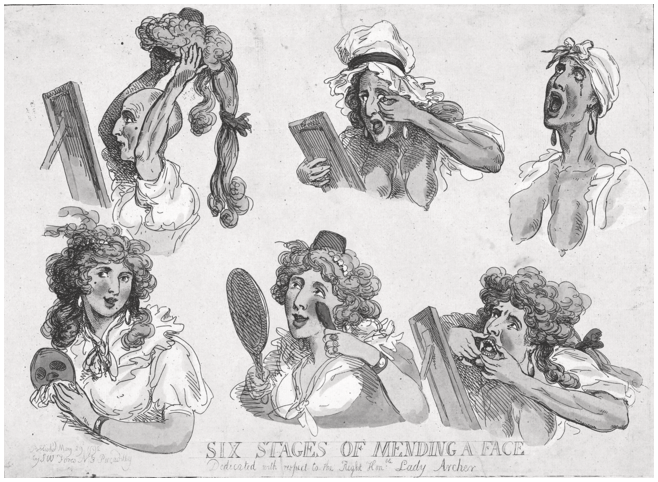
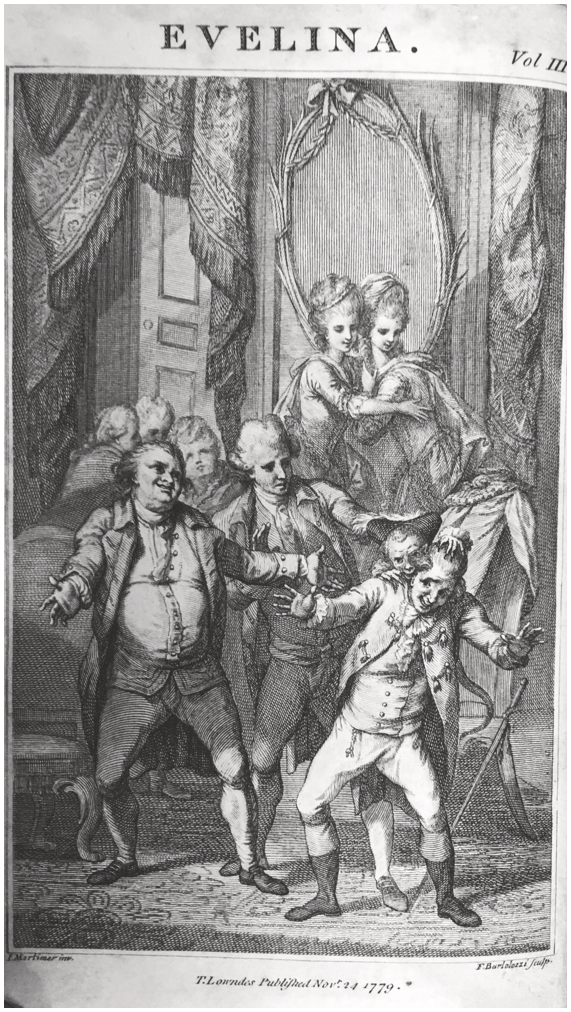
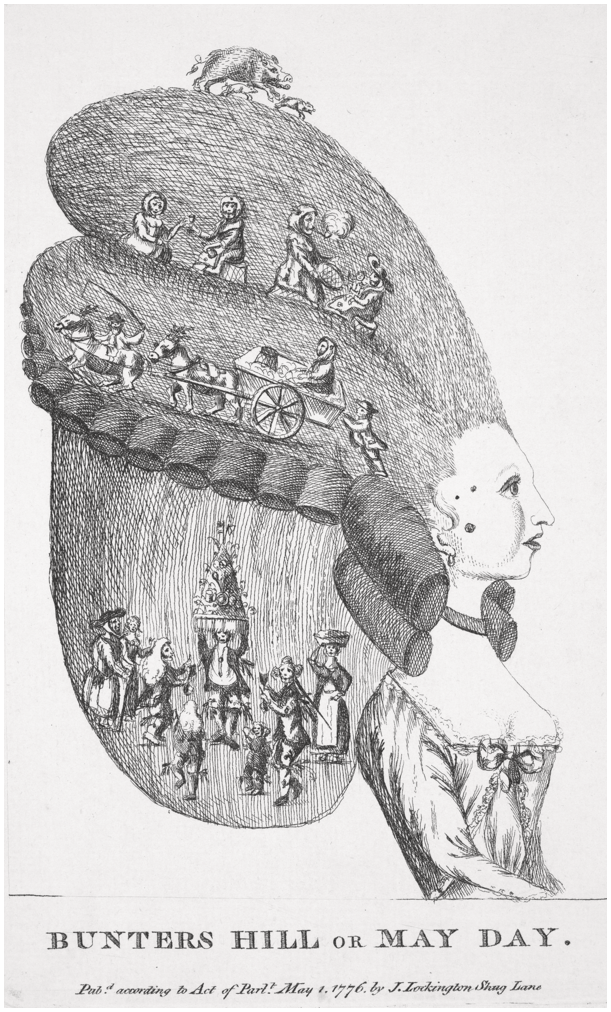

 Open access