
×
×
Home
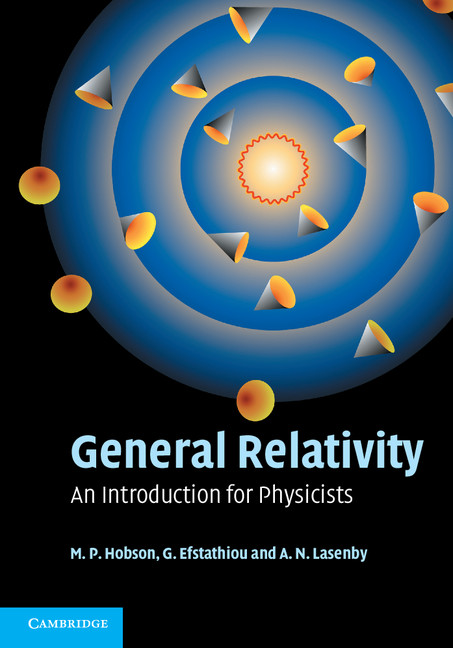
General Relativity
  • This book is no longer available for purchase
  • Cited by 114
  • Cited by
    This (lowercase (translateProductType product.productType)) has been cited by the following publications. This list is generated based on data provided by CrossRef.

    Saw, Vee-Liem 2018. Asymptotically simple spacetimes and mass loss due to gravitational waves. International Journal of Modern Physics D, Vol. 27, Issue. 01, p. 1730027.

    Fukushima, Kimichika and Sato, Hikaru 2018. Derivation of the cut-off length from the quantum quadratic enhancement of a mass in vacuum energy constant Lambda. The European Physical Journal C, Vol. 78, Issue. 4,

    Sharif, M. and Kousar, Lubna 2018. Tidal Forces in Dyonic Reissner-Nördstrom Black Hole. Communications in Theoretical Physics, Vol. 69, Issue. 3, p. 257.

    Ornigotti, Marco Bar-Ad, Shimshon Szameit, Alexander and Fleurov, Victor 2018. Analog gravity by an optical vortex: Resonance enhancement of Hawking radiation. Physical Review A, Vol. 97, Issue. 1,

    Pires, D G Rocha, J C A and Brandão, P A 2018. Ergoregion in metamaterials mimicking a Kerr spacetime. Journal of Optics, Vol. 20, Issue. 2, p. 025101.

    Saw, Vee-Liem 2018. Bondi mass with a cosmological constant. Physical Review D, Vol. 97, Issue. 8,

    Heras, José A 2018. Decomposition of a symmetric second-order tensor. European Journal of Physics, Vol. 39, Issue. 3, p. 035202.

    Gómez, César and Zell, Sebastian 2018. Black hole evaporation, quantum hair and supertranslations. The European Physical Journal C, Vol. 78, Issue. 4,

    Koohbor, J Nouri-Zonoz, M and Tavanfar, A 2018. Hawking modes and the optimal disperser: holographic lessons from the observer's causal-patch unitarity. Journal of Physics Communications, Vol. 2, Issue. 4, p. 045027.

    Oliveira, Leandro A. Crispino, Luís C. B. and Higuchi, Atsushi 2018. Scalar radiation from a radially infalling source into a Schwarzschild black hole in the framework of quantum field theory. The European Physical Journal C, Vol. 78, Issue. 2,

    Hadi, Miftachul Anderson, Malcolm and Husein, Andri 2017. The gravitational field equations of a twisted skyrmion string: numerical solution. Journal of Physics: Conference Series, Vol. 795, Issue. , p. 012006.

    Tang, Zi-Yu Chin Ong, Yen and Wang, Bin 2017. Lux in obscuro II: photon orbits of extremal AdS black holes revisited. Classical and Quantum Gravity, Vol. 34, Issue. 24, p. 245006.

    Deymier, Pierre and Runge, Keith 2017. Sound Topology, Duality, Coherence and Wave-Mixing. Vol. 188, Issue. , p. 37.

    Burikham, Piyabut Harko, Tiberiu and Lake, Matthew J. 2017. The QCD mass gap and quark deconfinement scales as mass bounds in strong gravity. The European Physical Journal C, Vol. 77, Issue. 11,

    Sharif, M. and Shahzadi, Misbah 2017. Particle dynamics near Kerr-MOG black hole. The European Physical Journal C, Vol. 77, Issue. 6,

    Salahshoor, K. Nozari, K. and Khesali, A. R. 2017. More on accreting black hole spacetime in equatorial plane. Astrophysics and Space Science, Vol. 362, Issue. 2,

    Heidler, Richard 2017. Epistemic Cultures in Conflict: The Case of Astronomy and High Energy Physics. Minerva, Vol. 55, Issue. 3, p. 249.

    Giacomelli, Luca and Liberati, Stefano 2017. Rotating black hole solutions in relativistic analogue gravity. Physical Review D, Vol. 96, Issue. 6,

    Farrugia, Christine and Sultana, Joseph 2017. Thermodynamic geodesics of a Reissner Nordström black hole. General Relativity and Gravitation, Vol. 49, Issue. 1,

    Deymier, Pierre and Runge, Keith 2017. Sound Topology, Duality, Coherence and Wave-Mixing. Vol. 188, Issue. , p. 319.

    ×

Book description

General Relativity: An Introduction for Physicists provides a clear mathematical introduction to Einstein's theory of general relativity. It presents a wide range of applications of the theory, concentrating on its physical consequences. After reviewing the basic concepts, the authors present a clear and intuitive discussion of the mathematical background, including the necessary tools of tensor calculus and differential geometry. These tools are then used to develop the topic of special relativity and to discuss electromagnetism in Minkowski spacetime. Gravitation as spacetime curvature is then introduced and the field equations of general relativity derived. After applying the theory to a wide range of physical situations, the book concludes with a brief discussion of classical field theory and the derivation of general relativity from a variational principle. Written for advanced undergraduate and graduate students, this approachable textbook contains over 300 exercises to illuminate and extend the discussion in the text.

Reviews

'… this book is a fine introduction and exposition of many of the theory's features. … A beautiful approach is taken: the authors show that a consistent theory of electromagnetism can be derived from the simple supposition that there is a force … I strongly recommend this book for a very wide range of readers. Advanced undergraduates will obtain a good first understanding of GR; postgraduates will find it a useful reference book, and will no doubt learn a great deal that they have not fully covered at undergraduate level. Researchers and lecturers will also find it an invaluable book, not only for recommending to students, but also for obtaining significant new insights themselves.'

Source: The Observatory

'What I enjoyed was the clarity. The text was erudite and thorough, and flowed beautifully.… It was clear that students, with diligent application, could work their own way through the text and benefit hugely from self discovery of this fascinating subject.'

Source: The Times Higher Education Supplement

'The book is well-written and easy to follow because it is essentially self-contained and every new concept is carefully motivated and justified. Exercises are given at the end of every chapter and numerous examples appear throughout the text.'

Source: General Relativity and Gravitation

Refine List
Actions for selected content:
Select all | Deselect all
  • View selected items
  • Export citations
  • Download PDF (zip)
  • Send to Kindle
  • Send to Dropbox
  • Send to Google Drive
  • Send content to

    To send content items to your account, please confirm that you agree to abide by our usage policies. If this is the first time you use this feature, you will be asked to authorise Cambridge Core to connect with your account. Find out more about sending content to .

    To send content items to your Kindle, first ensure no-reply@cambridge.org is added to your Approved Personal Document E-mail List under your Personal Document Settings on the Manage Your Content and Devices page of your Amazon account. Then enter the ‘name’ part of your Kindle email address below. Find out more about sending to your Kindle.

    Note you can select to send to either the @free.kindle.com or @kindle.com variations. ‘@free.kindle.com’ emails are free but can only be sent to your device when it is connected to wi-fi. ‘@kindle.com’ emails can be delivered even when you are not connected to wi-fi, but note that service fees apply.

    Find out more about the Kindle Personal Document Service.

    Please be advised that item(s) you selected are not available.
    You are about to send
    ×

Save Search

You can save your searches here and later view and run them again in "My saved searches".

Please provide a title, maximum of 40 characters.
×

Metrics

Altmetric attention score

Full text views

Total number of HTML views: 0
Total number of PDF views: 977 *
Loading metrics...

Book summary page views

Total views: 1126 *
Loading metrics...

* Views captured on Cambridge Core between September 2016 - 12th June 2018. This data will be updated every 24 hours.
