
Skip to main content Accessibility help
×
  • Cited by 5
    • Show more authors
    • Open Access
      You have digital access to this book
    • Select format
    • Publisher:
      Cambridge University Press
      Publication date:
      05 January 2014
      09 January 2014
      ISBN:
      9781139542739
      9781107035041
      9781107474932
      Creative Commons:
      Creative Common License - CC Creative Common License - BY Creative Common License - NC Creative Common License - ND
      This content is Open Access and distributed under the terms of the Creative Commons Attribution licence CC-BY-NC-ND 3.0.
      https://creativecommons.org/creativelicenses
      Dimensions:
      (228 x 152 mm)
      Weight & Pages:
      0.52kg, 284 Pages
      Dimensions:
      (229 x 152 mm)
      Weight & Pages:
      0.39kg, 286 Pages
    Open Access
    You have digital access to this book
    Selected: Digital
    View content
    Add to cart View cart Buy from Cambridge.org

    Book description

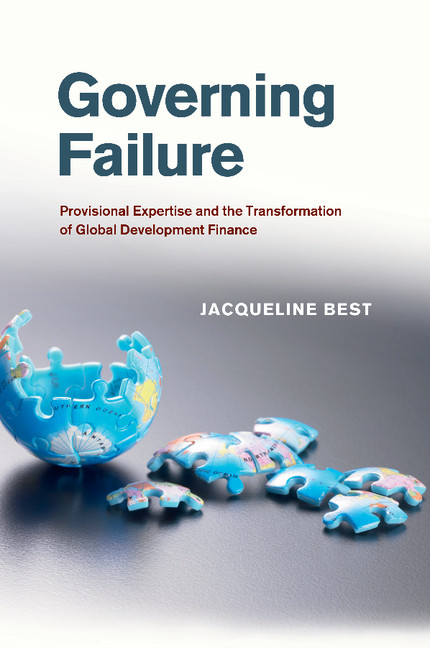
    Jacqueline Best argues that the 1990s changes in IMF, World Bank and donor policies, towards what some have called the 'Post-Washington Consensus,' were driven by an erosion of expert authority and an increasing preoccupation with policy failure. Failures such as the Asian financial crisis and the decades of despair in sub-Saharan Africa led these institutions to develop governance strategies designed to avoid failure: fostering country ownership, developing global standards, managing risk and vulnerability and measuring results. In contrast to the structural adjustment era when policymakers were confident in their solutions, this is an era of provisional governance, in which key actors are aware of the possibility of failure even as they seek to inoculate themselves against it. Best considers the implications of this shift, asking if it is a positive change and whether it is sustainable. This title is available as Open Access on Cambridge Books Online and via Knowledge Unlatched.

    Reviews

    ‘Supremely over-confident in the 1980s and 1990s, international financial institutions have now recognized some of the limits of their capacity to effect change in an uncertain world. But, if structural adjustment has failed, what comes afterwards? In a brilliant analysis, Jacqueline Best shows us how the IFIs have invented a new form of ‘provisional governance’: failure is now anticipated, the authority of experts is known to be fragile, and government has become something of an experiment.’

    Andrew Barry - University College London

    ‘Governing Failure is a fascinating exploration of the dynamics of expertise, authority, and power in international development institutions and the paradoxes that result. Expertise generates authority, which is undermined by perceived failure resulting from contingency. Governance therefore becomes more provisional, but if it is cautious rather than experimental it ultimately jeopardizes the authority upon which these institutions rely.’

    Robert O. Keohane - Woodrow Wilson School of Public and International Affairs, Princeton University

    ‘Drawing on a highly creative and wide-ranging engagement with theory and extensive empirical research, this wonderful new book by Jacqueline Best makes a major contribution to our understanding of how the IMF and World Bank have changed since the structural adjustment era and to theorizing global governance more generally.’

    Tony Porter - McMaster University, Canada

    ‘Best offers a much needed theoretical account of how and why there has been a move to ‘govern failure’ within international organizations. Along the way, Best gives us a powerful framework for understanding the dynamics of global governance in general, and the role of international organizations in particular.’

    Ole Jacob Sending - Director of Research, Norwegian Institute of International Affairs (NUPI)

    Refine List

    Actions for selected content:

    Select all | Deselect all
    • View selected items
    • Export citations
    • Download PDF (zip)
    • Save to Kindle
    • Save to Dropbox
    • Save to Google Drive

    Save Search

    You can save your searches here and later view and run them again in "My saved searches".

    Please provide a title, maximum of 40 characters.
    ×

    Contents

    Full book PDF
    • Governing Failure - Half title page
      pp i-ii
    • Copyright page
      pp iv-iv
    • Contents
      pp v-v
    • Figures
      pp vi-vi
    • Acknowledgements
      pp vii-viii
    • Abbreviations
      pp ix-x
    • Part I - Understanding how global governance works
      pp 1-42
    • 1 - Introduction
      pp 3-19
    • 2 - A meso-level analysis
      pp 20-42
    • Part II - History
      pp 43-88
    • 3 - What came before
      pp 45-65
    • 4 - Transformations
      pp 66-88
    • Part III - New governance strategies
      pp 89-186
    • 5 - Fostering ownership
      pp 91-114
    • 6 - Developing global standards
      pp 115-138
    • 7 - Managing risk and vulnerability
      pp 139-163
    • 8 - Measuring results
      pp 164-186
    • Part IV - Conclusion
      pp 187-208
    • 9 - The politics of failure and the future of provisional governance
      pp 189-208
    • Endnotes
      pp 209-262
    • Index
      pp 266-276

    Metrics

    Altmetric attention score

    Full text views

    Total number of HTML views: 0
    Total number of PDF views: 0 *
    Loading metrics...

    Book summary page views

    Total views: 0 *
    Loading metrics...

    * Views captured on Cambridge Core between #date#. This data will be updated every 24 hours.

    Usage data cannot currently be displayed.

    Accessibility standard: Unknown

    Why this information is here

    This section outlines the accessibility features of this content - including support for screen readers, full keyboard navigation and high-contrast display options. This may not be relevant for you.

    Accessibility Information

    Accessibility compliance for the PDF of this book is currently unknown and may be updated in the future.
