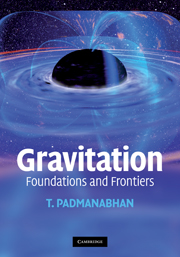
Book contents
- Frontmatter
- Contents
- List of exercises
- List of projects
- Preface
- How to use this book
- 1 Special relativity
- 2 Scalar and electromagnetic fields in special relativity
- 3 Gravity and spacetime geometry: the inescapable connection
- 4 Metric tensor, geodesics and covariant derivative
- 5 Curvature of spacetime
- 6 Einstein's field equations and gravitational dynamics
- 7 Spherically symmetric geometry
- 8 Black holes
- 9 Gravitational waves
- 10 Relativistic cosmology
- 11 Differential forms and exterior calculus
- 12 Hamiltonian structure of general relativity
- 13 Evolution of cosmological perturbations
- 14 Quantum field theory in curved spacetime
- 15 Gravity in higher and lower dimensions
- 16 Gravity as an emergent phenomenon
- Notes
- Index
1 - Special relativity
Published online by Cambridge University Press: 05 June 2012

Book contents
- Frontmatter
- Contents
- List of exercises
- List of projects
- Preface
- How to use this book
- 1 Special relativity
- 2 Scalar and electromagnetic fields in special relativity
- 3 Gravity and spacetime geometry: the inescapable connection
- 4 Metric tensor, geodesics and covariant derivative
- 5 Curvature of spacetime
- 6 Einstein's field equations and gravitational dynamics
- 7 Spherically symmetric geometry
- 8 Black holes
- 9 Gravitational waves
- 10 Relativistic cosmology
- 11 Differential forms and exterior calculus
- 12 Hamiltonian structure of general relativity
- 13 Evolution of cosmological perturbations
- 14 Quantum field theory in curved spacetime
- 15 Gravity in higher and lower dimensions
- 16 Gravity as an emergent phenomenon
- Notes
- Index
Summary
Introduction
This chapter introduces the special theory of relativity from a perspective that is appropriate for proceeding to the general theory of relativity later on, from Chapter 4 onwards. Several topics such as the manipulation of tensorial quantities, description of physical systems using action principles, the use of distribution function to describe a collection of particles, etc., are introduced in this chapter in order to develop familiarity with these concepts within the context of special relativity itself. Virtually all the topics developed in this chapter will be generalized to curved spacetime in Chapter 4. The discussion of Lorentz group in Section 1.3.3 and in Section 1.10 is somewhat outside the main theme; the rest of the topics will be used extensively in the future chapters.
The principles of special relativity
To describe any physical process we need to specify the spatial and temporal coordinates of the relevant event. It is convenient to combine these four real numbers – one to denote the time of occurrence of the event and the other three to denote the location in space – into a single entity denoted by the four-component object xi = (x0, x1, x2, x3) ≡ (t, x) ≡ (t, xα). More usefully, we can think of an event P as a point in a four-dimensional space with coordinates xi. We will call the collection of all events as spacetime.
Information
- Type
- Chapter
- Information
- GravitationFoundations and Frontiers, pp. 1 - 53Publisher: Cambridge University PressPrint publication year: 2010
Accessibility standard: Unknown
Why this information is here
This section outlines the accessibility features of this content - including support for screen readers, full keyboard navigation and high-contrast display options. This may not be relevant for you.Accessibility Information
Accessibility compliance for the PDF of this chapter is currently unknown
and may be updated in the future.