

This chapter consists of two parts. The first part (Section 7.1) answers the book’s research questions by systematically applying the research protocol to the three focal systems and pulling together the empirical findings and conclusions from the previous chapters. Comparing, as it does, the speed, scope, and depth of unfolding reconfigurations across the techno-economic, actor, and policy dimensions of the three systems, this part is rather dense. The second part (Sections 7.2, 7.3, and 7.4) discusses broader issues such as cross-cutting findings across the three systems, policy recommendations, and future research suggestions.
7.1 Comparing Low-Carbon Transitions in Electricity, Heat, and Mobility Systems
The previous empirical chapters made comprehensive whole system analyses of unfolding low-carbon transitions in the electricity, heat, and mobility systems. Although these transitions-in-the-making vary in speed, scope, and depth, they all involve interactions between multiple niche-innovations and multiple existing (sub)systems. These analyses thus confirm the general usefulness and empirical validity of our system reconfiguration approach, which changes the transition imagery from singular ‘bottom-up’ disruption, with niche-innovations replacing existing systems, towards a more dispersed reconfiguration process that results from multiple change mechanisms including incremental improvement in existing elements, replacements of system elements, changes in the relative size of (sub)systems, and changes in how elements are linked together in system architectures.
The low-carbon transitions in the three focal systems are in different stages of a Great Reconfiguration. In terms of emission performance, the transition has progressed farthest in the UK electricity system, where GHG emissions decreased by 71% between 1990 and 2019. It is beginning to unfold in land-based passenger mobility systems, where GHG emissions decreased by 14% from their peak in 2007 to 2019, despite an 11% increase in passenger-kilometres in the same period. Transport GHG emissions declined by 29% in 2020 because of COVID-related lockdowns, which strongly affected passenger mobility systems. A low-carbon transition is not yet unfolding in residential heat. Although heat-related GHG emissions decreased by 24% from their peak in 2001 to 2019, a temporal breakdown shows that the low-carbon transition has stagnated: GHG decreased by 29% from the peak year 2001 to 2014 (despite a 9.5% increase in the number of dwellings), but increased by 6.4% between 2014 and 2019, partly due to a 4% housing stock increase over that period and weakened insulation activities.
This chapter aims to explain these salient differences between the three systems and answer the following four research questions from Chapter 1:
(1) Which innovations and system changes contributed directly to the varying GHG emission performances in the three systems?
(2) What are the underlying techno-economic, actor, and policy reconfigurations, and what do these changes imply for the scope and depth of socio-technical system reconfiguration?
(3) Are the unfolding low-carbon transitions moving in the direction of a Great Reconfiguration, characterised by high scope and depth of system changes?
(4) What explains the different speed between unfolding low-carbon system reconfigurations?
7.1.1 Low-Carbon Innovations Driving GHG Emission Reductions
To answer the first research question, this section summarises the findings from the previous chapters about the low-carbon innovations and system changes that directly contributed to the varying emission reduction performance in different systems. For the electricity system, we found that the substantial emission reductions resulted from the following four main innovations and sub-system changes, which we characterise in bold in MLP terms:
niche-innovations: the diffusion of renewable electricity technologies (e.g., onshore wind, offshore wind, bio-power, and solar-PV), which increased their contribution to power generation from 2% in 1990 to 39% in 2019, and mostly displaced coal;
within system substitution: a substantial and rapid switch from coal to gas in the power generation sub-system in the 1990s, which reduced coal’s contribution to power generation from 73% in 1990 to 29% in 1999 and increased gas’s contribution from 0% to 41% in the same period;
niche-innovations: the diffusion of CFLs and LEDs, which has started to replace incandescent light bulbs in the electricity consumption sub-system, leading to a 38% reduction in electricity use for lighting between 2007 and 2015;
incremental system improvement: efficiency innovation in appliances, which (combined with lighting substitutions and industrial offshoring) reduced electricity demand by 15% between 2005 and 2019, despite substantial appliance proliferation (particularly consumer electronics and computers).
While not directly contributing to GHG emission reduction, incremental innovations in transmission grids (extensions, strengthening, new offshore grids, new interconnectors) complemented and enabled diffusion of renewable electricity technologies (incremental system improvement). Several niche-innovations with transformative potential (e.g., smart grids, battery storage, demand-side response) have not yet widely diffused, while smart meters did diffuse, but have been less transformative than anticipated.
Figure 7.1 provides a schematic MLP-representation of the unfolding UK electricity system reconfiguration, summarising the relative contributions of various innovations to GHG emission reductions.
Schematic MLP-representation of electricity system reconfiguration with bold, normal, and dotted lines representing the relative contributions of different innovations to unfolding carbon reductions

In passenger mobility systems, we found that emission reductions resulted mostly from the following innovations and system changes, which we characterise in bold in MLP terms:
incremental system improvement: incremental engine innovations that improved the fuel efficiency of new petrol and diesel cars by respectively 25% and 27% in the 2007–2016 period (although the manipulation of emission test results by automakers cast doubt on the reliability of these numbers);
within system substitution: a gradual shift since 2001 from petrol to diesel cars, which are more fuel-efficient (this trend reversed after the 2016 Dieselgate scandal);
between system substitution: a doubling of rail travel since the mid-1990s, including some modal shift from cars to trains, especially for commuting in and out of London;
niche-innovation: the diffusion of biofuels, which increased from 0.8% of fuel blends in 2007 to 4.3% in 2019;
niche-innovations: the diffusion of electric vehicles (HEVs, BEVs, PHEVs), which increased from 0.3% of the passenger car fleet in 2007 to 3.3% in 2020; electric vehicles accounted for 20.8% of all passenger car sales in 2020;
niche-innovation: tele-working at home, which increased from 2.7% of the working population in 2007 to 5% in 2019 and 8.5% in 2020 (although the influences on GHG emission reduction are uncertain).
Several niche-innovations with transformative potential (e.g., car sharing, intermodality, self-driving cars) have not yet widely diffused, while ride-hailing did diffuse but is not very radical. Figure 7.2 provides a schematic MLP-representation of the unfolding UK reconfiguration in passenger mobility systems.
Schematic MLP-representation of passenger mobility systems reconfiguration with bold, normal, and dotted lines the relative contributions of different innovations to unfolding carbon reductions

In the heat system, we found that emission reductions resulted mostly from the following innovations and changes, which we characterise in bold in MLP terms:
incremental system improvement: efficiency improvements in gas boilers and piecemeal insulation measures (e.g., double glazing, cavity wall insulation, loft insulation), delivery of which has collapsed since 2013.
niche-innovations: some diffusion of renewable heat technologies (such as domestic wood combustion, heat pumps, plant biomass, biomethane), which significantly increased their contribution to heat generation in all sectors (residential, commercial, public administration) to 9% in 2019. Not all renewable heat technologies are zero-carbon, however, so the GHG emission reduction effects are lower than the diffusion rates.Footnote 1
Several niche-innovations with transformative potential (e.g., heat networks, greening the grid, passive house, whole house retrofit) have not yet widely diffused. Figure 7.3 provides a schematic MLP-representation of the unfolding UK heat system reconfiguration.
Schematic MLP-representation of heat system reconfiguration with bold, normal, and dotted lines the relative contributions of different innovations to unfolding carbon reductions

7.1.2 Depth and Scope in Techno-Economic Reconfigurations
To answer the techno-economic aspect of the second research question, this section summarises and evaluates the findings from the previous chapters with regard to types of change that represent different depth: ‘modular incrementalism’ (which represents limited depth), ‘architectural stretching’ (which represents limited depth), ‘modular substitution’ (which represents moderate-depth if it involves radical niche-innovations and limited depth if it involves relative size changes in existing systems), and ‘architectural reshaping’ (which represents substantial depth involving radical innovations and changing system linkages). To evaluate scope, we assess the difference between the low-carbon innovations that have diffused (i.e., actual scope) and the low-carbon innovations that have emerged but remained stuck in small niches (i.e., potential scope).
For the electricity system, the identified innovations imply that the current techno-economic reconfiguration has mainly taken the form of ‘modular incrementalism’ and moderate-depth ‘modular substitution’ but is beginning to be complemented by ‘architectural stretching’ and deeper ‘architectural reshaping’.
‘Modular incrementalism’ has been the dominant type of change in the electricity consumption sub-system, where continued incremental innovations in existing appliances have substantially improved energy efficiency, leading to electricity demand reduction. The depth of change has thus been limited, but the scope was substantial since many appliances have been improved.
Various forms of ‘modular substitution’ have been the dominant type of change in the electricity generation sub-system: 1) coal-to-gas switching represents a partial substitution between existing system technologies, representing limited depth of change, 2) bio-power has mostly taken the form of converting existing coal plants to burn biomass, which represents a moderate-depth hybridisation of niche-innovation and existing system, and 3) onshore wind, offshore wind, and solar-PV are niche-technologies that replaced existing system technologies (mostly coal), representing moderate-depth change. The replacement of incandescent light bulbs by CFLs and LEDs also represents a moderate-depth niche-to-system modular substitution in the consumption sub-system.
Limited depth ‘architectural stretching’, which builds on existing technical capabilities, occurred in transmission grids that were extended to connect remote wind and solar generation sites and strengthened to enable more electricity flows from Scotland to England. Stretching also took the form of building new offshore grids and new interconnectors to European countries, including France, Northern Ireland, Ireland, and the Netherlands.
Substantial depth ‘architectural reshaping’ and modification of linkages among the generation, consumption, and grid sub-systems are only just emerging in response to increasing amounts of variable renewable generation (especially from wind power and solar-PV). Because electricity generation and consumption need to be closely aligned to avoid blackouts, the deployment of intermittent renewables is creating challenges for grid management and load balancing. To address these problems, various niche-innovations are being introduced such as battery storage (which can rapidly provide additional capacity), demand-side-response (DSR, which enables peak shifting and temporary demand reductions), smart grids (which improve the management of bi-directional electricity flows from centralised power stations to users and from decentralised wind and solar assets into the grid), smart meters (which may enable new time-variable tariffs and remote control), and capacity markets (which pay providers of back-up capacity). Changes in the generation sub-system are thus having knock-on effects on the grid and consumption sub-systems, which are beginning to make system boundaries more porous, leading to new operational principles such as intelligent and flexible load management, peak shifting, and demand-follows-supply (instead of the present supply-follows-demand).
The types of changes that are reconfiguring UK electricity systems are mostly large-scale options that fit incumbent interests and have been systematically favoured by policymakers. These moderate-depth large-scale options have thus played more prominent roles than the various small-scale options that represent deeper forms of reconfiguration, including a shift from centralised to decentralised systems:
large-scale wind farms (by energy companies, investors, project developers) are more prominent than smaller-scale community wind projects;
large-scale solar-PV farms (operated by landowners, investors, project developers) are more prominent than small-scale roof-top solar-PV (by households);
large-scale bio-power (e.g., co-firing and biomass conversion of coal-fired plants) is more prominent than smaller-scale dedicated biomass plants (by sawmills or poultry farms);
large-scale battery storage (by new and incumbent companies) is more prominent than decentralised batteries by households with rooftop solar-PV;
smart grids in relation to the flexibility agenda are more prominent than micro-grids in relation to decentralisation and energy independence;
Capacity Markets policies favour conventional back-up capacity (by utilities) rather than domestic DSR.
Deeper ‘architectural reshaping’ based on small-scale decentralised renewables, local storage, and micro-grids has thus remained limited in favour of moderate-depth large-scale technical options and flexible grid management. For the overall electricity system, the realised reconfiguration scope has thus remained more limited than the potential scope, because of choices by incumbent firms and policymakers.
For the passenger mobility system, the identified innovations also imply that the unfolding techno-economic reconfiguration is mainly taking the form of ‘modular incrementalism’ and moderate-depth ‘modular substitution’.
Limited depth incremental innovations in system modules (e.g., car engine improvements, shift from petrol to diesel cars, railway extension) have been relevant since the early 2000s. Various forms of ‘modular substitution’, which replace system components but do not require deeper changes in the system architecture, have gained importance during the last decade: 1) some limited depth system-to-system switching occurred in the form of a small modal shift from automobility to railways, 2) moderate-depth hybridisation occurred within the automobility system in the form of biofuel blending and hybrid-electric vehicles, 3) battery-electric vehicles, plug-in hybrid-electric vehicles, ride-hailing, and tele-working represent moderate-depth niche-innovations that replaced existing technologies or business models (for ride-hailing), or reduced mobility demand (in the case of tele-working).
Substantial depth ‘architectural reshaping’ has remained limited in passenger mobility systems. There are seeds for deeper architectural reshaping (such as car sharing, Mobility-as-a-Service (MaaS), driverless cars, and intermodal transport), but the associated innovations have remained relatively small and have uncertain growth paths. The only exception is London, which has succeeded in creating an effective intermodal transport system with frequent bus, tube, and rail services that are well-aligned through transfer hubs and an integrated electronic payment scheme. Using this system, more than 20% of London’s commuting trips involve multiple transport modes.
For the overall passenger mobility system, however, the realised reconfiguration scope has remained much more limited than the potential scope, for lack of an integrated approach to mobility (demand reduction, multimodality), apart from London, and a focus on engine substitution in automobility.
For the heat system, the identified innovations imply that limited-depth ‘modular incrementalism’ is the most prominent type of change, complemented with some moderate-depth ‘modular substitution’ options.
Limited depth incremental improvements in gas boilers and piecemeal home insulations have been the dominant type of change since the 1990s (with insulation measures experiencing marked slowdown since 2013). Various forms of ‘modular substitution’ have become somewhat more prominent since the mid-2010s: 1) domestic wood combustion has diffused somewhat as an add-on niche-innovation that is used besides gas boilers (mostly for reasons of cosiness), while small amounts of biomethane (from anaerobic digestion) are injected into gas grids; both options represent limited depth change, 2) heat pumps and plant biomass (in commercial settings) somewhat replaced gas boilers, representing medium-depth change.
Substantial depth ‘architectural reshaping’ options (e.g., passive-house designs, heat networks, green hydrogen) and ‘architectural stretching’ options (e.g., whole-house retrofit) have remained very small, because they face significant hurdles. More generally, efforts to reduce heat demand by deeply reconfiguring the housing stock have stagnated, which means that ‘modular substitution’ efforts in heat technologies presently dominate. The realised reconfiguration scope has thus remained substantially more limited than the potential scope, because of little or fragile policy support to increase the attractiveness of low-carbon heating and high-efficiency housing for mainstream users.
This comparison shows that ‘modular incrementalism’ and ‘modular substitution’ are the dominant types of change in all three systems. Only the electricity system is beginning to experience some degree of substantial depth ‘architectural reshaping’ because supply-side modular substitutions are having knock-on effects in other sub-systems. For all three systems, however, the realised reconfiguration scope has been more limited than the potential scope, because more radical niche-innovations involving deeper architectural change have remained small. The rationale behind this finding is that incremental and modular changes are generally easier to implement and are less threatening to incumbent interests than changes that alter the entire system architecture.
Generalising from these findings, we can formulate the following propositions:
P1: ‘Modular incrementalism’ and ‘modular substitution’ are more common techno-economic reconfiguration pathways because they are easier to implement, do not stretch existing business models and system configurations, and are likely to face less resistance from incumbent interests (even though firms may need to acquire new capabilities).
P2: Deeper kinds of techno-economic reconfiguration options, which require radical innovations and some degree of architectural reshaping, often struggle to diffuse beyond initial niches, even when they hold substantial low-carbon promise, and thus require more policy support to gain momentum.
7.1.3 Depth and Scope in Actor Reconfigurations
To answer the actor-related part of the second research question, this section summarises and evaluates the findings from the previous chapters with regard to realised actor reconfigurations that represent different depths: small adjustments in behavioural templates, routines, or habits (limited depth); changes in innovation strategies, (technical) capabilities, and resource allocation (moderate-depth); and changes in cultural-cognitive beliefs, repertoires, or paradigms (substantial depth). To establish the scope of reconfiguration in different systems, we evaluate the degree of substantial change across the main actor groups (firms, consumers, policymakers, civil society).
In the electricity system, substantial actor reconfiguration was especially enacted by incumbent firms and policymakers, in the context of pressures from changing public debates and discourses.
The scope of actor reconfiguration in the electricity generation sub-system has been substantial because many actors (except consumers) changed substantially.
Utilities, energy companies, and project developers enacted substantial depth reconfiguration, as they substantially changed their views of low-carbon transitions and their strategies towards renewable electricity technologies (RETs), moving from reluctant acknowledgement and engagement to strategic reorientation in the past 15 years. They also adjusted their investment strategies and (technical and operational) capabilities as they realised that substantial public subsidies and ongoing techno-economic developments made RET deployment financially attractive while allowing them to retain their large-scale business models.
Policymakers also made substantial depth reorientations by adjusting capabilities, instruments, governance style, and policy goals (further discussed later in the chapter). Public discourses experienced moderate-depth change as they came to express positive views on renewables, negative views on coal, and increasing concerns about climate change in general.
Consumer reconfiguration in the generation sub-system has remained of limited depth: rooftop solar-PV adoption by households has stagnated, while ‘prosumers’ (who use self-generated low-carbon electricity) remain a marginal sub-group. Consumers did, however, ultimately pay for low-carbon generation assets through their electricity bills and through general taxation (which underpinned government subsidies) – although this resulted from policy decisions rather than consumer choices. Because electricity bills are very opaque, utilities could pass extra costs on to consumers without the latter consenting to (or being aware of) the upstream low-carbon investments. This specific payment mechanism thus helped to create ‘indirect’ or ‘involuntary’ market demand for low-carbon electricity, which is an important difference with the mobility and heat systems where consumers need to make active decisions to purchase low-carbon technologies.
The scope of actor reorientation in the electricity consumption sub-system has remained moderate to limited, with only appliance manufacturers and policymakers enacting moderate to substantial change.
European and UK policymakers in the electricity consumption sub-system increasingly accepted demand reduction and climate mitigation as important goals, which led to tightening energy efficiency standards for appliances (e.g., refrigerators, televisions, washing machines), representing moderate to substantial depth change. From the mid-1990s to 2012, UK policymakers also imposed increasing energy savings obligations on UK energy suppliers (to drive deployment and uptake of energy-efficient appliances).
International appliance manufacturers initially contested the new energy efficiency regulations, but in the mid-1990s changed their strategic and technological orientations, representing moderate-depth change, which led to substantial energy efficiency improvements in their products through mostly incremental innovations. Appliance manufacturers did not alter their business model, which remained focused on rapid product lifecycles, increasing functionalities, persistent innovation, product differentiation, and market expansion.
Public debates on energy efficiency remained relatively muted, representing limited depth change. Consumers did not substantially alter their social practices or cultural conventions, but they did purchase more energy-efficient appliances, which represents limited depth change.
Actor reorientation in the electricity grid sub-system remained limited in scope and depth, as few actors enacted substantial change.
Transmission Network Operators (TNOs) build on existing capabilities to make expensive but incremental changes in transmission grids (e.g., extensions, strengthening, new offshore grids, new interconnectors).
Distribution Network Operators (DNOs) engaged in some R&D and demonstration projects, but mostly remained locked in their traditional operational model (around passive distribution), capabilities, and strategy (low cost ‘sweating the assets’).
In the passenger mobility system, there has been deep reconfiguration by some actors as well as substantial lock-in and inertia for other actors.
In the automobility system there has been some substantial actor reorientation (by automakers and policymakers, and some segments of the user population) towards electric vehicles. For all other low-carbon innovations, however, actor reconfiguration has been moderate or limited depth, which suggests that the overall scope of actor reconfiguration is limited.
Car manufacturers substantially changed their views of low-carbon transitions and their strategies for electric vehicles, moving from reluctant acknowledgement and engagement to strategic reorientation in the past 10 years. These changing views and strategies, which represent substantial reconfiguration, were accompanied by large and increasing investments in new technical capabilities and factories, and were largely conditioned by an accelerating innovation race that threatened to leave behind car manufacturers not involved with electric vehicles.
Automakers also started to invest in the development of driverless cars, often in collaboration with IT companies such as Microsoft to bring in new technical capabilities. But since this technology is in an early developmental stage, and because of recent deflations in the hype-cycle, we evaluate this as moderate-depth reconfiguration. Automakers also have some limited depth engagement in the car sharing segment to learn about its potential.
Transport policymakers also substantially reoriented regarding electric vehicles, developing new goals, governance strategies, and policies in the past 10 years (including phase-out policies for diesel and petrol cars) and creating new organisations (such as the Office for Low Emission Vehicles (OLEV) and the Automotive Council) to facilitate coordination with industrial actors.
Transport policymakers have provided far less support to car sharing, mobility services, teleworking, and other transport systems (bus, rail, cycling). They also invest substantially in new road building (£27 billion in the 2020–2025 period), which helps to further entrench the automobility system. The 2021 Transport Decarbonisation Plan and the new bus and cycling strategies, introduced in 2020 and 2021, represent attempts at policy reconfiguration because they emphasise modal shifts to public and active transport and hope to change local transport systems in the next decade. Their success is uncertain at present, despite £3 billion and £2 billion new funding for bus and bicycle system improvements.
The past 10 years also saw the entry of new organisations such as car sharing organisations and ride-hailing companies (e.g., Uber), whose mobility services have disrupted the taxi market. We evaluate both changes currently as limited depth, because ride-hailing is not particularly radical and car sharing has remained a small application niche. They do, however, have future potential for deeper actor reconfiguration as both options have started to question the taken-for-grantedness of car ownership while user experiences with mobility apps may prepare the ground for further changes (e.g., intermodality or MaaS).
User reconfiguration in the automobility system shows diverging trends, which reflects geographical and age-related variation between user groups as well as the relevance of other considerations such as comfort, safety, convenience, or speed, which many consumers find more important than climate mitigation. On the one hand, there are limited and moderate-depth reorientations in low-carbon directions through increased electric vehicle purchase (mostly by middle-aged, affluent urbanites with an interest in new technology and environmental issues), increased use of ride-hailing, and some uptake of car sharing (mostly by highly educated, tech-savvy, young people in big cities). Driver’s licenses and car ownership have also become less prevalent among younger generations, especially in big cities, although the relative importance of cultural reasons (less favourable attitudes towards cars) and economic reasons (unaffordability) is unclear. In our evaluation, this represents limited to moderate-depth change.
On the other hand, there are deep user lock-ins to automobility, especially in rural areas and for families with children, and even some trends in high-carbon directions, which represent limited depth or even climate-negative reconfiguration. Passenger-kilometres by cars have remained around 85% of total passenger mobility between 2007 and 2019. The percentage of households with two or more cars has gradually increased since the early 2010s. And the percentage of heavy SUVs in passenger car sales increased from 6.6% in 2009 to 21.2% in 2018. So, although new mobility practices are beginning to emerge on the fringes, a major behavioural shift away from cars does not yet appear to be underway. This conclusion is reinforced by the response to the pandemic, which substantially reduced car travel during the lockdowns but saw rapid rebounds to pre-pandemic levels when restrictions were lifted. So, while the pandemic created an opportunity for modal shifts away from cars, which led to many optimistic speculations by the green commentariat, these did not materialise.
Despite substantial expansion of the railway system, actor reconfiguration remained limited in depth and scope until the pandemic, since no actors enacted deep change.
Climate change has been of low importance to Train Operating Companies, whose strategies mostly focused on financial gaming of the complex franchise and lease system by privatising gains and collectivising costs (such as rail infrastructure investments that are mostly paid by the government and taxpayer).
Rail use has more than doubled since the mid-1990s, despite soaring rail fares that are among the highest in Europe. But this increased rail travel represents limited depth change because it required no new skills and did not result from new user preferences or climate concerns. Instead, increased rail travel resulted from other reasons such as high rents and house prices in London (which forced many people to live elsewhere and commute to London) as well as car access and parking restrictions in London. The importance of Greater London in rail travel is underlined by the fact that almost two-thirds of all rail journeys start or end there, which relates to its socio-economic importance and population size (about nine million people). Rail travellers are more concerned about rising costs, over-crowding, and punctuality than about climate mitigation. Rail travel decreased by 95% during the first COVID-lockdown and has only partly rebounded since then, reaching 50% of pre-pandemic levels by July 2021. It is thus possible that health concerns about travelling with others in confined spaces have structurally reconfigured user preferences.
Policymakers invested in new rail infrastructure but did not substantially change their visions or governance style before the pandemic. Since March 2020, however, policymakers have provided £12 billion emergency support and in May 2021 introduced substantial institutional reform that did reconfigure actors and incentives. This is further discussed in Section 7.1.4.
Although cycling has increased in the last 10 years, especially in cities that have built dedicated cycling infrastructures (like London), there was limited mainstream actor reorientation towards this transport mode before the pandemic.
Cycling has remained a small mobility practice, accounting for less than 1% of travel distance in 2019. Most cyclists are young urban professionals, who cycle to increase fitness and save travel time and money. Most non-cyclists perceive cycling as dangerous and unsuitable for the British weather, which is why we evaluate the current scope and depth of actor reconfiguration as limited. Cycling increased by 46% in 2020, with even larger expansions during and immediately after the first COVID-lockdown. Subsequently, however, bicycle use returned to pre-pandemic levels, as car traffic resumed, and safety concerns resurfaced.
The new 2020 cycling and walking strategy aims to boost active travel in cities and stimulate broader and deeper actor engagement in the future.
Actor reconfiguration also remained limited depth in the bus system.
Bus companies have been more concerned about surviving in shrinking markets than about climate mitigation. The great majority of buses in Great Britain still use diesel fuel, which substantially contributes to local air pollution. Although a few UK city regions (e.g., Nottinghamshire, North Yorkshire, Greater Manchester) adopted some electric and hybrid-electric buses, only London’s bus companies used government subsidies to significantly adopt hybrid and electric buses (amounting to 40% of the London fleet in 2019), which represents limited depth change.
Across Great Britain, travellers have steadily abandoned buses due to increasing fares and decreasing service quality. London, in contrast, saw bus travel increases, partly because the city continued to regulate prices and service quality, and partly because the 2003 London congestion charge restricted automobile use in the city centre. Bus travel plummeted by almost 90% during the first COVID-lockdown and had subsequently rebounded to only 60% of pre-pandemic levels by July 2021, suggesting that lingering health concerns continue to shape user practices.
Policymakers did not change their visions, governance style, or strategies before the pandemic. Since then, however, they first provided £1.4 billion emergency support and in 2021 introduced a National Bus Strategy for England, which aims to improve bus services outside London and reverse the decades-long decline.
Actor reconfiguration has been substantial depth in London, which enabled the creation of an effective intermodal transport system that is widely used and led to a pronounced modal shift, resulting in a 35–40% decline in car travel between 2002–2018. The changes were supported by substantial depth reconfiguration of policymakers, which included the articulation of new transport goals and political leadership by successive mayors, investments in improved public transport and cycling systems, the introduction of the London congestion charge, and the creation of Transport for London (TfL) in 2000, which produced a local governance organisation with substantial budgetary and policy discretion and the ability to coordinate and align the different transport modes.
Substantial depth actor configuration also underpinned the rapid diffusion of tele-working, which jumped from 5% of the working population in 2019 to 8.5% in 2020, reaching as high as 46.6% in April 2020. Although the tele-working niche had grown gradually since the 1990s, this jump was due to the COVID-lockdowns, which forced people to stay at home, and was enabled by technological progress in computers, internet, and videoconferencing. The external shock forced workers and organisations to make deep changes in office procedures, cultural norms, work practices, and physical arrangements (e.g., creating dedicated home office spaces). These changes were easier to make for highly skilled occupational categories, for whom they are likely to become structural (to some degree), than for workers in manufacturing, hospitality, leisure, or retail.
Actor reconfiguration has been limited in depth and scope in the heat system, owing to the dominance (and resistance) of powerful incumbent industries, limited consumer interest, and risk-aversion and weak governance by policymakers.
Gas suppliers, boiler manufacturers, and appliance installers have mainly focused on limited depth incremental efficiency improvements in gas boilers, and limitedly diversified to low-carbon technologies and skills. Only recently have gas companies started to advance new visions and engaged in some demonstration projects with hydrogen and biomethane injection in gas grids, but we interpret this, at least partly, as a delay tactic intended to obfuscate public debates, which started to focus more on heat pumps and heat networks as low-carbon options.
Volume housebuilders, which dominate the UK building system, engaged in some exploratory low-carbon diversification after the introduction of the 2006 Zero Carbon Homes (ZCH) policy, but they abandoned this strategy in the early 2010s when their political lobbying activities first succeeded in watering down and then removing the ZCH policy in 2015. Their low-carbon reconfiguration has thus remained limited depth.
Policymakers engaged in limited depth reconfiguration, because low-carbon heat hardly figured on the policy agenda until the early 2010s, because it is overshadowed by other priorities (e.g., energy security, fuel poverty, supporting the construction industry), and because policy action has fluctuated and changed direction rather than consistently ratcheting up. Furthermore, close relationships with incumbent industry interests have contributed to watering down policies, which have been oriented towards incremental improvements and maintaining existing assets rather than shaking up industry practices.
At the fringes of the heating system, new actor coalitions pioneered low-carbon niche-innovations (e.g., domestic wood combustion, heat pumps). But since the subsidised market niches remained small, we evaluate mainstream actor reconfiguration as limited depth. New actor coalitions also pioneered passive house designs and whole-house retrofits, but these niche-innovations remained even smaller, owing to limited policy support and disinterest from volume housebuilders.
Niche-innovations in both systems also remained small because of limited interest from mainstream consumers, who did not reconfigure themselves, except for some green consumers purchasing low-carbon heat innovations. Most users remained disengaged from low-carbon heating, as they do not think much about their heating system, except when it breaks down. Low-carbon options are also more expensive and therefore less attractive than gas boilers (heat pumps cost thousands of pounds more, while comprehensive low-carbon housing measures cost tens of thousands of pounds). Consumer reorientation also remained limited depth because consumers struggled to navigate uncertainties about low-carbon options, including performance, cost, and the reliability and skills of installers.
In all three systems, the unfolding low-carbon system transitions were primarily enacted by existing mainstream actors (incumbents) rather than by new entrants whose contributions remained relatively small, except perhaps in the automobility system (where some new entrants introduced disruptive innovations). Although the academic literature sometimes speculates about consumer-led or civil society-led low-carbon transitions, we find little evidence for this in the UK cases, which are currently mostly incumbent-led, involving close interactions between existing industries and policymakers. Civil society actors have been important in shaping public debates but have not been much involved in decision-making and were not successful in driving the diffusion of local or grassroots innovations. Substantial and moderate-depth reconfiguration has only been enacted by incumbent firms and policymakers in the electricity generation sub-system, the electricity consumption sub-system, and the automobility system. Some user segments in the automobility system also enacted moderate-depth change. Other mainstream actors thus remained relatively locked-in or were more concerned about other issues than climate mitigation (especially in the electricity grid sub-system, railway system, bus system, cycling system, and heat system).
Generalising from these findings, we can formulate the following propositions:
P3: Incumbent actors are not inert and can reorient to drive low-carbon transitions, in which case they are likely to use their market power and political influence to reduce the potential scope and depth of reconfigurations.
P4: Because incumbent actors have pre-existing commitments to established goals, interpretations, and ways of doing things, deep reconfiguration to address new issues (such as climate change) is challenging and requires dedicated efforts and favourable conditions.
7.1.4 Depth and Scope in Policy Reconfigurations
To answer the policy-related part of the second research question, this section summarises and evaluates the findings from the previous chapters with regard to realised policy reconfigurations. New instruments and a change in governance style (including new goals) respectively represent moderate and substantial depth, while the number of new policy instruments determines scope. Policy reconfigurations varied significantly between the three systems, which is another major explanation for the differences in the low-carbon transitions in the three systems.
In the electricity system, policy reconfiguration was substantial in scope and depth in the generation sub-system, which experienced substantial changes in both governance style and policy instruments, substantial in depth and moderate in scope in the consumption sub-system, and limited in depth and scope in the grid sub-system.
In the late 2000s, the governance style in electricity generation experienced substantial depth change from a hands-off, technology-neutral approach towards a more interventionist and technology-specific style that shaped markets and supported the deployment of low-carbon technologies. Around the same time, the 2008 Climate Change Act and the 2009 UK Low Carbon Transition Plan introduced long-term targets (80% GHG reduction by 2050 and 30% renewable electricity by 2020), which created a sense of direction and acknowledged climate mitigation as an equally important policy goal as affordability and energy security (which was recognised by the introduction of the ‘energy trilemma’ concept). A suite of generic policy strategies,Footnote 2 technology-specific plans,Footnote 3 and new policy instrumentsFootnote 4 increased the scope, consistency, and comprehensiveness of the policy mix, while the creation in 2009 of a new Ministry (the Department for Energy and Climate ChangeFootnote 5) provided a dedicated organisation with policy and budgetary responsibilities to drive implementation. The policy instruments not only provided attractive financial subsidies for the deployment of low-carbon technologies but also had a political dimension because they systematically favoured incumbent actors and large-scale options, as noted in Section 7.1.2. The ending of feed-in tariffs for small-scale renewables in 2019 further skewed the policy mix towards large-scale renewables and incumbents.
The electricity consumption sub-system also experienced substantial depth policy reconfiguration. The governance style has gradually become more interventionist as energy efficiency standards for appliances were steadily tightened from the mid-2000s, shaping markets and innovation strategies. The scope of policy reconfiguration remained more limited than in the electricity generation sub-system because the policy instrument mix was less comprehensive. Nevertheless, it contained several instruments that stimulated both the gradual development and adoption of more energy-efficient appliances such as performance standards, energy labels, energy savings obligations on electricity suppliers (which were removed in 2013), and a ban on incandescent light bulbs, which strongly shaped markets.
Policy reconfiguration had limited depth and scope in the electricity grid sub-system. The independent regulator Ofgem, which is dominated by mainstream economic thinking, reluctantly accommodated climate mitigation as a policy goal, but this remained an add-on to traditional goals (promoting competition and efficiency to lower costs). Because efficiency-oriented price control regulations reduced innovation activities by TNOs and DNOs, Ofgem introduced some new policy instrumentsFootnote 6 and a new policy framework, RIIO,Footnote 7 for the post-2015 period, to drive innovation. Although these add-on instruments stimulated R&D and demonstration projects, they did not drive broad deployment of new technologies in distribution networks. Ofgem’s negotiated investment model (in which infrastructure investments must be legitimated with regard to demonstrated needs) has been somewhat more successful in supporting incremental changes in transmission grids. Nevertheless, policies have remained too weak and limited to drive deeper and more comprehensive infrastructure change.
In the passenger mobility systems, policy reconfiguration before the pandemic was limited depth and scope in the railways, bus, and cycling systems. In the automobility system, policy reconfiguration was substantial depth for electric vehicles (EVs) but limited and moderate-depth for other innovations. The scope of automobility policy goals thus remained limited and focused on EVs, although recent policy strategies in 2020 and 2021 expanded the scope somewhat. But the scope of EV policy instruments was substantial, using multiple instrument types.
Overall, passenger mobility policy reconfigurations before the pandemic remained limited in scope, as policymakers were mostly committed to a ‘greening of cars’ strategy rather than a more multi-modal transition approach. This translated into continued investments in road infrastructures and significant support to alternative propulsion, notably EVs.
Looking at the level of automobility innovations, policymakers reconfigured substantially towards EVs, switching to an interventionist governance style that actively shaped markets and stimulated EV development through a broadening scope of policy instruments that steadily increased the consistency, comprehensiveness, and strength of the policy mix. These instruments included financial support for R&D, the build-up of a battery recharging infrastructure, and EV purchase subsidies. They also included tightening European CO2 emission regulations (which since 2019 comprised stiff financial penalties for non-compliance) and a UK commitment to phase out petrol and diesel cars by 2030. Policymakers also created a dedicated organisation (the Office for Low Emission Vehicles), which since 2009 has strengthened the EV innovation system by stimulating interactions between automakers, policymakers, and research organisations. The EV-oriented policy reconfiguration was underpinned by an increasing alignment of climate mitigation and industrial policy goals, which aim to reposition the UK car industry in the global EV innovation race.
Policymakers also supported driverless cars (with substantial R&D subsidies) and biofuels (through R&D subsidies and RFTO-targets,Footnote 8 which have substantially increased since 2017). Although these policy reconfigurations represent limited to moderate-depth and scope, they indicate that UK policymakers expect cars to remain central in future low-carbon transitions. Policymakers have given much less support to low-carbon options with a stronger behavioural component such as car sharing, mobility services, or teleworking (which might reduce automobility demand), which means that general automobility policy has limited scope.
Policy reconfiguration before the pandemic remained limited depth and scope in the railways, bus, and cycling systems. Although these systems continued to receive support, the assistance was piecemeal, fragmented, and time-limited, often characterised by repeated stop-start dynamics that hampered long-term planning. Railways have been helped with operational support for Network Rail and through large-scale London-centric rail infrastructure investments (e.g., Crossrail, Thameslink, HS2) rather than through whole-system improvements (including in signalling and railway electrification). In response to the pandemic, policymakers provided substantial financial support (around £12 billion) and in May 2021 introduced an institutional shake-up which creates a new organisation from 2023 (Great British Railways) in charge of rail infrastructure, fares, timetables, and contracting. The reforms also include a shift from franchises to contracts for railway companies, which will incentivise them for improved coordination, better consumer services, efficiency improvements, and reduced public subsidies. Large investments in rail infrastructure (including £100 billion for new high-speed rail) also aim to grow rail networks and travel.
The bus system has been supported with bus service operator grants, some hybrid bus adoption subsidies, and bus travel passes for the elderly, but none of these support measures before the pandemic were transformative. Policymakers provided £1.4 billion COVID emergency support to bus operators and in March 2021 introduced the new National Bus Strategy, which represents an attempt at deeper and broader policy reconfiguration. In terms of high-level policy goals, the strategy aims to elevate the importance of buses in local transport systems and reverse their decades-long decline outside London. More specifically, it aims to improve bus systems by stimulating innovations such as bus priority lanes, 4,000 electric buses, contactless intermodal payment systems, and improved digital information, as well reducing fares and extending services. In terms of policy instruments, it provides £3 billion funding over five years and introduces institutional reforms, including Enhanced Partnerships that give local policymakers more influence. The future success of this top-down strategy is not guaranteed and depends on local uptake, renewed user interest in bus travel, and reductions in COVID-related concerns.
Policy support for cycling was limited before the pandemic, with fluctuating national funding for local cycle lanes resulting in ad-hoc improvements rather than interlinked cycling infrastructures (except for London). The new cycling and walking strategy, introduced in July 2020, represents an attempt at deeper and broader policy reconfiguration. In terms of goals, it elevates the importance of active transport, aiming for ‘half of all journeys in towns and cities being cycled or walked by 2030’ (DfT, 2020b: 12). It also broadens the scope of instruments, providing £2 billion funding for local initiatives, offering technical design advice for safe and high-quality cycling infrastructure, issuing statutory guidance advising local authorities on reallocating road space to cycling and walking, and creating a new body (Active Travel England) to oversee and inspect local schemes. In response to this strategy and in the pandemic context, many cities implemented local initiatives, including pop-up segregated cycle lanes and low-traffic neighbourhoods. Future success is uncertain, however, because numerous cities have subsequently abandoned or downscaled initiatives in response to local protests, and because the strategy does not include ‘sticks’ such as congestion charging to incentivise a shift away from cars.
While the new policy strategies are aspirational but inconclusive, the only realised and effective example of substantial depth and substantial scope policy reconfiguration in the last two decades is London, which created a dedicated local governance organisation in 2000 (Transport for London) with significant budgetary and policy discretion. Additionally, successive mayors (Livingstone, Johnson, Khan) provided political leadership and allocated financial resources to the improvement of public transport and cycling systems, which resulted in an effective intermodal transport system. The 2003 London congestion charge also dis-incentivised automobility, galvanising a substantial modal shift.
Policy reconfiguration has remained limited in depth and scope for the heat system, which helps explain stagnation in the low-carbon transition in this domain.
Heat decarbonisation did not rise on the policy agenda until 2012, when it was layered on top of other policy goals such as energy poverty, affordability, and energy security (in relation to gas supplies), which have remained more important than climate mitigation. Energy saving was included in the building regulations in the mid-1990s, followed by climate mitigation in the mid-2000s, but both goals have remained add-ons to existing goals of the Housing Ministry, which traditionally focused on increased housebuilding (to address persistent shortages) and the safety and quality of buildings (through building regulations).
Because of the limited coherence of policy goals, policymakers have not been able (or willing) to develop an integrated governance approach to low-carbon transitions in the heat system. In the 1990s and 2000s, policymakers succeeded in stimulating incremental improvements in gas boilers and piecemeal building insulation measures with gradually tightening regulationsFootnote 9 and successive energy savings obligations on energy suppliers, which required them to assist in the deployment of efficient gas boilers as well as other measures (e.g., insulation, lighting, appliances).Footnote 10 Policymakers have been far less successful, however, in driving more radical and transformative low-carbon innovations.
One attempt was the 2006 Zero Carbon Homes (ZCH) policy, which mandated that all new buildings from 2016 would be carbon-neutral or carbon-negative. But this policy failed due to resistance and lobbying from volume housebuilders, which led to its watering down in the early 2010s and its removal in 2015. Another attempt was the 2013 Green Deal, which aimed to drive a mass rollout of energy efficient retrofits through a novel finance mechanism. But this policy also failed because design failures (such as a high loan interest rate) led to low consumer uptake. Both policy failures left the building system without effective low-carbon governance or policy instruments, which represents limited policy depth and scope. This problem has remained unaddressed since the mid-2010s, despite various government promises, and has contributed to low confidence in policy action and uncertainties for low-carbon heat interests.
To drive low-carbon innovation in the domestic heating system, policymakers introduced the Renewable Heat Incentive (RHI) in 2014, which provided subsidies for the installation of renewable heat technologies. Although the RHI stimulated some household adoption, the reliance on a single demand-oriented instrument means that the policy mix has limited scope and lacks complementary instruments to develop technology, supply chains, and installation skills needed for the delivery of a large-scale roll-out of alternative heat appliances.
Policy visions of low-carbon heating have changed substantially in the last decade, from an almost exclusive reliance on electric heat pumps in the early 2010s to a mix of heat pumps (for sub-urban and rural houses) and district heating (for dense city centres) in the mid-2010s. By the late 2010s, the strategic vision changed again to also include the injection of hydrogen and biomethane in gas grids as possible low-carbon options. This inclusion partly resulted from lobbying by gas industry actors, who became worried about the threat of heat pumps and heat networks to their sunk investments in the gas grid. On the one hand, this increasing diversity may prevent premature lock-ins and enable learning about the suitability of various options in different application contexts. On the other hand, this diversity creates deep uncertainties about future transition pathways, which hinder industrial and market developments because actors delay making commitments and investing resources.
Low-carbon transitions in the heat system are thus hampered by the absence of clear long-term strategic frameworks, the limited translation into a consistent and comprehensive policy instrument mix, and a governance style of attending closely to incumbent interests, which explains preference for interventions aimed at preserving existing assets and infrastructures and reluctance concerning regulatory constraints. Effective governance is also impeded by a deficit of policy expertise and coordination, and the lack of a dedicated body with oversight and responsibility for low-carbon heating and buildings. Policy reconfiguration has not just remained limited in depth and scope but actually moved backwards over the past decade because policy terminations, policy reversals, and a fragmented ‘hands-off’ approach relying on isolated market-based policy instruments have created uncertainties, stakeholder frustrations, and disappointing results (except perhaps for some progress in low-carbon heat technologies).
The upcoming Heat and Buildings Strategy, supported by a new string of objectives set out in the Ten Point Plan for a Green Industrial Revolution (HM Government, 2020b) and the Energy White Paper (HM Government, 2020a), is an opportunity to deliver a more coordinated and coherent policy framework for low-carbon heat and to put an end to years of detrimental policy signals. It remains to be seen if this opportunity will be used, but repeated delays and concerns about funding and implementation do not bode well.
Generalising from these findings, we can formulate the following propositions:
P5: Where policy goals, instruments, and governance styles have been deeply reconfigured, they have substantially contributed to low-carbon transition pathways in selected (sub)systems by advancing particular innovations.
P6: Policy reconfiguration is challenging, because existing policy goals, instruments, and governance styles are locked-in and often linked to vested interests. Policy reconfiguration is therefore contested and liable to weakening or reversals, particularly in early stages when momentum is limited, and vested interests may effectively counter-mobilise.
7.1.5 Moving towards a Great Reconfiguration?
Table 7.1 summarises our conclusions with regard to the depth and scope of low-carbon system reconfigurations in the three focal systems and sub-systems. Answering the third research question, this table shows that none of the low-carbon transitions yet qualifies as a ‘Great Reconfiguration’, which Chapter 1 defined as a particular kind of reconfigurational change with high scope and high depth.
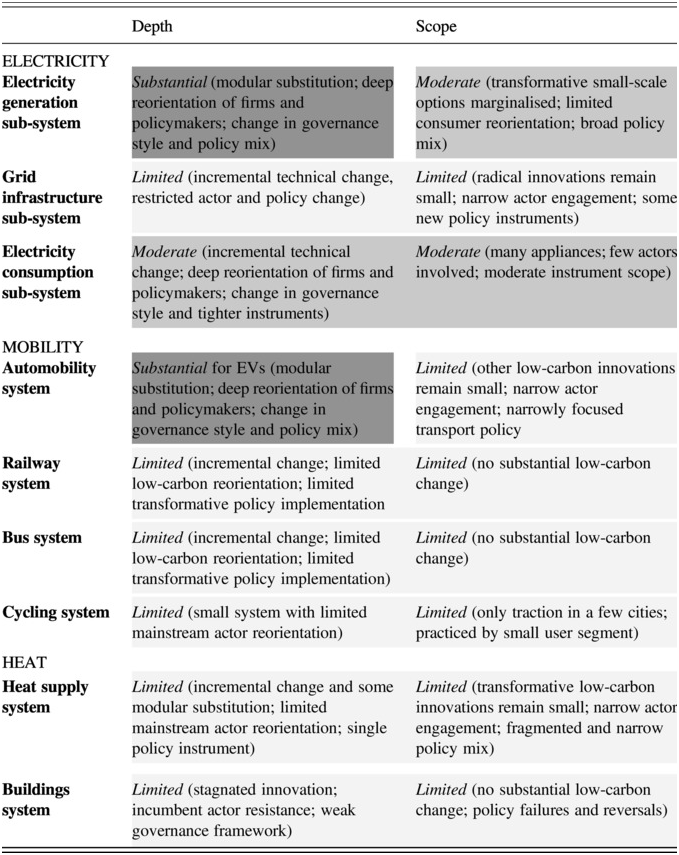
The low-carbon electricity transition, however, has substantially progressed in the direction of a Great Reconfiguration as it achieved substantial depth and moderate scope in electricity generation and moderate depth and moderate scope in electricity consumption. With limited depth and scope of change, the grid infrastructure sub-system is increasingly becoming a bottleneck (due to actor lock-ins and ineffective governance). However, the emergence of radical innovations (such as smart grids, battery storage, capacity markets, demand-side response) does offer potential for deeper system reconfiguration in the coming years. Future grid transformations will become even more necessary when the likely diffusion of electric vehicles and the potential diffusion of electric heat pumps will increase the pressure on local distribution grids. The boundaries among electricity generation, consumption, and grid sub-systems are also likely to become more porous in the future, because the increase in intermittent renewables (especially wind and solar-PV) requires adjustments in the other two sub-systems, which will likely also entail architectural changes in the entire system and thus also in actor roles and capabilities.
In the passenger mobility systems, only electric vehicles (EVs) and tele-working presently represent substantial depth change. But since EVs are modular substitutions, they represent limited scope change, which means that EVs on their own do not qualify as a Great Reconfiguration. Tele-working can substantially shape mobility demand, but its scope has, so far, been limited to highly skilled professions, so on its own it does not (yet) qualify as a Great Reconfiguration. Other innovations have appeared, but they are not very radical (ride-hailing), in early developmental stages (driverless cars), or very small (car sharing, intermodal transport). The only exception, which has achieved substantial depth and substantial scope change, is London, which has created an effective intermodal transport system with well-aligned bus, tube, and rail services as well as a dedicated cycling infrastructure. Emulation of this change by other UK cities, which would require major institutional change and large investments, would qualify as a Great Reconfiguration for local transport. Recent bus and cycling strategies and the 2021 Transport Decarbonisation Plan aim to stimulate future changes in that direction, but their effectiveness remains to be seen. Even a major local transport reconfiguration, however, would not provide a solution for long-distance high-speed travel on major roads, which accounted for 62% of motor vehicle traffic in 2019. So, even if local transport systems were deeply reconfigured, EVs would still have to be part of a low-carbon transition to reduce the GHG emissions of the remaining passenger car travel (which is likely to remain substantial in the next one or two decades).
The heat system, where change is limited in both depth and scope, is not yet moving in the direction of a Great Reconfiguration. Even piecemeal improvements have slowed to a trickle in the building system, owing to weak and fragmented policies, incumbent actor opposition, and limited consumer interest. In the heating system, there have been some positive developments in recent years, notably the adoption of some low-carbon heat technologies. But there is limited actor commitment or policy drive to roll-out these modular technologies on a wider scale, or to implement more systemic or architectural changes.
7.1.6 The Speed of Low-Carbon System Reconfiguration
Since existing technologies, mainstream actors, and policies are stabilised by various lock-in mechanisms, the speed (as well as the depth and scope) of low-carbon system reconfiguration initially tends to be low. Our conceptual framework suggests, and our empirical findings confirm, that an increase in the speed of low-carbon system reconfiguration results from a strengthening momentum of emerging innovations and favourable opportunity structures resulting from weakening system lock-ins, both of which involve interactions between techno-economic, actor, and policy change mechanisms.
For increasing momentum of emerging innovations, these mechanisms include:
techno-economic: a) technological performance improvements, b) increasing availability of complementary innovations, c) large-scale infrastructure investments, and d) decreasing costs, which can result from multiple mechanisms (e.g., scale economies in production, learning-by-doing improvements in deployment, lower financing costs, increased competition, overproduction, or price dumping);
actors: a) an increase in the number of enrolled actors (through expanding social networks, alliances, coalitions), which enhances available skills, resources, connections, lobbying power; b) changes in actor orientations towards particular low-carbon innovations (e.g., in interpretations, views, expectations, preferences, strategies, commitments) and activities (e.g., investments, purchase, behaviour, deployment, learning); c) feedbacks between actor groups: for example, increasing consumer adoption creates larger markets, which attract more firms, which invest more in technologies, which then decrease in costs, which boosts further adoption; another feedback loop is that more positive public discourses stimulate demand and legitimate stronger policy support for firms or consumers, which stimulates demand or investments, which advance the technology and further improve public discourses;
policy: a) changing strategies and governance frameworks to reach new goals, b) changes in supportive policy instruments (e.g., purchase subsidies, investment grants, direct infrastructure investments, regulations, information campaigns), c) the creation of dedicated agencies or ministries with strategic and implementation responsibilities, budgets, and political significance.
For weakening system lock-ins and opportunity structures, these mechanisms include:
techno-economic: a) unaddressed technical performance challenges and ‘reverse salients’ (i.e., problems that hold back particular parts of a system), b) technical accidents, failures, or system breakdowns, c) increasing costs and decreasing competitiveness of existing technologies;
actors: a) legitimacy pressures on established technologies or ways of doing, b) defection or disbanding of critical actors from incumbent alliances and networks;
policy: a) dealignment between the existing system and changing political agendas and goals, which may result from increasing system problems, niche-innovation opportunities, or pressures from interest groups, the media, and wider publics, b) significant swing in electoral politics that shifts policy priorities away from the existing system.
The kinds and strengths of these interacting mechanisms are likely to vary depending on the types of innovations, and sectoral and socio-political contexts. The general answer to the fourth research question thus is that more of these mechanisms were activated in the electricity system than in the passenger mobility systems, while very few were activated in the heating and building systems.
More specifically, the empirical analyses of electricity and mobility systems included several instances of accelerated change, including the diffusion of renewable electricity technologies (RETs), the diffusion of electric vehicles, the diffusion of LEDs and CFLs, the diffusion of tele-working, rapidly increasing cycling in London, and London’s modal shift from cars to other transport modes. We briefly summarise these acceleration instances with the aim of indicating the main interacting mechanisms and articulating more general lessons.
The rapid diffusion of RETs (e.g., onshore wind, offshore wind, bio-power, solar-PV) since 2010 was driven by the following momentum-enhancing mechanisms: a) rapidly falling costs,Footnote 12 which made many RETs more cost-competitive with coal and gas-fired power plants, b) technical improvements that enhanced capacity, load factors, and efficiency, c) a new Ministry (DECC, later BEIS) and a more interventionist governance style, which actively shaped markets and technologies through a range of financial support policies that made RET-investment more attractive and less risky, d) a change in the views and strategies of utilities and energy companies, who came to see RETs as attractive economic opportunities and invested accordingly, e) a positive public discourse about RETs, which legitimated increasing policy support.
The following ‘lock-in weakening mechanisms’ also created opportunity structures for RET diffusion: a) decreasing competitiveness of coal compared to RETs, partly due to the Carbon Price Floor instrument, which increased the relative price of coal, b) civil society campaigns and negative public discourses about unabated coal-fired power plants, which eroded its legitimacy, c) the 2015 government decision to phase-out unabated coal by 2025.
Two structural characteristics of the electricity system also enabled rapid RET-diffusion. First, the separation of supply and demand by the electricity grid means that electricity companies could reorient towards RETs without directly affecting or involving consumers. Second, the specific payment mechanism of electricity bills means that consumers pay for RETs without being aware or agreeing to this. Earlier, we characterised this as ‘indirect’ or ‘involuntary’ market demand, which differs from the other two systems where consumers need to make active purchase or behaviour change decisions.
The accelerating diffusion of electric vehicles since the early 2010s was driven by the following momentum-enhancing mechanisms: a) rapidly falling battery costs, which decreased by almost 90% between 2010 and 2020, and the expectation that battery electric vehicles will be cheaper to buy than conventional cars by the mid-2020s, b) technical improvements resulting in longer ranges and shorter charging times, c) a more interventionist governance style, including the creation of a dedicated policy unit (OLEV), which actively shaped markets and technologies through purchase subsidies, R&D subsidies, and recharging infrastructure investment, d) increasing consumer interest (despite higher EVs prices, even with subsidies), e) positive public discourses about EVs, f) changing views and strategies of automakers, some of which started to substantially reorient towards EVs, leading to an innovation race involving the entire industry, g) the alignment of EVs with multiple policy goals, including climate mitigation, air pollution reduction, and supporting the UK car industry in the global EV race.
The following ‘lock-in weakening mechanisms’ also created opportunity structures for EVs: a) the 2015 Dieselgate scandal, which revealed widespread emission test cheating, damaged the legitimacy of automakers (particularly Volkswagen), and caused major sales declines of diesel cars, b) public debates about local air pollution problems, which eroded the legitimacy of petrol and diesel cars, c) stronger European CO2 regulations (with stiff financial penalties) and a regulatory ban on the sale of diesel and petrol cars from 2030.
The rapid diffusion of LEDs and CFLs since the late 2000s was driven by the following momentum-enhancing mechanisms: a) technical changes that made CFLs 3–5 times and LEDs 7–10 times more energy-efficient than incandescent light bulbs (ILBs), b) rapidly falling prices, especially for LEDs, which decreased 96% in price between 2008 and 2015, c) consumer uptake because of decreasing prices and new functionalities (such as better light control to influence ambience).
The following ‘lock-in weakening mechanisms’ also created opportunity structures for LEDs and CFLs: a) civil society pressure and negative public debates since the 1990s about inefficient ILBs, b) increasing regulatory pressure as policymakers shifted their views and policies from voluntary measures to an ILB phase-out ban (2007 in the UK, 2009 in the EU), c) support for stricter measures from European incumbent lighting firms who struggled to compete with Chinese firms in the ILB-market and therefore strategically reoriented from ILBs towards CFLs and LEDs.
The rapid diffusion of tele-working was due to the COVID-lockdowns, which abruptly destabilised existing work practices and forced managers and organisations to overcome their hesitations regarding tele-working (such as less oversight and control). The diffusion was also enabled by learning processes and technical developments that had improved tele-working’s feasibility in preceding years. The forced diffusion also stimulated further learning processes that are likely to lead to some degree of permanent change (for some occupations), as workers can gain time (and money) by not having to commute and organisations realise they may be able to cut costs by reducing office space.
London’s rapid modal shift from cars to other transport modes since the early 2000s was driven by the following momentum-enhancing mechanisms: a) political leadership from successive London mayors to reconfigure local transport systems, b) investments, improvements, and expansions of alternative transport modes (bus, tube, rail, cycling), c) improved coordination and alignment of transport modes by TfL and through integrated payment mechanisms (such as the 2003 Oyster Card) that expedited intermodal transport and kept public transport costs relatively low.
The following ‘lock-in weakening mechanisms’ also created opportunity structures for the modal shift: a) steadily increasing congestion, parking problems, and parking restrictions, which reduced the convenience and practicality of car use in London, b) negative public debates about worsening problems (e.g., congestion, parking, local air pollution) that created pressure on local policymakers to enact reforms, c) the 2003 London congestion charge, which (through successive increases) made car use more expensive.
The rapid increase in cycling in London since the early 2000s was driven by the following momentum-enhancing mechanisms: a) substantial infrastructure investments in dedicated cycling infrastructure, b) political leadership from successive London mayors that provided drive and visibility for cycling plans, targets, and campaigns as part of wider local transport reconfigurations, c) stronger governance and implementation capacities (including financial and policy responsibilities) through the creation of Transport for London (TfL) in 2000, d) local NGO campaigns and positive public debates about cycling and further safety improvements, e) increased cycling uptake by segments of the population and the articulation of new identities, f) company interest and consumer uptake of bicycle sharing.
The cycling expansion also benefited from the same opportunity structures that stimulated London’s modal shift, as discussed previously.
In terms of general lessons, these brief summary analyses confirm that acceleration does not result from a single driver but from multiple interacting mechanisms across techno-economic, social, and political dimensions, which together drive innovations and system destabilisation across tipping points where the speed of change alters from slow to rapid.
Cost decreases were important in several cases, but this in itself was both a consequence and a driver of increasing deployment by consumers, investments by companies, and stronger policy support in the context of public debates. Carbon pricing, which economists have peddled for decades as the most important instrument, was only marginally important in one case (RET diffusion), suggesting that carbon pricing is neither necessary nor sufficient to accelerate low-carbon transitions. Purchase subsidies, R&D subsidies, and public infrastructure investment were clearly much more important financial instruments. Regulatory instruments, including bans and phase-out policies, were also important in most cases, as well as the creation of dedicated governance units or ministries to plan, coordinate, and drive implementation. Most cases also showed the importance of public support and positive discourses, and the influence on these from NGOs and political leaders.
Most of these acceleration cases, except London’s cycling and modal shift, represented modular incremental or modular substitution options rather than whole system reconfigurations, and in that sense had relatively limited scope. This suggests there may be trade-offs between the speed and scope of system reconfiguration, as others have also found in historical transitions (Wilson, Reference Wilson2012). The reason for this is that it is easier and quicker to substitute particular components in an existing system than to change or build a whole new system, which usually requires more coordination, investment, and stakeholder engagement. In tightly coupled systems there may be limits to this logic, because modular component substitutions may have knock-on effects that require adjustments in other parts of the system (Berkers and Geels, Reference Berkers and Geels2011). This did indeed occur in the electricity system, where generation and use of electricity need to be closely linked to avoid blackouts. Increasing amounts of intermittent renewables thus required adjustments in the electricity grid and consumption sub-systems, which is why the scope of electricity system reconfiguration has increased with RET-diffusion.
Generalising from these findings, we can formulate the following propositions:
P7: Faster reconfiguration results from combinations of increasing momentum of (niche)innovations and changing opportunity structures resulting from weakening system lock-in mechanisms.
P8: Innovations that are framed as addressing multiple issues tend to have greater legitimacy, and political and corporate backing, resulting in higher momentum.
P9: Shocks can decisively accelerate reconfigurations if they occur when emerging innovations have stabilised and acquired some endogenous momentum.
P10: There are likely trade-offs between speed and scope of system reconfiguration, since focused activities and interventions on a few elements (e.g., modular substitutions) are easier and quicker to implement than altering entire systems.
7.2 Cross-Cutting Themes
Drawing on the rich material in our empirical chapters, this section highlights several findings and insights with regard to relevant cross-cutting themes in socio-technical transitions research.
7.2.1 Incumbent Firms
The socio-technical transitions literature traditionally emphasises the role of new entrants in pioneering radical niche-innovations (Kemp et al., Reference Kemp, Schot and Hoogma1998; Schot and Geels, Reference Schot and Geels2007). Our empirical chapters did indeed show instances of this pattern, for example, community energy groups deploying wind turbines, Tesla developing electric vehicles, new companies pioneering ride-hailing (e.g., Uber) and car sharing, ICT companies (co)developing driverless cars, new companies (e.g., Tesla, Powervault, Moixa, Sonnen) developing home batteries, and environmentally conscious architects, self-builders, and organisations such as the Passivhaus Trust pioneering low-energy house designs.
In all three systems, however, incumbent firms have been the dominant actors in enacting the low-carbon reconfigurations. In the electricity generation and consumption sub-systems, these included electric utilities, energy companies, project developers, appliance manufacturers, and lighting firms, which all reoriented their views and strategies to accommodate low-carbon transitions. In the automobility system, incumbent automakers have started to reorient towards electric vehicles, while also co-developing driverless cars (often with ICT companies) and dipping a toe in the car sharing market. Incumbent firms did not reorient much in the railway, bus, and cycling systems, but they also faced limited challenges from new entrants.
The continued dominance of incumbents in these systems further explains the prevalence of ‘modular incremental’ and ‘modular substitution’ options in the associated system reconfigurations. While incumbents may be willing to act at speed (if they are sufficiently incentivised or become convinced about economic opportunities), they are likely to prefer narrow transition paths that maintain or protect their core business models. This has, so far, limited the scope of UK low-carbon transitions and marginalised more radical niche-innovations that would entail ‘architectural reshaping’ or deeper social and institutional innovation.
In the buildings system, the role of incumbent firms has been more pernicious as they actively resisted low-carbon transitions and successfully lobbied for the removal of the zero-carbon homes policy in the mid-2010s. In the heating system, gas supply and boiler companies continue to defend and improve existing heating technologies and gas grids, while also advancing visions of hydrogen or biomethane dissemination through adjusted gas pipelines and engaging in some demonstration projects. At present, we interpret this mostly as a strategic response aimed at reducing policy commitments to heat pumps and district heating, although we acknowledge the future possibility of stronger company commitments to hydrogen or biomethane, which would avoid the gas grid becoming a stranded asset.
The continued dominance of incumbent firms also relates to characteristics of the UK governance style and is thus not an inevitable characteristic of low-carbon reconfigurations.
7.2.2 Governance Style and Politics
Although the UK governance style and policy instruments have changed substantially for some low-carbon innovations, as discussed earlier, there are some recurring features across the three systems that politically privilege incumbent interests and particular kinds of transitions pathways. First, the UK has a highly centralised style of policymaking, the so-called Westminster model (Lijphart, Reference Lie and Sørensen2012), and close-knit policy networks that provide some access to big incumbent firms but remain closed for new entrants and start-ups (Bailey, Reference Bailey2007). In all three systems, this has reproduced a ‘working with incumbents’ governance style (Geels et al., Reference Geels, Kern, Fuchs, Hinderer, Kungl and Mylan2016b) that tailors policy support to the interests and concerns of electric utilities, automakers, volume housebuilders, and gas industry companies.
Second, the UK’s liberal market economy (Hall and Soskice, Reference Hall and Soskice2001) has for the past few decades been characterised by a neo-liberal political ideology, which explains the policy preference for market-based policy instruments (e.g., auctions in low-carbon electricity) that tend to favour incumbents over new entrants. In the 1980s and 1990s, this ideology also led to privatisation and liberalisation in the electricity, gas, railways, and bus systems, which produced fragmented industry structures with multiple roles and interfaces between organisations with different incentives. Despite the economic rhetoric that increased competition would improve services, increase efficiency, and lower costs, these promises did not always materialise (especially not in rail and bus transport). It also led to significant worsening on non-monetised public goods dimensions such as accessibility, fairness, and energy poverty, which departs significantly from many other countries that approach access to energy or mobility as fundamental rights. The fragmented industry structures also created coordination problems and incentives that generated misalignments with the need for low-carbon transitions (because they hampered collaboration and knowledge flows between actors). In line with neo-liberal ideology, policymakers also adopted a hands-off policy style in the electricity, gas, railways, and bus systems, leading to the disbanding of the Department of Energy in 1992 and the creation of independent regulators to oversee the efficient functioning of market forces (e.g., the Office of Gas and Electricity Markets; the Office of Rail Regulation).
Third, the UK has a technocratic, top-down governance style that pays limited attention to engaging a wider set of stakeholders: ‘The government in the UK is still meant to govern – full stop. … The government of the day acts. Others react. … Reforms … are not negotiated painstakingly with stakeholders. They are handed down from above by governments’ (King, Reference King2015: 283). In the electricity system, this ‘bulldozer’ style (Geels et al., Reference Geels, Kern, Fuchs, Hinderer, Kungl and Mylan2016b) has generated social acceptance problems for onshore wind, biomass combustion in converted coal-fired plants, and shale gas, which were pushed through with limited consultation of citizens and societal actors, who then mobilised to express their concerns through protests. In the building system, this top-down style led to the sudden introduction of the 2006 Zero-Carbon Homes policy, against which housebuilders successfully lobbied, leading to its equally sudden removal in 2015. Policymakers also seem to think they can drive change by top-down formulation of demanding targets, without paying much attention to complementary policies that address skills, supply chains, public acceptance, or industry support. This has led to a recurring pattern of over-promising and under-delivering (e.g., with CCS, nuclear power, zero-carbon homes), which may well be repeated with heat pumps and hydrogen.
Fourth, the high degree of centralisation also implies limited autonomy for cities and local policymakers (McCann, Reference McCann2016), who often do not have the regulatory or financial responsibilities to address allocated tasks, especially with regard to local transport systems, as discussed in Chapter 5. Rather than giving local policymakers sufficient long-term budgets, the Treasury requires them to apply for central funding for specific projects (e.g., new cycle paths or cleaner buses), which often leads to on-the-ground fragmentation because cities may win money in one allocation round but not in another, leading to stop-start dynamics. Eadson (Reference Eadson2016) characterises the resulting implementation style as ‘disordered, syndromic experimentation and government-by-project rather than any systematic programme of government’. The recent bus and cycling strategies aim to reconfigure local transport governance but still represent a top-down push that may encounter local implementation problems.
In all instances of more rapid reconfiguration, discussed earlier, one or more of the aforementioned characteristics were changed, leading to more interventionist policies that mobilised multiple kinds of instruments (financial, regulatory, infrastructure investment) that were strengthened over time to drive change that was overseen or coordinated by dedicated new agencies (TfL, OLEV) or ministries (DECC, BEIS) with sufficient budgets and responsibilities.
In the systems with less transitional progress, most of those governance characteristics are still pertinent, leading to a reliance on single market-based instruments (e.g., the RHI, the Green Deal), selective infrastructure investments (e.g., ‘flashy’ rail projects), and frequent chopping and changing of policies such as the sudden scrapping of CCS-support (in 2016), the unforeseen downscaling (in 2015) and removal (in 2019) of Feed-in-Tariffs, the unexpected closure of Renewables Obligations for small-scale renewables (in 2016), the removal of the ZCH-policy (in 2015) and the Green Deal (in 2015). The CCC (2020: 99) characterises these changes as ‘shortcomings’, noting that ‘frequent changing of policy should be avoided’ because it ‘can damage faith in Government policy and reduce business willingness to invest’.
7.2.3 Users
The role of users has been relatively muted in the low-carbon system reconfigurations we analysed. Despite calls by critical theorists and sustainable consumption scholars for deep value changes and a move away from consumer societies, our analyses of the three systems shows little evidence of widespread behavioural or cultural revolutions, except perhaps for tele-working, which is likely to permanently alter work practices (in some professions).
Our analyses do, however, show instances of more limited change such as purchasing greener products or behavioural adjustments that are not particularly demanding or disruptive. For instance, some segments of the population have been willing to buy electric vehicles, LEDs, energy-efficient appliances, wood burners, or electric heat pumps, which suggests they have some willingness to pay if product performance has sufficiently improved and additional costs are not too high. We also found that people are doing more cycling, more train travel, and more intermodal transport in London, but these changes are relatively easy and sometimes enacted in response to changing incentives (e.g., London’s congestion charge). Increasing levels of public concern about climate change thus do not seem to have translated into widespread deep behaviour change in the direction of frugality, sufficiency, or down-scaling.
These findings resonate with Dubois et al. (Reference Dubois, Sovacool, Aall, Nilsson, Barbier and Herrmann2019), whose large-scale survey research of users in Germany, France, Sweden, and Norway found that most consumers are willing to implement relatively simple low-carbon changes, such as enhanced waste recycling or buying energy-efficient appliances, but are unwilling to make more drastic changes such as abandoning private cars or flying (unless forced by external shocks such as the COVID-pandemic). These findings imply that the limited scope of unfolding low-carbon reconfigurations is not only due to incumbent interests and governance styles but also to limited mainstream user interest in more radical options such as passive house, whole house retrofit, modal shift or intermodality (except for London), car sharing, mobility services, or electricity prosumption.
One possible reason for this limited user interest is that policymakers, opinion leaders, and other relevant actors have not yet sufficiently tried to shape consumer preferences and social practices in low-carbon directions (through information campaigns, consumer training, or infrastructure provision), because they have, so far, mostly focused on technological changes. Another possible reason is that mainstream users, despite expressing high concerns about climate change, are not really willing to sacrifice convenience, comfort, or practicality, nor pay high switching costs, when considering low-carbon options for heating, lighting, appliances, or mobility. This explanation partly relates to the value-action gap literature (Flynn et al., Reference Flynn, Bellaby and Ricci2009), which has found substantial discrepancies between what people say they care about and what they actually do. On the other hand, our summary-analysis in Section 7.1.6 of London’s modal shift from cars to other transport modes suggests that interventionist policies, public debates, and investments in alternatives can indeed shape user practices and preferences to some degree. Open questions for the coming years are how far such user practices can be modulated and how strongly policymakers are willing to push for demand-side change.
7.2.4 Wider Publics and Civil Society Organisations
The socio-technical transitions literature suggests that public debates about issues are important because they shape cultural meanings and legitimacy, which can influence consumer preferences, create a sense of urgency, and exert credibility pressure on policymakers (Hermwille, Reference Hermwille2016; Roberts, 2017; Roberts and Geels, Reference Roberts and Geels2018; Rosenbloom et al., Reference Rosenbloom, Berton and Meadowcroft2016; Sovacool, Reference Sovacool2019). Civil society and social movement organisations can shape these public debates (Benford and Snow, Reference Benford and Snow2000) and also nurture grassroots innovations to develop alternative options themselves (Feola and Nunes, Reference Feola and Nunes2014; Smith and Seyfang, Reference Smith and Raven2013). Our findings confirm many of these influences but in varying degrees.
At a general level, the fluctuating level of public attention and public debate about climate change (Figure 1.1) was important to create conditions for the strengthening of climate policies. The public attention increase in the mid-2000s was an important driver for the pathbreaking 2008 Climate Change Act and subsequent translation policies. Weakening public attention in the years after the 2007/8 financial crisis then created conditions for the political weakening of climate mitigation policies, for instance in the electricity and heating systems. The resurging attention in the late 2010s, and the emergence of new framings such as ‘climate emergency’, then helped to create the conditions for net-zero commitments and stronger climate policies by the UK government and other countries, although many of these have not yet been translated into substantial changes.
Civil society and social movement organisations helped to shape these general climate change debates in various ways. Environmental NGOs, for instance, organised the 2006 Big Ask campaign, which mobilised wider constituencies (including the National Federation of Women’s Institutes, Christian Aid, the National Trust, Oxfam, UNISON, and the RSPBFootnote 13) and the wider public to pressure policymakers for a climate law with ambitious GHG reduction targets (Carter and Jacobs, Reference Carter and Jacobs2014). And in 2019, public protests by school children and civil society organisations (e.g., Extinction Rebellion, Climate Justice movement) helped to push climate change and framings high onto public and political agendas.
For specific technologies, public debates and civil society activities also shaped socio-cultural meanings that, in turn, affected public policies. We found multiple instances of negative debates and campaigns that eroded legitimacy and created pressure for stronger policies. In the late 1990s and early 2000s, environmental NGOs (e.g., WWF, Greenpeace) campaigned at the EU-level against the inefficiency of ILBs, framing these in terms of ‘energy waste’, which helped to create the conditions for the 2009 ILB phase-out ban (Franceschini and Alkemade, Reference Franceschini and Alkemade2016). In the late 2000s, campaigns by activist groups (e.g., Climate Camp) and public debates succeeded in halting plans to expand coal-fired power stations, and created negative discourses that later contributed to coal phase-out policies. In the early 2010s, environmental NGO campaigns and public debates about the sustainability of imported biomass pellets led to the creation of sustainability standards, although they did not succeed in halting the expansion of industrial-scale biomass combustion in converted coal-fired power plants. Throughout the 2010s, environmental NGOs and local communities contested plans for fracking and shale gas technologies, which in 2019 resulted in termination, even though the government for many years had dismissed the protests. The public outrage following the 2015 Dieselgate scandal is another example of how negative public debates can erode legitimacy and prepare the ground for stricter policy action, in this case a sales ban by 2030.
Positive public debates can also stimulate reconfigurations by shaping consumer preferences and creating legitimacy for stronger policy support. Positive public debates about electric vehicles (which increasingly align multiple issues, including cleaner air, climate mitigation, cost reductions, new industry and job creation) underpinned and legitimated stronger policy support. Debates about onshore wind have been more mixed, with some groups emphasising positive issues (like clean energy, cost reductions, jobs) and other groups underlining negative issues (e.g., visual burdens, noise, shadow flicker, industrialisation of the countryside, bird fatalities, intermittency), which, in conjunction with other issues, led to fluctuating policy support (including a moratorium on new-built turbines in 2016, which was overturned again in 2020). Debates on offshore wind have become increasingly positive, as costs fell and industrial prospects became clearer, which underpinned an escalation of future targets to 40GW installed capacity by 2030.
Civil society and social movement organisations also helped to develop grassroots innovations, but in all three systems these struggled to diffuse and scale-up because of unfavourable contexts and policies. There are thousands of UK energy community projects, often organised as small wind parks, but their cumulative electricity generation has remained small, leading Strachan et al. (Reference Strachan, Pye and Kannan2015: 105) to conclude that ‘community renewables remain weakly developed in the UK’. They suggested that ‘this can be attributed to the persistence of key features of the socio-technical regime for electricity provision, which continues to favour large corporations and major facilities. Indeed, key structuring elements – in systems of market support and planning policy in the UK – have arguably become more supportive of hard energy paths in the years since 2000, not less’ (p. 106). This resonates with our more up-to-date findings that UK policies systematically and increasingly favour large-scale electricity generation technologies over small-scale ones, including community energy projects.Footnote 14
Civil society and social movement organisations also pioneered radical innovations such as low-energy house designs in the building sector. Since the 1970s, a sustainable building movement, including pioneering architects, specialised suppliers, and self-builders, developed new knowledge and construction principles in dedicated niches. Although some of these insights and principles were selectively adopted by volume housebuilders (Smith, Reference Smink, Negro, Niesten and Hekkert2007), the grassroots eco-housing niche has remained very small in the UK, as shown in Chapter 6.
In the mobility sector, environmentally concerned citizens pioneered car sharing in the late 1980s and early 1990s at the local community level (Ornetzeder and Rohracher, Reference Ornetzeder and Rohracher2013). But the wider diffusion of this new practice involved professionalisation and the creation of commercial business models (Truffer, Reference Truffer2003). Although car sharing has deep transformative potential, the niche has remained relatively small, confined to a few big cities (especially London) and user segments (such as young urban professionals without children).
In sum, wider publics and civil society organisations have been more influential in shaping UK low-carbon reconfigurations through public debates and campaigns than through grassroots innovations. Even with regard to public debates, however, the effects on low-carbon reconfigurations have been mitigated by public concerns about other issues such as rising prices (for electricity, gas, railways, buses, petrol/diesel), fuel poverty, energy security, housing shortage, road congestion, jobs, growth, industrial opportunities, overcrowding (in trains), reliability, and punctuality (trains, buses). Particularly in the heat and mobility systems, these other public concerns have often been more important than climate change mitigation, which has had constraining effects on low-carbon transitions.
7.2.5 Landscape Developments
The socio-technical transitions literature also suggests that exogenous ‘landscape’ developments play important roles because they may help to open up, orient, or accelerate opportunities for fundamental change. Several exogenous shocks and landscape developments influenced the UK low-carbon reconfigurations in various ways. The rapid rise of oil prices, which reached $140 per barrel in 2008 and remained high for several subsequent years, made car-driving more expensive and, combined with the 2007/8 financial-economic crisis, reduced automobility, car-related GHG emissions, and car sales in the 2008–2012 period. These effects were short-lived, however, and trends rebounded as oil prices decreased after 2012 and economic growth picked up again. In the electricity sector, rising oil prices increased gas prices (because both are linked), which led to increased coal use and GHG emissions between 2010 and 2012. This temporary landscape effect, however, did not overturn the post-2007 trend of declining coal use.
While the oil price rise mostly had short-term effects, the 2007/8 financial-economic crisis and the subsequent recession and austerity politics, had longer-lasting effects. They changed political priorities and perceptions, leading to greater emphasis on renewed economic growth and less political emphasis on climate change and low-carbon transitions, which the Conservative Prime Minister David Cameron in 2013 reportedly referred to as ‘green crap’ that raised energy bills and created red tape for industries. Since the early 2010s, these changing political priorities and perceptions, which assumed opposition and trade-offs between low-carbon transitions and economic growth, resulted in the weakening of several policy instruments, including weaker financial support for onshore wind, bio-power, and solar-PV (particularly through the 2015 energy reset), and the watering down and scrapping of the zero-carbon homes policy (2015) and the Green Deal (2015).
It was not until the late 2010s that the effects of the financial crisis began to fade and low-carbon transition policies strengthened again in the context of the 2017 Industrial Strategy and the 2017 Clean Growth Strategy, which both reduced the presumed opposition with economic growth. The stronger policies did, however, concur with stronger alignment of climate change and industrial policies, which in many instances led to a focus on large-scale technological mitigation options and job-related issues.
The 2016 Brexit referendum decision was a landscape development that especially affected the UK car industry, which was closely entwined with Europe through supply chains and exports. The prolonged Brexit negotiations, which were not resolved until 2020, created deep uncertainties about trade barriers and tariffs, which led automakers to reduce investments in UK manufacturing plants by about 75% for several years. Uncertainties and slow economic growth also reduced UK car sales and car manufacturing in subsequent years, creating challenging circumstances for the industry. The re-appearance of an explicit industrial strategy, including for low-carbon transitions, was thus also partly a response to the economic effects of Brexit, driven by new priorities such as increased national independence, revived manufacturing, and job creation.
Another consequence of Brexit was the delayed publication of major policy documents (such as the Energy White Paper, and the Buildings and Heat Strategy), because the prolonged Brexit negotiations not only created much uncertainty but also reduced the political bandwidth for other policy discussions. Further long-term Brexit consequences are still uncertain, for instance how it may affect interconnectors and electricity flows between the UK and European countries, or in which countries automakers will decide to build new electric vehicle manufacturing plants.
The COVID-19 pandemic, which led to a series of lockdowns and significantly reduced economic activity in 2020, is still ongoing at the time of writing. It is too early to definitively appraise its effects because long-term consequences are still in the making and because the emergence of new variants means the pandemic may not yet be over. Nevertheless, we can make some tentative evaluations. With regard to our three domains, COVID-lockdowns had the largest effects on mobility, where lockdowns reduced transport-related energy use by 46% in the second quarter of 2020 (Figure 7.4). For the whole of 2020, transport-related energy use and GHG emissions were 29% lower than in 2019 (CCC, 2021), which is likely a temporary effect.
Final energy consumption (in million tonnes of oil equivalent) by user category

Although automobility decreased substantially in the second quarter of 2020, it has since then almost entirely rebounded (Figure 5.4), which suggests that COVID was a temporary shock with limited structural effects on automobility behaviours. Bus and rail travel also plummeted in 2020 but have not rebounded as much because people have remained cautious about traveling with others in confined spaces. COVID could thus have longer-term effects on public transport, and potentially even lead to a modal shift towards personal cars. Cycling increased in 2020, but subsequently returned to pre-pandemic levels. Tele-working rapidly increased and is likely to have long-term structural effects for many skilled professions. Lockdowns and tele-working also increased home energy use, which raised emissions from residential buildings by 2% in 2020 (CCC, 2021). There are also indications that COVID may have affected people’s housing preferences, notably a desire for larger suburban houses with gardens, which would also increase heat demand and residential GHG emissions. Longer-term COVID consequences could also include greater acceptance of a more interventionist role of the state, which might enable stronger governance of low-carbon transitions. They could also include empty office blocks (if people work more from home) and closures of high street shops (if people shop more online), which may both seriously affect city centres, with unclear effects on low-carbon transitions.
7.3 Future Low-Carbon Transitions and Policy Recommendations
Although GHG emissions decreased by 41% between 1990 and 2019, the UK is not on track to reach net-zero by 2050. The reason is that the bulk of emission reductions have so far come from low-carbon transitions in the electricity system and from industrial offshoring (which is not captured by our evaluation) and efficiency improvements. Low-carbon transitions in heat and mobility are not yet progressing with sufficient speed and scope to reach the 2050 targets.
Current trends, policies, future targets, and actor commitments suggest that low-carbon transitions in electricity are likely to continue in the coming years, although this will probably require deeper reconfigurations in the electricity grid sub-system, especially related to battery storage, capacity markets, smart grids, and perhaps also demand-side response.
In the automobility system, current trends, policies, future targets, and actor commitments suggest that a low-carbon transition to electric vehicles is likely to continue, although reaching the 2030 targets will be challenging and require faster creation of rapid battery-recharging facilities as well as upgrading of local electricity grids (because increased home-charging will intensify local electricity flows). In cities, there are also opportunities to reconfigure local transport systems more deeply by increasing public transport, cycling, car sharing, mobility services, and ride-hailing, and simultaneously reducing car travel through traffic restrictions (e.g., one-way streets, closing city centre access) and pricing mechanisms (e.g., congestion charging, emission zones). London has led the way in this regard, and the recent bus and cycling strategies and the 2021 Transport Decarbonisation Plan aim to stimulate similar changes in other cities, but success is not guaranteed due to structural problems (e.g., car dependence, lack of capabilities, local opposition). The railway system has expanded since the mid-1990s, but the pandemic (and a shift to tele-working) has substantially reduced rail travel, so a future transition is uncertain, which is compounded by the recent institutional reforms that aim to reduce the need for public subsidies. The bus system outside London has been declining for decades, and it remains to be seen if the new bus strategy can reverse this, especially in the COVID context.
In the heat system, current trends, policies, and actor commitments suggest that a low-carbon transition is not underway. Policy terminations, policy reversals, and weakened governance in the past decade have slowed low-carbon progress and weakened actor commitments. There has been some progress in the deployment of low-carbon heating devices, but more radical heat and building options have remained relatively small. The government’s green recovery plan, launched in 2020, announced a £1.5 billion Green Homes Grant to stimulate energy-efficiency upgrades and the ambition to roll out 600,000 heat pumps per year by 2028. But the Green Homes Grant experienced implementation problems and was scrapped in March 2021, while the absence of clear implementation policies make the heat pump target rather unrealistic, reinforcing the ‘overpromising and underdelivering’ pattern.
In light of this evaluation, reaching the 2050 net-zero target will require significantly stronger low-carbon governance and more comprehensive policies in heat and passenger mobility systems, as well as in agri-food, waste, and industrial production systems, which the book did not analyse. Our analyses show that this not only involves tinkering with market incentives but also a shift from a hands-off governance style to an interventionist approach that actively seeks to shape markets and technologies as well as develop skills and infrastructures. Financial instruments (such as R&D subsidies, capital grants, purchase subsidies, feed-in-tariffs, contracts-for-difference, congestion charges, emission zones, and public infrastructure investments) are important in this regard, but so are regulatory instruments (such as energy efficiency regulations, building standards, emission standards, supplier obligations, phase-out bans) and instruments that enable learning-by-doing and skills development (such as demonstration projects, apprenticeships, retraining schemes, accreditation). Stronger governance and effective policy implementation may also require the creation of dedicated agencies or bodies with sufficient budgets, oversight, and responsibilities, which is noticeably missing in the heat system, as we noted previously. To avoid recurrent and detrimental policy reversals, it is also important to nurture processes that help the ratcheting up of low-carbon policy commitments and implementation stringency, as we further discuss later.
Policymakers cannot change governance styles and policy frameworks at will because they are themselves locked-in by procedures, capabilities, and policy networks (Pierson, Reference Pierson2000). Instead of voluntarist appeals to ‘political will’, we need to better understand the political conditions within which major policy change can occur (Roberts and Geels, Reference Roberts and Geels2019a, Reference Roberts and Geels2019b). These conditions include increased pressure from interest groups, citizens, and public opinion, as Hall (Reference Hall1993: 287) also notes: ‘It is not civil servants or policy experts, but politicians and the media who play preeminent roles in third-order policy change. … The struggle to replace one policy paradigm with another is a society-wide affair, mediated by the press, deeply imbricated with electoral competition, and fought in the public arena.’
Additionally, policymakers can nurture the creation of conditions for deeper policy change by setting targets and using critical evaluations of initial policy instruments to implement stronger ones. This policy-sequencing and ratcheting pattern happened with energy-efficient lighting, where policymakers started with voluntary instruments (e.g., labelling and give-away programmes), then increased energy-efficiency standards for light bulbs, and then introduced an ILB-ban when alternatives were sufficiently developed. Renewable electricity policies also strengthened through policy-sequencing, starting with the auction-based Non-Fossil Fuels Obligation (1990), then moving to the non-technology specific Renewables Obligation (2002), and then to the technology-specific Renewables Obligation (2009), which was followed by a raft of other instruments.
Conditions for deeper policy change can also be nurtured through programmes of on-the-ground demonstration projects, which help demonstrate the practical feasibility of particular options and build the confidence and validated knowledge base required for upscaling (Turnheim and Geels, Reference Turnheim, Asquith and Geels2019), and through industrial policy targeted at supporting new firms that can lobby for policy change (Meckling et al., Reference Meckling, Sterner and Wagner2017, Reference Meckling, Kelsey, Biber and Zysman2015; Roberts and Geels, Reference Roberts and Geels2019a).
7.4 Future Research
Research on socio-technical sustainability transitions has progressed rapidly in the past two decades (Geels, Reference Geels2019; Köhler et al., Reference Köhler, Geels, Kern, Markard, Wieczorek and Alkemade2019). The expansion of the research field has also given rise to increasing specialisation, often along disciplinary lines, leading to more research on the roles of particular actors (e.g., users, business, policymakers, intermediary actors) or dimensions (e.g., economic, political, cultural, consumption). While this specialisation has deepened our understandings in some respects, it also carries the potential risk of disciplinary fragmentation and a loss of attention for multi-actor interactions and co-evolution between multiple dimensions, which has characterised socio-technical transitions research from the start and contributed to the field’s intellectual excitement.
While the tendency to ‘zoom’ in and focus on the roles of particular actors or dimensions is understandable, this book has hopefully demonstrated the importance and fruitfulness of ‘zooming out’ and investigating ‘whole system’ transitions, which was arguably the original motivation of the socio-technical transitions literature (Elzen et al., Reference Elzen, Geels and Green2004; Geels, Reference Geels2005). We hope that future research will further explore this topic, which our book has only begun to open up.
Such socio-technical whole system research is important to complement, and critically engage with, the engineering and modelling research communities that have long made ‘whole system’ analyses of low-carbon transitions, which are, however, based on rather restrictive assumptions that oversimplify social realities and pay little attention to actors and behaviours, including politics, power struggles, beliefs, meanings, strategies (Turnheim et al., Reference Turnheim, Berkhout, Geels, Hof, McMeekin and Nykvist2015; Turnheim and Nykvist, Reference Turnheim and Nykvist2019). As policymakers shift attention from abstract modelling to real-world implementation of low-carbon transition pathways, there will be an increasing demand for better understandings and analyses of real-world dynamics. Socio-technical research on whole system reconfiguration, as advanced in this book, is well suited to address this policy demand.
We also hope that future research on socio-technical system reconfiguration will be interdisciplinary, as this is the only way to investigate the co-evolutionary interactions and feedbacks that are essential in long-term, large-scale transformations, as Section 3.1 explained. This is not easy because ‘the social sciences are highly balkanized and tribal’ (Pierson, Reference Pierson2004: 7). Many disciplinary analyses of low-carbon transitions are therefore characterised by pleas for deeper investigations of political, economic, or cultural dimensions, while downplaying the importance of other dimensions. While interesting in some respects, this approach is ultimately reductionist and does not generate comprehensive multi-dimensional understandings of low-carbon transitions. Our book has tried to alleviate this problem by explicitly addressing techno-economic, social, political, and cultural processes and the interactions between them. As a trade-off, the analyses of these processes are probably not deep enough for disciplinary scholars, so we should anticipate and accept criticisms along these lines. Nevertheless, we hope that future research will continue along the path of making inter-disciplinary co-evolutionary analyses of unfolding low-carbon system reconfigurations.
Comparative research between socio-technical systems is also a fruitful avenue for future research. Although comparative socio-technical research between countries (for the same innovation or socio-technical system) is becoming more common, there is almost no research that compares between systems. But because socio-technical transitions research has over the past two decades produced a wealth of studies on single innovations, particular actors, and specific systems, it is now becoming more feasible to make comparative analyses of whole system reconfigurations: ‘There is an unmistakable drive towards systematic comparison and theory-building from cases’ (Köhler et al., Reference Köhler, Geels, Kern, Markard, Wieczorek and Alkemade2019: 19). Our book has only started to explore this comparative opportunity, so there is much more that can be done on this topic.
Our analyses mostly consisted of systematic empirical comparisons across several conceptual dimensions. Future research could try to abstract further and articulate theoretical patterns or typologies of whole system reconfiguration pathways. Future comparative research could also aim to reflect deeper on the morphological differences between socio-technical systems and the implications of different system architectures for the dynamics of change. We identified some structural characteristics of the electricity system that enabled substantial changes in the generation sub-system (such as the separation of supply and demand by the grid and the passing on of costs through electricity bills, which creates ‘indirect’ or ‘involuntary’ market demand). We suspect that further structural differences can be identified for the other systems. The agri-food system, for instance, consists of hundreds of parallel commodity chains that are increasingly coordinated by supermarkets, which probably shapes reconfiguration dynamics in important ways (Mylan et al., Reference Mylan, Morris, Beech and Geels2019, Reference Mylan, Geels, McMeekin, Gee and Foster2015). The cultural meaning of food and the roles of diets, civil society organisations, and agri-food governance styles also make the food system structurally different in some ways from electricity, heat, and mobility, which likely has implications for the dynamics of change.
The broader implication of this point is that there may be limitations to the degree of possible theoretical generalisation about low-carbon system reconfiguration dynamics. If structural differences between socio-technical systems do indeed have substantial implications for reconfiguration dynamics, then insights from electricity system analyses may not entirely translate to mobility, heating, agri-food, or industrial systems. Instead of a general parsimonious theory of complex longitudinal research topics such as socio-technical transitions, it may therefore be more realistic to generalise in terms of middle-range analytical frameworks (such as the Multi-Level Perspective) and a toolbox of more differentiated theories about causal processes and mechanisms. For such research topics, Little (Reference Lindblom2016: xvi) notes that the ‘hope for a comprehensive theory of social change is chimera; it does not correspond to the nature of the social world. It does not sufficiently recognize several crucial features of social phenomena: heterogeneity, causal complexity, contingency, path dependency and plasticity.’ Instead, he suggests that: ‘A “mature” social science would involve not a deductive theory with a few high-level generalizations and laws, but rather an eclectic ensemble of theories of mid-level processes and mechanisms’ (Little, Reference Lindblom2016: 260). Elsewhere, he made a thoughtful comment about large-scale historical research, which also holds relevance for low-carbon system reconfigurations:
The best hope we have for generalizations about large historical processes … is not at the level of wholes …. Rather, what we can hope to do is to discover a number of recurring mid-level processes and mechanisms (political, demographic, technology, institutional, and economic) that can be identified and studied in multiple historical cases.
Although there are clear differences between the three systems we analysed, there are also similarities, particularly with regard to the governance style and the role of incumbent firms, as we discussed earlier. Since country contexts matter, future research could also fruitfully make comparative analyses of system reconfigurations in other countries that differ from the UK in one or more dimensions, for instance countries with a stronger role for the state (e.g., France, India, Japan) or a decentralised state (e.g., Germany), countries with a less market-driven or neo-liberal forms of capitalism, countries with a more mission-driven governance style (e.g., Costa Rica, Austria), or countries with significant manufacturing capacity (e.g., China). It would be interesting to investigate how these country differences affect system reconfiguration dynamics.
Another interesting topic for future research concerns the conditions and drivers of accelerated low-carbon transitions. Section 7.1.6 already identified several conditions and drivers and illustrated these with multiple examples. However, more can be done on this topic, which is likely to become more important in the coming years. A related topic are the trade-offs and tensions between different aspects of transitions. Section 7.1.6 already identified potential trade-offs between speed and scope of low-carbon system reconfigurations. Scholars also identified trade-offs between speed and inclusive deliberation (Ciplet and Harrison, Reference Ciplet and Harrison2020; Skjølsvold and Coenen, Reference Skeete2021). Investigating such trade-offs and tensions, and how they can best be navigated, is interesting and important, and arguably more realistic than assuming that multiple social problems (e.g., climate change, democratic deficits, poverty, inequality, exclusion) will be solved in one great or deep transition.
To conclude, low-carbon system reconfiguration is an interesting, exciting, and ambitious topic for future socio-technical transitions research. This topic opens up many new questions and research puzzles that build on but go beyond existing transitions research. It enables (and requires) new conceptual contributions and new empirical research templates, which support systematic multi-dimensional comparisons between systems. We hope that our book has not only produced novel insights but also opened up fruitful research avenues that other transition scholars may want to further elaborate. Considering that socio-technical transition research has come a long way in the past two decades, it will be interesting to see what the next two decades will bring.



 Open access