Summary
What is a speculative logic?
For the most part, Hegel's designation for his theoretical philosophy is “Science” (Wissenschaft). As we have seen from the PhG, to be strictly accurate, science is not “philosophy,” or the love of wisdom, but the completion of philosophy, or the achievement of wisdom in a comprehensive, systematic account by “thought” of itself, the completion of what we have been variously calling, since the discussion of the Jena material, the “self legitimation of reason” or the “self-grounding of absolute subjectivity.” Such an enterprise is to be distinguished from traditional speculation, metaphysics, since the latter treats the objects of thought, including mind itself, as substances, indeed as substances beyond or transcending finite particulars, whereas Hegelian science, often also called “speculation” or even “speculative philosophy,” has succeeded in thinking of traditional substance “as subject,” and by doing so has completely rejected any notion of the metaphysically real beyond, or behind, or “more real” than what can be understood in “Spirit's experience of itself,” or, now, by “thought's examination of itself.” And, although the title of the Encyclopedia makes it clear that in Hegel's view there can be many “philosophical sciences,” there is only one comprehensive account of his basic scientific position, his “logic,” expressed in the Science of Logic of 1812–16 and in his more schematic but often more intelligible version, the Encyclopedia Logic (1817, 1821, and 1830).
Information
- Type
- Chapter
- Information
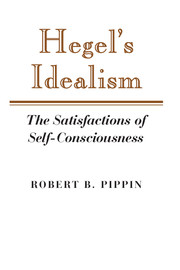
- Hegel's IdealismThe Satisfactions of Self-Consciousness, pp. 175 - 200Publisher: Cambridge University PressPrint publication year: 1989
Accessibility standard: Unknown
Why this information is here
This section outlines the accessibility features of this content - including support for screen readers, full keyboard navigation and high-contrast display options. This may not be relevant for you.Accessibility Information
Accessibility compliance for the PDF of this book is currently unknown
and may be updated in the future.