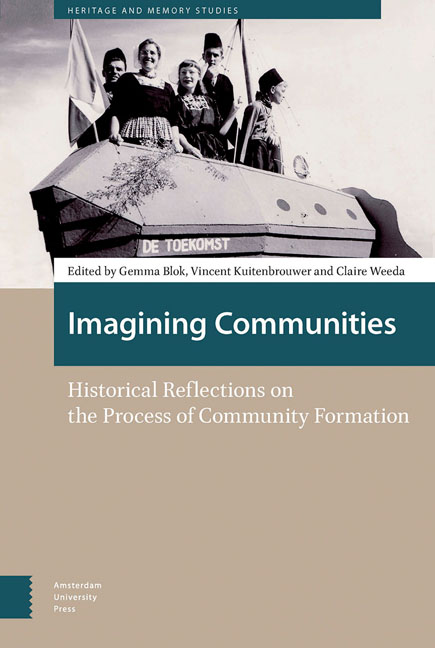

In his groundbreaking Imagined Communities, first published in 1983, Benedict Anderson argued that members of a community experience a deep, horizontal camaraderie. Despite being strangers, members feel connected in a web of imagined experiences. Yet while Anderson's insights have been hugely influential, they remain abstract: it is difficult to imagine imagined communities. How do they evolve and how is membership constructed cognitively, socially and culturally? How do individuals and communities contribute to group formation through the act of imagining? And what is the glue that holds communities together? Imagining Communities examines actual processes of experiencing the imagined community, exploring its emotive force in a number of case studies. Communal bonding is analysed, offering concrete insights on where and by whom the nation (or social group) is imagined and the role of individuals therein. Offering eleven empirical case studies, ranging from the premodern to the modern age, this volume looks at and beyond the nation and includes regional as well as transnational communities as well.
Loading metrics...
* Views captured on Cambridge Core between #date#. This data will be updated every 24 hours.
Usage data cannot currently be displayed.
This section outlines the accessibility features of this content - including support for screen readers, full keyboard navigation and high-contrast display options. This may not be relevant for you.
Accessibility compliance for the PDF of this book is currently unknown and may be updated in the future.
