Book contents
- Frontmatter
- Contents
- Preface
- Map of Italy showing regional borders and capitals
- 1 The political context
- 2 The Christian Democrats: The indispensable center?
- 3 The Communists' struggle for legitimacy and acceptance
- 4 The ambiguous role of the Socialists
- 5 The small parties: The lay forces and the extremes
- 6 Parliament, prime minister, and president
- 7 Public administration and sottogoverno
- 8 The administration of justice
- 9 Dangers to the state: Plots, terrorism, and the mafia
- 10 Economic and social transformation
- 11 Regional devolution and the problem of the South
- 12 The changing relations between church and state
- 13 Foreign and security policy
- 14 “But it does move” – a summing up
- Appendixes
- Bibliography
- Index
Preface
Published online by Cambridge University Press: 03 May 2010
Book contents
- Frontmatter
- Contents
- Preface
- Map of Italy showing regional borders and capitals
- 1 The political context
- 2 The Christian Democrats: The indispensable center?
- 3 The Communists' struggle for legitimacy and acceptance
- 4 The ambiguous role of the Socialists
- 5 The small parties: The lay forces and the extremes
- 6 Parliament, prime minister, and president
- 7 Public administration and sottogoverno
- 8 The administration of justice
- 9 Dangers to the state: Plots, terrorism, and the mafia
- 10 Economic and social transformation
- 11 Regional devolution and the problem of the South
- 12 The changing relations between church and state
- 13 Foreign and security policy
- 14 “But it does move” – a summing up
- Appendixes
- Bibliography
- Index

HTML view is not available for this content. However, as you have access to this content, a full PDF is available via the 'Save PDF' action button.
Summary
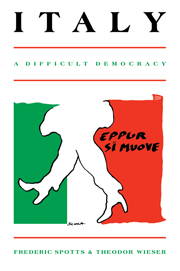
All Western political systems are unique, but some are more unique than others. The Italian form of government may be similar to that of most parliamentary democracies in structure and constitutional principles, but in functioning and ethos it is fundamentally different. The most obvious difference is one of which Aldo Moro frequently spoke in the last years of his life: “We know that our system is characterized by limited change of government and is therefore, in contrast to other European systems, a difficult democracy.” The anomalies of government, in addition to the dark world of scandal, terrorism, and the mafia that are the staple of most media reports, make Italy a strange case in the European panorama.
Italian politics are, for all that, no impenetrable mystery. Their functioning follows remarkably clear patterns, and although these may be subtle and complex, they are deeply woven into the fabric of Italian life. In 1893 Vilfredo Pareto described the politics of the earliest years of the unified Italian state in an article, “The Parliamentary Regime in Italy,” for the Political Science Quarterly. The Italy of Pareto seems almost as distant as the Italy of Augustus. The political system he described, however, is astonishingly similar to that of Italy today. Such is the continuity that runs through Italian political life. It is epitomized in the celebrated passage in The Leopard of Giuseppe Tomasi di Lampedusa: “If we want everything to remain as it is, it will be necessary for everything to change.”
Information
- Type
- Chapter
- Information
- ItalyA Difficult Democracy: A Survey of Italian Politics, pp. ix - xPublisher: Cambridge University PressPrint publication year: 1986
Accessibility standard: Unknown
Why this information is here
This section outlines the accessibility features of this content - including support for screen readers, full keyboard navigation and high-contrast display options. This may not be relevant for you.Accessibility Information
Accessibility compliance for the PDF of this chapter is currently unknown
and may be updated in the future.
 You have
Access
You have
Access