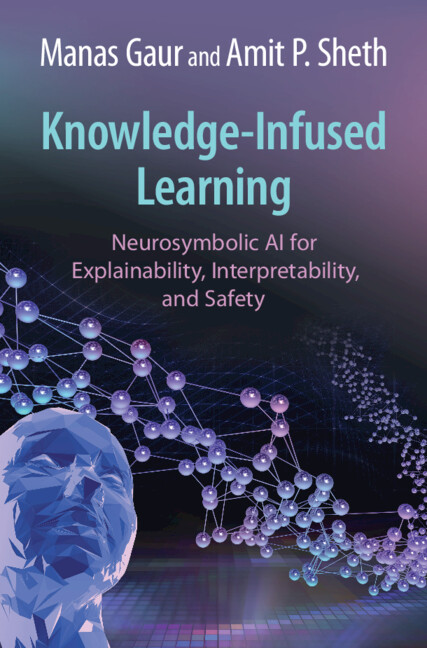
Knowledge-Infused Learning

-
Select format
-
- Publisher:
- Cambridge University Press
- Publication date:
- 22 April 2026
- 07 May 2026
- ISBN:
- 9781009513722
- 9781009513746
- Dimensions:
- (229 x 152 mm)
- Weight & Pages:
- 0.636kg, 324 Pages
- Dimensions:
- Weight & Pages:
You may already have access via personal or institutional login
Show more authors 
You may already have access via personal or institutional login
Book description
Knowledge-infused learning directly confronts the opacity of current 'black-box' AI models by combining data-driven machine learning techniques with the structured insights of symbolic AI. This guidebook introduces the pioneering techniques of neurosymbolic AI, which blends statistical models with symbolic knowledge to make AI safer and user-explainable. This is critical in high-stakes AI applications in healthcare, law, finance, and crisis management. The book brings readers up to speed on advancements in statistical AI, including transformer models such as BERT and GPT, and provides a comprehensive overview of weakly supervised, distantly supervised, and unsupervised learning methods alongside their knowledge-enhanced variants. Other topics include active learning, zero-shot learning, and model fusion. Beyond theory, the book presents practical considerations and applications of neurosymbolic AI in conversational systems, mental health, crisis management systems, and social and behavioral sciences, making it a pragmatic reference for AI system designers in academia and industry.
Reviews
‘Professor Amit Sheth is a leading expert in knowledge-infused learning. The topics covered by this book are important to advance state-of-the-art AI. As our understanding of generative AI deepens, we ask what the next frontiers of AI are. This timely book offers a refreshing answer that explores AI research beyond large language models.’
Huan Liu - Arizona State University
‘This timely and insightful book by Manas Gaur and Amit Sheth combines data-driven AI with structured human knowledge, creating a practical pathway toward transparent and safe AI. Addressing critical gaps in AI's explainability and interpretability, especially in healthcare and crisis management, the authors introduce ‘Knowledge-infused Learning’-an essential approach for human-centric AI. Their innovative frameworks, like CREST, are thoughtfully designed for real-world impact. For anyone deeply engaged in multimodal AI, digital health, or responsible technology use, this book is a must-read guide, offering robust technical foundations and thoughtful ethical considerations crucial for equitable AI solutions.’
Ramesh Jain - University of California, Irvine
‘Knowledge-Infused Learning is a timely and essential guide to building AI systems that are not only powerful, but also interpretable and trustworthy. Gaur and Sheth brilliantly show how integrating human knowledge with machine learning leads to more explainable, safer, and more responsible AI. A must-read for anyone shaping the future of intelligent systems.’
Craig Knoblock - Information Sciences Institute, University of Southern California
‘My 1997 book, Intelligent Systems for Engineering: A Knowledge-Based Approach, briefly discussed the need to integrate neural networks with knowledge-based reasoning. It is gratifying to see Manas carry this vision forward. His formulation of knowledge-infused learning resonates strongly with what DARPA later termed the ‘third wave’ of AI systems capable of contextual adaptation, reasoning, and explainability. I believe that knowledge-infused learning serves as the operational process for achieving neuro-symbolic integration, effectively catalyzing the transition into the third AI wave. In an era dominated by opaque models, this work is a timely reminder that grounding and trust remain central. I believe it will inspire students and researchers to build AI systems that are not only powerful but also truly understandable and socially responsible.’
Ram Sriram - NIST
Contents
Metrics
Altmetric attention score
Full text views
Full text views helpTotal number of HTML views: 0
Total number of PDF views: 0 *
 Loading metrics...
* Views captured on Cambridge Core between #date#. This data will be updated every 24 hours.
Usage data cannot currently be displayed.
Accessibility standard: WCAG 2.1 A
Why this information is here
This section outlines the accessibility features of this content - including support for screen readers, full keyboard navigation and high-contrast display options. This may not be relevant for you.
Accessibility Information
The PDF of this book complies with version 2.1 of the Web Content Accessibility Guidelines (WCAG), covering newer accessibility requirements and improved user experiences and meets the basic (A) level of WCAG compliance, addressing essential accessibility barriers.
Content Navigation
Table of contents navigation
Allows you to navigate directly to chapters, sections, or non‐text items through a linked table of contents, reducing the need for extensive scrolling.
Index navigation
Provides an interactive index, letting you go straight to where a term or subject appears in the text without manual searching.
Reading Order and Textual Equivalents
Single logical reading order
You will encounter all content (including footnotes, captions, etc.) in a clear, sequential flow, making it easier to follow with assistive tools like screen readers.
Short alternative textual descriptions
You get concise descriptions (for images, charts, or media clips), ensuring you do not miss crucial information when visual or audio elements are not accessible.