Book contents
- Frontmatter
- Contents
- Preface
- Acknowledgements
- Introduction
- Part I Kropotkin and the development of the theory of anarchist communism
- Part II Kropotkin and the development of anarchist ideas of revolutionary action by individuals and small groups (1872–1886)
- Part III Kropotkin and the development of anarchist views of collective revolutionary action (1872–1886)
- Conclusion
- Notes
- Bibliography
- Index
Book contents
- Frontmatter
- Contents
- Preface
- Acknowledgements
- Introduction
- Part I Kropotkin and the development of the theory of anarchist communism
- Part II Kropotkin and the development of anarchist ideas of revolutionary action by individuals and small groups (1872–1886)
- Part III Kropotkin and the development of anarchist views of collective revolutionary action (1872–1886)
- Conclusion
- Notes
- Bibliography
- Index
Summary
Anarchism, encompassing as it does such a broad spectrum of ideas, cannot be as precisely defined in ideological terms as marxism, nor has it, outside Spain, made the same impact on twentieth-century European history. It is perhaps not altogether surprising, therefore, that the anarchist movement which emerged from the struggles in the First International has tended to attract attention from scholars primarily in terms of its relevance to the development of marxism. Interest has focussed mainly on the life and work of Bakunin whose quarrel with Marx was such an important feature of the early history of marxism. Peter Kropotkin, however, was the chief exponent of the ideas of the European anarchist movement, which for the most part, only developed after Bakunin's death.
The study of anarchism as a historical movement, in spite of notable exceptions such as Maitron's work on the French anarchist movement, has tended until recent years to be neglected. It now evokes a much keener interest both amongst scholars and the public at large. This is perhaps partly because of an increasing scepticism about the efficacy of conventional politics and a tendency for the aggrieved to take to the streets which have given a new point and relevance to the anarchist critique of the state. At the same time there has been an upsurge of ‘green’ and ‘community’ politics which, in common with anarchism and particularly anarchist communism, focus on free association in community initiative and action and insist on the need for balance and harmony between humankind and the rest of the natural world.
Information
- Type
- Chapter
- Information
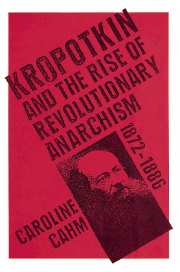
- KropotkinAnd the Rise of Revolutionary Anarchism, 1872-1886, pp. ix - xiPublisher: Cambridge University PressPrint publication year: 1989
Accessibility standard: Unknown
Why this information is here
This section outlines the accessibility features of this content - including support for screen readers, full keyboard navigation and high-contrast display options. This may not be relevant for you.Accessibility Information
Accessibility compliance for the PDF of this book is currently unknown
and may be updated in the future.