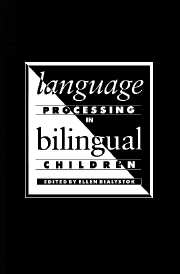
Book contents
- Frontmatter
- Contents
- List of figures
- List of tables
- List of contributors
- Preface
- Introduction
- 1 Language modules and bilingual processing
- 2 Phonological processing in two languages
- 3 Second-language learning in children: a model of language learning in social context
- 4 Interdependence of first- and second-language proficiency in bilingual children
- 5 Giving formal definitions: a linguistic or metalinguistic skill?
- 6 Metalinguistic dimensions of bilingual language proficiency
- 7 Translation skill and metalinguistic awareness in bilinguals
- 8 Towards an explanatory model of the interaction between bilingualism and cognitive development
- 9 Constructive processes in bilingualism and their cognitive growth effects
- 10 Language, cognition, and education of bilingual children
- Index
Introduction
Published online by Cambridge University Press: 11 January 2010
Edited by

Book contents
- Frontmatter
- Contents
- List of figures
- List of tables
- List of contributors
- Preface
- Introduction
- 1 Language modules and bilingual processing
- 2 Phonological processing in two languages
- 3 Second-language learning in children: a model of language learning in social context
- 4 Interdependence of first- and second-language proficiency in bilingual children
- 5 Giving formal definitions: a linguistic or metalinguistic skill?
- 6 Metalinguistic dimensions of bilingual language proficiency
- 7 Translation skill and metalinguistic awareness in bilinguals
- 8 Towards an explanatory model of the interaction between bilingualism and cognitive development
- 9 Constructive processes in bilingualism and their cognitive growth effects
- 10 Language, cognition, and education of bilingual children
- Index
Summary
The study of the cognitive and linguistic achievements of bilingual children has recently become a respectable, even popular, area of inquiry in psychology and education. The issue is not new, but its history as a serious topic of research is somewhat speckled. Researchers have indulged in speculation for some time about the consequences of bilingualism for children's cognitive development, school achievement, linguistic processing, and metalinguistic abilities, but clear theoretical connections based on sound empirical data have been rare.
One factor that has made the problem so difficult to study is the enormous diversity that accompanies children's bilingualism. Consider, for example, some of the conditions under which children can become bilingual. Children can learn both languages simultaneously in the home; the second language can be learned through submersion in a foreign culture (and here the relative status of the first and second language becomes critical in determining outcomes); or the second language can be learned through immersion or foreign-language classrooms with the majority-language environment. These differences undermine most attempts to identify precise conditions for second-language acquisition, the psychological factors that accompany bilingualism, and the implication of bilingualism for academic and other achievements. Where research has been attempted, the enterprise has often been rendered uninterpretable by the failure to account for, and sometimes even to acknowledge, the critical differences among these situations.
Information
- Type
- Chapter
- Information
- Language Processing in Bilingual Children , pp. 1 - 9Publisher: Cambridge University PressPrint publication year: 1991
Accessibility standard: Unknown
Why this information is here
This section outlines the accessibility features of this content - including support for screen readers, full keyboard navigation and high-contrast display options. This may not be relevant for you.Accessibility Information
Accessibility compliance for the PDF of this chapter is currently unknown
and may be updated in the future.
- 1
- Cited by