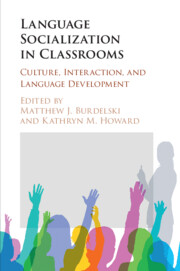
Book contents
- Language Socialization in Classrooms
- Language Socialization in Classrooms
- Copyright page
- Dedication
- Contents
- Figures
- Tables
- Contributors
- Acknowledgments
- Transcription Conventions
- 1 Introduction
- Part I Socializing Values, Dispositions, and Stances
- Part II Socializing Identities
- 5 Learning to Be a Poet
- 6 Teaching Words, Socializing Affect, and Social Identities
- 7 Making the Familiar Change
- 8 Negotiating Epistemic Authority and Co-Constructing Difference
- Part III Language Socialization and Ideology
- Part IV Conclusion
- Index
- References
8 - Negotiating Epistemic Authority and Co-Constructing Difference
Socializing “Nonnative Speaker” Teachers in a US Graduate Program in TESOL
from Part II - Socializing Identities
Published online by Cambridge University Press: 10 February 2020

Book contents
- Language Socialization in Classrooms
- Language Socialization in Classrooms
- Copyright page
- Dedication
- Contents
- Figures
- Tables
- Contributors
- Acknowledgments
- Transcription Conventions
- 1 Introduction
- Part I Socializing Values, Dispositions, and Stances
- Part II Socializing Identities
- 5 Learning to Be a Poet
- 6 Teaching Words, Socializing Affect, and Social Identities
- 7 Making the Familiar Change
- 8 Negotiating Epistemic Authority and Co-Constructing Difference
- Part III Language Socialization and Ideology
- Part IV Conclusion
- Index
- References
Summary
This chapter explores the expert–novice construct through an investigation of classroom discourse focusing on four international graduate students in an MA program in TESOL at a US university. It examines the contingent and shifting nature of expert–novice in two teaching methods courses, which were situated at a nexus of multiple communities of practice: the classrooms, the program, graduate school, the TESOL profession, etc. Microanalysis of classroom interactions reveals how instructors ascribed knowledge to students and positioned them along a continuum of expertise, and considers how focal students’ identities as nonnative speakers of English shaped this positioning. Classroom practices are juxtaposed against focal students’ self-representations as displayed in interviews and classroom behavior as they validated, resisted, or negotiated their positioning. The chapter reflects on the impact of these expert–novice identifications on focal students’ socialization as well as implications of a more dynamic and fluid conceptualization of expert–novice for the study of academic discourse socialization.
Information
- Type
- Chapter
- Information
- Language Socialization in ClassroomsCulture, Interaction, and Language Development, pp. 158 - 178Publisher: Cambridge University PressPrint publication year: 2020
References
American Psychological Association (2010). Publication Manual of the American Psychological Association, 6th Ed. Washington, DC: American Psychological Association.Google Scholar
Brutt-Griffler, J. and Samimy, K. (1999). Revisiting the colonial in the postcolonial: critical praxis for nonnative-English-speaking teachers in a TESOL program. TESOL Quarterly, 33(3), 413–431.CrossRefGoogle Scholar
Brutt-Griffler, J. and Samimy, K. (2001). Transcending the nativeness paradigm. World Englishes, 20(1), 99–106.CrossRefGoogle Scholar
Chandler, J. (2003). The efficacy of various kinds of error feedback for improvement in the accuracy and fluency of L2 student writing. Journal of Second Language Writing, 12(3), 267–296.CrossRefGoogle Scholar
Cho, S. (2013). Disciplinary enculturation experiences of three Korean students in US-based MATESOL programs. Journal of Language, Identity, and Education, 12(2), 136–151.Google Scholar
Cook, V. (1999). Going beyond the native speaker in language teaching. TESOL Quarterly, 33(2), 185–209.Google Scholar
Davies, A. (2003). The Native Speaker: Myth and Reality. Clevedon, UK: Multilingual Matters.Google Scholar
Doerr, N. M. (2009). Introduction. In Doerr, N. M. (ed.), The Native Speaker Concept: Ethnographic Investigations of Native Speaker Effects (pp. 1–10). Berlin: Mouton de Gruyter.CrossRefGoogle Scholar
Duff, P. A. (2002). The discursive co-construction of knowledge, identity, and difference: an ethnography of communication in the high school mainstream. Applied Linguistics, 23(3), 280–322.CrossRefGoogle Scholar
Duff, P. A. and Anderson, T. (2015). Academic language and literacy socialization for second language students. In Markee, N. (ed.), The Handbook of Classroom Discourse and Interaction (pp. 337–352). Malden, MA: Wiley.CrossRefGoogle Scholar
Freeman, D. and Johnson, K. E. (1998). Reconceptualizing the knowledge-base of language teacher education. TESOL Quarterly, 32(3), 397–417.Google Scholar
Garrett, P. B. and Baquedano-López, P. (2002). Language socialization: reproduction and continuity, transformation and change. Annual Review of Anthropology, 31, 339–361.CrossRefGoogle Scholar
Goffman, E. (1981). Footing. In Goffman, E., Forms of Talk (pp. 124–159). Philadelphia, PA: University of Pennsylvania Press.Google Scholar
Hedgcock, J. S. (2002). Toward a socioliterate approach to second language teacher education. Modern Language Journal, 86(3), 299–317.CrossRefGoogle Scholar
Heritage, J. (2012). Epistemics in action: action formation and territories of knowledge. Research on Language and Social Interaction, 45(1), 1–29.CrossRefGoogle Scholar
Ho, M. (2011). Academic discourse socialization through small-group discussions. System, 39(4), 437–450.CrossRefGoogle Scholar
Holliday, A. (2008). Standards of English and politics of inclusion. Language Teaching, 41(1), 119–30.CrossRefGoogle Scholar
Jacoby, S. and Gonzales, P. (1991). The constitution of expert–novice in scientific discourse. Issues in Applied Linguistics, 2(2), 149–181.CrossRefGoogle Scholar
Jaffe, A. (2009). Introduction: the sociolinguistics of stance. In Jaffe, A. (ed.), Stance: Sociolinguistic Perspectives (pp. 3–28). New Y, NY: Oxford University Press.CrossRefGoogle Scholar
Jefferson, G. (1984). On the organization of laughter in talk about troubles. In Atkinson, J. M. and Heritage, J. (eds.), Structures of Social Action: Studies in Conversation Analysis (pp. 346–369). Cambridge: Cambridge University Press.Google Scholar
Krachu, B. (1992). The Other Tongue: English across Cultures. Urbana, IL: University of Illinois Press.Google Scholar
Lee, J. S. and Bucholtz, M. (2015). Language socialization across learning spaces. In Markee, N., (ed.), The Handbook of Classroom Discourse and Interaction (pp. 319–336). Malden, MA: Wiley.CrossRefGoogle Scholar
Medgyes, P. (1992). Native or non-native: who’s worth more? ELT Journal, 46(4), 340–349.Google Scholar
Morita, N. (2000). Discourse socialization through oral classroom activities in a TESL graduate program. TESOL Quarterly, 34(2), 279–210.CrossRefGoogle Scholar
Morita, N. (2002). “Negotiating participation in second language academic communities: a study of identity, agency, and transformation.” Unpublished doctoral dissertation, University of British Columbia, Canada. https://open.library.ubc.ca/media/download/pdf/831/1.0078209/1Google Scholar
Morita, N. (2004). Negotiating participation and identity in second language academic discourse communities. TESOL Quarterly, 38(4), 573–603.CrossRefGoogle Scholar
Motha, S. (2006). Racializing ESOL teacher identities in US K-12 public schools. TESOL Quarterly, 40(3), 495–518.CrossRefGoogle Scholar
Moussu, L. and Llurda, E. (2008). Non-native English-speaking English language teachers: history and research. Language Teaching, 41(3), 315–348.CrossRefGoogle Scholar
Ochs, E. (1993). Constructing social identity: a language socialization perspective. Research on Language and Social Interaction, 26(3), 287–306.CrossRefGoogle Scholar
Ochs, E. (1996). Linguistic resources for socializing humanity. In Gumperz, J. J. and Levinson, S. C. (eds.), Rethinking Linguistic Relativity (pp. 407–437). New York, NY: Cambridge University Press.Google Scholar
Ochs, E. and Schieffelin, B. B. (2011). The theory of language socialization. In Duranti, A., Ochs, E., and Schieffelin, B. B. (eds.), The Handbook of Language Socialization (pp. 1–21). Malden, MA: Blackwell.Google Scholar
Rampton, M. B. H. (1990). Displacing the “native speaker”: expertise, affiliation, and inheritance. ELT Journal, 45(2), 97–101.CrossRefGoogle Scholar
Riley, K. (2011). Language socialization and language ideologies. In Duranti, A., Ochs, E., and Schieffelin, B. B. (eds.), The Handbook of Language Socialization (pp. 493–514). Malden, MA: Blackwell.Google Scholar
Romaine, S. and Lange, D. (1991). The use of like as a marker of reported speech and thought: a case of grammaticalization in progress. American Speech, 66(3), 227–279.CrossRefGoogle Scholar
Singh, G. and Richards, J. C. (2009). Teaching and learning in the course room. In Burns, A. and Richards, J. C. (eds.), Cambridge Guide to Second Language Teacher Education (pp. 201–208). New York, NY: Cambridge University Press.CrossRefGoogle Scholar
Talmy, S. (2015). A language socialization perspective on identity work of ESL youth in a superdiverse high school classroom. In Markee, N. (ed.), The Handbook of Classroom Discourse and Interaction (pp. 353–368). Malden, MA: Wiley.CrossRefGoogle Scholar
Wright, T. (2010). Second language teacher education: review of recent research on practice. Language Teaching, 43(3), 259–296.Google Scholar
Accessibility standard: Unknown
Why this information is here
This section outlines the accessibility features of this content - including support for screen readers, full keyboard navigation and high-contrast display options. This may not be relevant for you.Accessibility Information
Accessibility compliance for the HTML of this chapter is currently unknown
and may be updated in the future.
- 3
- Cited by