Book contents
- Frontmatter
- Dedication
- Contents
- Preface and Acknowledgments
- 1 Introduction
- 2 Warrior Morality and the Fate of Civilization
- 3 Legitimacy and Legality, Thinking and Ruling in the Closed Society and the World State
- 4 Strauss’s Machiavelli
- 5 Thucydides versus Machiavelli
- 6 Justice and Progress
- 7 Conclusion
- Abbreviations
- Index
- References
1 - Introduction
Reopening the Case of Leo Strauss
Published online by Cambridge University Press: 05 September 2014

Book contents
- Frontmatter
- Dedication
- Contents
- Preface and Acknowledgments
- 1 Introduction
- 2 Warrior Morality and the Fate of Civilization
- 3 Legitimacy and Legality, Thinking and Ruling in the Closed Society and the World State
- 4 Strauss’s Machiavelli
- 5 Thucydides versus Machiavelli
- 6 Justice and Progress
- 7 Conclusion
- Abbreviations
- Index
- References
Summary
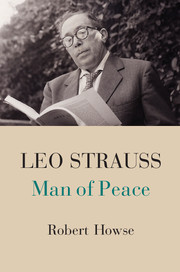
This book reconsiders the views of Leo Strauss on the relationship of philosophy and law to political violence – the aspect of Strauss’s scholarship that has been most publicly controversial and where his intentions have been most vehemently disputed. Around the time of the Iraq War, a bevy of books and articles appeared claiming Strauss and his followers had inspired the foreign and defense policies of the George W. Bush administration. Scholars and journalists alike scoured Strauss’s difficult and erudite works about political thinkers such as Machiavelli and Thucydides. They purported to discover cleverly placed and shrewdly veiled messages of bellicose imperialism, war without limits, and unbounded executive power – the doctrines they suspected Strauss of teaching orally to a closed circle of disciples.
Here I contest these charges through reinterpreting Strauss’s published work in light of the lectures and seminars he gave to his students, which have become available over the last few years. Strauss, I argue, offers a new, classically inspired philosophy of political violence, but one based on a strong preference for peace over war. This philosophy holds that there are circumstances in which the use of violence is a justified necessity, a radically different proposition from arguing against all moral and legal constraints on war. As Strauss puts it, “Socrates was a man of peace rather than of war. It should go without saying that a man of peace is not the same as a pacifist” (XSD, p. 89).
Information
- Type
- Chapter
- Information
- Leo StraussMan of Peace, pp. 1 - 24Publisher: Cambridge University PressPrint publication year: 2014
References
, Leo Strauss and the Politics of Exile: The Making of a Political Philosopher (Boston: Brandeis Univ. Press, 2006)Google Scholar
, is “Leo Strauss: September 20, 1899–October 18, 1973,” in , Giants and Dwarfs: Essays 1960–1990 (New York: Simon & Schuster, 1990), pp. 235–255Google Scholar
, Leo Strauss and the Politics of American Empire (New Haven, CT: Yale University Press, 2004), p. 26Google Scholar
, “Why Leo Strauss? Four Answers and One Consideration concerning the Use and Disadvantages of the School for the Philosophical Life,” in and , eds., Modernity and What Has Been Lost: Considerations on the Legacy of Leo Strauss (South Bend, IN: St. Augustine’s Press, 2011), pp. 19–31Google Scholar
, “Allan Bloom: A Reminiscence,” in Political Philosophy and the Human Soul: Essays in Memory of Allan Bloom, edited by and (Lanham, MD: Rowman & Littlefield, 1995), 1–14Google Scholar
and , The Truth About Leo Strauss: Political Philosophy & American Democracy (Chicago: University of Chicago Press, 2006)Google Scholar
, “On the Interpretation of Genesis,” L’Homme, Jan–Mar 1981 XXI, no. 10, 5–20, p. 6
, Leo Strauss: An Introduction to His Thought and Legacy (Baltimore, MD: Johns Hopkins University Press, 2006), p. 5Google Scholar
Hannah Arendt Karl Jaspers Correspondence 1926–1969, ed. and , tr. and (New York: Harcourt, Brace & Co., 1992), Letter 156, p. 244
and , Recollections of a Historian of Ideas: Conversations with Isaiah Berlin (New York: Charles Scribner’s Sons, 1991), p. 31Google Scholar
, “The Anti-Strauss,” The Journal of Politics 74, no. 01, January 2012, pp. 142–155CrossRefGoogle Scholar
,” Philosophy and Rhetoric 32, no. 01, 1999
, “Selective Intelligence,” The New Yorker, May 12, 2003, pp. 44–51
, “A Classicist’s Legacy: New Empire Builders,” The New York Times, May 4, 2003, sec. 4, pp. 1–4
and , The Truth About Leo Strauss: Political Philosophy & American Democracy (Chicago: University of Chicago Press, 2006)Google Scholar
, ; , Straussophobia: Defending Leo Strauss and Straussians Against Shadia Drury and Other Accusers (Lanham, MD: Lexington Books, 2009)Google Scholar
, : Seminar on The Philosophy of History, University of Chicago 1958
, “Defending Strauss,” The Chicago Reader, August 23, 2007
, “‘To Spare the Vanquished and Crush the Arrogant’: Leo Strauss’s Lecture on ‘German Nihilism,’” in The Cambridge Companion to Leo Strauss, edited by (New York: Cambridge Univ. Press, 2009), pp. 171–192CrossRefGoogle Scholar
, “Legal Theory and the Weimar Crisis of Law and Social Change,” in Weimar Thought: A Contested Legacy, edited by and (Princeton, NJ: Princeton University Press, 2013), pp. 55–72Google Scholar
, The German Stranger: Leo Strauss and National Socialism (Lanham, MD: Lexington Books, 2010)Google Scholar
“Misreading Leo Strauss,” Policy Review, December 2012/January 2013, pp. 83–94
, Independent Journal of Philosophy 5/6 (1988): 177–192, p. 183
, “Cohen and Maimonides,” in Leo Strauss on Maimonides, edited by (Chicago: University of Chicago Press, 2013), p. 222CrossRefGoogle Scholar
, “Progress or Return? The Contemporary Crisis in Western Civilization,” in Modern Judaism I (1987), p. 17Google Scholar
, “Advocating T’shuvah: The Influence of Hegel in Leo Strauss’s Lectures on the Relation of Progress and Return,” Filosof, Fall 2010, pp. 42–58Google Scholar
and , eds., trs., Machiavelli and his Friends: Their Personal Correspondence (DeKalb, IL: NIU Press, 1996), p. 264
Accessibility standard: Unknown
Why this information is here
This section outlines the accessibility features of this content - including support for screen readers, full keyboard navigation and high-contrast display options. This may not be relevant for you.Accessibility Information
Accessibility compliance for the PDF of this book is currently unknown
and may be updated in the future.