Skip to main content Accessibility help
×
Hostname: page-component-68c7f8b79f-xmwfq Total loading time: 0 Render date: 2026-01-01T20:17:26.013Z Has data issue: false hasContentIssue false

6 - Memory kinds

Published online by Cambridge University Press:  05 June 2012

Kurt Danziger
Affiliation:
York University, Toronto
Get access

Summary

A coat of many colours

The language of everyday life has many ways of referring to the activity of memory. Not only do we speak of remembering an appointment, we also recollect what was said at yesterday's meeting, reminisce about that vacation in the Alps, recognize the face of a friend not seen for many months, memorize the text of a favourite poem, are reminded of a scene in a film and so on. Moreover, each of these memory words can be used in several different senses, as a glance at any good dictionary will show.

What this seems to tell us about ‘memory’ is that it is essentially an abstraction, a convenient but rather loose way of referring to a large array of activities that are all felt to have something in common. What that something might be is not so easily said. Is it that they all refer to the past? Aristotle thought so. But what about remembering tomorrow's appointment? I may have forgotten making the appointment, but still remember that tomorrow there is this appointment. Philosophers have not found it easy to pinpoint the essence of memory – St Augustine frankly threw up his hands and proclaimed it a mystery.

Attempts at solving the mystery have generally followed one of two paths. One path is that of scepticism: if we cannot pin down the essence of memory, no matter how hard we look, this probably means that there is no such essence, that ‘memory’ and its associated words are just that, words.

Information

Type
Chapter
Information
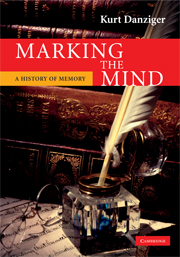
Marking the Mind
A History of Memory
, pp. 156 - 187
Publisher: Cambridge University Press
Print publication year: 2008

Access options

Get access to the full version of this content by using one of the access options below. (Log in options will check for institutional or personal access. Content may require purchase if you do not have access.)

Book purchase

Temporarily unavailable

Accessibility standard: Unknown

Why this information is here

This section outlines the accessibility features of this content - including support for screen readers, full keyboard navigation and high-contrast display options. This may not be relevant for you.

Accessibility Information

Accessibility compliance for the PDF of this book is currently unknown and may be updated in the future.

Save book to Kindle

To save this book to your Kindle, first ensure no-reply@cambridge.org is added to your Approved Personal Document E-mail List under your Personal Document Settings on the Manage Your Content and Devices page of your Amazon account. Then enter the ‘name’ part of your Kindle email address below. Find out more about saving to your Kindle.

Note you can select to save to either the @free.kindle.com or @kindle.com variations. ‘@free.kindle.com’ emails are free but can only be saved to your device when it is connected to wi-fi. ‘@kindle.com’ emails can be delivered even when you are not connected to wi-fi, but note that service fees apply.

Find out more about the Kindle Personal Document Service.

  • Memory kinds
  • Kurt Danziger, York University, Toronto
  • Book: Marking the Mind
  • Online publication: 05 June 2012
  • Chapter DOI: https://doi.org/10.1017/CBO9780511810626.006
Available formats
×

Save book to Dropbox

To save content items to your account, please confirm that you agree to abide by our usage policies. If this is the first time you use this feature, you will be asked to authorise Cambridge Core to connect with your account. Find out more about saving content to Dropbox.

  • Memory kinds
  • Kurt Danziger, York University, Toronto
  • Book: Marking the Mind
  • Online publication: 05 June 2012
  • Chapter DOI: https://doi.org/10.1017/CBO9780511810626.006
Available formats
×

Save book to Google Drive

To save content items to your account, please confirm that you agree to abide by our usage policies. If this is the first time you use this feature, you will be asked to authorise Cambridge Core to connect with your account. Find out more about saving content to Google Drive.

  • Memory kinds
  • Kurt Danziger, York University, Toronto
  • Book: Marking the Mind
  • Online publication: 05 June 2012
  • Chapter DOI: https://doi.org/10.1017/CBO9780511810626.006
Available formats
×