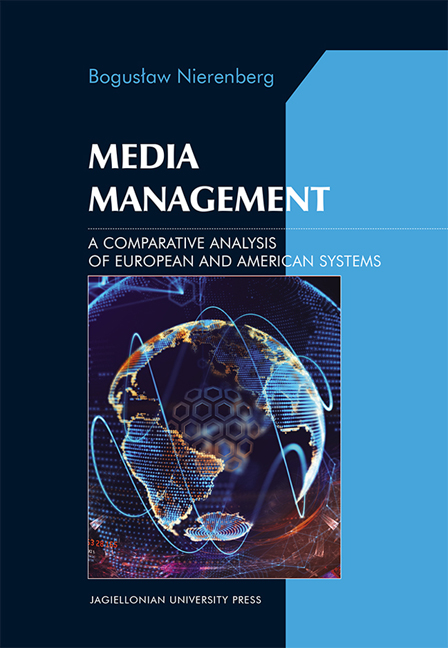
Media Management

-
Select format
-
- Publisher:
- Jagiellonian University Press
- Publication date:
- 10 January 2018
- 01 January 2016
- ISBN:
- 9788323393917
- 9788323339908
- Dimensions:
- Weight & Pages:
- Dimensions:
- Weight & Pages:
- Subjects:
- Management: General Interest, Management
You may already have access via personal or institutional login- Subjects:
- Management: General Interest, Management
Show more authors 
You may already have access via personal or institutional login
Book description
The thesis that the media have become the basic determinant of the modern world is so apparent that we think it is even trivial. However, the banality of this phenomenon does not mean it is commonly known. It does not mean, either, that we are familiar with the rules that are behind it. It seems that things look similar with regard to media management.
The book entitled Media Management: A Comparative Analysis of European and American Systems is the result of research conducted by the author for many years. Its principal objective is to compare the academic achievements in the scope of media management in American and European media management systems. The two theses by Peter Drucker have become its basis: the first that says "information shall be the basic resource in the 21st c." and the other one that says "the more the information is widespread, the more valuable it is". While the first thesis is fairly widely accepted, the other one is not in line with traditional economic knowledge. This is one of the most essential characteristics of the media industry, for which information is the basic resource, thus the properties of this resource play a decisive role in such importance of media organizations.
In order to describe the issues related to media management, the authors have adopted systematic methodology, according to which the phenomena under study should be understood as an integrated whole and it contains parts which are directly or indirectly related to each other. Three questions, which are of the key importance for the systemic understanding of the phenomena under study and which were posed by Gerald Weinberg, have been applied in order to describe the phenomena: 1. Why do I see what I see? 2. Why are things as they are? 3. Why do things change? This method of perceiving reality allows one to render the essence of the issue under study.
The analysis presented in the book has proved that management is not secret knowledge. It can be learnt. The same applies to media management. Managers who desire to direct media organizations should possess such knowledge and competencies.
Contents
Contents
Metrics
Full text views
Full text views helpTotal number of HTML views: 0
Total number of PDF views: 0 *
 Loading metrics...
* Views captured on Cambridge Core between #date#. This data will be updated every 24 hours.
Usage data cannot currently be displayed.
Accessibility standard: Unknown
Why this information is here
This section outlines the accessibility features of this content - including support for screen readers, full keyboard navigation and high-contrast display options. This may not be relevant for you.
Accessibility Information
Accessibility compliance for the PDF of this book is currently unknown and may be updated in the future.