Skip to main content Accessibility help
×
Hostname: page-component-74d7c59bfc-6sd86 Total loading time: 0 Render date: 2026-02-08T11:44:24.464Z Has data issue: false hasContentIssue false

Introduction

Published online by Cambridge University Press:  23 October 2017

Nikolay Koposov
Affiliation:
Emory University, Atlanta

Summary

Information

Type
Chapter
Information
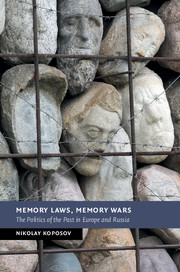
Memory Laws, Memory Wars
The Politics of the Past in Europe and Russia
, pp. 1 - 24
Publisher: Cambridge University Press
Print publication year: 2017

Introduction

The Meaning of “Memory Laws”

The term “memory laws” (lois mémorielles) was coined in France in the 2000s to refer to legislation that penalizes Holocaust negationism or recognizes certain events as crimes against humanity while not prohibiting their denial. The invention of a new term shows that memory laws were widely perceived as a novelty that could not be adequately described within existing categories. Laws such as these are indeed a relatively recent phenomenon, which dates back to the 1980s. Initially, the concept was colored by a strong ironic overtone and was used mostly by opponents of the new legislation, such as the eminent historians René Rémond and Pierre Nora and the novelist Françoise Chandernagor, who invoked its bizarre nature to repudiate it.Footnote 1 The lois mémorielles were deemed to be part of the phénomène mémoriel, or the rise of memory in the late twentieth century, which their adversaries typically considered a manifestation of the fragmentation and crisis of the French national identity.Footnote 2 But quite soon the term became more commonplace due to its remarkable success in the media, and transformed into a relatively neutral marker. An ad hoc polemical tool had thus grown into a historical concept, which is a typical trajectory for many notions in the historian’s lexicon. Unsurprisingly, though, using it for purposes of classification creates problems, because this is not what the concept was coined for.

Precisely which laws does the term refer to? There seems to be a contradiction between its literal sense and its conventional use, the first being far broader than the second. In addition, the term’s meaning in different languages is not exactly the same, the English concept of memory laws being more inclusive than the original French notion of lois mémorielles. Taken literally, “memory laws” in English would mean laws regulating historical memory or simply laws on memory. In contrast to the French notion, there is here no appreciable lexical relationship with the current memory boom. In other languages, the meaning of the term vacillates between the French and the English models.Footnote 3 Those nuances notwithstanding, however, in most languages the notion can be used both in a broad sense encompassing all laws that regulate collective representations of the past and in the narrow sense of prohibitions on Holocaust denial and other similar legislation. As a matter of fact, it is most often, although not always, used in the latter sense.

The tension between the two meanings can occasionally become politically charged. While many critics of memory laws in France stressed their “absolute novelty,”Footnote 4 the partisans of this legislation invoked precedents dating back to the period of the French revolution.Footnote 5 In this context, the demonstration of an established tradition of memory laws was intended to serve as a gauge of their legitimacy. In 2008, a special commission of the French Parliament (the Accoyer Commission,Footnote 6 which had been created to investigate the legitimacy of the memory laws), reached the following conclusion regarding their uniqueness:

The concept of lois mémorielles is very recent: the expression appears only in 2005 to retrospectively designate a group of texts the first of which dates back only to 1990. But the laws that this concept refers to belong to a long-standing commemorative tradition whose legacy they have both developed and problematized.Footnote 7

This is, I believe, a reasonable conclusion, characterizing as it does the complex relationship between the “new generation” of memory laws (the term used in the Accoyer Report) and their historical predecessors. The tension between the broad and the narrow meanings of the term may, however, be heuristically productive, in drawing attention to both the novelty of the present-day memory laws and their multiple connections with previous legislation.

The group of texts mentioned in the quote above includes first of all the 1990 Gayssot Act that penalizes Holocaust negationism and three “declarative” laws – the “Armenian” Law of 2001 that recognizes the 1915 massacre of Armenians in the Ottoman Empire as a genocide; the Taubira Act, also of 2001, that proclaims slavery and the slave trade a crime against humanity; and the 2005 Mekachera Act that “acknowledges the sufferings and sacrifices” of the “civil and military victims” of the Algerian war on the French side. These statutes are usually viewed as canonical memory laws.Footnote 8

However, there is no consensus in France on whether these four laws can even be seen as members of the same category,Footnote 9 and not only because one of them criminalizes certain statements about the past while others do not. It is sometimes argued that the laws of 2001 and 2005 are declarations rather than real laws because they have created no new norms.Footnote 10 More significantly, these three laws are often viewed as products of electoral manipulation and a competition of victims, such criticism being rarely voiced with regard to the Gayssot Act.

Nonetheless, the term “memory laws” was coined to refer to all these acts. The Accoyer Report states that what they have in common is their goal of fulfilling the “duty of memory” (le devoir de mémoire),Footnote 11 which since the early 1990s has become a central theme of public debates in France.Footnote 12 This is, of course, just another way of saying that memory laws are legislation having to do with the phénomène mémoriel, and there are several other laws that fall under this definition,Footnote 13 not all of which are mentioned in the Accoyer Report. For instance, the report does not count as a memory law the enactment passed on October 8, 1987, that created mort en déportation (died during deportation) as an official status attributable to a deceased person. That could, of course, be a simple omission, for this piece of legislation was obviously in line with the duty of memory agenda. But are there good reasons not to designate as memory laws similar acts that had been passed long before the duty of memory became a fashionable idea? The law of 1987 was modeled after a law of July 2, 1915, that had introduced the concept (“mention”) of mort pour la France (died for France) in the context of legislation aimed at commemorating fallen soldiers and granting privileges to their families.Footnote 14 If the former legislation belongs to this category, why should the latter not also be called a memory law? The only possible answer is that 1915 is distant from us in time, while memory laws are a recent fact. Similar arguments have been adduced in other debates on memory laws.Footnote 15

As with most historical concepts, the category of memory laws should probably be conceived in terms of the prototype theory of classification. The prototype theory states that, contrary to Aristotelian logic, human categories, or the concepts that our minds naturally form, do not follow the principle of necessary and sufficient conditions but are formed around prototypes or good examples, to which less good examples and borderline cases are associated by means of a vague family resemblance. Definitions or general concepts, it is maintained, are of little use in the actual categorization process, which is guided by a holistic perception of objects, not by a trait analysis. Empirically formed categories tend to have a hard core and a complexly structured periphery. An object can belong to this or that extent to a prototypical class (“some dogs are more doggy than others”), which is impossible with regard to an Aristotelian class, whose members are all equal so long as they satisfy the required conditions for category membership. In response, critics of the prototype theory argue that humans form different kinds of concepts. In many cases, prototypical effects do indeed occur but this does not prove that a concept does not have a meaning that we spontaneously interpret analytically, in terms of necessary and sufficient conditions.Footnote 16 In a moderated version that emphasizes the plurality of forms of classification and the complexity of the semantic structures of our concepts, the prototype theory can arguably be a useful tool of historical research.Footnote 17

Historical concepts (like many words of our everyday language) tend to have a general meaning and refer to concrete historical occurrences that can be seen as good examples of a particular category. In other words, they have aspects of both Aristotelian and prototypical categories. Given that these occurrences are unique historical phenomena, limited in space and time (or, to borrow from the language of the German historicists, “historical individuals,” which includes collective individuals),Footnote 18 it may be said that historical concepts combine elements of a common and a proper name. We will return to this theory later, since it can help us understand an important aspect of the present-day historical consciousness. For now, however, I will limit myself to the following suggestion.

I believe that the hard core of the broadly understood category of memory laws consists of legislation penalizing statements about the past (or memory laws per se), while its periphery includes several other kinds of laws: declarative memory laws giving an official assessment of historical events, including those that recognize certain events as crimes against humanity; laws on state symbols, holidays, remembrance days, and commemorative ceremonies; acts renaming cities, streets, and public institutions to commemorate historical figures or events; laws on the creation of museums, erection of monuments, and organization of archives; laws on education that regulate the teaching of history; legislation on veterans and on the memory of fallen soldiers; laws granting amnesty to the participants in certain historical events (such as the Paris Commune and the Spanish Civil War) or rehabilitating victims of repressions and providing compensations for past injustices; lustration acts that aim at purifying public institutions from collaborators of a former regime; and laws prohibiting certain symbols, parties, and ideologies (which involves a historical assessment). This list is by no means complete.Footnote 19 In many cases, such legislation has practical political and social goals that extend far beyond the regulation of historical memory (for instance, combating the danger from the far right or defining veterans’ rights). The more obvious the “memorial component” of a given act is, the closer it is to the center of the category of memory laws. Characteristically, most types of peripheral memory laws existed long before this concept was coined subsequent to the emergence of the category’s hard core, as described here.Footnote 20

My focus in the book is on that hard core of the category of memory laws, or legislation criminalizing statements about the past that I believe typifies the present-day historical consciousness. However, I also consider them in the context of other laws regulating collective representations of history. From among all kinds of memory laws in the broad sense of the word, anti-fascist legislation has been particularly important to the genesis of memory laws per se, and I consider it in Chapter 2. In Eastern Europe, memory laws have also continued another legislative tradition, namely that of de-communization, which I discuss in Chapter 3.

But even in the narrowest possible sense of enactments criminalizing statements about the past, memory laws are a complexly structured category that includes several subtypes and various borderline cases, and it is not always easy to decide whether a given law belongs to that category. One of this book’s main goals is to propose a typology of those laws. Here, however, I will restrict myself to just one more brief comment on the changing meaning of this concept.

Typically, memory laws ban factual (or, more exactly, counter-factual) statements about history rather than assessments of the past. Initially (in the 1980s), they came into being to prevent Holocaust negationism, and one of the arguments in their favor was that they ban lies (the Auschwitz-lie) rather than opinions. That, in fact, is why those laws were called Holocaust denial laws. Indeed, occurrences of statements such as “Hitler was right to exterminate the Jews” could be more easily prosecuted on the basis of enactments prohibiting fascist propaganda and hate speech, while claims that “there had been no gas chambers” were, according to the deniers, an academic position that could not be outlawed. The goal of the new legislation was to identify that “position” as a lie and an expression of racism.

As time passed, however, the original notion began to change. Its scope expanded to include the denial of certain other crimes against humanity, so that the original target of the Auschwitz-lie had to be replaced with a broader formula. The expression “memory laws” no longer refers, therefore, only to denial, and many such laws (especially recent ones) penalize both denial and justification of those crimes. Criminalizing negationism remains crucial to the notion of memory laws because of their genealogy, but in some cases, which I would consider peripheral to the category, denial is not banned whereas justification is.Footnote 21 Moreover, prohibitions of utterances that contain certain assessments of past events seem to antedate the emergence of the legislation that bans factual statements about history. Thus, some postwar anti-fascist laws, both in Western and Eastern Europe, contained formulas that can be interpreted as bans on the positive historical evaluation of fascism.Footnote 22 But they were just remote predecessors, or early peripheral cases, of the category of memory laws, as it has emerged since the 1980s when the task of criminalizing untrue statements became urgent in the context of the growing Holocaust denial movement.

Memory Laws as a Pan-European Phenomenon

Pierre Nora once called memory laws “a distinctively French legislative sport.”Footnote 23 He is right insofar as nowhere else have public debates on these laws been as passionate as in France, not to mention that the Gayssot Act of 1990 is a prototypical memory law that has provided a model for several other national enactments and international agreements. Yet the first Holocaust denial laws were adopted in Germany (1985) and Israel (1986). Since the 1990s, this legislation has become a pan-European phenomenon; to this point, some thirty European countries have laws criminalizing statements about the past on their books.Footnote 24 In some countries, “the French sport” has become at least as popular as in France. For instance, over the past twenty-five years, Ukrainian lawmakers have proposed more than ninety bills dealing with different aspects of historical memory. Given the variety of historical memory regimes in Europe, a comparative approach to memory laws is crucial to their understanding. My intention here is to consider this legislation in the various forms that it has taken at the mature stage of its development, rather than to fall under the spell of “the idol of origins” (Marc Bloch), which sometimes prompts us to explain a social phenomenon by the circumstances of its genesis.

This book has been written by a historian, not by a legal scholar. Although we owe to jurists most of what is known about memory laws, in particular with respect to the ongoing debate about the legitimacy of that legislation, history has an important contribution to make to the legal dispute that I will review later in this introduction. I hold that the expansion of memory laws, which is characteristic of the present-day political climate, is gradually changing their nature. Over recent decades, memory laws have become a historical phenomenon with its own logic of development, which has led legislators in many European countries far beyond the original intentions of the authors of the first new-generation memory laws. Initially conceived as a means of maintaining peace, these laws have instead become one of the preferred instruments of the memory wars within and between many European countries.

The book is the first study to offer a complete overview of the laws criminalizing statements about the past in Europe, including in Russia.Footnote 25 Most of the existing literature deals with memory laws in the West. Their more recent Eastern European, and especially Russian and Ukrainian, analogues are far less well known, for all that they are critical in assessing the role of memory laws as a device of the present-day politics of history and in understanding the polarity of the two main forms of European memory.Footnote 26

Although adopted largely on the initiative of the European Union and in compliance with its recommendations, some Eastern European memory laws differ significantly from their Western prototypes. I argue that in Eastern Europe, legislation on the issues of the past is often used to give the force of law to narratives centered on the history of the nation-states, which is the opposite of what such laws were meant to achieve in Western Europe and what the European Union intends to accomplish by promoting them. The latter’s goal is to create a common European memory centered on the memory of the Holocaust as a means of integrating Europe, combating racism, and averting the national and ethnic conflictsFootnote 27 that national narratives are likely to stimulate.

The Russian case is central to my book because it convincingly demonstrates the changing nature of legislation on the issues of the past and its transformation into an instrument of memory wars that can potentially lead to shooting wars. The Russian law adopted in the midst of the Ukraine crisis in May 2014 penalizes “dissemination of knowingly false information on the activities of the USSR during the Second World War.”Footnote 28 This document is almost unique among memory laws, which normally protect the memories of the victims of state policy. Russian legislators claim that their law differs in no way from Western memory laws; but what they are actually seeking to do is protect the memory of the Stalin regime against the memory of its victims. The law gives legal protection to the cult of World War II (or the Great Patriotic War, as the Russians typically call it) that under Putin has become the myth of the origins of post-Soviet Russia. This cult includes the notion of the Yalta System and legitimizes the Soviet occupation of Eastern Europe in the aftermath of the war. However, as radical as it is, the Russian case points to broader tendencies in the evolution of the legislation of memory, which is now being widely used in promoting nationalistic goals. (Edoardo Grendi’s notion of exceptional/normalFootnote 29 could almost have been coined to account for the peculiarity of this country, where world-wide trends often take extreme forms whose study helps us better understand those trends themselves.) I will, in particular, show that memory laws were an important instrument in the memory war between Russia and Ukraine, which laid the groundwork for the Russian annexation of Crimea and the war in Donbass.Footnote 30 Fans of “the French sport” need to be aware of its potential dangers.

Memory Laws and the Rise of Memory

Alongside the role of memory laws in present-day politics, my second concern in this book is with their cultural meaning, and more specifically with what they reveal about the changing forms of modern historical consciousness and political legitimation. In other words, I will consider memory laws in the context of the rise of memory in the late twentieth and early twenty-first centuries.

The memory boom is perhaps the most salient feature of the present-day historical consciousness. Here too, the proliferation of new concepts signals some important changes that have been taking place in recent decades. Such expressions as “historical memory,” “identity,” “politics of history,” and “memory wars” are relative newcomers to the vocabulary of the social and human sciences. Before the 1980s, the concept of memory, and of historical memory in particular, was only occasionally used by historians, political scientists, sociologists, anthropologists, or literary scholars.Footnote 31 But since then, memory has become “perhaps the leading term” in cultural history and “a central concept in the humanities and the social sciences” in general.Footnote 32 The notion of identity (in the sense of personal identity) was coined in the 1950s, but came to prominence only with the emergence of interest in memory, with which its meaning largely overlaps.Footnote 33 Indeed, memory, both individual and collective, is often viewed as the custodian of identity.Footnote 34 The term “politics of history” (Geschichtspolitik) was invented in 1986 in the context of the West German Historikerstreit (“the historians’ debate” over the uniqueness of the Holocaust), although the adjective geschichtspolitisch was occasionally used in the early twentieth century to denounce politically biased interpretations of the past.Footnote 35 The notion of memory wars came to be widely used as recently as the 1990s and 2000s, not because there had previously been no heated political disagreements over the past but because they had not been conceptualized as a form of conflict typifying the age of memory.

The study of memory laws is a promising entry into the problematic of present-day historical consciousness, memory, and identity. As already mentioned, laws that regulate collective representations of the past are not a new phenomenon, but laws that criminalize certain statements about the past are. Even the USSR, with its formidable system of censorship, had no memory laws in the narrow sense, notwithstanding the importance of history to the communist ideology. The emergence of memory laws in the strict sense shows that in the age of memory, the past has become even more important for cultural identity and political legitimation than it was in the age of history-based political ideologies. It also demonstrates the ongoing “juridification” [Verrechtlichung] of our societies (in Jürgen Habermas’ sense of “the tendency towards an increase in formal… law”).Footnote 36

Understanding how the present-day historical consciousness differs from that of the age of ideologies entails recognizing not only the novelty of the laws that penalize statements about the past but also the kinds of statements that this legislation bans. All memory laws without exception prohibit “incorrect” interpretations of concrete historical events, which demonstrates that in the age of memory, Western historical consciousness has become centered not on “master narratives” but on the fragments of the past that symbolically represent national communities and other constituencies.Footnote 37 Most of these events are tragedies and traumas that have become central to the ways in which particular communities represent themselves in a context informed by the new culture of victimhood typical of the late twentieth and early twenty-first centuries.Footnote 38 It goes without saying that self-victimization often presents as a perverse form of self-glorification.

To appreciate the importance of that shift, we need to return to the theory of historical concepts. As has already been suggested, each historical concept combines aspects of both a general and a proper name, which is why Jean-Claude Passeron calls them semi-proper names.Footnote 39 But there are various kinds of historical concepts, some of which are closer to the model of general names while others are closer to that of proper names. In addition, as we will see in Chapter 1, the proportion in which the elements of a common and a proper name typically come together to form a concept’s meaning changes over time. Preferencing more general names over more proper ones, or vice versa, entails differing forms of legitimation (reference to universal values versus reference to the ways in which collective individuals such as nations have emerged over time).Footnote 40 In his dialogues with René Rémond, François Azouvi claims that “the promulgation of memory laws is happening in the historical and cultural context, which privileges communitarian identities.”Footnote 41 I will argue that the present-day politics of memory, especially in Russia, tends to privilege concepts that are closer to proper than to general names. To put it differently, the idea of a special path of historical development (or Sonderweg, to use the infamous German notion that has traditionally supported much of the nationalistic thinking in Central and Eastern Europe) has become particularly prominent of late, which presupposes a far more relativistic approach to values and a crisis of democracy conceived as a profoundly universalistic project.

The idea of memory laws was genealogically linked to the notion of universal values. But this idea was overtaken by revived national narratives, not least because its logical form (or event-centeredness) is perfectly compatible with them.Footnote 42 The memory boom and the revival of nationalism are not only contemporaneous but also closely interrelated phenomena. Today, concrete historical events symbolizing different communities of memory have acquired an importance that they could never have had earlier, when ideological battles developed around the projects of the future and interpretations of global history.Footnote 43

Memory Laws: Pro et Contra

Various arguments have been put forward for and against the criminalization of certain statements about the past, in terms of both legitimacy and practical utility.Footnote 44 As far as legitimacy is concerned, some jurists maintain that memory laws violate freedom of speech (and freedom of historical research, historians add). The claim that nothing is more important to democracy than freedom of speech is based on the assumption that only open discussion can lead to truth and justice.

The partisans of memory laws reply that this is a naïve expectation (some ironically call it “the Darwinian theory of free speech”Footnote 45). Freedom of speech is but one of the rights that need to be protected, and in cases where that freedom comes into conflict with right to safety and human dignity, it can be legitimately limited. Moreover, freedoms can be abused, and Holocaust denial is just such an abuse. Deniers are not searching for truth but intentionally misinterpreting facts to promote their anti-Semitic goals. Consequently, the prohibition of negationism is not even a restriction of freedom of research,Footnote 46 since this legislation bans knowingly false statements.Footnote 47

The argument based on the abuse of freedom dates back to the concept of militant democracy,Footnote 48 according to which democracy is not just about procedures but about certain values, which it must be able to defend (substantial democracy versus procedural democracy). Given that the experience of the Weimar Republic seems to give weight to this claim, it is no wonder that today’s Germany is a classic example of militant democracy.Footnote 49

As a matter of fact, all democracies limit freedoms. Partisans and opponents of memory laws agree in principle that those limits should be as minimal as possible. But what is a reasonable minimum? This is the subject of a never-ending dispute to which the issue of memory laws is quite central, some observers even suggesting that “laws forbidding Holocaust denial are perhaps the most controversial limitation on freedom of expression to have flourished over the past few decades.”Footnote 50 Many jurists hold that limiting freedom of speech can be legitimate only when its exercise exposes concrete individuals to danger or causes them immediate harm; indeed, some memory laws specify that negationism is a criminal offence only when it is intentional and hazardous to actual individuals. In practice, however, German and French courts, as well as the European Court of Human Rights, assume that denial is always dangerous; the potential danger is so great that it makes no sense to wait until it becomes real.Footnote 51 There can also be the belated effects of certain acts that do not create immediate danger today but may strongly contribute to it in the future. Some jurists speak of the accumulation of harm: minor harms of a racist nature, if constantly repeated, can produce pernicious long-term effects (by lowering a person’s status, etc.). At this point, their opponents advance a slippery-slope argument in which trying to foresee all possible dangers of all possible abuses of freedom can lead to overreach in limiting those freedoms.Footnote 52 But a simple counter-argument is possible here: abusus non tollit usum (abuse is not an argument against valid use).

Another important question deals with the type of crimes whose denial can be legitimately prohibited. Some jurists argue that such prohibition should be limited only to crimes committed by the state, which would include genocide, commonly viewed as a state-sponsored crime. Following this logic, the state has no right to prohibit the rehabilitation of entities other than itself.Footnote 53 (I find this to be a very strong argument.)

A recurrent objection to memory laws is that not only courts of law but also parliaments have neither the authority nor the competence to judge history or, as articulated by the French opponents of memory laws, “history is not an object of law.”Footnote 54 However, there are counter-arguments here as well. Can we imagine a state without a minimal official history embodied in its constitution, symbols, rituals, and the like? Should we condemn acts of official repentance, state apologies, and restitution, which are impossible without judging the past?Footnote 55 In other words, the principle of state non-interference in issues of the past also labors under certain restrictions. De facto, in most countries including France, history has long been an object of law.Footnote 56 But one can of course still claim that although the authorities are entitled to express their official position regarding past events, they have no right to penalize alternative opinions.

The necessity for memory laws can be called into question because denial can be (and on some occasions has been) punished under existing laws against hate speech. What is particularly dangerous about deniers is not denial per se but the intention behind it, the hateful message it conveys. But why do we need special laws prohibiting certain statements about the past if their racist animus is already banned by other laws? However, one can also approach this issue from a different angle, by asking if it really matters which law is used to punish certain statements. The real question, therefore, might be not whether we need special laws to punish denial, but whether it should be punished at all.

Confronted with these difficulties, some jurists have tried a different tactic. There can scarcely be any absolute answers to the question of the legitimacy of memory laws in a democratic society, because democracies vary: “Free speech rights are highly culturally contingent.”Footnote 57 Thus, American democracy gives priority to freedom of expression, while German tradition privileges human dignity and public order.Footnote 58 In principle, communitarianism favors restrictions on free speech, while libertarianism protects it.Footnote 59 As a rule, it is easier to limit freedom of expression in civil law countries than in common law countries. The latter (the United States, the United Kingdom, Canada) consistently resist the idea of criminalizing statements about the past, as is also true of those civil law countries that have been strongly influenced by the common law tradition (the Scandinavian countries, for example). However, some jurists believe that “the prohibition of some denials of crimes against humanity… is constitutional in most of the legal systems” that have other laws limiting freedom of expression.Footnote 60 The fact that many countries refuse to criminalize denial because they have other laws that provide for its punishment is a strong argument in support of this position.

This approach looks appealing, although relativizing democratic principles beyond certain limits risks undermining the very idea of democracy. The difficulty arises when we remember that legal frameworks can and do undergo permanent change. The First Amendment liberalism that is considered fundamental to the American legal tradition is in fact a recent development in the United States, where “periods of libertarian tendencies have alternated with periods of sharp regulation of speech.”Footnote 61 One had to wait until the 1960s to see “First Amendment absolutism” emerging as a part of the broad cultural movement that liberalized American society.Footnote 62 The Brandenburg doctrine that embodies First Amendment absolutism regarding Holocaust denial was formulated in 1969.Footnote 63 What prevents us from supposing that this “absolutism” may not have triumphed permanently? This demonstrates the limits of legal relativism: we need criteria to determine what is acceptable in a democratic society.

Contextualizing the phenomenon of memory laws has yet another aspect, which is that similar acts committed in different societies are not necessarily considered equally dangerous. The recent history of certain types of crimes, or the lack of such history, affects the acceptance of prohibitions on the denial of those crimes.Footnote 64 Fascist movements have, as a rule, been more robust in civil law countries than in common law countries, and it therefore comes as no surprise that civil law countries are more apt to prohibit Holocaust denial, memory laws being widely perceived as an expression of state repentance.

The efficacy of memory laws is another difficult question. We have no reliable data to measure that efficacy, and localized examples have proven rather inconclusive. Thus, the deniers’ activity in Germany decreased very considerably after the adoption of the memory law of 1994. But its center moved to the United States and Canada, and denial websites there are easily accessible from Germany. Moreover, in the 2000s, denial reemerged in popular music, especially in the former German Democratic Republic (GDR).Footnote 65 What does this tell us about the efficacy of memory laws?

From the 1980s on, the adoption of memory laws has been justified by “the growing assault on truth and memory” (to borrow from Deborah Lipstadt’s title).Footnote 66 Is this assault still growing, though? If it is not, perhaps those limitations on freedom are no longer needed. But if it is (and far-right movements are indeed rising throughout the world), what should our conclusion be: that we need more laws to stop the assault or that laws cannot stop it? Perhaps it makes sense to concentrate efforts not on legislation but, rather, on education? “Memory and identity battles can hardly be resolved by legal engagement,” writes Stiina Löytömäki.Footnote 67 Other researchers also believe that “genocide allegations may increase hostility, not diminish it.”Footnote 68 Emanuela Fronza suggests that “European states should consider proceeding down the long route of encouraging remembrance and commemoration rather than the short route of criminalizing negationism.”Footnote 69

A skeptical evaluation of law as an instrument for use by the politics of memory draws upon the idea of the incompatibility of legal truth and the “broader and more profound issues studied by historians.”Footnote 70 This has to do in particular with the two differing ways of assessing the evidence: “History aims to tell the whole truth – jurisdictional concepts and procedural rules affect the creation of a complete historical record…. A historian… would surely be more interested in the real truth than in the ‘trial truth.’”Footnote 71 In addition, “whereas legal judgment is final…, neither memory nor history has any strong interest in finality.”Footnote 72 Unsurprisingly, some historians have refused to give testimony at war criminals’ trials because (they argue) their knowledge bears not upon the individuals in question but upon the historical phenomena.Footnote 73 As for the deniers’ trials, their impact is questionable: one of the chief arguments against memory laws is that those trials help deniers propagate their theories.

Having examined arguments for and against memory laws, a historian might conclude that jurists are much more convincing in showing the complexity of the issue than in justifying any one solution for it. As I have already suggested, taking into account the evolution of the laws prohibiting certain statements about the past seems to back the critics of this legislation. Assessing memory laws historically may be important in the context of “the proliferation of new local hate speech laws” when “the ‘minimalist’ approach is losing out under a growing, punitive trend that is introducing new speech bans into national criminal codes.”Footnote 74 Understanding where this “punitive trend” may lead cannot be a matter of purely legal analysis.

Assessing Memory Laws and Understanding the Rise of Memory

In many cases, a positive or negative assessment of memory laws by a given author correlates with his or her understanding of the rise of memory. This is particularly true of the historians’ take on the issue. Most historians protest memory laws in the name of freedom of research, which they feel is endangered by such “Stalinist” regulations.Footnote 75 In contrast, those historians who welcome memory laws argue that this legislation does nothing to restrain their freedom.Footnote 76 (This said, though, even in France there have been cases in which professional historians with nothing in common with deniers were persecuted for their opinions of the issues of genocide.Footnote 77) Another typical criticism of memory laws by historians is that they tend to be used in the interests of a manipulative kind of memory politics. Timothy Garton Ash imagines the “horse-trading behind closed doors in Brussels (Polish official to French counterpart: ‘OK, we’ll give you the Armenian genocide if you give us the Ukrainian famine.’) Pure Gogol.”Footnote 78 Yet, the main reason behind some of the historians’ protests against these laws seems to lie elsewhere.

We will see in Chapter 1 that the rise of the memory of the Holocaust was crucial to the emergence of the age of memory, although the present-day fascination with the past has been conditioned by other factors of equal importance as well. Initially, the rise of memory was widely perceived as a sign of the growing emancipation of individuals and (especially subaltern) social groups from (often nationalist) state-sponsored history-based ideologies, as a powerful instrument for exploring one’s own subjectivity and identity.Footnote 79 Promoting the memory of the victims of past crimes and injustices was an important item on the agenda of the left, which includes a significant – and in many countries even predominant – segment of the historical profession. Originally, the obsession with the duty of memory and a broad support for Holocaust denial laws came largely from that political and cultural contingent. Characteristically, in France, most of those who in the 2000s became ardent opponents of laws about the past had hailed the adoption of the Gayssot Act in 1990.Footnote 80

From the outset, however, some historians protested memory laws, while others doubted that the rise of memory was such a healthy phenomenon. In the 1980s and 1990s, the founding fathers of memory studies, David Lowenthal and especially Pierre Nora, had developed ironic narratives about the “heritage crusade” and the “era of commemoration.”Footnote 81 Both diagnosed an obsessive nostalgia for the past as a hallmark of their time but were themselves nostalgic about the intellectual culture of the era that had preceded the memory boom. It was not by chance that they both saw the rise of memory as a consequence of the crisis of history (or the crisis of the future). In a sense, memory studies were born of cultural pessimism, although they were very soon overrun by devotees of the coming age of memory.

A few years later, when the rise of memory had already become a fait accompli, new voices began expressing concerns about its possible consequences. On the one hand, Tony Judt powerfully argued in 1992 that the postwar recovery in Europe had been made possible only by a tacit yet universal agreement to leave the past in the past and focus on building a better future.Footnote 82 This historical observation had an obvious implication: for all its humanistic intentions, focusing on the past may not always be an efficient cultural and political strategy – a claim that might sound overly Nietzschean, although for Judt it was essentially pragmatic. On the other hand, Charles C. Maier, famous in particular for his persuasive critical examination of the unwillingness of right-wing German politicians and intellectuals to face the legacy of the Nazi past head on,Footnote 83 unambiguously condemned what he labeled a “surfeit of memory”:

The surfeit of memory is a sign not of historical confidence but of a retreat from transformative politics. It testifies to the loss of a future orientation, of progress toward civic enfranchisement and growing equality. It reflects a new focus on narrow ethnicity as a replacement for encompassing communities based on constitutions, legislation and widening attributes of citizenship. The program for this new ethnicity… aspires preeminently to the recognition by other groups of its own sufferings and victimhood.Footnote 84

As we see, criticism of the rise of memory, and not just fascination with it, was apt to emanate from the left. Since that time, the problem of too much versus not enough memory has become a recurrent theme of public debates and academic explorations.Footnote 85 Maier’s denunciations were largely in line with Nora’s analysis of the pernicious impact of the rise of memory on democracy and national identity in France. To Nora, the present-day memory is no longer a natural memory transmitted from one generation to another, but an “artificial hyper-reality” created by various agents of memory in the interests of political manipulation. Being essentially fragmented, this manipulative artificial memory can only divide a nation internally and undermine its identity.Footnote 86 More than that, since particularistic memories emphasize past tragedies, they deprive France of its “positive relation” to its history and stimulate a “national masochism” in the name of multiculturalism.Footnote 87

This “anti-multimemorism” has largely informed the protest movement against memory laws in France. (By multimemorism, I mean a mnemonic situation typical of the age of multiculturalism, when multiple memories of historical events co-exist, and struggle for official recognition, in our societies.) It also explains why the declarative memory laws of the 2000s, rather than the normative Gayssot Act, were its main target. The Holocaust being perceived as a universal symbol of suffering, the law that protected its memory could be said to express the nation’s adherence to universal values and its repentance for its part in this crime. By contrast, laws recognizing other crimes were often viewed in the context of the fragmentation of national identity rather than in terms of the nation’s access to universal values. René Rémond’s answer to François Azouvi’s question about the potential dangers of the “legitimate recognition of diversity” (read: the expansion of memory laws) makes this logic absolutely obvious: “The process becomes dangerous when attachment to the particular overrides adherence to the general and prevents [a nation] from opening toward the universal.”Footnote 88 From this vantage point, the main problem with the Gayssot Act was that it had created a precedent for the proliferation of memory laws. Characteristically, those French historians who supported (albeit with reservations) the memory laws insisted that all of them “had been adopted in the name of universal values.”Footnote 89

Similar objections to memory laws have also been raised outside France.Footnote 90 Seeing the multiplication of memory laws through the lens of a competition of victims naturally leads to their assessment as manipulative electoral devices and their dismissal as a legitimate tool of democratic history politics. But are there good grounds for such a gloomy view of the present-day historical memory? Does not the memory boom, on the contrary, hold out the promise of modern man’s more human and democratic relationships with the past? In my first chapter, I will try to answer those questions before turning to an analysis of memory laws in the chapters that follow.

Footnotes

1 Françoise Chandernagor, “L’enfer des bonnes intentions,” Le Monde, December 16, 2005; René Rémond, “L’histoire et la loi,” Études 404/6 (2006), pp. 763773; Rémond, Quand l’État se mêle de l’histoire: Entretiens avec François Azouvi (Paris: Stock, 2006); Pierre Nora and Françoise Chandernagor, Liberté pour l’histoire (Paris: CNRS Editions, 2008); and Nora, Historien public (Paris: Gallimard, 2011).

2 Rémond, Quand l’État se mêle de l’histoire, pp. 82–83.

3 The expression lois mémorielles is translated into Italian as “laws on memory” (leggi sulla memoria). In Germany, which was the first country to pass a special Holocaust denial bill, in 1985, its original unofficial name was “the law against the Auschwitz-lie” (Gesetz gegen die Auschwitz-Lüge). Although the German term “Erinnerungsgesetze” came into being as a translation of lois mémorielles, its meaning seems closer to the English notion of memory laws. It is lexically connected to such concepts as Erinnerungskultur (the culture of memory), which contains a reference to the present-day obsession with the past, but its prevailing interpretation holds that the culture of memory is a universal phenomenon equally typical of ancient societies and our own epoch. See Jan Assmann, “Collective Memory and Cultural Identity,” New German Critique 65 (1995), pp. 125133; Aleida Assmann, Cultural Memory and Western Civilization: Functions, Media, Archives (New York: Cambridge University Press, 2011). The Spanish expression leyes de la memoria histórica, which is normally used in the singular and refers to the 2007 Historical Memory Act, evokes primarily the memory of the Civil War and the Franco regime, which this act regulates, and this brings the Spanish notion closer to the French. But the Spanish term can be also used in the plural, especially since the government of Andalusia proposed a regional bill titled “Law on Historical and Democratic Memory” (Ley 2/2017, de 28 de marzo, de Memoria Histórica y Democrática de Andalucía). In the Slavic languages, the terms for memory laws are usually calques of the French concept (e.g., memorial’nyie zakony in Russian, memorial’ni zakony in Ukrainian, ustawy memorialne in Polish). They refer to the French memory laws and hence, indirectly, to the memory boom. All these expressions are recent and have yet to become firmly established in their respective languages.

4 Rémond, Quand l’État se mêle de l’histoire, p. 9.

5 Arno Klarsfeld, “L’histoire n’appartient pas aux historiens,” Le Monde, January 27, 2006. Similar arguments can be put forward without any ideological implications. See Serge Barcellini, “L’État républicain, acteur de la mémoire: des morts pour la France aux morts à cause de la France,” in Les guerres de mémoire, eds. Pascal Blanchard and Isabelle Veyrat-Masson (Paris: La Découverte, 2008), p. 209; Timothy Garton Ash, “Trials, Purges and History Lessons: Treating a Difficult Past in Post-Communist Europe,” in Memory and Power in Post-War Europe: Studies in the Presence of the Past, ed. Jan-Werner Müller (Cambridge: Cambridge University Press, 2002), p. 267.

6 The commission was chaired by Bernard Accoyer, President of the National Assembly.

7 Assemblée Nationale: Rapport d’information no 1262: Rassembler la Nation autour d’une mémoire partagée (Paris: Assemblée Nationale, 2008), p. 11.

8 Marc Olivier Baruch, Des lois indignes? Les Historiens, la politique et le droit (Paris: Tallandier, 2013).

9 Footnote Ibid., p. 111. Some French legal scholars use the term “purely memory laws” (“lois purement mémorielles” or “lois strictement mémorielles”) to refer to declarative laws that establish “the truth of the past” but have no normative component. See Marc Frangi, “‘Les lois mémorielles’: De l’expression de la volonté générale au législateur historien,” Revue du droit public 1 (2005), p. 243, and Nathalie Droin, “L’avenir des lois mémorielles à la lumière de la décision du Conseil constitutionnel du 28 février 2012 relative à la loi visant à réprimer la contestation de l’existence des génocides reconnus par la loi,” Revue française de droit constitutionnel 3/95 (2013), pp. 589-610. From this vantage point, the Gayssot Act is but a “partially memory law” (“loi partiellement mémorielle”). See also Patrick Fraisseix, “Le droit mémoriel,” Revue française de droit constitutionnel 67/3 (2006), pp. 483508 ; Anne-Chloé Foirry, “Lois mémorielles, normativité et liberté d’expression dans la jurisprudence du Conseil constitutionnel: Un équilibre complexe et des évolutions possibles,” Pouvoirs 4/143 (2012), pp. 141-156; and Thomas Hochmann, “Le problème des lois dites ‘mémorielles’ sera-t-il résolu par les résolutions ? La référence à l’article 34-1 de la Constitution dans le discours contemporain sur les relations entre le Parlement et l’histoire,” Droit et cultures 66 (2013), pp. 57-69. This use of the concept is justified insofar as the problem of normativity of law is essential to legal theory. However, it obscures the novelty of laws that criminalize certain statements about the past.

10 Until the reform of 2008, the constitution of the Fifth Republic did not give the parliament the right to adopt declarations; legislators had to pass a law should they want to express their official position on a given issue. See Baruch, Des lois indignes?, p. 110, and Assemblée Nationale: Rapport d’information no 1262, p. 23.

11 Assemblée Nationale: Rapport d’information no 1262, p. 25.

12 Olivier Lalieu, “L’invention du ‘devoir de mémoire,’Vingtième siècle: Revue d’histoire 69 (2001), pp. 8394; Sébastien Ledoux, Le devoir de mémoire: Une formule et son histoire (Paris: CNRS Éditions, 2016); Myriam Bienenstock, ed., Devoir de mémoire? Les lois mémorielles et l’histoire (Paris: Éditions de l’éclat, 2014).

13 Assemblée Nationale: Rapport d’information no 1262, pp. 25–33.

14 Barcellini, “L’État républicain,” pp. 209–219.

15 Pierre Nora, “Malaise dans l’identité historique,” in Nora and Chandernagor, Liberté pour l’histoire, p. 14; Rémond, Quand l’État se mêle de l’histoire, p. 40.

16 George Lakoff, Women, Fire, and Dangerous Things: What Categories Reveal about the Mind (Chicago, Ill.: The University of Chicago Press, 1987); Eric Margolis and Stephen Laurence, eds., Concepts: Core Readings (Cambridge, Mass.: MIT Press, 1999); Gregory L. Murphy, The Big Book of Concepts (Cambridge, Mass.: MIT Press, 2004). I formulated my understanding of the prototype theory and its relevance to the study of historical concepts in my De l’imagination historique (Paris: Editions de l’Ecole des hautes études en sciences sociales, 2009), pp. 73–105.

17 In one interpretation, Max Weber attributed a prototypical structure to his ideal types. See Jean-Claude Passeron, Le raisonnement sociologique: L’espace non-popperien du raisonnement naturel (Paris: Nathan, 1991), pp. 6061.

18 On the notion of historical individuals, see Heinrich Rickert, The Limits of Concept Formation in Natural Science: A Logical Introduction to the Historical Sciences [1896/1902], ed. Guy Oakes (Cambridge: Cambridge University Press, 1986); Ernst Troeltsch, Der Historismus und seine Probleme, Erstes Buch: Das Logische Problem der Geschichtsphilosophie (Tübingen: J.C.B. Mohr, 1922).

19 For other kinds of memory laws see Chapter 3.

20 Cf. Milosz Matuschek, Erinnerungsstrafrecht: Eine Neubegründung des Verbots der Holocaustleugnung auf rechtsvergleichender und sozialphilosophischer Grundlage (Berlin: Duncker & Humblot, 2012), pp. 4344.

21 Thus, between 2007 and 2015, Spain banned only the justification but not the denial of crimes against humanity.

22 E.g., the 1952 Italian Scelba Law, which prohibited “publicly exalting proponents, principles, deeds, and methods of fascism,” and the 1968 East German Penal Code, which criminalized “the glorification of fascism or militarism.” Both formulas obviously implied a ban on certain claims about the past.

23 Pierre Nora, “Lois mémorielles: pour en finir avec ce sport législatif purement français,” Le Monde, December 27, 2011; Françoise Chandernagor (“L’histoire sous le coup de la loi,” in Nora and Chandernagor, Liberté pour l’histoire, p. 37) calls memory laws a “French virus.”

24 To the best of my knowledge, there are almost no laws outside Europe that expressly criminalize statements about the past, which does not, however, mean that there is no censorship of historical thought there. See Antoon De Baets, Censorship of Historical Thought: A World Guide, 1945–2000 (Westport, Conn.: Greenwood Press, 2002). The exceptions that I am aware of include the Israeli 1986 law and a series of Rwandan laws, including the Constitution of 2003 (Article 13) and Law No. 33bis/2003 on Repressing the Crime of Genocide, Crimes against Humanity and War Crimes, which has introduced a penalty of up to twenty years’ imprisonment for the denial, crass minimization, or justification of genocide. See Yakaré-Oulé (Nani) Jansen, “Denying Genocide or Denying Free Speech? A Case Study of the Application of Rwanda’s Genocide Denial Laws,” Northwestern Journal of International Human Rights 12/2 (2014), pp. 191213.

25 Texts of most memory laws are available in English in Talia Naamat, Nina Osin and Dina Porat, eds., Legislating for Equality: A Multinational Collection of Non-Discrimination Norms, vol. 1: Europe (Leiden: Martinus Nijhoff, 2012). Pedro Lima Marcheri, Legislação europeia de combate ao nazismo, doutrinas de ódio e discriminação racial (Editora Cio Do Ebook, 2015) quotes those laws in original languages as well. However, both books give only the laws’ last versions as amended by 2012 and 2015, respectively. Thomas WandresDie Strafbarkeit des Auschwitz-Leugnens (Berlin: Duncker and Humblot, 2000) and Robert A. Kahn’s Holocaust Denial and the Law: A Comparative Study (New York: Palgrave Macmillan, 2004) were the first monographical studies of memory laws (to 2000 and 2004 respectively). Matuschek’s Erinnerungsstrafrecht focuses on German, French, and Polish cases. Other useful overviews include Michael Whine, “Expanding Holocaust Denial and Legislation Against It,” in Extreme Speech and Democracy, eds. Ivan Hare and James Weinstein Oxford: Oxford University Press, 2009), pp. 538556; Luigi Cajani, “Criminal Laws on History: The Case of the European Union,” Historein 11 (2011), pp. 1948; Cajani, “Diritto penale et libertà dello storico,” in Riparare, Risarcire, Ricordare: Un dialogo tra storici e giuristi, eds. Georgio Resta and Vinzenzo Zeno-Zencovich (Napoli: Editoriale Scientifica, 2012), pp. 371410; and Law and Memory: Towards Legal Governance of History, eds. Uladzislau Belavusau and Aleksandra Gliszczyńska-Grabias (Cambridge University Press, forthcoming).

26 On the perception of Eastern Europe “as a marginal [and] supplementary” issue in memory studies, see Małgorzata Pakier and Johanna Wawrzyniak, “Introduction: Memory and Change in Eastern Europe: How Special?” in Memory and Change in Europe: Eastern Perspectives (New York, Oxford: Berghahn Books, 2016), p. 1.

27 Klas-Göran Karlsson, “The Uses of History and the Third Wave of Europeanisation,” in A European Memory? Contested Histories and Politics of Remembrance, eds. Małgorzata Pakier and Bo Stråth (New York: Berghahn Books, 2010), pp. 3846.

28 See below, Chapter 6.

29 Edoardo Grendi, “Microanalisi e storia sociale,” Quaderni storici 35 (1977), p. 512.

30 Cf. Georgiy Kasianov, “How a War for the Past Becomes a War in the Present,” Kritika: Explorations in Russian and Eurasian History 16/1 (2015), pp. 149156.

31 Maurice Halbwachs’ groundbreaking research on collective memory (Les cadres sociaux de la mémoire [Paris: Félix Alcan, 1925]) had little influence before the 1980s. See Philippe Joutard, Histoire et mémoires, conflits et alliance (Paris: La Découverte, 2013), pp. 1213. Joutard’s own study of the memory of the Camisard insurrection in France and George Duby’s book on the memory of the battle of Bouvines were the first signs of the emerging interest in historical memory in France. See George Duby, Le dimanche de Bouvines: 27 juillet 1214 (Paris: Gallimard, 1973), and Joutard, La légende des Camisards: Une sensibilité au passé (Paris: Gallimard, 1977). Frances A. YatesThe Art of Memory (London: Routledge and Kegan Paul, 1966) marked the discovery of this problematic in English-language historiography. But it was not until the publication of Yosef H. Yerushalmi’s Zakhor: Jewish History and Jewish Memory (Seattle: University of Washington Press, 1982), David Lowenthal’s The Past Is a Foreign Country (London: Cambridge University Press, 1985), and especially Pierre Nora’s Les lieux de mémoire (Paris: Gallimard, 1984–1992, vols. 1–7) that historical memory has become a central preoccupation for historians.

32 Alon Confino, “Collective Memory and Cultural History: Problems of Method,” American Historical Review 102/5 (1997), p. 1386; Wulf Kansteiner, “Finding Meaning in Memory: A Methodological Critique of Collective Memory Studies,” History and Theory 41/2 (2002), p. 180; and William G. Rosenberg, “Is Social Memory a ‘Useful Category of Historical Analysis’?,” in Rossiya i SShA: Poznavaya drug druga [Russia and the United States: Coming To Know One Another], ed. V.V. Noskov et al. (Saint Petersburg: Nestor-Istoriya, 2015), p. 300.

33 The identity discourse became central to the German conservatives’ attempts to rehabilitate the national past after the publication of philosopher Hermann Lübbe’s 1976 speech on identity-building as history’s principal function. See Edgar Wolfrum, Geschichte als Waffe: Vom Kaiserreich bis zur Wiedervereinigung (Göttingen: Vandenhoeck & Ruprecht, 2001), p. 126; Hermann Lübbe, “Zur Identitätspräsentationsfunktion von Historie,” in Identität, eds. Odo Marquard and Karlheinz Stierle (Munich: W. Fink, 1979), pp. 277292.

34 “The modern conception of the self has memory at its core,” as Michael S. Roth and Charles G. Salas put it. See their “Introduction,” in Disturbing Remains: Memory, History, and Crisis in the Twentieth Century (Los Angeles, Calif.: Getty Research Institute, 2001), p. 2. Anthony Smith claims: “One might almost say: no memory, no identity; no identity, no nation.” See his “Memory and Identity: Reflections on Ernst Gellner’s Theory of Nationalism,” Nations and Nationalism 2/3 (1996) p. 383.

35 Harald Schmid, “Vom publizistischen Kampfbegriff zum Forschungskonzept: Zur Historisierung der Kategorie ‘Geschichtspolitik,’” in Geschichtspolitik und kollektives Gedächtnis: Erinnerungskulturen in Theorie und Praxis (Göttingen: Vandenhoeck & Ruprecht, 2009), p. 65; Stefan Troebst, “Geschichtspolitik,” Docupedia-Zeitgeschichte, 04.08.2014: http://docupedia.de/zg/Geschichtspolitik; Troebst, “Geschichtspolitik: Politikfeld, Analyserahmen, Streitobjekt,” in Geschichtspolitik in Europa seit 1989: Deutchland, Frankreich und Polen in internationalen Vergleich, eds. Étienne François, Kornelia Kończal, Robert Traba, and Troebst (Göttingen: Wallstein Verlag, 2013), pp. 1719. In English, the term “politics of history” was occasionally used with regard to publicly engaged historical research. See Howard Zinn, The Politics of History [1970], 2nd ed. (Urbana-Champaign: University of Illinois Press, 1990).

36 Jürgen Habermas, The Theory of Communicative Action, vol. 2, Lifeworld and System: A Critique of Functionalist Reason [1981] (Boston: Beacon Press, 1987), p. 357.

37 On nations as “primary memory communities” of the present-day world see Etienne François, “Geschichtspolitik und Erinnerungskultur in Europa heute,” in Geschichtspolitik in Europa seit 1989, pp. 541–544. To be sure, no hard and fast dividing lines can be drawn between master narratives and the interpretation of singular events. Events acquire their symbolic meaning within broader interpretative frameworks, and we can hardly imagine a master narrative that would not mention concrete events. But there is a clear difference in emphasis between a narrative organized around a philosophy of history and one that explores the symbolic meanings of historical events.

38 Chris Lorenz, “Unstuck in Time, Or: The Sudden Presence of the Past,” in Performing the Past: Memory, History, and Identity in Modern Europe, eds. Karin Tilmans, Frank van Vree, and Jay Winter (Amsterdam: Amsterdam University Press, 2010), p. 83. On victimization, see below, Chapter 1.

39 Passeron, Le raisonnement sociologique, pp. 60–61.

40 See my “The Logic of Democracy,” Le Banquet 27 (2010), pp. 101–121, and “Collective Singulars: A Reinterpretation,” Contributions to the History of Concepts 6/1 (2011), pp. 37–62.

41 Rémond, Quand l’État se mêle de l’histoire, p. 82.

42 On the logical implications of the event-centered historical consciousness, see my “Events, Proper Names and the Rise of Memory,” in Afterlife of Events: Perspectives of Mnemohistory, ed. Marek Tamm (London: Palgrave Macmillan, 2015), pp. 44–61.

43 This theory resonates with the claim that the notion of collective memory has replaced those of ideology and myth that were used in the 1960s and 1970s to refer to similar phenomena. See Aleida Assmann, Der lange Schatten der Vergangenheit: Erinnerungskultur und Geschichtspolitik (Munich: Beck, 2006), p. 30.

44 Some scholars explicitly advocate outlawing denial, and some are openly opposed to it. For the first position, see Martin Imbleau, “Denial of the Holocaust, Genocide, and Crimes against Humanity: A Comparative Overview of Ad Hoc Statutes,” in Genocide Denials and the Law, eds. Ludovic Hennebel and Thomas Hochmann (Oxford: Oxford University Press, 2011), pp. 235277; Whine, “Expanding Holocaust Denial and Legislation against It,” pp. 555–556 (the author suggests, though, that “laws alone” are insufficient absent improvements in education on the Holocaust); Jonathan D. Josephs, “Holocaust Denial Legislation: A Justifiable Infringement of Freedom of Expression?” Série de Working Papers du Centre Perelman de philosophie du droit, no. 2008/3, pp. 25–28, 61; Pascale Bloch, “Response to Professor Fronza’s The Punishment of Negationism,” Vermont Law Review 30/3 (2006), pp. 627643; and Matuschek, Erinnerungsstrafrecht. For the second position, see Emanuela Fronza, “The Punishment of Negationism: The Difficult Dialogue between Law and Memory,” Vermont Law Review 30/3 (2006), pp. 609626; Fronza, “The Criminal Protection of Memory: Some Observations About the Offense of Holocaust Denial,” in Genocide Denials and the Law, pp. 155–181; Peter R. Teachout, “Making ‘Holocaust Denial’ a Crime: Reflections on European Anti-Negationist Laws from the Perspective of U.S. Constitutional Experience,” Vermont Law Review 30/3 (2006), pp. 655692; Laurent Pech, “The Law of Holocaust Denial in Europe: Toward a (Qualified) EU-Wide Criminal Prohibition,” in Genocide Denials and the Law, pp. 185–234; Andrew Altman, “Freedom of Expression and Human Rights Law: The Case of Holocaust Denial,” in Speech and Harm: Controversies over Free Speech, eds. Ishani Maitra and Mary Kate McGowan (Oxford: Oxford University Press, 2012), pp. 2449; and Stiina Löytömäki, Law and the Politics of Memory: Confronting the Past (London: Routledge, 2014).

45 Stephanie Farrior, “Molding the Matrix: The Historical and Theoretical Foundations of International Law Concerning Hate Speech,” Berkeley Journal of International Law 14/1 (1996), p. 95.

46 Kenneth Lasson, “Defending Truth: Legal and Psychological Aspects of Holocaust Denial,” Current Psychology 26 (2007), p. 265; Martin Imbleau, “Denial of the Holocaust, Genocide, and Crimes Against Humanity,” p. 277; Thomas Hochmann, “The Denier’s Intent,” in Genocide Denials and the Law, pp. 279–319; and Israel W. Charny, “A Classification of Denials of the Holocaust and Other Genocides,” Journal of Genocide Research 5/1 (2003), pp. 1134.

47 According to the European Court of Human Rights, the denial of “clearly established historical facts – such as the Holocaust – … would be removed from the protection of Article 10 [freedom of expression] by Article 17 [prohibition of abuse of rights] of the ECHR [European Convention on Human Rights] (Lehideux and Isorni v. France, judgment of 23.9.1998).” See Report from the Commission to the European Parliament and the Council on the Implementation of Council Framework Decision 2008/913/JHA on Combating Certain Forms and Expressions of Racism and Xenophobia by Means of Criminal Law, January 27, 2014, p. 5, note 6.

48 Karl Loewenstein, “Militant Democracy and Fundamental Rights,” The American Political Science Review 31/3 (1937), pp. 417432, and 31/4 (1937), pp. 638–658.

49 Gregory H. Fox and Georg Nolte, “Intolerant Democracies,” Harvard International Law Review 36/1 (1995), pp. 1417; Pech, “The Law of Holocaust Denial in Europe,” pp. 190–206; Dieter Oberndörfer, “Germany’s ‘Militant Democracy’: An Attempt to Fight Incitement against Democracy and Freedom of Speech through Constitutional Provisions: History and Overall Record,” in Freedom of Speech and Incitement against Democracy, eds. Davis Kretzmer and Francine Kershman Hazan (Hague: Kluwer Law International, 2000), pp. 235246.

50 Erik Bleich, “The Rise of Hate Speech and Hate Crime Laws in Liberal Democracies,” Journal of Ethnic and Migration Studies 37/6 (2011), p. 920.

51 Alexander Tsesis, Destructive Messages (New York: New York University Press, 2002), p. 145; Pech, “The Law of Holocaust Denial in Europe,” pp. 210–222.

52 Roger W. Smith, “Legislating against Genocide Denial: Criminalizing Denial or Preventing Free Speech?Journal of Law and Public Policy 4/2 (2010), p. 137.

53 Lawrence Douglas, “The Memory of Judgment: The Law, the Holocaust, and Denial,” History and Memory 7/2 (1995), p. 103. On the connection between the emergence of modern state and genocides, see Enzo Traverso, L’Histoire déchirée: Essai sur Auschwitz et les intellectuels (Paris: Cerf, 1997).

54 “Liberté pour l’histoire,” Libération, December 13, 2005; Rémond, Quand l’État se mêle de l’histoire, p. 51.

55 Elazar Barkan, The Guilt of Nations: Restitution and Negotiating Historical Injustices (New York: W.W. Norton, 2000); Antoine Garapon, Peut-on réparer l’histoire? Colonisation, esclavage, Shoah (Paris: Odile Jacob, 2008).

56 Baruch, Des lois indignes?, pp. 99–169.

57 Ronald J. Krotoszynski, Jr., The First Amendment in Cross-Cultural Perspective (New York: New York University Press, 2006), p. 214, and Linda O. Smiddy, “An Essay on Professor Fronza’s Paper: Should Holocaust Denial Be Criminalized?,” Vermont Law Review 30/3 (2006), p. 653.

58 Robert A. Kahn, “Informal Censorship of Holocaust Revisionism in the United States and Germany,” George Mason University Civil Rights Law Journal 9/1 (1998), pp. 125149; John C. Knechtle, “Holocaust Denial and the Concept of Dignity in the European Union,” Florida State University Law Review 36 (2008), pp. 4166.

59 Ian Cram, Contested Words: Legal Restrictions on Freedom of Speech in Liberal Democracies (Aldershot: Ashgate, 2006), pp. 19, 97–138.

60 Ludovic Hennebel and Thomas Hochmann, “Introduction: Questioning the Criminalization of Denials,” in Genocide Denials and the Law, p. li. See also Fox and Nolte, “Intolerant Democracies”; Michel Troper, “La loi Gayssot et la constitution,” Annales: Histoire, Sciences Sociales 54/6 (1999), pp. 12391255.

61 Robert A. Kahn, “Cross-Burning, Holocaust Denial, and the Development of Hate Speech Law in the United States and Germany,” University of Detroit Mercy Law Review 83/3 (2006), p. 166.

62 Antony Lewis, “Keynote Address: Freedom of Speech and Incitement against Democracy,” in Freedom of Speech and Incitement against Democracy, pp. 3–10; Knechtle, “Holocaust Denial and the Concept of Dignity in the European Union,” pp. 46–47; Teachout, “Making ‘Holocaust Denial’ a Crime,” pp. 677–678.

63 Brandenburg doctrine holds that speech can be punished only if it “is directed to inciting or producing imminent lawless action and is likely to incite or produce such action.” See Altman, “Freedom of Expression and Human Rights Law: The Case of Holocaust Denial,” pp. 34–35.

64 Knechtle, “Holocaust Denial and the Concept of Dignity in the European Union,” p. 52.

65 Anthony Long, “Forgetting the Führer: The Recent History of the Holocaust Denial Movement in Germany,” Australian Journal of Politics and History 48/1 (2002), pp. 7284; Michael J. Bazyler, “Holocaust Denial Laws and Other Legislation Criminalizing Promotion of Nazism,” p. 5: http://beta.genocidepreventionnow.org/Portals/0/docs/Bazyler-GPN-Original.pdf.

66 Deborah Lipstadt, Denying the Holocaust: The Growing Assault on Truth and Memory (New York: Free Press/Macmillan, 1993).

67 Stiina Löytömäki, “Law and Memory: The Politics of Victimhood,” Griffith Law Review 21/1 (2012), pp. 1, 19.

68 Robert M. Hayden, “‘Genocide Denial’ as Secular Heresy: A Critical Analysis with Reference to Bosnia,” Slavic review 67/2 (2008), p. 406; Teachout, “Making ‘Holocaust Denial’ a Crime,” pp. 689–91.

69 Fronza, “The Punishment of Negationism,” p. 625. See also her “The Criminal Protection of Memory,” p. 181, and Ash, “Trials, Purges and History Lessons,” p. 281.

70 David Frazer, “Law’s Holocaust Denial: State, Memory, Legality,” in Genocide Denials and the Law, p. 7; Yan Thomas, “La vérité, le temps, le juge et l’historien,” Le Débat 102/5 (1998), pp. 1736; Antoon De Baets, “Conceptualising Historical Crimes,” Historein 11 (2011), pp. 5968.

71 Fergal Gaynor, “Uneasy Partners – Evidence, Truth and History in International Trials,” Journal of International Criminal Justice 10 (2012), pp. 1258, 1260.

72 Mark Osiel, Mass Atrocity, Collective Memory, and the Law (New Brunswick, N.J.: Transaction Publishers, 1997), pp. 217, 220. Osiel believes it possible to “cultivate liberal memory” by legal means. On “the conflict between the ‘time of jurisdiction’ and the ‘time of history’” see Berber Bevernage, History, Memory, and State-Sponsored Violence: Time and Justice (New York, London: Routledge, 2012).

73 Henry Rousso, The Haunting Past: History, Memory, and Justice in Contemporary France (Philadelphia: University of Pennsylvania Press, 2002); Olivier Dumoulin, Le rôle social de l’historien: De la chair au prétoire (Paris: Albin Michel, 2003); Richard J. Evans, “History, Memory, and the Law: The Historian as Expert Witness,” History and Theory, 41/3 (2002), pp. 326345.

74 Miklos Haraszti, “Foreword: Hate Speech and the Coming Death of the International Standard before It Was Born (Complaints of a Watchdog),” in The Content and Context of Hate Speech: Rethinking Regulation and Responses, eds. Michael Herz and Peter Molnar (Cambridge: Cambridge University Press, 2012), pp. xivxv.

75 Timothy Garton Ash, “The Freedom of Historical Debate Is under Attack by the Memory Police,” Guardian, October 16, 2008.

76 Baruch, Des lois indignes?, p. 319.

77 Those cases include the condemnation, in 1995, to a symbolic fine of one franc of Bernard Lewis, the eminent American historian of the Near East, for having rejected the qualification of the 1915 massacre of the Armenians as a genocide; and a 2005 case against a leading French historian of the slave trade Olivier Pétré-Grenouilleau, who argued that this phenomenon did not fall within the scope of the concept of genocide as defined in international law (see below, Chapter 2).

78 Ash, “The Freedom of Historical Debate.” Georges Mink suggests that by replacing “history” with “memory” in Paul Valéry’s famous dictum, “History is the most dangerous product evolved from the chemistry of the intellect,” one would “obtain… a fairly accurate representation of how memory manifests itself and is used at the present time.” See his Geopolitics, Reconciliation and Memory Games: For a New Social Memory Explanatory Paradigm,” in Clashes in European Memory: The Case of Communist Repression and the Holocaust, eds. Muriel Blaive, Christian Gerbel, and Thomas Lindenberger (Innsbruck: Studien Verlag, 2011), p. 255.

79 To quote Michael S. Roth, “Memory seems to promise immediacy.” See his The Ironist’s Cage: Memory, Trauma, and the Construction of History (New York: Columbia University Press, 1995), p. 9.

80 Rémond, Quand l’État se mêle de l’histoire, p. 14.

81 In addition to the works quoted above, see Lowenthal, The Heritage Crusade and the Spoils of History (New York: Free Press, 1996).

82 Tony Judt, “The Past is Another Country: Myth and Memory in Postwar Europe,” Daedalus 21/4 (1992), pp. 83118, and Judt, Postwar: A History of Europe since 1945 (New York: Penguin Books, 2005), pp. 803831.

83 Charles C. Maier, The Unmasterable Past: History, Holocaust, and German National Identity (Cambridge, Mass.: Harvard University Press, 1988).

84 Charles C. Maier, “A Surfeit of Memory? Reflections on History, Melancholy and Denial,” History and Memory 5/2 (1993), pp. 136152.

85 Gil Eyal, “Identity and Trauma: Two Forms of the Will to Memory,” History and Memory 16/1 (2004), pp. 536; Ariana Macaya, “Un passé qui ne passe pas: les enjeux juridiques de la ‘mémoire historique’ en France et en Espagne,” Jurisdoctoria 3 (2009), pp. 6595.

86 Pierre Nora, “General Introduction: Between Memory and History” [1984], in Realms of Memory, ed. Lawrence D. Kritzman (New York: Columbia University Press, 1996–1998), vol. 1, pp. 120; Rémond, Quand l’État se mêle de l’histoire, pp. 82–83.

87 Nora, “Malaise dans l’identité historique,” pp. 20, 23; Andreas Huyssen, “International Human Rights and the Politics of Memory: Limits and Challenges,” Criticism 53/4 (2011), pp. 607624; David Rieff, In Praise of Forgetting: Historical Memory and Its Ironies (New Haven, Conn.: Yale University Press, 2016).

88 Rémond, Quand l’État se mêle de l’histoire, p. 86.

89 Baruch, Des lois indignes?, p. 319.

90 Löytömäki, “Law and Memory: The Politics of Victimhood,” pp. 1, 19.

Accessibility standard: Unknown

Why this information is here

This section outlines the accessibility features of this content - including support for screen readers, full keyboard navigation and high-contrast display options. This may not be relevant for you.

Accessibility Information

Accessibility compliance for the HTML of this book is currently unknown and may be updated in the future.

Save book to Kindle

To save this book to your Kindle, first ensure no-reply@cambridge.org is added to your Approved Personal Document E-mail List under your Personal Document Settings on the Manage Your Content and Devices page of your Amazon account. Then enter the ‘name’ part of your Kindle email address below. Find out more about saving to your Kindle.

Note you can select to save to either the @free.kindle.com or @kindle.com variations. ‘@free.kindle.com’ emails are free but can only be saved to your device when it is connected to wi-fi. ‘@kindle.com’ emails can be delivered even when you are not connected to wi-fi, but note that service fees apply.

Find out more about the Kindle Personal Document Service.

  • Introduction
  • Nikolay Koposov, Emory University, Atlanta
  • Book: Memory Laws, Memory Wars
  • Online publication: 23 October 2017
  • Chapter DOI: https://doi.org/10.1017/9781108304047.003
Available formats
×

Save book to Dropbox

To save content items to your account, please confirm that you agree to abide by our usage policies. If this is the first time you use this feature, you will be asked to authorise Cambridge Core to connect with your account. Find out more about saving content to Dropbox.

  • Introduction
  • Nikolay Koposov, Emory University, Atlanta
  • Book: Memory Laws, Memory Wars
  • Online publication: 23 October 2017
  • Chapter DOI: https://doi.org/10.1017/9781108304047.003
Available formats
×

Save book to Google Drive

To save content items to your account, please confirm that you agree to abide by our usage policies. If this is the first time you use this feature, you will be asked to authorise Cambridge Core to connect with your account. Find out more about saving content to Google Drive.

  • Introduction
  • Nikolay Koposov, Emory University, Atlanta
  • Book: Memory Laws, Memory Wars
  • Online publication: 23 October 2017
  • Chapter DOI: https://doi.org/10.1017/9781108304047.003
Available formats
×