Book contents
- Morphological Complexity
- Cambridge Studies in Linguistics
- Morphological Complexity
- Copyright page
- Contents
- Figures
- Tables
- Acknowledgements
- Abbreviations
- 1 Introduction
- 2 External Typology of Inflection Classes
- 3 Features
- 4 Motivation
- 5 Conditions on Paradigms
- 6 Paradigm Structure
- 7 Lexicon and Grammar
- 8 Morphological Complexity and Morphological Autonomy
- Appendix
- References
- Author Index
- Language Index
- Subject Index
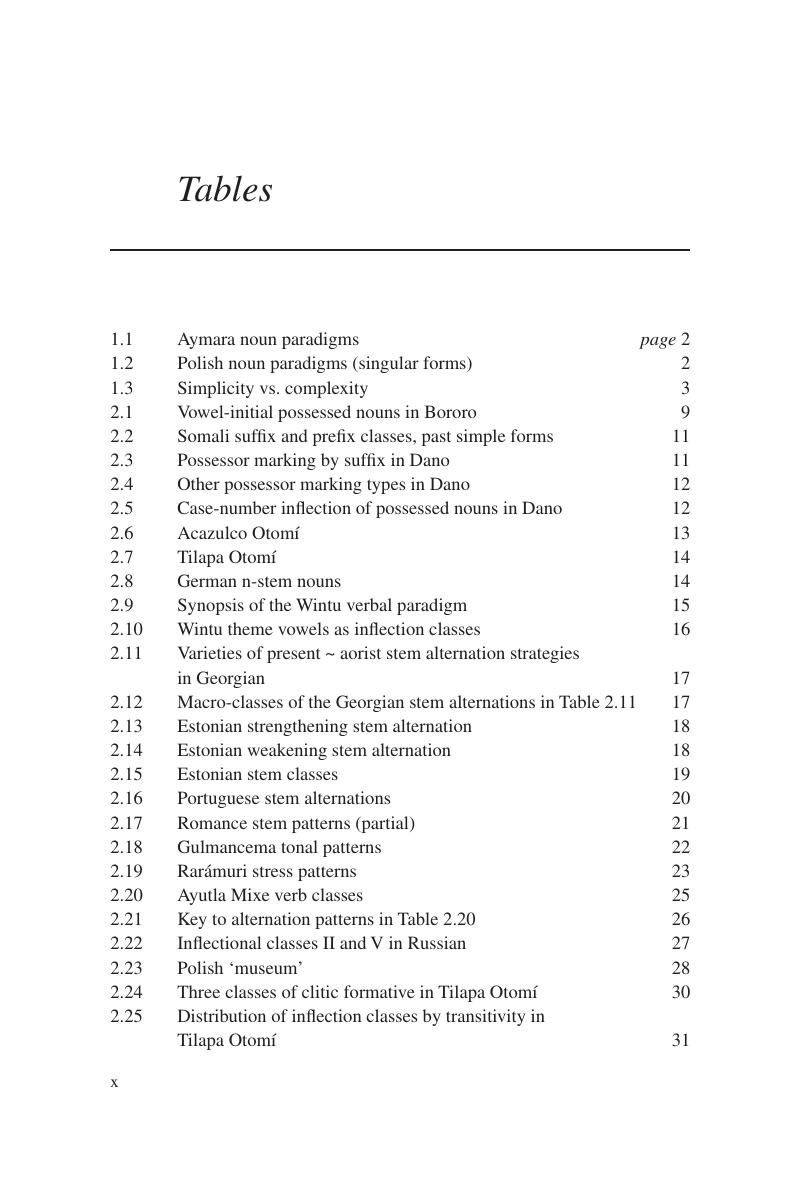
Tables
Published online by Cambridge University Press: 13 July 2017

Book contents
- Morphological Complexity
- Cambridge Studies in Linguistics
- Morphological Complexity
- Copyright page
- Contents
- Figures
- Tables
- Acknowledgements
- Abbreviations
- 1 Introduction
- 2 External Typology of Inflection Classes
- 3 Features
- 4 Motivation
- 5 Conditions on Paradigms
- 6 Paradigm Structure
- 7 Lexicon and Grammar
- 8 Morphological Complexity and Morphological Autonomy
- Appendix
- References
- Author Index
- Language Index
- Subject Index
Summary
A summary is not available for this content so a preview has been provided. Please use the Get access link above for information on how to access this content.
Information
- Type
- Chapter
- Information
- Morphological Complexity , pp. x - xviPublisher: Cambridge University PressPrint publication year: 2017
Accessibility standard: Unknown
Why this information is here
This section outlines the accessibility features of this content - including support for screen readers, full keyboard navigation and high-contrast display options. This may not be relevant for you.Accessibility Information
Accessibility compliance for the HTML of this chapter is currently unknown
and may be updated in the future.