Book contents
- Frontmatter
- Contents
- Preface
- Acknowledgements
- Chapter 1 The Importance of the Moon
- Chapter 2 First Steps
- Chapter 3 Moon/Mars
- Chapter 4 An International Flotilla
- Chapter 5 The Moon Rises from the Ashes
- Chapter 6 Moons Past
- Chapter 7 The Pull of the Far Side
- Chapter 8 Water in a Land of False Seas
- Chapter 9 Inconstant Moon
- Chapter 10 Moonlighting
- Chapter 11 Lunar Living Room
- Chapter 12 Lunar Power
- Chapter 13 Stepping Stone
- Chapter 14 Return to Earth
- Glossary
- Appendix A Von Braun et al. Space and Lunar Exploration Issues
- Appendix B Topics in Transient Phenomena on the Moon
- Index
Preface
Published online by Cambridge University Press: 05 September 2014

Book contents
- Frontmatter
- Contents
- Preface
- Acknowledgements
- Chapter 1 The Importance of the Moon
- Chapter 2 First Steps
- Chapter 3 Moon/Mars
- Chapter 4 An International Flotilla
- Chapter 5 The Moon Rises from the Ashes
- Chapter 6 Moons Past
- Chapter 7 The Pull of the Far Side
- Chapter 8 Water in a Land of False Seas
- Chapter 9 Inconstant Moon
- Chapter 10 Moonlighting
- Chapter 11 Lunar Living Room
- Chapter 12 Lunar Power
- Chapter 13 Stepping Stone
- Chapter 14 Return to Earth
- Glossary
- Appendix A Von Braun et al. Space and Lunar Exploration Issues
- Appendix B Topics in Transient Phenomena on the Moon
- Index
Summary
Preface
There is a new Moon. Many of the most dramatic recent discoveries in planetary science are lunar. They transform our understanding of the Moon and lunar exploration’s prospects for exciting work there. Yet in many minds the Moon is an old story. NASA sent a dozen men to its surface in 1969–1972, and most people do not remember those events personally. Only in the past few years has lunar exploration accelerated again, and many, including policy makers deciding about the space program, do not realize how rapidly our knowledge of the Moon is changing.
This ignorance is unfortunate, since from 2004 to 2010 we were headed to the Moon but changed our minds. Some of these recent discoveries about the Moon might have changed our minds back again. By “our” in this case I refer to the United States, since many other nations’ space programs still see the Moon as an essential objective.
Information
- Type
- Chapter
- Information
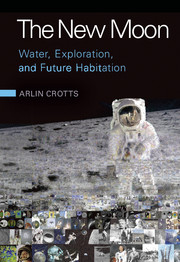
- The New MoonWater, Exploration, and Future Habitation, pp. vii - viiiPublisher: Cambridge University PressPrint publication year: 2014
Accessibility standard: Unknown
Why this information is here
This section outlines the accessibility features of this content - including support for screen readers, full keyboard navigation and high-contrast display options. This may not be relevant for you.Accessibility Information
Accessibility compliance for the PDF of this chapter is currently unknown
and may be updated in the future.