Book contents
- Frontmatter
- Contents
- Preface to the second edition
- Preface to the first edition
- 1 Introduction
- 2 Developing a coding scheme
- 3 Recording behavioral sequences
- 4 Assessing observer agreement
- 5 Representing observational data
- 6 Analyzing sequential data: First steps
- 7 Analyzing event sequences
- 8 Issues in sequential analysis
- 9 Analyzing time sequences
- 10 Analyzing cross-classified events
- 11 Epilogue
- Appendix: A Pascal program to compute kappa and weighted kappa
- References
- Index
4 - Assessing observer agreement
Published online by Cambridge University Press: 13 October 2009

Book contents
- Frontmatter
- Contents
- Preface to the second edition
- Preface to the first edition
- 1 Introduction
- 2 Developing a coding scheme
- 3 Recording behavioral sequences
- 4 Assessing observer agreement
- 5 Representing observational data
- 6 Analyzing sequential data: First steps
- 7 Analyzing event sequences
- 8 Issues in sequential analysis
- 9 Analyzing time sequences
- 10 Analyzing cross-classified events
- 11 Epilogue
- Appendix: A Pascal program to compute kappa and weighted kappa
- References
- Index
Summary
Why brother?
Imagine that we want to study how objects are used in communication between mothers and their 15-month-old infants, and have made a number of videotapes of mothers and infants playing together. We might focus our attention on those times when either the mother or the infant tries to engage the other's interest in some object, and then describe what those attempts look like and what their consequences are. After viewing the videotapes several times, sometimes in slow motion, we might be convinced that we had detected all such episodes, had accurately described them, and were now ready to make statements about how mothers and infants go about attempting to interest each other in objects.
We should not be surprised, however, if other investigators do not take our conclusions as seriously as we do. After all, we have done nothing to convince them that others viewing the videotapes would see the same things, much less come to the same conclusions. We are probably all aware how easy it is to see what we want to see, even given the best of intentions. For that reason, we take elaborate precautions in scientific work to insulate measuring procedures from the investigator's influence.
When measurements are recorded automatically and/or when there is little ambiguity about the measurement (for example, the amount of sediment in a standard sample of seawater), as is often the case in the “hard” sciences, the problem of investigator bias is not so severe.
Information
- Type
- Chapter
- Information
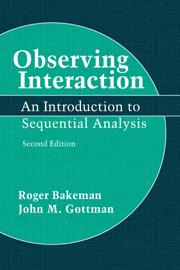
- Observing InteractionAn Introduction to Sequential Analysis, pp. 56 - 80Publisher: Cambridge University PressPrint publication year: 1997
Accessibility standard: Unknown
Why this information is here
This section outlines the accessibility features of this content - including support for screen readers, full keyboard navigation and high-contrast display options. This may not be relevant for you.Accessibility Information
Accessibility compliance for the PDF of this chapter is currently unknown
and may be updated in the future.
- 7
- Cited by